20 Brilliant Inventions Quietly Transforming the Lives of Homeless People Across America
20 Remarkable Inventions That Are Transforming the Lives of Homeless People Across America
20 Hidden Inventions That Are Changing Homeless People’s Lives In America

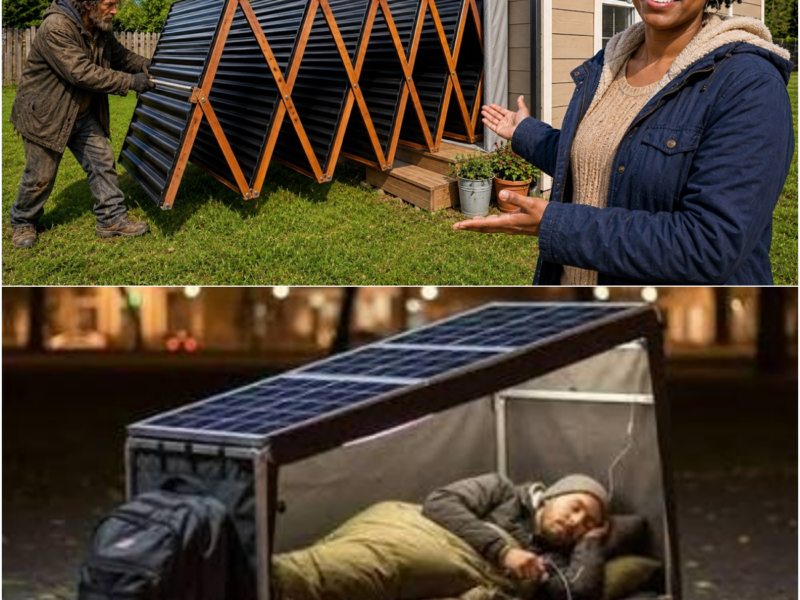
Somewhere in America tonight, a winter coat is quietly turning into a sleeping bag. A retired city bus is pulling up to a curb with hot showers running inside it, and in Texas, a printer the size of a truck is building an entire house out of concrete . These are not futuristic fantasies; they are 20 tangible, gritty, and ingenious inventions that are changing life on the streets of this country right now, and almost nobody is talking about them.
More than half a million Americans will sleep without a home tonight, and tens of thousands of them are veterans who once wore the uniform of this country. That number can feel hopeless. It feels like a mountain too high to climb, a crisis too vast for any one person to influence. Yet, all across America, ordinary people—students, nurses, retirees, and small business owners—have looked at that problem and started building. They didn’t form committees, they didn’t write endless reports, and they didn’t wait for a government directive. They built actual things you can touch.
The scale of this crisis is often cited in dry, statistical terms, but the reality is visceral. It is the shivering at 3:00 AM in a Michigan winter; it is the humiliation of being turned away from a job interview because of stained clothing; it is the profound, soul-crushing silence of being invisible to the thousands of people who walk past you every day . The 20 inventions we are exploring today are not just tools; they are acts of resistance against that invisibility.
The Engineering of Dignity

Consider the EMPWR coat, born from a student’s class assignment in Detroit. It is a heavy-duty, waterproof garment that unfolds into a full sleeping bag at night, then packs down into a shoulder bag by morning. But the brilliance isn’t just in the fabric; it’s in the model. The nonprofit behind it hires parents living in shelters, training them to manufacture the coats themselves, providing a path into permanent housing. This is the heartbeat of these solutions: they do not just address the symptom; they leverage the human potential that is so often ignored.
Then there is the concept of “radical hospitality” exemplified by Lava Mae. A woman in San Francisco, haunted by the plea of a homeless woman who just wanted to be clean, gutted retired city buses and turned them into mobile bathrooms. Thousands have regained their dignity one hot shower at a time.
Why Small Inventions Have Massive Impact

In the complex tapestry of the American homeless crisis, we often look for “silver bullet” legislation. But perhaps the true innovation is found in the granular, the specific, and the immediate. Take, for example, the “laundry truck,” a van equipped with washers and dryers. While the machines spin, volunteers sit and talk, washing away the loneliness that frequently accompanies homelessness [03:40]. As one volunteer noted, clean clothes open the door, but conversation is what walks a person through it.
The “pallet shelter” developed in Everett, Washington, is another testament to this. These 64-square-foot cabins, assembled in under an hour, offer a locking door—the first time in years many residents have been able to sleep without keeping one eye open. It is a profound, simple, and revolutionary shift in psychological safety.
The Future of Community
As we look toward the future, these small-scale inventions may pave the way for broader, systemic changes. If we project these models forward, we see a potential shift in urban design and community planning.
Scaling Decentralized Care: If mobile shower and laundry services become standard in every major city, the immediate barrier to employment—hygiene—could be significantly reduced.
Economic Integration: Programs that hire the homeless to manufacture their own support tools (like the EMPWR coat) could potentially be expanded into wider manufacturing sectors, creating sustainable job pathways.

Technological Symbiosis: With the rise of 3D-printed housing, as seen in Austin, Texas, the cost of entry for transitional housing could drop exponentially. Imagine a future where city land—currently underutilized—is efficiently converted into small, durable communities using rapid construction techniques.
The culmination of this movement is best represented by the “Community First Village” in Texas . This 51-acre neighborhood of tiny homes, where residents earn an income and live as neighbors, flips the conventional wisdom on its head. It posits that housing will never solve homelessness, but community will.
The Human Cost of Inaction
While these innovations offer hope, we must calculate the cost of our current trajectory if we do not adapt. If the rate of homelessness continues to outpace the creation of affordable, dignifying shelter, the strain on emergency rooms, police departments, and public health services will become unsustainable.
Dr. Jim Withers’ “street medicine” movement is already proving this . By treating wounds and infections under bridges, these medical teams save emergency rooms a fortune while providing the kind of care that truly reaches people where they are.
Conclusion
The 20 inventions listed here—from the sock revolution to the app that rescues dinner —share a common thread: they acknowledge the humanity of the person they serve. They provide a phone number of your own , a secure place for your life , and most importantly, a name.
As we continue to navigate this crisis, these builders remind us that the problem is not hopeless; it is waiting for more of us to join the effort. Whether it is donating to a local mobile shower program or advocating for managed shelter villages in your neighborhood, every action counts. The path forward is not just in bigger government budgets or abstract policy debates; it is in the simple, quiet, and persistent work of rebuilding dignity, one neighbor at a time.