A Man Recognized Himself in an Age-Progressed Missing Child Photo—DNA Revealed the Incredible Truth
He Found an Age-Progressed Missing Child Photo That Looked Exactly Like Him—DNA Later Confirmed He Was the Child Who Had Vanished Years Earlier
The Man Who Found Himself on a Missing-Children Website

For most people, the internet is a place to lose time. For Steven Carter, it became the place where time came back for him.
It began with a question that had followed him for most of his life: Who was he before he was Steven Carter?
He had a name. He had a life. He had memories, though many were scattered, incomplete, and strange in the way childhood memories often are. He knew he had been adopted when he was 4 years old. He knew his early years had passed through foster care in Honolulu, Hawaii. He knew there were gaps in his story that no one had ever fully closed.
But what he did not know was that somewhere, buried in a national missing-children database, was a face that looked almost exactly like his own.
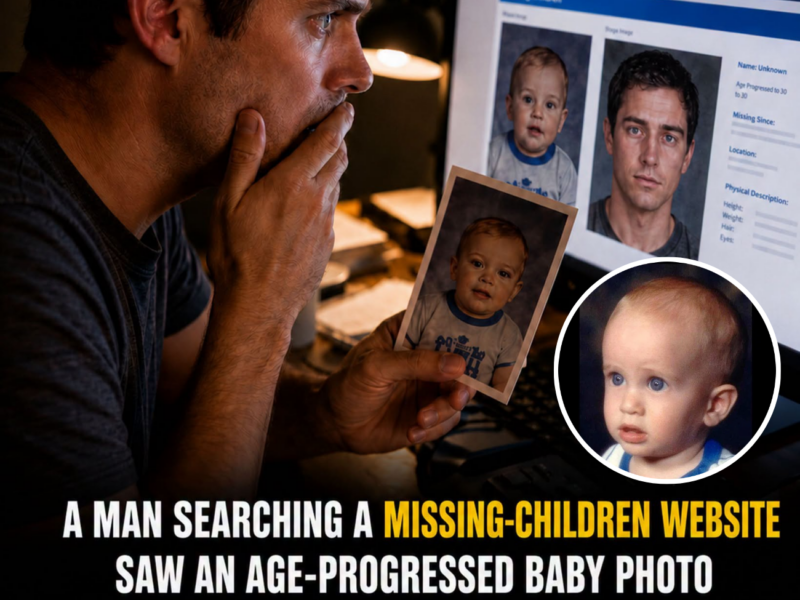
Not his adult face, of course. Not a photograph taken from his driver’s license or a family album. It was an age-progressed image of a baby who had vanished decades earlier, a child with a long and unusual name: Marx Panama Moriarty Barnes.
To Steven, it was supposed to be just another search. Another late attempt to make sense of a past that had never quite made sense. In 2010, he went to MissingKids.com and began looking through cases connected to Hawaii. He was not a detective. He was not a journalist. He was not chasing a headline. He was a grown man looking for pieces of himself.
Then he saw the photo.
There are moments in life when the mind recognizes something before the heart is ready to accept it. A face on a screen. A set of eyes. A shape of the jaw. A resemblance so sharp it feels less like coincidence and more like accusation.
The image seemed to stare back at him.
It looked like him.
For a moment, the entire logic of his life must have shifted. The story he had carried for decades — adoption, foster care, uncertainty — suddenly stood beside another possibility, one so startling it would sound impossible if it appeared in a novel. What if the missing child on the screen had not disappeared forever? What if he had survived? What if the person looking for him was the missing child himself?
Steven Carter did not have proof yet. But he had enough to be unable to look away.
The details only deepened the unease. The missing baby had disappeared from Hawaii. Steven had been adopted from a foster home in Honolulu. The timeline was close. The origin was close. The face was too close.
A man searching a missing-children website had found an age-progressed baby photo that looked like him.
And later, DNA would confirm the unthinkable.
Steven Carter was Marx Panama Moriarty Barnes.
He was the missing child.

The discovery did not begin with police knocking on a door, or a dramatic phone call in the middle of the night. It began quietly, almost privately, with a man alone in front of a computer, following a suspicion that most people would have dismissed as too strange to say out loud.
But some suspicions do not fade. They grow heavier.
For Steven, the search was not born from idle curiosity. Adoption can give a child a family, a home, and a future, but it does not always give answers. Some adoptees grow up with complete records, names, histories, photographs, explanations. Others grow up with fragments. The first chapter of life becomes a locked room. People may offer summaries, but summaries are not the same as truth.
Steven knew he had come through the foster care system in Hawaii. He knew he had been adopted at age 4. But infancy, birth, and biological origins remained blurred. Who had held him first? Who had named him? Why had he entered care? Was there someone out there who had looked for him? Had someone let him go, or had he been lost?
These are not small questions. They are the kind that sit quietly in the background for years, then return with force when a person becomes old enough to understand how much a missing beginning can shape an entire life.
The internet gave Steven a tool previous generations did not have. He could search databases. He could compare dates. He could look at old cases. He could try, without asking permission from anyone, to locate himself in the public record.
So he went looking.
On MissingKids.com, maintained by the National Center for Missing & Exploited Children, age-progressed images are created for cases in which children have been missing for years. They are part science, part art, part hope. Specialists take old photographs and try to imagine time: how a child’s face might lengthen, how baby fat might disappear, how family features might emerge, how a missing toddler might look as a teenager, how an infant might appear as an adult.
The images are not perfect. They cannot be. No artist can predict every accident of growth, every inherited trait, every expression shaped by years lived elsewhere. But sometimes they are close enough to make someone stop.
Steven stopped.
The child in the listing had vanished from Hawaii in the late 1970s. His name was Marx Panama Moriarty Barnes. He had been an infant, about 6 months old. The case had lingered for decades, unsolved and unanswered.
According to later reporting, Marx’s birth mother, Charlotte Moriarty, had taken him for a walk and did not return home. His birth father, Mark Barnes, reported both mother and baby missing. Somewhere after that, the baby entered care under a different identity. That change — a name, a label, a disconnected file — became the small administrative break that hid a missing child in plain sight.
It is the kind of detail that turns a disappearance from tragic to almost unbearable.
The child had not vanished into another country. He had not been hidden on the far side of the world. He had been absorbed into a system, renamed, and eventually adopted. A father had reported his baby missing. A son had grown up not knowing he was missing at all.
For decades, two truths existed side by side without touching. In one truth, Marx Panama Moriarty Barnes was a missing child from Hawaii. In the other, Steven Carter was an adopted man with unanswered questions about his origins.
The internet finally brought those truths together.
But recognition was not enough. A resemblance can disturb a person, but it cannot rewrite a birth certificate. It cannot legally restore a name. It cannot tell a family that a missing child has been found. For that, Steven needed verification.
He contacted authorities.
That decision alone carried emotional risk. What does a person say in such a call? That he was browsing missing-children cases and found a face that looked like his? That the age-progressed image of a vanished baby might be him? That the story of his adoption and the story of a missing infant seemed to overlap in ways he could no longer ignore?
There must have been fear in it. Fear of being wrong. Fear of opening a wound that belonged not only to him, but to strangers who might still be grieving. Fear of learning that the resemblance meant nothing. Fear, perhaps even greater, of learning that it meant everything.
DNA removed the uncertainty.
CBS News later reported that testing confirmed Steven Carter was Marx Panama Moriarty Barnes.
The sentence is simple. Its meaning is not.
DNA did what memory could not do. It traveled backward through names, paperwork, lost years, and human confusion. It cut through the fog of adoption records and missing-person files. It answered the question that had followed Steven for most of his life.
He had been someone else before he was Steven Carter.
He had been a missing baby.
The revelation gave him a birth name. It gave him a history. It gave him a biological family connection that had been broken before he was old enough to remember it. It also gave him a story so shocking that it sounds almost impossible: a grown man found his own missing-child poster online.
For many Americans, missing-children cases occupy a grim corner of public consciousness. They appear on television specials, posters, websites, news segments, and anniversary stories. The images are meant to be seen by strangers. A cashier. A teacher. A neighbor. A traveler passing through an airport. Someone who notices a familiar face and calls police.
But Steven Carter’s case asks a stranger question: What happens when the person who notices the face is the child himself?
It is hard to imagine the emotional collision. To learn you were adopted is one kind of knowledge. To learn you were missing is another. Adoption suggests transition, however painful or complicated. Missing suggests rupture. It suggests someone searched. Someone filed a report. Someone waited for a phone call that may never have come.
The word “missing” changes the entire architecture of a life.
It means the absence was not just private. It was official. It was recorded. It was investigated. It means the child’s face belonged not only to family memory, but to a national plea for help.
Steven had spent years as himself. Then, in adulthood, he learned that the country had once known him as a lost baby.
The case is suspenseful not because of a dramatic chase or courtroom confrontation, but because of the quiet terror of paperwork failing to connect. A baby disappears. A baby later enters care. The names do not match. The systems do not speak clearly enough to each other. Years pass. The child grows. The missing-child case remains open. The adult wonders where he came from.
No villain needs to appear in every chapter for the story to feel haunting. Sometimes the most chilling force is the gap between institutions, the small clerical fracture through which a human life can fall.
That is what makes the Steven Carter story so unsettling for a wide public audience. It touches a fear almost everyone understands: the fear that the story of your life may rest on information you have never been given.
Americans often speak of identity as something self-made. You become who you choose to become. You build a life. You define yourself. But Steven’s discovery is a reminder that identity is also inherited, recorded, withheld, misplaced, and sometimes recovered by accident. A name can be changed before a child knows how to say it. A file can follow the wrong path. A family can search while the child they are searching for grows up under another name.
When Steven found the age-progressed image, he was not simply looking at a face. He was looking at a version of time that had been waiting for him.
Age progression itself is an act of faith. It assumes the missing child is still out there somewhere, aging year by year, becoming someone. It refuses to let the case freeze at the last known photograph. For families, those images can be painful because they imagine birthdays missed and years stolen. For investigators, they are tools. For the public, they are reminders.
For Steven, one of those images became a mirror.
The face on the screen was not an exact photograph from his life. It was a prediction created from absence. Yet it carried enough truth to draw him in. It said: this is what the missing baby might look like now. And Steven saw himself.
That moment is almost cinematic, but its power comes from being real.
There was no orchestra. No dramatic lighting. No detective revealing a hidden file. Just a man, a computer, a search term, and a photo that refused to be ignored.
The deeper he looked, the more the coincidences narrowed. Hawaii. Foster care. Adoption around age 4. A missing baby from decades earlier. An age-progressed image that resembled him. Any one detail might have been explainable. Together, they formed a pattern.
Suspense in real life rarely arrives all at once. It accumulates. One fact makes the stomach tighten. Another makes the room feel smaller. A third makes denial difficult. By the time Steven contacted authorities, the story had already begun to move beyond curiosity. It had become a possible recovery.
But recovery, in a missing-child case, is never simple.
When a missing infant is found decades later as an adult, what exactly has been restored? The person is alive, which is the answer every family hopes for. But the years are gone. The first steps, first words, birthdays, school photographs, ordinary days — none of those can be returned. The child survived, but the family history was interrupted. The adult gains truth, but also inherits the grief that truth reveals.
Steven’s confirmation through DNA gave him answers, but it could not give him back the infancy he never knew. It could not erase the confusion that allowed him to grow up disconnected from his birth identity. It could not undo the pain of those who had once reported him missing.
What it could do was end one terrible uncertainty.
For the Barnes family, the missing baby was no longer only a name in a database. For Steven, Marx was no longer only a face on a website. They were the same person.
The story also forces uncomfortable questions about child welfare systems and missing-person investigations, especially in earlier decades. How could a baby reported missing later enter care under another identity without the case being connected? How many decisions, documents, and missed signals had to line up for that to happen? Were people looking in the wrong place? Did someone have incomplete information? Did the system simply lack the tools needed to compare cases across agencies?
The answers are not always clean. In the era before modern databases, DNA testing, and instant information sharing, records could remain isolated. A child welfare file in one lane might not meet a missing-child report in another. Names could change. Dates could be misremembered or recorded differently. A baby too young to speak for himself could not say, “That is my father. That is my name. I am the child they are looking for.”
That helplessness is what gives the case its emotional force.
An infant depends entirely on adults and institutions to preserve his identity. If those adults disappear, become unreachable, or provide misleading information, and if institutions fail to connect the dots, the child’s original story can be buried. Not erased completely, but buried deep enough that only a strange combination of technology, curiosity, and courage can uncover it decades later.
Steven Carter’s search was personal, but its implications are public. It shows why missing-children databases matter. It shows why age-progressed images matter. It shows why DNA matters. It also shows that a case can appear cold for years and still contain a living answer.
The phrase “cold case” suggests stillness. A file in a drawer. A mystery that has stopped moving. But Steven’s case was never truly still. The missing baby kept aging. The adult kept wondering. The father’s report remained part of the record. The database kept the name alive. Time moved on, but it did not fully close the story.
Then, in 2010, the missing child found the missing-child report.
It is one of those twists that makes readers lean closer because it reverses the usual pattern. We are used to hearing about parents searching for children, police searching for suspects, journalists searching for truth. Here, the lost person searched for himself and succeeded.
That success required him to trust his own unease.
Many people might have clicked away. They might have told themselves the resemblance was coincidence. They might have feared looking foolish. They might have decided that whatever happened long ago should remain long ago. Steven did not. He followed the clue through the proper channels until science answered.
There is a lesson in that, though not a simple inspirational one. The truth did not arrive because the world was fair. It arrived because a man refused to ignore a detail that unsettled him.
In American culture, stories of lost identity often become myths of reinvention. A person discovers a hidden family, a secret origin, a buried name. But Steven Carter’s case is not merely about reinvention. It is about restoration. He did not become someone new when DNA confirmed his identity. He became more fully connected to the person he had always been.
Steven Carter and Marx Panama Moriarty Barnes were not two separate lives. They were two names attached to one continuous human being.
That may sound obvious, but emotionally it is profound. The missing baby did not remain frozen in the past. He grew up. He became a man capable of searching. He became the person who could solve the mystery that began before he had language.
The shock of the story lies not only in the DNA result, but in the ordinary way the truth surfaced. It did not require a confession. It did not require a dramatic discovery in an attic. It required a public database, an age-progressed image, and a person willing to ask, “Could that be me?”
The question must have been terrifying.
Because behind it were other questions.
If that is me, why did no one know?
If that is me, who was looking?
If that is me, what happened to my mother?
If that is me, what name was I born with?
If that is me, what parts of my life have I never been told?
Every answer would carry weight.
Reports say his birth mother, Charlotte Moriarty, had taken him for a walk when he was about 6 months old and did not return. His father, Mark Barnes, reported them missing. Those facts alone create a haunting opening scene: a mother and baby leaving, a father waiting, then realizing they are gone. What happened after that is the space where speculation often rushes in, but responsible storytelling must be careful. The known point is stark enough. The baby eventually entered care under another identity. That identity shift kept the missing-child case from connecting to the living child.
It is a bureaucratic sentence with devastating human consequences.
“He entered care under a different identity.”
Inside that sentence are years of separation.
A father did not know where his son was. A son did not know his birth name. A missing-child case did not know its subject was alive in the system. The country’s machinery for protecting children had, in this case, failed to recognize the very child it needed to find.
That does not mean every person involved acted with malice. Real life is often more complicated and more disturbing than that. Systems can fail through confusion, limited information, outdated technology, overburdened workers, and fragmented records. But for the child at the center, the reason matters less than the result. His identity was split from him.
When DNA restored that identity, it also restored a connection to biological family. For adoptees searching for origins, such discoveries can be emotionally overwhelming. There may be joy, grief, anger, relief, loyalty conflicts, and a strange sense of mourning for people one has only just found. A person can love the family who raised him and still need to know the family he came from. One truth does not cancel the other.
That nuance is important. Steven’s discovery does not reduce his adoptive life to a mistake. It expands the known story. It adds the missing first chapter.
In many adoption stories, the search for origins is portrayed as a rejection of the adoptive family. That is too simplistic. For many people, searching is not about replacing one family with another. It is about answering basic human questions: What is my birth name? What medical history do I carry? Who do I resemble? Why was I placed? Was I wanted? Was I lost?
In Steven’s case, those questions carried an extraordinary twist. He was not only adopted. He had been listed as missing.
That revelation transforms the emotional stakes.
To discover biological roots is powerful. To discover that one’s biological family may have been searching, waiting, or grieving under the belief that the child had vanished is something else entirely. It turns a private identity search into the closing of a public mystery.
The broader American audience understands the missing-child poster. It has been part of national life for decades — on mailers, websites, television segments, and news reports. These cases often leave behind a painful uncertainty. Was the child taken? Did the child survive? Is the child living under another name? Could someone, somewhere, recognize a face?
Steven Carter’s answer was yes.
Someone could recognize the face.
He could.
That is why the story feels both shocking and strangely hopeful. It reveals a failure, but also a recovery. It exposes how a child can be lost in plain sight, but also how modern tools can reach backward into old mysteries. It shows the cruelty of time, but also the persistence of records kept alive by people who refused to let a missing child disappear completely.
The age-progressed image did not solve the case alone. It needed Steven’s attention. It needed authorities to take the possibility seriously. It needed DNA to confirm the connection. But without that image, the truth might have remained hidden.
One picture changed the direction of a man’s life.
The phrase sounds exaggerated until you understand the case. A single image gave Steven the lead that decades of uncertainty had not. A single image connected his adult face to an infant name. A single image opened the path to DNA, biological identity, and long-delayed answers.
And yet, even after confirmation, the story remains emotionally complicated.
What does a person do after learning that the first years of life were attached to a national missing-child case? Does he introduce himself by the name he has always used, or the name he was born with? Does he feel anger toward the system, compassion for the people who searched, gratitude for the life he had, sorrow for the years lost? The answer may be all of those at once.
Human identity is not a switch. It does not flip neatly from one name to another. Steven Carter did not stop being Steven Carter when he learned he was Marx Panama Moriarty Barnes. The revelation added truth, but truth can be heavy. It can heal and wound at the same time.
The most haunting part of the case is the delay. The baby was about 6 months old when he disappeared. Steven was adopted at 4. The discovery came decades later. In that long gap, an infant became a child, a child became an adult, and the original question remained unanswered.
For families of missing children, time is its own kind of torment. Every year expands the distance between the last known moment and the present. Photographs become outdated. Witnesses forget. Records age. Hope changes shape. Some relatives keep searching publicly. Others grieve quietly. But the question remains: Where are they?
In this case, the answer was almost unimaginable.
He was alive.
He had grown up.
He was looking too.
That mutual searching — even if separated by years and systems — gives the story its emotional center. A father reported a missing baby. Decades later, the baby, now a man, searched missing-child records from Hawaii. The search moved from one generation to another. The lost child became the investigator of his own disappearance.
It is difficult to imagine a more American form of modern mystery: a man, a database, a DNA test, and a past hidden in public view.
The story also speaks to the changing power of technology in old cases. In earlier decades, missing-person investigations relied heavily on local reporting, paper records, phone calls, photographs, and the memory of individuals. Today, searchable databases and genetic testing can create connections that once would have been nearly impossible. A person can sit at home and access records that might once have required official permission or geographic proximity. DNA can confirm relationships across time, distance, and changed names.
But technology alone is not enough. It cannot decide which resemblance matters. It cannot feel the shock of recognition. It cannot carry the emotional burden of making contact. Steven had to do that part himself.
There is bravery in that. Quiet bravery, but bravery nonetheless.
It is not easy to disturb the foundation of your own life. Many people prefer uncertainty because certainty can be disruptive. A blank space may hurt, but an answer can change everything around it. Steven risked finding out that his origin story involved loss, confusion, and a missing-child investigation. He risked learning that his life had been shaped by events far more dramatic than he knew.
He searched anyway.
For readers, the case lands like a question: How well do we really know our own beginnings? Most people trust the stories they are told about themselves. Where they were born. Who their parents were. Why certain decisions were made. But those stories depend on records, memory, honesty, and chance. When any of those fail, identity becomes something fragile.
Steven Carter’s story is extraordinary, but the longing behind it is universal. Everyone wants to know where they come from. Everyone wants the first chapter to make sense.
When that chapter is missing, people search.
Some search through family stories. Some search through adoption records. Some search through DNA databases. Steven searched through missing-children cases and found his own face.
The ending, if it can be called an ending, is not the kind that closes every door. It answers the central question — Steven was Marx — but it also opens others about what happened, how the system failed to connect him sooner, and how families rebuild after decades apart. Real stories rarely end as cleanly as fiction. They leave echoes.
Still, there is something undeniably powerful about the confirmation.
For decades, Marx Panama Moriarty Barnes existed publicly as a missing infant. Steven Carter existed privately as an adopted man with questions. DNA brought those identities together and made the world acknowledge what had always been true.
The missing child had survived.
He had found himself.
In an age when people scroll past thousands of images without remembering them, Steven Carter saw one he could not forget. It was not a celebrity, not a viral joke, not a random stranger’s post. It was a digitally aged face built from a baby’s disappearance and a family’s unanswered plea.
It was, impossibly, his own.
That is the shocking heart of the story. Not simply that a missing child was found, but that he found the clue himself. Not simply that DNA confirmed a biological identity, but that the confirmation rewrote decades of personal history. Not simply that one old case was solved, but that the solution had been living, growing, and wondering all along.
One photograph waited on a website.
One man clicked.
And a life divided by names became whole again.