A Metro Security Guard Went Viral Overnight—Losing His Job Led Him to an Unexpected Modeling Career
A Stranger’s Viral Video Cost Lucas Prado His Security Job—but It Also Launched an Incredible Modeling Career He Never Saw Coming
The Security Guard Who Went Viral for His Face—and Lost Everything Before the Internet Gave It Back
The shift began like countless others.
Commuters streamed through the Santa Cruz metro station in São Paulo with their eyes fixed on phones, clocks and electronic gates. Trains arrived with metallic shrieks. Doors opened. Crowds spilled onto the platform and disappeared into tunnels, escalators and corridors beneath one of the largest cities in the Western Hemisphere.
At the center of that movement stood Lucas Prado.
He wore a security uniform. His job was not glamorous, and it was not supposed to attract attention. He watched the gates, observed the passengers and helped maintain order inside a transit system used by people who were usually too busy to remember the faces of the workers around them.
Prado was one of those workers whom thousands of people might pass without knowing his name.
Then one passenger stopped looking ahead.
A phone came out.
The stranger began recording him without his knowledge.
Prado did not perform for the camera. He did not dance, argue with a passenger or stage a dramatic rescue. He did not say anything controversial. He apparently did nothing that would ordinarily turn an unknown security guard into an internet sensation.
The camera captured him simply standing there.
That was enough.
The clip was uploaded, shared and pushed into the unpredictable machinery of social media. Within a short time, people across Brazil were watching the same footage. Then it traveled farther. Viewers replayed it, reposted it and filled the comment sections with variations of the same astonished reaction.
Who was this man?
Why was someone who looked like a professional model working security inside a metro station?
How had he remained unknown?
Prado, who uses the name Hassami online, had arrived for work as an ordinary employee. By the time the internet finished with the video, he had become a public object of fascination.
Millions of views transformed his face into a national conversation.
Then he was fired.
The event that could have been dismissed as a strange, harmless moment of internet celebrity instead became the beginning of a story about work, power, appearance and the brutal speed with which a person’s life can be rewritten by strangers.
Prado had not asked to be filmed.
He had not asked to go viral.
He had not asked millions of people to debate his appearance, his job or his future.
Yet one person pressed a record button, and the security guard’s old life began to collapse.
The Man at the Metro Gate
There is a particular anonymity attached to transit work.
Metro stations are built around urgency. People arrive late, tired, distracted or irritated. They hurry through turnstiles while calculating how many minutes remain before the next train. They notice delays, broken escalators and crowded platforms. They often pay little attention to the workers who keep the system moving.
Security guards occupy an especially complicated position inside that environment.
They are visible but frequently overlooked. Their uniforms signal authority, but their names are rarely known. Passengers may speak to them only when something has gone wrong. Most of the time, they become part of the station’s architecture: another fixed presence among signs, barriers, surveillance cameras and ticket machines.
Prado stood out.
According to the account that spread online, it was his appearance that caused the stranger to begin filming. His features, physical presence and distinctive dreadlocks contrasted with what viewers expected to see at a subway gate.
Those expectations revealed something about the audience as much as they did about Prado.
Many of the comments were intended as compliments. Viewers described him as unusually handsome. Some expressed disbelief that a man who looked ready for a fashion campaign was wearing a security uniform. Others joked that commuters would intentionally miss their trains just to remain near his post.
The tone was playful.
The consequences were not.
Internet users treated the video as an accidental discovery, as though Prado had been hidden in the station waiting for the public to recognize what his employer had failed to see. To the people watching through screens, he was a striking stranger who had been found in an unexpected place.
But Prado was not a character in a romantic comedy.
He was an employee at work.
The uniform represented a paycheck, structure and livelihood. It was not a costume he could casually remove when the comments told him he belonged somewhere else.
For viewers, the video lasted only seconds.
For Prado, it would affect everything that came after.
A Face Becomes Public Property
Virality often creates the illusion of intimacy.
A person appears in a short clip, and viewers immediately feel entitled to construct a complete story about that person’s life. They decide who he is, what he should be doing and whether his present circumstances match the identity they have invented for him.
In Prado’s case, millions of strangers quickly arrived at a conclusion: he looked too much like a model to be working as a security guard.
The statement was presented as praise. Beneath it was an uncomfortable assumption.
What is a security guard supposed to look like?
Why should physical beauty make a working-class job seem surprising?
Why did viewers find it difficult to believe that someone they considered exceptionally attractive might work long shifts inside public transportation?
The reaction exposed a hierarchy many people absorb without examining. Certain appearances are associated with luxury, wealth, entertainment and fashion. Other appearances are associated with service work, manual labor and public-facing jobs that receive little recognition.

Prado disrupted that hierarchy merely by standing in uniform.
The comments suggested that beauty belonged in an advertisement rather than at a metro station. They implied that his appearance represented wasted potential because it was not already being converted into attention, status or money.
The internet did not know his ambitions. It did not know whether he enjoyed his work, needed the stability or had ever considered modeling. Viewers saw only an image and immediately tried to relocate him into a life they believed suited his face.
Then the relocation happened more violently than anyone expected.
The company dismissed him.
Prado said he was told that he no longer met the employer’s interests.
The explanation sounded corporate, vague and final.
It did not explain whether the company disliked the publicity, feared disruption at the station or considered his sudden popularity incompatible with the job. It did not explain what Prado had done wrong, because according to the story that spread publicly, he had done nothing wrong at all.
He had been filmed by someone else.
Strangers had made the footage famous.
Yet Prado paid the immediate price.
The Call That Changed the Story
Getting fired is often described in deceptively simple language.
A supervisor calls an employee into a room. A decision is communicated. A badge, uniform or access card may be returned. The employee leaves through the same door he has entered countless times before, but now every familiar detail feels different.
For Prado, dismissal carried an additional humiliation.
His job loss was connected to public attention he had not sought.
The viral video had turned him into someone people recognized, but recognition offered no protection. The millions of views could not guarantee rent, food or another paycheck. The comments praising his appearance could not replace the practical security of employment.
The same people who declared that he belonged in fashion would soon scroll to another video.
Prado would still have to live with what happened.
One day, he was working inside Santa Cruz station.
Then the uniform was gone.
The phrase “no longer met their interests” carried the coldness of an institution protecting itself. It reduced a worker’s sudden crisis to a matter of organizational preference.
Prado’s personal interests—his income, dignity and future—were apparently secondary.
The story could have ended there.
Social media is filled with accidental stars whose moment of fame produces no lasting benefit. Some become memes and then disappear. Others are mocked, harassed or exposed without compensation. Their images generate engagement for platforms and accounts while the people themselves are left with embarrassment and disruption.
Prado might have become another example of an ordinary worker consumed by a viral cycle.
Instead, he decided to speak.
From the Metro to National Television
The story moved from phones to television.
Prado appeared on “Balanço Geral,” a major Brazilian television program known for covering crime, public controversy, celebrity news and dramatic human-interest stories.
The transition was striking.
Not long before, Prado had been standing inside a metro station while an unknown passenger recorded him from a distance. Now he sat beneath studio lights, answering questions about the most destabilizing event of his professional life.
For the first time, the man at the center of the viral video had a voice.
Until then, viewers had mostly discussed him rather than listened to him. They had admired him, joked about him and imagined alternative careers for him. The television appearance allowed Prado to describe what had happened after the clip spread.
The public learned that virality had not simply brought compliments.
It had cost him his job.
That revelation changed the emotional tone of the story.
The attractive security guard was no longer merely an entertaining discovery. He had become a worker who appeared to have been punished because someone else decided to turn him into content.
The irony was difficult to miss.
Companies routinely seek viral attention. Brands spend enormous sums trying to create the kind of organic public fascination that surrounded Prado. Advertising agencies search for faces that audiences will remember. Social media teams measure engagement and dream of millions of views.
Prado generated that attention simply by existing in the frame.
Yet his employer reportedly responded not by recognizing an opportunity but by ending his employment.
The dismissal shocked many people who had originally shared the clip as light entertainment. Their comments had helped create the attention surrounding him. Now that attention appeared to have harmed the person they admired.
The story became more complicated.
Was the internet rescuing Prado from an unsuitable job, as some romanticized it?
Or had the internet invaded his workplace, exposed him to corporate consequences and forced him into an entirely new future?
The answer may have contained elements of both.
Prado had lost control of the direction of his life.
His television appearance was an attempt to take some of that control back.
The Dangerous Gift of Going Viral
The phrase “went viral” sounds almost magical.
It suggests instant opportunity—a hidden talent discovered, an unknown person elevated, a door opened by the collective attention of the public.
But virality is not a gift in the ordinary sense. A gift is offered intentionally. It can be accepted or refused.
Viral attention arrives without consent.
It can turn a private citizen into a public figure before he understands what is happening. It can expose family members, employers and past experiences. It invites strangers to comment on a person’s body, face, clothing and worth.
For someone like Prado, whose viral clip centered almost entirely on his appearance, the attention could be especially objectifying.
Viewers did not first encounter his personality, intelligence or work ethic. They encountered his face and body.
His appearance became the product.
The internet turned him into a symbol before it knew him as a man.
That transformation contained opportunity, but also pressure.
Once millions of viewers insist that someone should become a model, what happens if he does not succeed? What happens if the agencies do not call, the brand deals do not last or the audience moves on?
What happens when a person’s livelihood becomes dependent on maintaining the same appearance that strangers first admired through a phone screen?
Prado faced those uncertainties after losing his job.
He could not return to the anonymity he had possessed before the recording. His face was already circulating widely. Remaining invisible was no longer an option.
He could attempt to convert the attention into something sustainable.
That path required more than being handsome.
Professional modeling involves discipline, punctuality, resilience and the ability to work under constant evaluation. Influencing requires an even broader set of skills: managing an audience, producing content, negotiating commercial partnerships and remaining visible in an online environment that is always demanding something new.
The public had declared that Prado looked like a model.
Now he would have to become one.
The Name Hassami
Online, Prado became known to a wider audience as Hassami.
The name offered a degree of separation between the former security guard and the emerging public figure. Lucas Prado had worked at the metro. Hassami would build a new identity in front of cameras.
Professional photo shoots replaced station shifts.
The transformation was dramatic but not instantaneous.
A viral clip can create attention. It cannot automatically create a career. Prado had to learn how to use that attention before it disappeared.
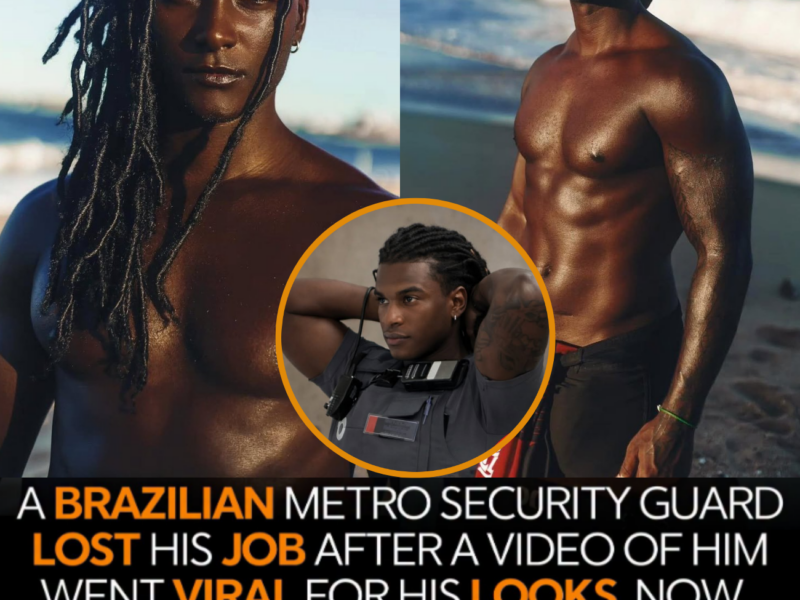
His dreadlocks, one of the features that made him visually memorable at Santa Cruz station, became part of his modeling image. In the metro, they distinguished him from the institutional uniform. In fashion photographs, they became an asset—texture, movement and identity.
Images soon showed him in settings far removed from public transportation.
Beach campaigns replaced ticket gates. Carefully constructed photographs replaced the shaky video captured by a stranger. Brand deals offered the possibility of income from the same appearance that had unexpectedly disrupted his old employment.
The camera remained central to his life.
But the relationship had changed.
The first camera took his image without permission and delivered it to millions of people.
The later cameras were part of work he had chosen.
That difference marked the beginning of his recovery of control.
In professional modeling, Prado could decide how to present himself. He could work with photographers, stylists and companies. He could transform public fascination into a portfolio and an audience into a business.
He was no longer simply the handsome security guard discovered in the subway.
He was attempting to become an independent personality whose future would not depend on the original clip.
When a Uniform Disappears
Uniforms do more than identify a job.
They shape how the public sees the person wearing them.
When Prado appeared in metro security clothing, the contrast between his appearance and occupation fueled the video’s popularity. Viewers considered the combination unexpected. The uniform made his looks seem even more striking because it placed him outside the glamorous context where audiences believed he belonged.
Once Prado became a model, the surprise changed.
Now he appeared in fashion shoots, and viewers could say the internet had been right all along.
The story took on the satisfying structure of a modern fairy tale.
A beautiful unknown person is discovered in an ordinary setting. An unjust employer removes him. National attention follows. The victim transforms the setback into success.
It is easy to understand why that version appealed to audiences.
It offers moral balance. The company that fired Prado becomes shortsighted. The internet becomes a talent scout. The man who lost his job rises into a more glamorous career.
But reality is rarely so clean.
The security job should not be treated as a humiliation simply because modeling appears more prestigious. Prado’s work at the station was legitimate labor. He was earning a living and performing a public service.
His transformation is powerful not because security work was beneath him, but because he found a way forward after losing employment under circumstances he did not create.
The distinction matters.
Otherwise, the story reinforces the same class assumptions that made the original clip go viral—the idea that some people are too beautiful, talented or valuable for ordinary jobs.
There was nothing shameful about Prado working security.
The shock lies in how quickly his right to continue doing that work apparently disappeared.
A Worker Punished for Attention
Prado’s experience speaks to a growing problem in modern employment.
Almost anyone can be filmed at work.
Retail workers, teachers, servers, flight attendants, nurses, delivery drivers and public employees may appear in videos uploaded by strangers. Sometimes the footage documents wrongdoing. Sometimes it captures an act of kindness. Sometimes it exists only because the person filming finds the employee attractive, unusual or entertaining.
The worker has little control over what happens next.
A short clip may remove context and trigger mass attention. Employers, faced with public scrutiny, often respond rapidly. Their priority may be limiting risk rather than protecting the employee who was recorded.
Prado’s case, as described publicly, is especially disturbing because the viral attention did not stem from misconduct.
He was not accused of mistreating a passenger.
He was not recorded ignoring his duties.
He was noticed because of his looks.
The company’s reported statement that he no longer served its interests raises troubling questions about who bears responsibility when a worker becomes famous without consent.
Should an employee lose a job because customers or passengers become distracted?
Should companies have policies protecting workers from unwanted online exposure?
Is viral attention itself a workplace disruption, even when the employee did nothing to cause it?
Prado’s story does not provide easy answers.
It does reveal the vulnerability of workers in an age when every public space is also a potential film set.
One stranger’s curiosity can become another person’s career crisis.
The Crowd That Built Him
Public attention is often described as though it were a single force.
In reality, Prado’s new career was built from countless individual actions.
One person filmed him.
Another uploaded the clip.
Thousands shared it.
Millions watched.
Television producers recognized a story.
Viewers searched for his accounts.
Photographers and brands saw commercial potential.
Each step pushed him farther from the station and closer to modeling.
No single person controlled the process.
That is part of what makes viral fame both powerful and frightening. It emerges from a crowd that has no leader and accepts little responsibility for the result.
The same crowd that lifts someone can also abandon him.
Prado’s success therefore depended on moving beyond passive visibility. He needed to turn fascination into connection. Followers had to become an audience interested not only in the old metro video but in the person he was becoming.
His growing social media presence suggests that he managed to extend the moment.
Professional images gave people new reasons to follow him. Campaigns showed that his appeal could translate beyond one accidental recording. The dreadlocks, physique and face that originally captured attention became part of a recognizable public brand.
The story that introduced him remained powerful.
Every new photograph carried the memory of where he had been found.
The metro platform became his origin story.
Beauty, Race and Brazilian Identity
Prado’s rise also carried cultural significance.
Brazil is one of the world’s most racially diverse nations, but its media and fashion industries have long reflected complicated hierarchies involving skin tone, hair texture and class.
Prado’s appearance—particularly his dreadlocks—became central to the public response. The style made him memorable and connected his image to a broader celebration of Black identity and natural hair.
In a traditional workplace, distinctive personal style can sometimes be treated as something that must be controlled or minimized. In modeling, the same feature can become the reason someone is booked.
The transition from security work to fashion therefore represented more than a change of clothing.
It demonstrated how different industries assign value to the same body.
At the metro station, Prado’s appearance made him an unexpected attraction.
In front of a professional camera, it became marketable.
That transformation exposes the unstable way society determines whose beauty matters and where it is permitted to appear.
People did not suddenly make Prado attractive by watching the video. They merely recognized qualities that had always existed.
The new career became possible when attention, opportunity and timing aligned.
Countless others with similar potential may never receive such a moment.
That reality complicates the inspirational message. Prado’s story suggests that talent and presence can be hidden in ordinary workplaces, but it also shows how random discovery can be.
He was not selected through a national competition.
He was noticed because a stranger happened to be at Santa Cruz station, noticed him and decided to record.
A different shift, a different passenger or a different algorithm might have produced no story at all.
The Life That Could Have Continued
There is another version of Lucas Prado’s life that is easy to imagine.
In that version, the passenger never presses record.
Prado completes his shift. He returns the next day and the day after that. Thousands of commuters pass him. Some notice him. Most do not.
His name does not trend.
Television producers do not call.
His employer has no reason to reconsider his position.
Perhaps he eventually explores modeling on his own. Perhaps he never does. Perhaps he remains in security, pursues another profession or builds a future entirely outside public view.
That life disappeared the moment the video spread.
People often speak about viral success as though it reveals a person’s destiny. Prado was “meant” to become a model, they might say. The internet merely helped him discover the path.
But destiny is a comforting word for an event created by chance.
The new path carried real rewards, yet it began with a violation of privacy and the loss of employment. Prado’s success does not erase the unfairness of the starting point.
It proves instead that a person can create possibility from an event he did not choose.
That is different from saying the event should have happened.
Reinvention Under Pressure
Reinvention is frequently romanticized after the outcome becomes visible.
People see the photo shoots, social media followers and brand campaigns. They do not always see the uncertainty between dismissal and success.
Prado had no guarantee that attention would become income.
He was entering an industry famous for instability. Modeling work can be seasonal and competitive. Influencer income can rise and fall with algorithms, trends and audience interest.
The security job may not have been glamorous, but it offered a defined role.
His new life required constant self-presentation.
He had to become both the product and the manager of the product.
Every post contributed to the public image of Hassami. Every campaign helped establish credibility. Every new follower offered potential but also increased the demand to remain visible.
The metro company had decided he no longer matched its interests.
Now Prado had to convince an entirely different group of companies that he matched theirs.
The reversal was remarkable.
A face that apparently became a problem for one employer became an opportunity for others.
The Shock Beneath the Success Story
Prado’s story is uplifting, but its most important element may be the part audiences are tempted to rush past.
He lost his job.
That fact should remain shocking even after the modeling success.
A happy outcome can soften public outrage. Once the fired worker becomes successful, people begin to treat the injustice as a necessary plot point.
They say losing the job was the best thing that could have happened.
Perhaps Prado’s career would not have developed without the controversy. But that does not make the dismissal fair.
A person should not have to become famous to survive being treated unjustly.
For every worker who converts unwanted exposure into a modeling career, many others suffer lasting damage. They lose employment, endure harassment or become the subject of jokes without receiving opportunities in return.
Prado’s story is exceptional because he found a way to benefit from the attention.
The system that placed him in danger remains.
The Person Behind the Image
The challenge for Prado now is to remain more than the image that introduced him.
Internet fame often freezes people at the moment they became visible. No matter what they accomplish later, audiences continue to describe them through the original clip.
Prado risks always being known as the attractive metro security guard.
The label is valuable because it makes his story memorable. It is also limiting.
A sustainable public career requires growth beyond the viral origin.
Followers must care about his personality, work and future projects. Brands must see professionalism rather than novelty. The story must evolve from “look at the handsome guard” into something more substantial.
Prado’s appearance opened the door.
His choices after the door opened will determine whether the career lasts.
So far, the transformation has been dramatic.
The man once filmed without consent now poses intentionally before professional lenses. The employee removed from a station has built a growing social media platform. The dreadlocks that caught a commuter’s attention now appear in commercial campaigns.
The internet took control of his image.
He began taking it back.
One Finger on a Record Button
The most unsettling part of the story is its simplicity.
No elaborate plan caused Prado’s life to change.
There was no talent agent searching the metro system. No reality television audition. No carefully produced campaign designed to introduce a new face.
There was a passenger, a phone and a few seconds of video.
That is all it took.
The story reflects the extraordinary power ordinary people now carry in their pockets. A phone can document abuse, expose corruption or capture an act of courage. It can also transform an unsuspecting stranger into content.
The person filming may never fully understand the consequences.
Prado’s video became a doorway, but first it became a threat.
It cost him his uniform before it gave him a career.
It exposed him before it empowered him.
It made millions of people familiar with his face before most of them knew his name.
The Station He Left Behind
Santa Cruz station continues to operate.
Trains arrive and depart. Security guards watch the gates. Passengers hurry through the same corridors where one worker became a national story.
Most commuters probably no longer expect to see Prado there.
His workplace is now a symbol of the life he lost and the career that began in its place.
There is a visual neatness to the transformation.
The fluorescent light of the metro gives way to beach sunlight.
The security uniform gives way to fashion.
The anonymous shift gives way to professional photography.
But the emotional reality is less tidy.
Prado did not walk away from security after calmly deciding to pursue a dream. He was pushed out during a moment of unwanted public exposure.
His success came from adaptation.
He was forced to confront a new reality and decided not to disappear inside it.
A Modern Brazilian Cinderella Story—with a Warning
It is tempting to describe Lucas Prado’s rise as a contemporary Cinderella story.
An overlooked worker is discovered in an ordinary setting. His appearance captivates the public. He loses one life and gains another. The uniform disappears, and a new world opens.
The comparison works only to a point.
Fairy tales usually have a benevolent force guiding the transformation.
Prado had an algorithm.
Fairy-tale heroes are often rescued from obscurity.
Prado first had to survive exposure.
The internet was not a fairy godmother. It was an uncontrolled crowd capable of admiration, cruelty, curiosity and indifference.
Prado succeeded because he learned to navigate that crowd after it had already changed his life.
His story contains inspiration, but it also carries a warning.
The strangers we film are real people.
The workers who appear in viral clips have bills, families and employers. They may face consequences invisible to the audience. A video shared for amusement can create disruption far beyond the few seconds captured on-screen.
Prado’s outcome was unusually fortunate.
He turned a firing into a reinvention.
That does not make the process harmless.
The Life After Virality
Today, the image of Prado at the metro exists alongside an entirely different collection of photographs.
In one, he is the security guard whose appearance made commuters stare.
In others, he is Hassami, the model and influencer photographed with confidence in commercial and lifestyle settings.
The contrast is the reason the story continues to resonate.
It offers viewers the emotional satisfaction of reversal.
The employer said he no longer fit its interests.
The wider public decided it was interested in him.
A workplace closed its door.
An industry opened another.
The attention that removed his uniform became the foundation of his new identity.
Yet the strongest image may still be the one that was never intentionally created: Prado standing at work, unaware that a camera was pointed toward him.
He did not know that millions of people would soon see his face.
He did not know that the job would end.
He did not know that he would appear on national television, build a following or pose for professional campaigns.
He was simply working.
That ordinary moment became the dividing line between two lives.
Before the recording, Lucas Prado was a security guard known primarily to the people around him.
Afterward, Hassami became a public figure.
The distance between those lives was only a few seconds long.
What the Internet Saw
The public believed it saw wasted beauty.
The employer may have seen unwanted attention.
Television producers saw a dramatic story.
Brands saw marketable potential.
Prado had to decide what he saw in himself.
That may be the true turning point.
The internet can identify a person, praise him and make him famous, but it cannot complete the transformation on his behalf.
Prado could have been overwhelmed by the dismissal. He could have retreated from public view or become permanently defined by resentment toward the employer.
Instead, he used the attention.
The professional shoots and campaigns did not erase the shock of the firing. They represented his answer to it.
The company had determined that he no longer served its interests.
Prado began serving his own.
The Last Train to an Old Life
Every transformation contains a moment when returning becomes impossible.
For Prado, that moment may have arrived when the video crossed from local curiosity into national fame. Once millions had seen him, he could not simply become anonymous again.
His old job disappeared, but so did the ordinary invisibility that had surrounded it.
The next phase of his life began under pressure, with the entire country watching to see whether the handsome security guard could become what commenters had predicted.
He did.
At least, he began to.
The station shifts gave way to modeling assignments. The spontaneous phone video gave way to controlled photography. Social media attention became a growing audience.
He had been recorded as an employee.
He reintroduced himself as a professional.
One Accidental Video, One Unrecognizable Future
The story of Lucas Prado is easy to summarize.
A stranger filmed an attractive security guard at a São Paulo metro station. The clip went viral. His employer dismissed him. He appeared on television and eventually became a full-time model and influencer.
But the summary misses the emotional violence of how quickly it happened.
A job vanished.
An identity changed.
A private citizen became a public figure.
A physical appearance that had once been simply part of who he was became a source of income, scrutiny and opportunity.
The incident forced Prado to build a future from attention he never requested.
That he succeeded is remarkable.
That he needed to do so is disturbing.
Today, when viewers see Hassami in a campaign or professional photograph, they may interpret the images as proof that the internet recognized something important before the traditional fashion industry did.
Perhaps it did.
But the internet also invaded an ordinary workday and helped create a crisis.
Both truths belong to the story.
Prado was not rescued from the metro because security work was unworthy of him.
He survived losing a job that should not have been taken from him merely because strangers found him attractive.
He then constructed a new career from the very attention that had destabilized his life.
The result resembles a triumph.
It began as a violation.
Somewhere inside Santa Cruz station, another guard now stands near the gates while commuters hurry past. Thousands of phones move through the building every hour.
Any one of them can become a camera.
Any stranger can become an audience.
Any ordinary shift can become the final day of a person’s old life.
Lucas Prado understands that better than most.
He arrived at work in a uniform, expecting another routine day.
Someone pressed record.
The video lasted seconds.
The consequences changed everything.