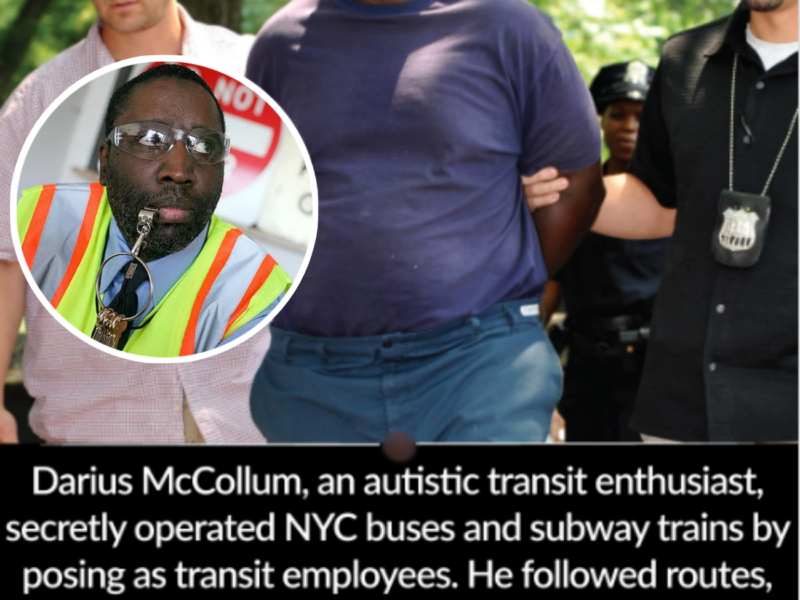
Arrested More Than 30 Times for Taking NYC Buses and Trains—The Autistic Man’s Unusual Passion Behind It Surprised Everyone
Autistic Man Arrested More Than 30 Times for Taking NYC Buses and Trains—But His Reason Shocked Everyone
The Man Who Knew Every Subway Route: The Extraordinary Story of a Transit Genius Who Couldn’t Stop Driving
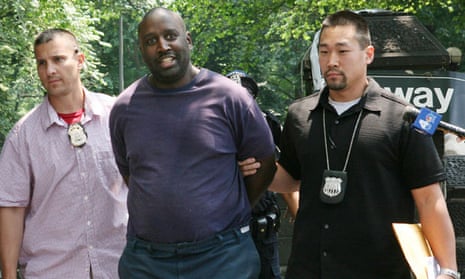
Long before New York City knew his name, before police reports and courtroom battles, before the headlines described him as a repeat offender, Darius McCollum was simply a child who found comfort underground.
While other children in Queens spent their afternoons playing sports, riding bicycles, or gathering in neighborhood streets, Darius had a different passion. He was fascinated by the New York City transit system — a massive, complicated network that confused even lifelong residents.
To him, it was not confusing at all.
The subway was a world with order.
Every station had a purpose. Every line followed a pattern. Every train arrived and departed according to rules that made perfect sense inside his mind.
By the time he was eight years old, Darius had memorized an astonishing amount of information about the subway system. He knew routes, transfers, station layouts, and schedules with an accuracy that surprised adults around him. What seemed overwhelming to others felt natural to him.
For a young boy struggling to fit into a world that often felt unpredictable, the subway became more than transportation.
It became his safe place.
Away from schoolyard cruelty and the challenges of social interaction, the underground tunnels offered something rare: acceptance.
The workers who operated the trains and maintained the system noticed him. They saw a quiet child with an unusual talent. They saw someone who could answer questions about routes and schedules that many employees themselves had to check.
Some transit workers treated him like a younger colleague rather than a child.
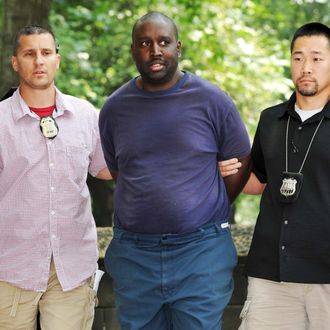
They allowed him to watch what they did. They explained how the trains worked. They introduced him to the complicated machinery behind one of the largest transportation systems in the world.
For Darius, those moments were unforgettable.
The subway was not just a hobby.
It was the place where he felt understood.
But what began as an innocent childhood fascination would eventually become the obsession that shaped his entire life.
And it would lead him into a decades-long battle between his dream and the law.
The Teenager Who Took the Controls
At fifteen years old, Darius did something that shocked authorities.
He entered an area where passengers were not allowed, gained access to an E train, and operated the train along part of its route.
To many people, the story sounds impossible.
A teenager taking control of a subway train in New York City should have created chaos. It should have ended in disaster.
But according to accounts of the incident, that was not what happened.
The train moved normally.
The announcements were made correctly.
The stops were handled properly.
Passengers reportedly had no idea that the person operating the train was not an authorized employee.
From the outside, everything appeared normal.
That was precisely what made the situation so complicated.
Darius was not trying to harm anyone. He was not looking for attention. He was not attempting to create fear.
He wanted to perform the job he had studied for years.
But wanting something and being legally allowed to do it were two very different things.
For the transit authority, he had crossed a serious line.
For Darius, it was the closest he had ever come to living the life he imagined.
The incident ended with his first arrest.
But it would not be his last.
A Dream That Would Not Disappear
Over the following decades, Darius repeatedly returned to the same world.
The uniforms.
The vehicles.
The routes.
The schedules.
The responsibility.
Again and again, he found ways to enter the transit environment and operate buses or trains without authorization.
Each incident brought another confrontation with police and another appearance in the legal system.
The numbers became shocking.
More than 30 arrests followed throughout his lifetime.
To many observers, the pattern seemed simple: someone repeatedly breaking the law.
But those who looked deeper saw something far more unusual.
There was no clear motive that matched traditional criminal behavior.
He did not steal money.
He did not threaten passengers.
He did not damage equipment.
He did not attempt to escape with vehicles.
Instead, he often did exactly what professional operators were expected to do.
He followed routes.
He helped passengers.
He made announcements.
He maintained schedules.
The very thing that made his actions dangerous from a legal perspective was also what made the story so difficult to understand.
He was not pretending to know the system.
He truly knew it.
In some ways, he understood the transit network better than many people who worked inside it.
The Battle Between Ability and Disability
At the center of Darius’s story is a complicated question that has followed him for years:
What happens when someone’s greatest ability becomes the source of their greatest problem?
Darius is autistic, and his intense focus on transportation became one of the defining features of his life.
For many people with autism, deep interests and extraordinary attention to detail can become powerful strengths. Some develop remarkable abilities in mathematics, music, technology, memory, or other specialized areas.
For Darius, that ability was transportation.
The subway system was not just something he liked.
It was something he understood on a level few others could match.
But society often struggles with people whose talents do not fit traditional expectations.
His knowledge was valuable.
His dedication was obvious.
His behavior, however, repeatedly placed him outside the boundaries of the law.
That created a painful contradiction.
The same passion that made him exceptional also made it difficult for him to walk away.
The Job He Wanted But Could Never Have
Perhaps the most heartbreaking part of Darius’s story was not the arrests.
It was the dream behind them.
He did not want to be famous.
He did not want to become a symbol.

He wanted a job.
He wanted to wake up each morning, put on a uniform, report to work, and operate a vehicle legally.
He wanted to be recognized for what he could do.
But his history made that almost impossible.
Every arrest created another barrier.
Every incident became another reason employers hesitated.
The transit system that had fascinated him since childhood became the same system that kept rejecting him.
For years, he remained trapped between two realities.
In one reality, he was a man with extraordinary knowledge and dedication.
In another, he was someone authorities saw as a repeated safety concern.
Both realities existed at the same time.
The People Who Saw More Than the Headlines
When stories about Darius appeared in newspapers and online discussions, reactions were often divided.
Some people focused on the legal violations.
They argued that operating trains and buses without permission could never be acceptable, regardless of skill or intention.
A transportation system carrying thousands of passengers every day depends on strict rules.
Training matters.
Authorization matters.
Safety procedures matter.
Others saw a different side.
They saw a person whose life had been shaped by an overwhelming passion and a desire to contribute.
They questioned whether the system had ever found a meaningful place for someone with his unique abilities.
To them, Darius represented a larger issue: how society responds when someone is different.
What if the same dedication that caused problems could have been redirected into something productive?
What if someone had recognized his talent earlier?
What if there had been a pathway for him to work with the system instead of constantly fighting against it?
Those questions have no simple answers.
Inside the Mind of a Transit Obsession
To understand Darius’s actions, it is important to understand what the subway represented to him.
For most people, transportation is temporary.
A train is something that takes you somewhere.
A bus is something you use.
But for Darius, the transit system was almost like a language.
Routes were sentences.
Stations were words.
Schedules were grammar.
He did not simply memorize information.
He connected with the entire structure.
The movement of trains, the timing of stops, and the organization of the network created a sense of certainty.
In a world filled with uncertainty, the subway followed rules.
And rules made sense.
That connection explains why walking away was not easy.
To others, he was giving up an interest.
To him, he was being separated from a fundamental part of himself.
A Lifetime Spent Between Freedom and Confinement
The tragedy of Darius’s story is that so much of his life became defined by the thing he loved most.
The subway gave him purpose.
But it also brought consequences.
Time after time, he returned to the same environment.
Time after time, authorities intervened.
Time after time, the same cycle repeated.
A young boy who once found friendship among transit workers eventually became someone known to police officers and court officials.
The question was never whether Darius loved trains.
Everyone knew that.
The question was whether there was a place in the world where that love could exist safely.
More Than a Story About Trains
At first glance, Darius McCollum’s story seems like a strange tale about a man who repeatedly took control of New York buses and trains.
But underneath the unusual details is a much deeper story.
It is a story about talent.
It is a story about isolation.
It is a story about misunderstanding.
And it is a story about the difficult space between what someone can do and what society allows them to do.
Many people spend their lives searching for a passion.
Darius found his when he was a child.
The tragedy was that his passion was something he could not simply enjoy from a distance.
He wanted to be part of it.
He wanted responsibility.
He wanted recognition.
He wanted to belong.
For years, the city saw him as someone who repeatedly broke the rules.
But those closest to his story saw something more complicated:
A man who knew the subway system almost perfectly, but struggled to find his own place within it.
The Final Stop
Darius’s life raises uncomfortable questions that do not have easy answers.
How should society handle extraordinary abilities that come with serious challenges?
Can someone’s talent be separated from the behavior surrounding it?
And when a person spends decades trying to become part of something they love, should the focus only be on the rules they broke — or also on the opportunities they never received?
The New York subway carries millions of people every day.
Each passenger has somewhere to go.
Each journey has a destination.
But for one man, the subway was never just a way to get somewhere.
It was where he felt he belonged.
And for decades, he chased the one dream that always seemed just out of reach:
Not stealing a train.
Not causing chaos.
Not becoming a headline.
Just becoming the person he believed he was meant to be — the person behind the controls, doing the job he had spent his entire life preparing for.