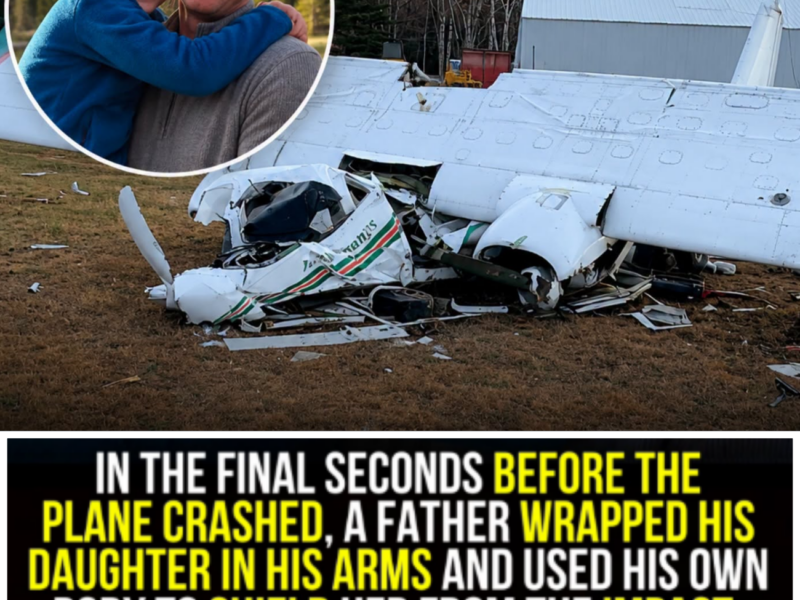
Before the Plane Crashed in Michigan, a Father Made One Final Choice—Protect His Daughter at All Costs
Seconds Before a Michigan Plane Crash, a Father Made One Final Choice: Protect His Daughter—And His Last Act of Love Saved Her Life
The Last Choice Mike Perdue Made: How a Father Became His Daughter’s Shield in a Michigan Plane Crash
The weekend was supposed to begin with a short flight.
There was no grand family trip planned, no complicated itinerary and no reason to expect that the journey would become the defining event of several lives. The destination was Beaver Island, a remote community in northern Lake Michigan known for its distance from the mainland and the small aircraft that regularly carry residents and visitors across the water.
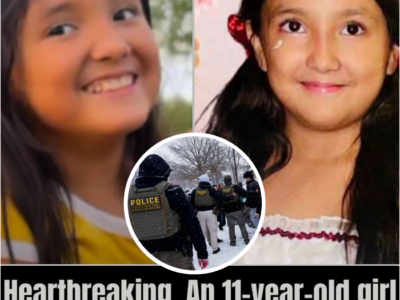
Laney Perdue was 11 years old.
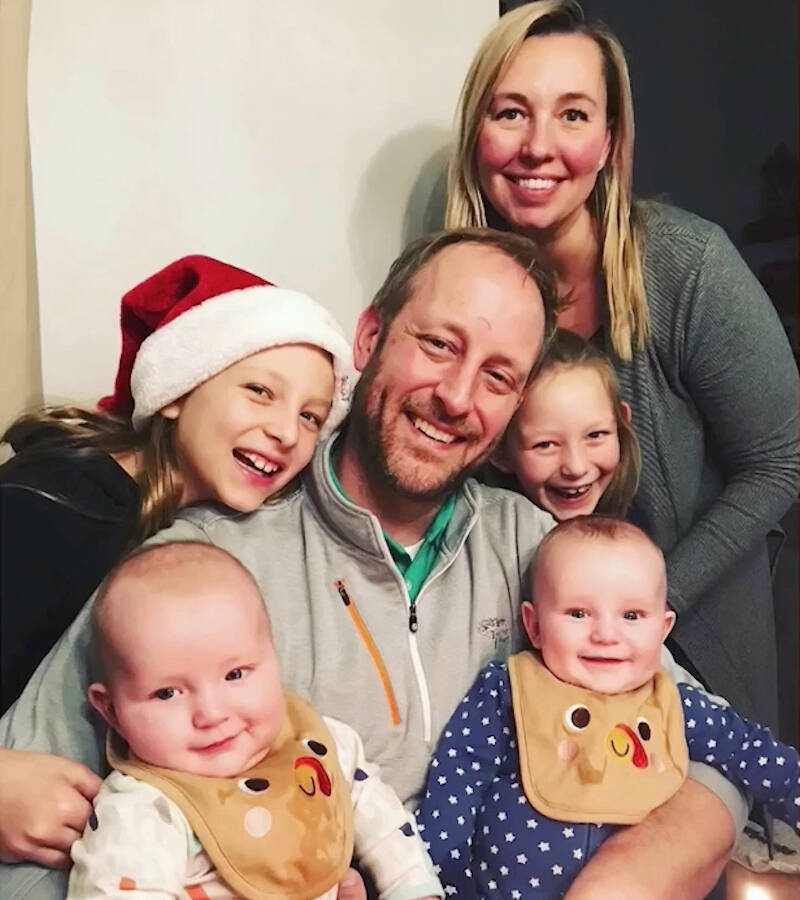
Her father, Mike Perdue, was a real estate agent from Gaylord, Michigan. The original plan was for Laney to take the commuter flight without him. It was a relatively brief trip, the kind of arrangement a family might consider ordinary after checking schedules and making sure someone would be waiting at the other end.
Then Mike changed his mind.
At the last minute, he decided that his daughter should not fly alone.
That decision placed him on the plane on November 13, 2021.
It also placed him beside Laney during the final seconds before the aircraft struck the ground on Beaver Island.
The plane carried four passengers and a pilot. By the end of the day, Laney would be the only person aboard who survived.
When rescuers reached the wreckage, they found Mike wrapped around his daughter. His arms were locked around her. His body had been positioned between Laney and the force of the crash.
The father who had decided she should not make the trip alone had made one final decision.
He had become her shield.
A Routine Flight Across the Water

Small-aircraft travel is part of life in many island communities. For people living far from the mainland, commuter planes are not symbols of adventure. They are transportation.
They carry families, workers, visitors, groceries and mail. The flights may be short, but they cross stretches of water where roads and bridges do not exist. Travelers place their trust in pilots, weather assessments, aircraft maintenance and the ordinary systems that make thousands of flights uneventful.
For Laney, the journey to Beaver Island was supposed to be temporary.
She was going to spend the weekend with friends and then return home.
Mike had not initially planned to accompany her. The arrangement suggested confidence that the trip would be safe and manageable. Laney would board, make the short flight and be met after landing.
But something caused Mike to reconsider.
The reason did not have to be dramatic. Parents often change plans because of a feeling too small to explain: a moment of hesitation, a protective instinct or the simple realization that a child might feel better with a familiar person nearby.
Whatever went through Mike’s mind, the result was clear.
He went with her.
At the time, the change probably seemed minor. One extra passenger. One father taking a seat beside his daughter. One adjustment to a weekend plan.
Later, that decision would become impossible for Laney’s family to separate from the miracle of her survival.
Mike had not been required to board the plane.
He chose to be there.
November 13, 2021
The aircraft departed for Beaver Island on a Saturday.
The plane was twin-engined, the kind of commuter aircraft designed to move a small number of people between regional destinations. The journey should have ended with a landing and a weekend beginning as expected.
Instead, the plane went down on the island.
The violence of an aircraft crash is difficult to comprehend from the neat language used afterward. Reports speak of impact, wreckage and casualties. Those words organize the event into categories, but they cannot fully describe what happens inside a small cabin when a controlled flight becomes an emergency.
There is little room.
There may be almost no time.
Passengers cannot step away from danger. They cannot change the direction of the aircraft or create a safer place to stand. They can only react within the few feet surrounding them.
Three passengers were killed in the crash. The pilot was removed from the scene by air but did not survive.
Laney did.
The survival of an 11-year-old child amid such destruction would have been extraordinary under any circumstances. What rescuers reportedly saw inside the wreckage gave the story an even more devastating meaning.
Mike was holding her.
He had drawn her toward him and wrapped his body around hers.
He had used the only protection he had left to offer.
Himself.
The Final Seconds
No one can know every thought that passed through Mike’s mind before the crash.
There is no complete account of the words spoken inside the plane. There is no way to reconstruct every motion with certainty. The people who could have described those final seconds did not survive.
What remained was the position in which father and daughter were found.
Mike’s arms were around Laney.
His body was between her and the impact.
The embrace has often been described as a bear hug—the kind of powerful, instinctive hold a parent uses when trying to pull a child as close as possible.
It was not a carefully designed rescue technique.
It was a father’s response.
There was no equipment available to him, no time to construct a barrier and no safe exit. He could not stop the aircraft from descending. He could not control where it would strike.
He could decide what would meet the impact first.
Mike chose his own body.
That choice may have lasted only seconds. It may have been made without words. It may have been less a calculated decision than the purest expression of parental instinct.
Protect the child.
Hold on.
Do not let go.
The Only Survivor
Laney survived with five broken bones.
The injuries were serious, but she was alive.
The location of those injuries became one of the most haunting details in the family’s account. Her broken bones were on the side opposite from where her father had been sitting—the side Mike was not shielding.
The implication was difficult to ignore.
The side nearest her father had been protected by his body.
The side beyond his reach absorbed the injuries.
A crash contains countless forces, and no single detail can offer a complete scientific explanation of survival. But for Laney’s family, the pattern of her injuries reinforced what the rescuers had seen.
Mike’s embrace had mattered.
His body had taken what hers did not.
The father who could not save himself had managed to create a small area of protection around his daughter.
It was not enough to prevent every injury.
It was enough to keep her alive.
Help Was Already in the Air
Survival after a crash can depend on what happens during the minutes that follow.
A person may endure the initial impact but remain in danger because of trauma, exposure, fire or delayed medical care. Remote locations make rescue more complicated. Beaver Island sits in northern Lake Michigan, separated from major mainland hospitals by water and distance.
On November 13, however, a United States Coast Guard helicopter was training nearby.
The timing proved crucial.
The crew was able to reach the crash scene quickly. Laney was removed from the wreckage and airlifted for medical treatment.
She was taken to McLaren Northern Michigan Hospital.
The same chain of chance that had placed Mike on the aircraft also placed trained rescuers close enough to respond rapidly.
Had the helicopter been farther away, the outcome might have been different. Had the crash occurred under slightly different conditions, help might have taken longer to arrive.
Instead, Laney was found alive, reached by rescuers and flown to a hospital.
She had survived the impact.
Now medical teams had to help her survive everything that came after it.
A Father Who Was Not Supposed to Be There
Laney’s mother later emphasized the detail that transformed the story from tragedy into something almost unbearable.
Mike was not originally supposed to be aboard.
He had decided at the last moment that he did not want Laney to travel alone.
It is natural to imagine how often that decision must have replayed in the family’s mind.
Had he stayed behind, Mike would have survived.
Laney might not have.
That is the brutal arithmetic of the story.
Mike’s presence placed him in the path of the crash. It also gave his daughter the protection that may have made her survival possible.
Families who endure sudden loss often return repeatedly to the final decisions made before disaster. They ask what would have happened if someone had left five minutes earlier, taken a different route or declined an invitation.
Usually, those questions bring only pain because they cannot be answered.
In this case, one answer seemed visible in the wreckage.
Mike went because Laney was his daughter and he did not want her to fly alone.
When the danger came, she was not alone.
The Meaning of an Ordinary Choice
Heroism is often imagined as a dramatic response to an obvious threat.
A person enters a burning building. A stranger jumps into a river. A soldier moves toward danger while others move away.
Mike’s first heroic choice did not look heroic at all.
It looked like a change in travel plans.
He decided to accompany his daughter on a short flight.
There were no cameras recording the moment. No one would have congratulated him. It was simply something a father chose to do.
That ordinary decision created the possibility of the extraordinary one that followed.
He could not have protected Laney during the crash if he had not been sitting beside her.
The last decision began with an earlier decision: to show up.
That is part of what made the story resonate so deeply with parents.
Most parental devotion is expressed through ordinary acts. Driving to practice. Waiting outside school. Checking a locked door. Changing a schedule because a child needs company.
These choices rarely become public stories.
Mike’s did because the ordinary act of accompanying his daughter placed him in an impossible situation, and he responded in the only way he could.
He held her.
The Distance Between Fear and Action
Fear can paralyze people.
In emergencies, the body may freeze. The mind may struggle to understand what is happening quickly enough to respond.
Mike appears to have acted.
Whatever fear he experienced, his attention turned toward Laney.
He did not have to be fearless. Courage does not require the absence of fear. It requires action while fear is present.
Inside the aircraft, Mike had no guarantee that his embrace would work. He could not know whether the position of his body would make a difference. He had no time to calculate the forces involved.
He could only recognize that his daughter was beside him and that danger was approaching.
Then he pulled her close.
The act was both simple and enormous.
Parents tell children that they will protect them. Most never face a situation that tests the promise in such absolute terms.
Mike did.
What Laney Carried Out of the Wreckage
Laney was rescued with physical injuries that could be treated.
The emotional injuries were less visible.
She was 11 years old and had survived an event that killed her father and the others aboard. She would eventually have to understand not only that Mike was gone but that he had died while physically protecting her.
Survivors of catastrophes often carry complicated emotions.
Gratitude can exist beside guilt.
Relief can exist beside grief.
The knowledge that someone else died while saving them can become both a source of strength and a burden.
Laney’s survival was something her family could celebrate.
The circumstances made celebration inseparable from mourning.
Every recovery milestone would carry Mike’s absence.
Every birthday, school event and future achievement could become another moment he should have witnessed.
Yet his final act would remain part of those moments too.
Laney did not leave the crash alone.
She carried the evidence of her father’s love with her.
A Story Told Through Position
There are photographs and videos that document acts of heroism directly.
This story was different.
The most important evidence was the position of two bodies inside the wreckage.
Mike’s arms were around Laney.
The scene allowed rescuers and family members to understand what he had attempted to do.
There was no need for a final note.
No recorded statement was required.
His body told the story.
It said that, at the moment when survival was uncertain, he had moved toward his daughter rather than away from her.
It said he had refused to let fear separate them.
It said he had tried to absorb the impact for her.
The position became his final message.
The Pilot and the Other Lives Lost
Laney’s survival became the center of public attention, but the crash took several lives.
Three passengers died at the scene. The pilot was airlifted but later died.
Each person aboard had a destination, relationships and plans beyond the flight. Each death created a separate circle of grief.
A compelling survival story should not erase those losses.
For the families of the other victims, November 13 was not primarily the day one child survived. It was the day someone they loved did not come home.
The same crash produced a miracle for one family and devastation for others.
That contradiction is part of nearly every major disaster. The public searches for hope, and survival provides it. But hope does not cancel tragedy.
Laney’s life was preserved.
Four other lives were lost.
Both truths belong to the story.
The Island
Beaver Island’s isolation gave the crash a stark setting.
The island lies in Lake Michigan, far enough from the mainland that aircraft service plays an important role in connecting it with the rest of northern Michigan.
For residents and frequent visitors, flying there can become routine. The route may feel familiar, almost like taking a bus or ferry.
Disaster destroys that sense of routine.
After the crash, the island was no longer simply the place where Laney planned to spend a weekend. It became the location where her father died saving her.
The ordinary destination became inseparable from the extraordinary loss.
Communities connected to small-aircraft routes often feel crashes intensely. The planes carry people who know one another. Pilots may be familiar faces. Passengers may be neighbors, relatives or friends.
The distance that makes the island beautiful can also make tragedy feel enclosed and personal.
The Coast Guard Crew
The Coast Guard helicopter crew did not know, while training nearby, that it would soon become part of a story remembered across the country.
Training exists for precisely that reason. Emergency teams prepare during ordinary hours so they can respond when an ordinary day suddenly becomes catastrophic.
When the call came, the crew moved toward the island.
Their arrival connected the moment of Mike’s sacrifice with the medical care that followed.
His body had protected Laney through the crash.
The rescuers had to carry that protection forward.
They located the wreckage, reached the only survivor and transported her toward advanced care.
The rescue did not reverse the tragedy.
It preserved what Mike had fought to save.
The Difference a Few Minutes Can Make
In emergency medicine, time can determine whether injuries remain survivable.
Internal bleeding, head trauma and shock can worsen rapidly. Cold conditions and remote terrain may add danger. Helicopter evacuation can remove hours from the journey to medical care.
The Coast Guard’s proximity was an accident of timing.
The crew happened to be training in the region.
That coincidence became one of several narrow margins surrounding Laney’s survival.
Mike happened to change his travel plan.
He happened to be seated beside her.
He managed to pull her close.
The helicopter happened to be nearby.
Rescuers reached her while survival was still possible.
No single part of that chain guarantees the outcome. Together, they gave Laney a path out of the wreckage.
The Five Broken Bones
Five broken bones would ordinarily define a traumatic injury.
In this story, they became evidence of survival.
The fractures showed how violently Laney’s body had been thrown and compressed. They also showed the limits of the protection Mike could provide.
He could not shield every part of her.
He could not make the crash harmless.
But the injuries were survivable.
The detail that all five broken bones were on the side opposite her father deepened the family’s belief that his position had saved her.
The side against Mike had been held.
The exposed side had broken.
The image is almost impossible to hear without imagining him tightening his arms around her as the aircraft descended.
The Last Embrace
Most families do not know exactly how a loved one spent the final seconds of life.
That uncertainty can become a source of lasting pain. People imagine fear, loneliness or confusion.
Mike’s family was given a different kind of answer.
His last known action was an embrace.
It was not a passive farewell. It was protective.
The final contact between father and daughter was not separation but closeness.
For Laney, that knowledge may become one of the most painful and most comforting facts she carries.
Her father’s final experience included her in his arms.
His last act expressed what he had likely demonstrated throughout her life: when she was in danger, he would move toward her.
The Choice Parents Understand
The story traveled far beyond Michigan because the choice was instantly recognizable.
Parents understood it without explanation.
Many believed they would do the same. Some may have imagined their own children in the seat beside them and felt the terror of having only seconds to act.
The response was not about aviation alone.
It was about the instinct to place a child’s life above one’s own.
That instinct appears in everyday forms. Parents lose sleep, sacrifice money and rearrange their futures for their children.
Mike’s final act was the most extreme version of that pattern.
He gave his body to absorb the crash.
The story asked a question no parent wants to face:
What would you do if the only thing standing between your child and death was you?
Mike answered before anyone could ask.
No Promise of Survival
Acts of sacrifice are often retold as though the person making them knows the outcome.
Mike did not.
He could not know Laney would survive.
He could not know rescuers would arrive quickly.
He could not know that his position would protect her from fatal injury.
He made the choice without a promise.
That uncertainty is what made the act courageous.
He did not shield her because success was guaranteed.
He shielded her because trying was the only option he could accept.
The Life He Gave Her Back
Laney’s survival meant that her life continued beyond November 13, 2021.
She would have years Mike no longer had.
She would grow older than the 11-year-old child he held inside the plane. She would continue through school, friendships, milestones and decisions that could not yet be imagined.
Each year would widen the distance between the crash and the person she became.
But the life she lived afterward would always be connected to her father’s final act.
This does not mean she owed the world a perfect life or constant public gratitude. Survivors should not be forced to transform tragedy into inspiration for others.
Laney’s life belonged to her.
Mike’s sacrifice gave her the opportunity to keep living it.
The Weekend That Never Happened
The original plan was painfully simple.
Fly to Beaver Island.
Spend time with friends.
Return home.
After the crash, that simplicity became heartbreaking.
Families often build their lives from assumptions about the near future. Dinner will happen. A child will come home Sunday. Work will resume Monday. The weekend will become another memory among hundreds.
The Perdue family had no reason to imagine that this particular plan would divide life into before and after.
Laney left expecting a visit.
She returned as the sole survivor of a crash.
Mike left because he did not want her flying alone.
He did not return.
What Survival Does Not Fix
Survival is sometimes treated as the end of the story.
It is usually the beginning of another.
Laney had to heal physically from five broken bones. Her family had to plan a funeral while caring for an injured child. They had to answer questions, process public attention and begin living with an absence that no medical recovery could repair.
The word “miracle” may describe the unlikely fact that Laney lived.
It does not describe everything that followed.
Miracles can coexist with trauma.
A child can be grateful to be alive and devastated by the price of survival.
A family can celebrate her rescue and mourn the man who made it possible.
The Father From Gaylord
Before becoming known nationally for the way he died, Mike Perdue had a life in Gaylord.
He worked in real estate. He was a husband, father, colleague and community member. People knew his habits, humor and ordinary routines.
Public stories of sacrifice can flatten a person into a single heroic act.
Mike deserves to be remembered for that act, but he was more than the final seconds inside an aircraft.
The instinct that caused him to hold Laney likely came from years of fatherhood. The embrace was not separate from the person he had been. It was the final expression of it.
He protected her because she was his daughter.
He went on the flight because she was his daughter.
The heroism of the ending began in the relationship that came before it.
A Decision Made Twice
Mike’s story contains two decisions that mirror one another.
The first happened before departure.
He decided Laney should not fly alone.
The second happened before impact.
He decided she should not face the crash alone.
In both moments, he moved closer.
The first decision placed him beside her.
The second placed him around her.
The repetition gives the story its emotional structure.
Mike did not suddenly become protective in the final seconds. Protection had already shaped his choice to board.
When the circumstances changed, the same instinct intensified.
Go with her.
Hold her.
Do not leave her alone.
The Last Thing He Could Control
During an aircraft emergency, passengers lose control over almost everything.
They cannot change the weather, repair a mechanical problem or alter the terrain below. They cannot determine the angle of impact or summon rescuers before the crash occurs.
Mike could not control the plane.
He could control the position of his body.
That final area of control became the difference between helplessness and action.
He used it completely.
The Shock of the Wreckage
For rescuers, crash scenes demand professionalism under extreme emotional pressure.
They must assess danger, locate survivors and move quickly. They often encounter scenes that remain with them long after the official response ends.
Finding an adult wrapped around a child would have communicated the story immediately.
The rescuers did not need to know the family’s travel plans or the last-minute decision that placed Mike aboard.
They could see what he had done.
The wreckage showed destruction.
The embrace showed resistance to it.
In the middle of a scene defined by loss, Laney’s breathing offered a reason to continue.
A Bear Hug Against the Impossible
The phrase “bear hug” usually describes affection.
A parent lifts a child, squeezes tightly and creates the feeling of total safety. The gesture belongs to reunions, bedtime, celebrations and comfort after small injuries.
Inside the plane, that familiar gesture was used against an impossible force.
Mike took an act of love and turned it into physical protection.
The same arms that may have hugged Laney countless times became the barrier between her and impact.
That is why the description remains so powerful.
The final embrace was both ordinary and unprecedented.
Laney knew the feeling of her father holding her.
This time, he held her to save her life.
The Story Her Mother Could Not Forget
Laney’s mother later described Mike’s last-minute decision and final act in terms that made the sequence impossible to dismiss as coincidence.
He was not supposed to be there.
He chose to go.
He chose to hold her.
For a grieving spouse, those facts carried both comfort and devastation.
Mike’s choice saved their daughter.
It cost him nothing that the crash had not already threatened to take. Yet his presence meant his family lost him that day.
There is no emotionally simple way to understand that exchange.
A mother could be grateful beyond words and heartbroken beyond measure.
The person she lost was the reason her child came home.
The Weight of “Only Survivor”
The phrase “only survivor” is often used as a dramatic headline.
For the survivor, it can become an identity imposed by tragedy.
Laney was not only a survivor. She was a child. She had interests, relationships and a life that existed before the crash.
Yet the event would follow her.
People would hear her name and remember the plane. They would remember her father’s body around hers. They would remember the five broken bones and the Coast Guard helicopter.
Living beyond catastrophe involves finding a way to carry the event without allowing it to become the whole self.
Laney’s survival was extraordinary.
Her future deserved to contain more than survival.
The Father’s Final Gift
Parents give children many things they may not fully understand until later.
Advice.
Security.
Time.
Confidence.
Memories.
Mike’s last gift was life itself—not in the biological sense, but in the most immediate physical sense imaginable.
He gave Laney the chance to wake in a hospital.
To recover.
To go home.
To grow older.
The gift came without ceremony.
There was no final speech.
There were only his arms around her.
Why the Story Endures
Many stories of heroism involve strangers.
Those acts are powerful because the rescuer has no personal obligation to the person in danger.
Mike’s story affects people differently because the bond was already there.
The question was not whether he loved Laney.
The question was what that love would do when tested by catastrophe.
It became action.
The story endures because it gives physical form to something parents often say but rarely have to prove:
I would take your place if I could.
Mike could not completely take Laney’s place.
He came as close as the circumstances allowed.
The Last Decision
It is tempting to describe Mike’s final decision as a single moment.
In reality, it may have been the completion of every decision that came before it.
Every time he had protected Laney.
Every time he had worried about her.
Every time he had chosen to remain close.
Those habits of love converged inside the aircraft.
The plane was going down.
His daughter was beside him.
He pulled her toward his chest.
Then he held on.
A Life Divided by One Flight
For the Perdue family, November 13, 2021, would remain fixed in time.
There was life before the flight and life after it.
Before, the weekend seemed ordinary.
After, nothing could be ordinary in the same way.
A short commuter trip had taken Mike’s life and nearly taken Laney’s.
It had also revealed, with terrible clarity, what a father was willing to do for his child.
What He Could Not Save
Mike could not save everyone aboard.
He could not save the pilot.
He could not stop the crash.
He could not return home to his family.
The story should not pretend that love defeats every disaster.
It does not.
Sometimes love can only protect one small part of what matters.
Mike protected Laney.
That was the part within his arms.
The Side He Shielded
The five fractures on the side opposite her father remain among the most striking details of the account.
They turn the position of Mike’s body into something almost measurable.
On one side, broken bones.
On the other, her father.
The human body is not designed to function as crash protection. It cannot reliably withstand the forces involved.
Yet his body altered what reached hers.
His sacrifice was not symbolic.
It was physical.
The Return Home
Laney’s eventual return could not resemble the homecoming her family had expected.
She returned without the father who had accompanied her.
She returned injured, alive and carrying a story no 11-year-old should have to carry.
The family had planned for her to spend a weekend away.
Instead, they began a lifetime of remembering why she came back.
The Quiet Heroism of Staying
Mike’s decision to board did not appear dramatic because many acts of love do not.
He stayed close.
That is all.
He did not know the flight would crash. He did not board intending to become a hero. He boarded because he did not want his daughter alone.
The heroism came later, but it depended on the earlier act of presence.
There is a lesson in that which extends beyond disaster.
People often imagine that love is proved through enormous sacrifice.
More often, it begins by being there.
The Last Thing Laney Felt
No one can say exactly what Laney remembers from the final seconds.
Memory during trauma can become fragmented. Sounds, pressure and brief images may remain while entire sections disappear.
But the physical facts suggest that one of the last things she felt before impact was her father holding her.
Not a stranger.
Not an empty seat.
Her father.
He had feared she might make the flight alone.
She did not.
The Shield
A shield is usually made of something hard.
Metal.
Wood.
Reinforced material designed to absorb force.
Mike had none of those.
He had his arms, chest and back.
He made a shield from a father’s body.
It broke no laws of physics. It did not make the crash survivable for everyone.
It created enough protection for one child.
The Choice That Remained
When everything else had been stripped away—control of the aircraft, certainty of survival, possibility of escape—one choice remained.
Mike could hold his daughter.
He made that choice.
The last act of his life was not surrender.
It was protection.
What Laney’s Survival Says
Laney’s survival does not suggest that every sacrifice will succeed.
It does not promise that love can overcome every impact.
It says only that, on one Michigan island in November 2021, a father’s embrace mattered.
His daughter lived.
That fact stands against the deaths, the wreckage and the life the family lost.
It does not erase them.
It gives them meaning.
The Weekend Plan
The plan had been simple.
Fly to Beaver Island.
Spend the weekend with friends.
Fly home.
Mike changed one detail.
He went too.
The small decision placed him inside the final chapter of his life and gave Laney a future beyond the crash.
No one making the plan could have understood what the change would mean.
That is why the story remains so shocking.
A minor adjustment became an act of destiny.
The Last Hug
Families often remember the final hug they gave someone who later died.
They wonder whether they held long enough. They replay the goodbye and search it for signs.
Laney’s last hug from her father was different.
It was not given at a doorway.
It was not a casual farewell.
It continued through impact.
Mike did not release her.
Rescuers found him still wrapped around the child he had chosen to accompany.
His arms had completed their final purpose.
The Decision That Saved Her
Mike Perdue could not know that November 13 would become his final day.
He could not know that the short flight would go down on Beaver Island.
He could not know that a Coast Guard helicopter would be training nearby or that Laney would reach the hospital alive.
He knew only that his daughter was beside him and that she needed protection.
He pulled her close.
He placed himself between her and the crash.
The aircraft went down.
Mike died.
Laney survived.
The story is not powerful because the ending is happy. It is not.
A child lost her father. A family lost a husband, parent and loved one. Four people aboard the plane died.
The story is powerful because, inside an event defined by helplessness, Mike found one final way to act.
He could not control whether the plane remained in the air.
He could decide whether Laney faced the impact alone.
She did not.
The first decision that weekend was to accompany her.
The final decision was to shield her.
Between those two choices lies the entire meaning of Mike Perdue’s last flight.
He went because he loved his daughter.
He held her because he loved his daughter.
And when rescuers arrived, they found that love in its final physical form: a father’s arms locked around an 11-year-old girl, his body positioned between her and death.
The last decision he ever made was to become her shield.