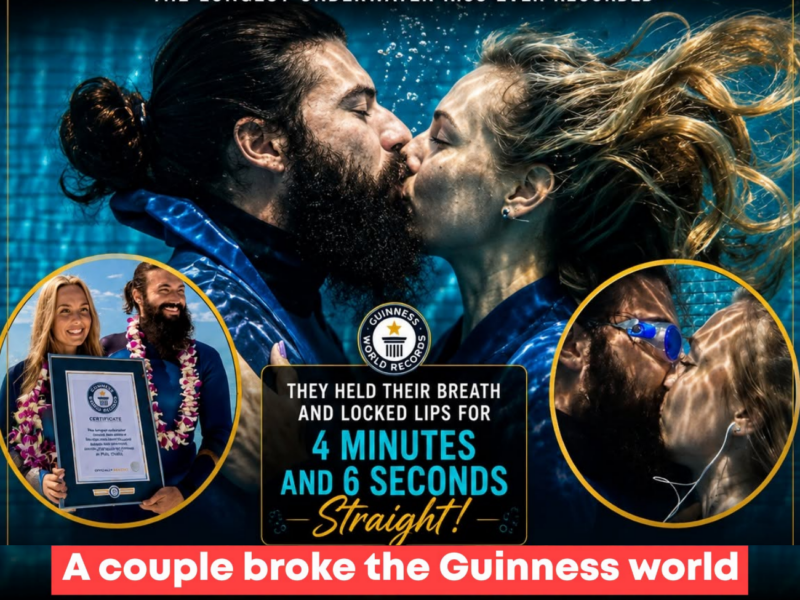
BREAKING: Couple Sets Guinness World Record With an Incredible 4-Minute, 6-Second Underwater Kiss
Love Under Pressure: Couple Breaks World Record by Kissing Underwater for More Than 4 Minutes
The Underwater Kiss That Broke a World Record—and the Human Limits Behind It

In the world of extreme human achievement, records are often broken with speed, strength, or endurance that seems almost mechanical in its precision. Marathon times are shaved by seconds. Deep-sea dives go a few meters further. Breath-holds extend just a little longer than what physiology says should be possible.
But every so often, a record emerges that feels less like sport and more like myth.
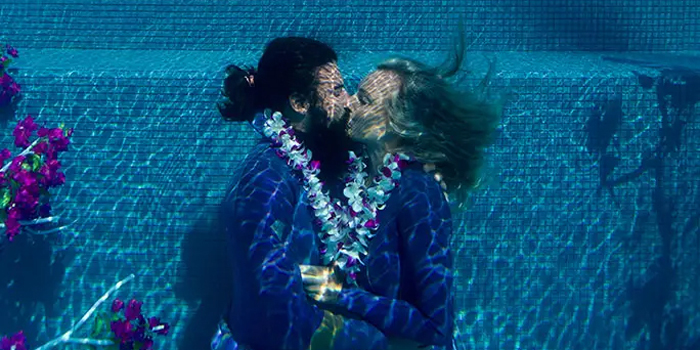
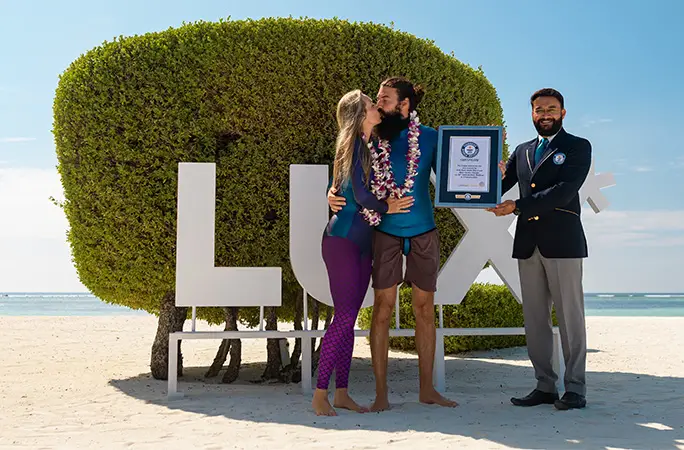
On February 4, 2023, in the turquoise stillness of an infinity pool at a luxury resort in the Maldives, a couple locked lips underwater and refused to let go—for 4 minutes and 6 seconds.
When they finally resurfaced, gasping into the warm island air, they hadn’t just broken a Guinness World Record. They had rewritten what two human bodies, tethered by love, training, and sheer willpower, could endure together.
Their names were Beth Neale and Miles Cloutier.
And what they did underwater was not just romantic. It was, by every physiological measure, a controlled confrontation with suffocation.
A RECORD THAT STOOD FOR 13 YEARS
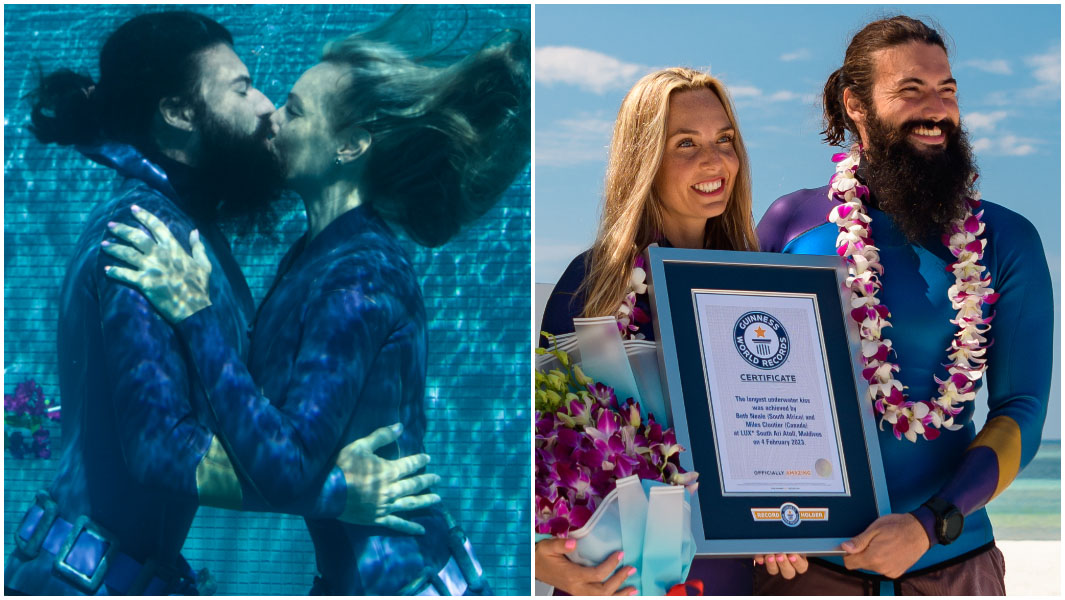
Before that February afternoon, the Guinness World Record for the longest underwater kiss had stood untouched for 13 years.
It wasn’t a headline-grabbing category. It lived quietly in the margins of human achievement, overshadowed by faster, higher, and more dangerous feats. But among freedivers and endurance athletes, it held a particular fascination: a test not only of breath control, but of synchronization between two bodies under extreme physiological stress.
The previous record had endured for more than a decade—until Neale and Cloutier arrived in the Maldives with a plan that sounded, to most people, almost absurd.
They intended not just to break it—but to push it beyond what they themselves had been able to achieve in training.
And for three days before the attempt, they could not.
THE ATHLETE AND THE STUDENT
Beth Neale was not new to extremes.
A four-time South African freediving champion, she had built her life around the discipline of breath-hold diving—an activity that demands a paradoxical relationship with the body: learning to relax in the very moment the body begins to panic.
Her partner, Miles Cloutier, was not originally part of that world. He learned freediving under her guidance. What began as instruction gradually turned into shared obsession, then partnership, and eventually a life structured around the ocean’s limits.
They met in Bermuda, drawn together by water as much as by circumstance. Over time, diving became less of a sport and more of a language between them—silent, precise, and intimate.
They now share a daughter, Neve.
And somewhere along the way, a strange idea took hold: that they would attempt a world record together. Not individually. Together.
A kiss underwater.
Held longer than any couple in history had ever managed.
WHAT HAPPENS WHEN YOU STOP BREATHING
To understand the magnitude of their attempt, one must understand what the human body experiences during prolonged breath-holding.
It is not oxygen deprivation that first triggers panic. It is carbon dioxide buildup.
As CO₂ accumulates in the bloodstream, it sends increasingly urgent signals to the brain: breathe. Surface. Escape. These signals are not subtle. They manifest as burning in the lungs, involuntary contractions of the diaphragm, and a rising psychological urgency that can feel indistinguishable from fear.
Elite freedivers train themselves to override these signals—not by eliminating them, but by tolerating them.
But tolerating them is one thing.
Synchronizing them with another human being—while maintaining physical contact, emotional focus, and stillness—is something else entirely.
Now add a kiss.
Now remove air.
Now extend time.
THE MALDIVES SETTING: BEAUTY AND PRESSURE

The attempt took place in an infinity pool at a luxury resort in the Maldives, a location chosen for its calm water, controlled depth, and visual isolation.
To observers above the surface, it may have looked serene. A couple embracing underwater, framed by sunlight rippling through clear blue water.
But beneath the surface, time behaves differently.
At first, there is control. Breath is held. Muscles are relaxed. Eye contact is maintained.
Then the body begins its countdown.
Beth later described the process in stark terms: the first minute is manageable. The second is negotiation. The third becomes a mental war. After that, there is only endurance.
Miles Cloutier would later say they were expecting a crowd reaction above water—cheers, encouragement, signals of progress.
But underwater, there was nothing.
No sound.
No applause.
Only pressure.
Only each other.
THREE DAYS OF FAILURE BEFORE SUCCESS
What makes their record more extraordinary is not just the final result—but what happened before it.
For three days leading up to the attempt, Neale and Cloutier trained and failed repeatedly. They could not match the existing record, let alone surpass it.
Their bodies resisted. Timing was off. Synchronization collapsed under stress.
For elite freedivers, this is not unusual. Performance under breath-hold conditions is highly variable, influenced by hydration, stress, sleep, and subtle physiological fluctuations.
But psychologically, repeated failure carries its own weight.
Each attempt underwater is not just physical—it is emotional exposure.
You cannot breathe your way out of doubt.
THE MOMENT EVERYTHING SHIFTED

On the day of the record attempt, conditions were ideal: calm water, controlled environment, and a support team monitoring timing above the surface.
But ideal conditions do not change biology.
Once submerged, the couple entered a state familiar to freedivers: slowed heart rate, reduced movement, intense internal focus.
At first, everything followed expectation.
Seconds passed.
Then a minute.
Then two.
By the third minute, most untrained bodies would have already surfaced involuntarily.
But they did not.
Instead, something unexpected happened.
Beth Neale later revealed she broke one of her own core training principles: she introduced external stimulation.
She placed underwater earphones in and played Eminem’s “Lose Yourself.”
It was not for entertainment.
It was survival.
The lyrics, rhythm, and intensity acted as a cognitive anchor—a way to redirect attention away from the rising physiological panic and toward structured mental focus.
A reminder, in her words, “to just keep going.”
FOUR MINUTES THAT FELT LIKE AN ETERNITY
At the surface, four minutes may seem brief. A song. A conversation. A short wait.
Underwater, without air, four minutes becomes something else entirely.
Miles Cloutier described it as waiting for a signal that never came. They expected cheers from above. They expected acknowledgment.
But underwater, there is no feedback loop. No external confirmation that anything is working.
Only the other person.
Only the kiss.
Only breath that is not coming.
At some point between minutes three and four, physiology begins to dominate willpower. Diaphragmatic contractions intensify. Cognitive clarity narrows. The brain begins prioritizing survival over everything else.
And yet they remained underwater.
Together.
THE FINAL SECONDS
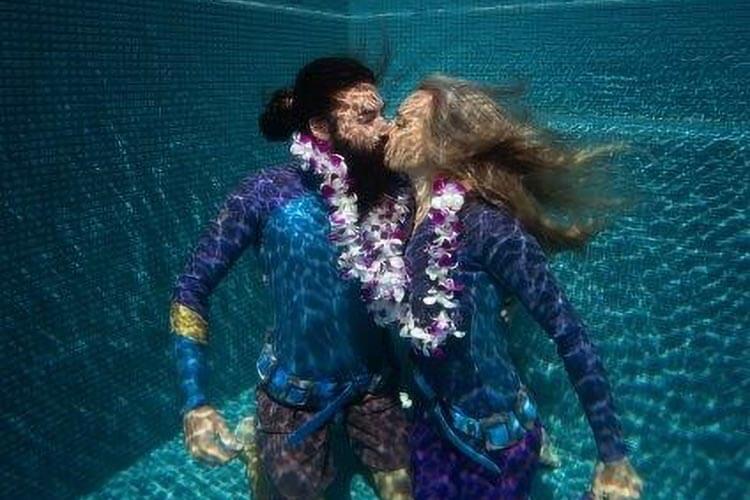
No official footage captures what those final seconds felt like internally. But in freediving, athletes often describe a narrowing of perception—a tunnel-like focus where the world shrinks to sensation and presence.
For Neale and Cloutier, that presence was each other.
There was no visible countdown. No clock underwater. Only intuition.
When they finally broke the surface, the release was immediate and violent in physiological terms: air hunger, gasps, sudden oxygen intake.
But emotionally, it was something closer to disbelief.
They had done it.
4 minutes.
6 seconds.
A new world record.
THE HUMAN COST OF CONTROL
To outsiders, the feat may appear purely romantic. A couple in love, pushing boundaries together, achieving something symbolic and cinematic.
But beneath the symbolism lies strict physiological reality.
Extended breath-holding carries risks: hypoxia, loss of motor control, shallow water blackout. Even trained freedivers respect the narrow margin between control and collapse.
Beth Neale’s admission that she “broke every rule she teaches her students” is not metaphorical. It reflects the tension between discipline and ambition that defines extreme sport.
What makes the story more complex is that they did not pursue this record as strangers or competitors—but as partners raising a child together.
Their daughter, Neve, exists outside the water. But the pursuit of this record exists because of what they share inside it.
A shared obsession.
A shared threshold.
A shared willingness to go further than logic would recommend.
WHY PEOPLE PURSUE LIMITS
Human beings have always been drawn to edges—of land, of sky, of endurance, of breath.
Records like this raise uncomfortable questions. Why hold your breath longer than is safe? Why risk discomfort for seconds on a stopwatch?
The answer, according to psychologists who study extreme athletes, is rarely about the record itself.
It is about control in environments where control normally disappears.
Underwater, humans are not meant to dominate. They are meant to survive briefly, then surface.
But freedivers like Neale and Cloutier invert that expectation. They extend the moment. They negotiate with panic. They turn biology into discipline.
And in doing so, they redefine what is possible between two synchronized bodies.
THE RECORD THAT FEELS LIKE A BEGINNING
In the official Guinness record books, their achievement is recorded in a single line: longest underwater kiss—4 minutes, 6 seconds.
But for those who understand the discipline behind it, the number is only the surface layer of a much deeper story.
It is about training that spans years.
About a relationship built in silence.
About a moment where two people chose to stay underwater long after their bodies demanded otherwise.
And about the strange intersection of love and physiology, where emotion and oxygen become part of the same equation.
EPILOGUE: WHAT REMAINS AFTER THE SURFACE
After they resurfaced, the Maldives air must have felt almost shockingly simple—warm, breathable, ordinary.
The record was complete.
The attempt was over.
But like all extreme achievements, the question that remains is not what happened in those 4 minutes and 6 seconds.
It is what it means to willingly enter them.
For Beth Neale and Miles Cloutier, the answer may not be complicated.
They trained.
They failed.
They tried again.
And when it mattered most, they held on.
Not just to breath.
But to each other.
And for 4 minutes and 6 seconds, that was enough to break a world record—and briefly suspend the rules of what the human body, and human connection, can endure.