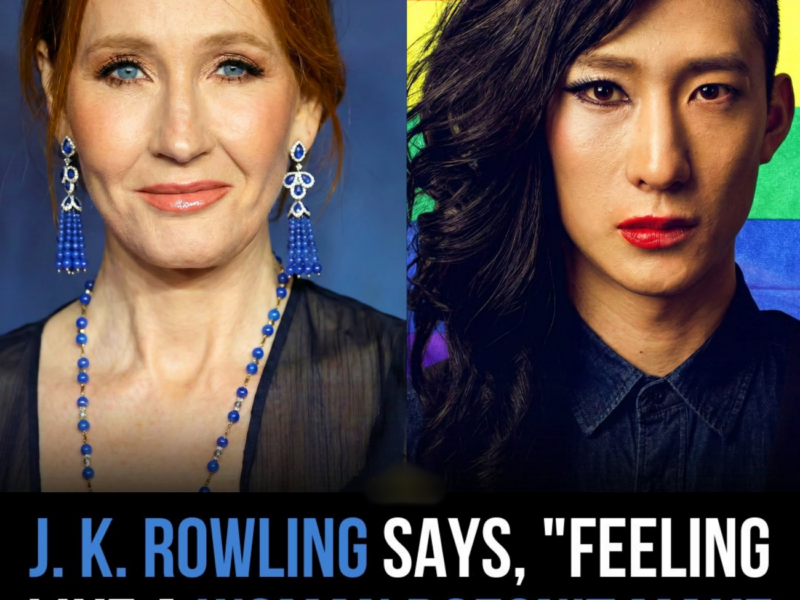
BREAKING: J.K. Rowling Sparks Major Debate With Comments on Gender Identity and What Defines Womanhood
J.K. Rowling Triggers Controversy After Statement on What Defines Womanhood
In the years following the global success of Harry Potter, J.K. Rowling found herself occupying an unusual place in cultural life: no longer just the creator of one of the most influential fantasy series in modern history, but a public intellectual whose words now echo far beyond fiction.
What began as occasional commentary on social media gradually evolved into one of the most polarizing cultural debates of the past decade—centered on gender, identity, language, and the boundaries of public discourse. At the heart of the controversy is a claim Rowling has repeatedly defended in various forms: that biological sex is real, materially significant, and should not be conflated with gender identity in policy or law.
Her critics argue that such framing erases or delegitimizes transgender people. Her supporters argue she is defending women’s rights and safeguarding sex-based protections. The result has been a cultural collision that has divided readers, fractured friendships, and split even the fictional world she created.
This is not just a story about a celebrity’s opinion. It is a story about a society struggling to define reality in an age where identity itself has become both deeply personal and politically charged.
From Literary Icon to Cultural Lightning Rod
For many years after Harry Potter concluded, Rowling was viewed almost exclusively through the lens of literary achievement. Her work had shaped a generation. Her name was synonymous with imagination, resilience, and moral clarity in storytelling.
But public perception began to shift as she engaged more directly in public debates about sex and gender. Her statements—initially framed by her as concerns about women’s rights and free speech—were interpreted by critics as exclusionary toward transgender people.
The reaction was swift and global.
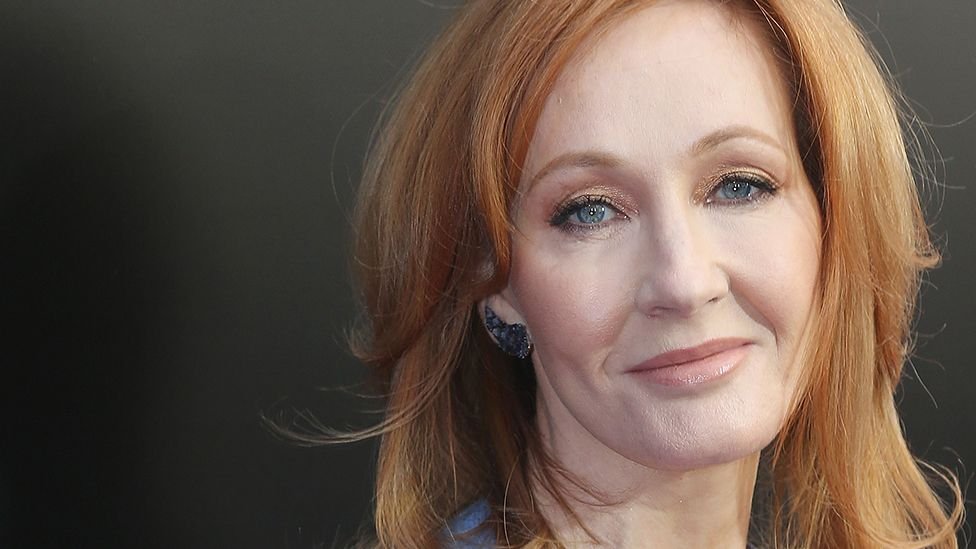
Some fans felt betrayed. Others defended her right to speak. Social media amplified every statement, turning nuanced arguments into viral flashpoints. Within months, Rowling was no longer just an author people admired or disliked—she had become a symbol in a broader cultural war.
What made the situation especially volatile was the emotional intensity on all sides. For many transgender advocates, the issue was not abstract: it touched on safety, dignity, and legal recognition. For many of Rowling’s supporters, the issue centered on sex-based rights, particularly in spaces such as sports, prisons, and shelters.
The disagreement was not merely political. It was existential.
The Core of the Dispute: Sex, Gender, and Language
Rowling’s central argument, as she has repeatedly stated, is that biological sex is an observable, material reality that carries consequences in law, medicine, and social policy. She has expressed concern that replacing sex-based language with gender identity in certain contexts could undermine protections historically built around female-specific experiences.
Her critics respond that gender identity is also a deeply real aspect of human experience, and that excluding transgender women from the category of women in any meaningful sense can contribute to discrimination and harm.
This disagreement is not simply about definitions. It is about which definitions matter in which contexts.
In academic fields, “sex” often refers to biological characteristics, while “gender” refers to social and psychological identity. In everyday language, however, these distinctions are frequently blurred, leading to misunderstandings that quickly escalate into conflict.
The controversy surrounding Rowling intensified because she framed her concerns in moral and rights-based terms. Supporters saw her as defending women’s protections. Opponents saw her as reinforcing exclusion.
Neither side has found common ground, in part because both are responding to real-world stakes that feel non-negotiable.
The Fallout: Fame, Friendship, and Fracture

As the debate intensified, figures associated with the Harry Potter franchise publicly distanced themselves from Rowling’s views. Among them were Daniel Radcliffe, Emma Watson, and Eddie Redmayne, each of whom expressed support for transgender rights in interviews and public statements.
Their responses were widely interpreted as a generational and ideological divide between the creator of the series and the actors who brought its characters to life.
The split was particularly striking because of the emotional bond fans associated with the franchise. For many, Harry Potter represented inclusion, friendship, and moral courage. Seeing its creator and its stars on opposing sides of a cultural issue created a sense of disorientation among audiences who had grown up with the stories.
Online communities fractured. Bookstores faced calls for boycotts. At the same time, Rowling’s books continued to sell in enormous numbers, underscoring a paradox: condemnation and consumption coexisting in the same cultural space.
A Culture of Amplification
One of the defining features of the controversy is the role of digital media. In earlier decades, disagreements between public figures might have unfolded through interviews or print journalism. Today, they unfold in real time across platforms designed to reward speed, outrage, and engagement.
A single post can be shared millions of times within hours. Responses become content. Counter-responses become news. Nuance is often the first casualty.
Rowling herself has frequently used social media to articulate her positions, respond to criticism, and engage directly with supporters and detractors. Her critics argue that this approach escalates conflict. Her supporters argue that it bypasses traditional media filters that might misrepresent her views.
What is clear is that the medium has shaped the message. The debate is no longer confined to academic or policy circles—it is embedded in the daily feed of millions of people.
Rights, Safety, and Competing Concerns
At the center of the dispute are competing claims about harm.

Transgender advocates emphasize the real-world vulnerabilities faced by trans people, including discrimination, violence, and barriers to healthcare. From this perspective, language that excludes or delegitimizes transgender identities is not merely theoretical—it has tangible consequences.
On the other side, those aligned with Rowling’s concerns emphasize sex-based protections, particularly in contexts where physical differences may matter for safety or fairness. They argue that policy frameworks must account for biological realities in order to protect women in vulnerable situations.
These positions often speak past each other because they are grounded in different definitions of harm.
One side sees harm in exclusion from identity recognition. The other sees harm in the erosion of sex-based categories. Both are responding to genuine concerns, but they prioritize different risks.
This is why the debate has proven so resistant to resolution. It is not just about facts—it is about which harms society chooses to prioritize when they come into conflict.
The Cost of Speaking Out
Rowling has stated that she has faced significant backlash, including public condemnation, boycotts, and threats. Supporters frame her continued public commentary as a form of resilience in the face of intense pressure. Critics argue that her platform amplifies views they consider harmful.
Regardless of interpretation, the personal cost is undeniable. Once celebrated almost universally, she now occupies a far more divided position in public opinion.
This transformation raises broader questions about the nature of celebrity in the digital age. Public figures are no longer insulated by distance or institutional mediation. Their statements are immediate, permanent, and globally accessible.
In such an environment, silence can be interpreted as complicity, and speech can carry consequences far beyond its original intent.
Beyond One Author: A Broader Cultural Fault Line
While Rowling remains the most visible figure in this debate, the underlying issues extend far beyond any single individual.
Governments, schools, sports organizations, and healthcare systems around the world are grappling with questions about how to define sex and gender in law and policy. Courts have weighed in. Legislatures have debated. Institutions have revised guidelines repeatedly as scientific, social, and ethical perspectives evolve.
What makes the Rowling controversy so emblematic is not that she originated these debates, but that she became one of their most recognizable cultural reference points.
Her case illustrates how quickly private conviction can become public conflict when it intersects with identity politics.
Interpretation and Meaning
Supporters of Rowling often describe her stance as a willingness to speak what they see as uncomfortable truths, regardless of social pressure. Critics describe it as a failure to fully recognize the lived realities of transgender people.
Between those interpretations lies a broader question: how should societies navigate disagreements over deeply held beliefs when both sides claim moral legitimacy?
The answer is not simple. Liberal democracies are built on the assumption that disagreement is inevitable, but not all disagreements are easily resolved through compromise. Some involve fundamentally different understandings of reality itself.
In such cases, cultural conflict becomes less about winning an argument and more about negotiating coexistence.
Conclusion: A Debate Without a Final Chapter
Years after the initial controversy, the debate surrounding J.K. Rowling shows no sign of fading. If anything, it has become a permanent feature of modern cultural discourse.
What began as a series of statements has evolved into a broader reflection of how society defines identity, language, and rights. It has drawn in actors like Daniel Radcliffe, Emma Watson, and Eddie Redmayne, along with countless readers, activists, and institutions.
Whether one views Rowling’s position as principled courage or as a failure of empathy often depends less on the argument itself and more on the framework through which it is interpreted.
And perhaps that is the most revealing aspect of the entire controversy: not that people disagree, but that they increasingly inhabit different interpretive worlds when they do.
In that sense, the debate is not just about gender. It is about how modern society constructs truth, assigns meaning, and decides who gets to define both.