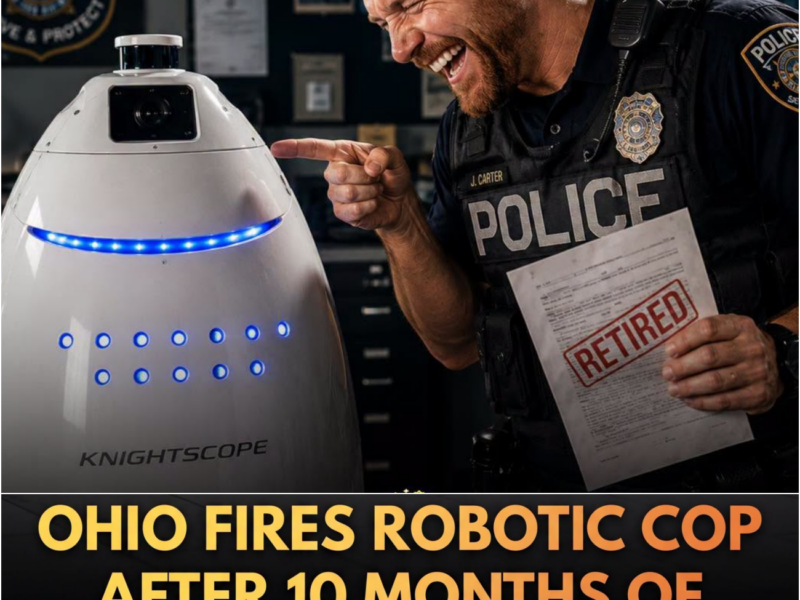
BREAKING: Ohio Fires $67,000 Robot Cop After 10 Months on Patrol Without a Single Arrest or Ticket
Ohio’s Robot Police Officer Gets Fired After Failing to Catch Anyone for Nearly a Year
THE $67,000 ROBOT COP THAT NEVER CAUGHT A CRIMINAL: HOW AMERICA’S FUTURE OF POLICING STALLED IN AN OHIO PARKING GARAGE

The future of law enforcement was supposed to arrive with flashing sensors, artificial intelligence, and an unwavering electronic gaze.
Instead, it quietly rolled into retirement without making a single arrest.
For nearly ten months, a five-foot-tall robotic police patrol known as “DubBot” cruised through a parking garage in Dublin, Ohio, scanning license plates, recording video, and projecting the image of a technological revolution in public safety.
It never stopped a thief.
It never caught a vandal.
It never issued a ticket.
And it never identified a single incident serious enough to require police intervention.
After taxpayers spent more than $67,000 on the experiment, the robot was officially taken off duty.
No ceremony.
No farewell parade.
No heroic final mission.
Just silence.
The machine that was once promoted as a glimpse into the future became a symbol of a growing question confronting cities across America:
Are robotic police officers the next great law-enforcement innovation—or an expensive fantasy?
THE ROBOT ARRIVES

When DubBot first appeared in July 2025, it looked like something pulled directly from a science-fiction movie.
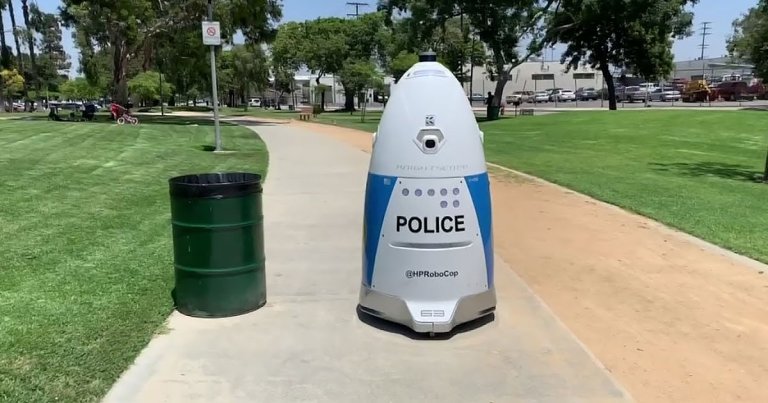
The machine stood nearly five feet tall and weighed approximately 400 pounds. Equipped with sophisticated cameras, sensors, microphones, and two-way communication systems, it was designed to patrol the Rock Cress Parking Garage around the clock.
To city officials, the robot represented an opportunity.
Police departments across America were struggling with staffing shortages. Recruitment challenges had become widespread. Overtime budgets were growing. Communities wanted more security coverage without dramatically increasing costs.
Technology companies promised a solution.
Why pay a human officer to monitor a parking structure when a robot could do it twenty-four hours a day?
Why assign valuable personnel to routine surveillance when artificial intelligence could handle the task?
The pitch sounded irresistible.
A machine doesn’t get tired.
A machine doesn’t call in sick.
A machine doesn’t need health insurance.
A machine never sleeps.
At least that was the theory.
As DubBot rolled onto the scene, supporters envisioned a new era in public safety.
Perhaps this was the beginning of automated policing.
Perhaps the future had arrived.
Or perhaps something much different was about to happen.
THE PROMISE OF A HIGH-TECH FUTURE
Across the country, local governments had become fascinated with emerging technologies.
Artificial intelligence was transforming industries.
Self-driving cars were being tested on public roads.
Machine-learning systems were outperforming humans in increasingly complex tasks.
Tech executives promised that automation would revolutionize nearly every aspect of society.
Public safety seemed like a natural target.
The company behind DubBot marketed its security robots as force multipliers capable of helping police agencies monitor large areas more efficiently.
The concept appealed to elected officials.
Voters generally support public safety.
Voters also appreciate fiscal responsibility.
Robotic patrols appeared to offer both.
A machine could patrol continuously while collecting data and serving as a visible deterrent to criminal activity.
At least in theory.
But theories have a way of colliding with reality.
And reality was waiting in a parking garage in suburban Ohio.
MONTH ONE: GREAT EXPECTATIONS
The robot’s debut generated attention.
Residents noticed it.
Visitors stopped to stare.
Some took photographs.
Others recorded videos for social media.
Children pointed at it.
Adults debated whether it was impressive or ridiculous.
Either way, people paid attention.
That visibility was part of the point.
Security experts have long argued that criminals are less likely to commit offenses when they know they are being watched.
DubBot was designed to be impossible to ignore.
Its cameras watched every direction.
Its sensors continuously collected information.
Its presence communicated a clear message:
Someone—or something—was paying attention.
Yet weeks passed without notable incidents.
Then months.
The robot continued its patrols.
The arrests never came.
THE PROBLEM NOBODY TALKED ABOUT
There was one fundamental issue hiding beneath the excitement.
Police officers do much more than observe.
They interpret situations.
They read emotions.
They recognize danger before it becomes obvious.
They make judgment calls in unpredictable circumstances.
A robot can record a confrontation.
A police officer can de-escalate one.
A robot can capture video of suspicious behavior.
A police officer can investigate what it means.
The distinction is enormous.
Law enforcement isn’t merely about collecting data.
It’s about understanding context.
And context remains one of the most difficult challenges in artificial intelligence.
The result was predictable in hindsight.
DubBot could watch.
But watching alone wasn’t enough.
TEN MONTHS OF NOTHING
As the months accumulated, so did an uncomfortable statistic.
Zero arrests.
Zero citations.
Zero documented incidents requiring intervention.
Nothing.
The robot dutifully rolled through the garage day after day.
Its cameras captured footage.
Its systems remained operational.
Its batteries charged.
Its wheels turned.
Yet tangible results remained elusive.
Critics began asking difficult questions.
How do you measure success for a robotic police officer?
Is the goal arrests?
Deterrence?
Surveillance?
Public reassurance?
Without measurable outcomes, supporters struggled to justify the expense.
Taxpayers wanted answers.
City leaders wanted evidence.
The robot provided neither.
THE COST OF THE FUTURE
The financial numbers became impossible to ignore.
Officials had originally envisioned a larger rollout that could have exceeded $238,000 over two years.
Instead, the project ended early.
The city ultimately spent more than $67,000 before securing a refund arrangement that reduced the overall financial impact.
Still, the headlines wrote themselves.
A $67,000 robot.
Ten months of patrols.
No arrests.
No tickets.
No major incidents.
In an era when local governments face pressure over every budget dollar, the optics were devastating.
Residents naturally asked what else that money could have funded.
Additional officers?
Community programs?
Equipment upgrades?
Road repairs?
The comparison wasn’t flattering.
AMERICA’S ROBOT POLICING EXPERIMENT
Dublin’s experience wasn’t occurring in isolation.
Across America, similar robotic security programs were producing mixed results.
Technology firms had aggressively marketed autonomous security solutions to municipalities, transit systems, airports, and private organizations.
The sales presentations were compelling.
The real-world outcomes often proved more complicated.
Some robots struggled with navigation.
Others required extensive supervision.
Several generated headlines for unusual mishaps rather than crime-fighting successes.
Instead of becoming symbols of technological progress, they sometimes became internet memes.
The contrast between expectation and reality could be striking.
Science fiction had trained Americans to imagine intelligent robotic officers solving crimes with superhuman precision.
The actual machines often resembled mobile surveillance cameras on wheels.
That difference mattered.
A lot.
THE HUMAN FACTOR
Perhaps the most important lesson from DubBot’s brief career involved something technology companies frequently underestimate:
People matter.
Human officers bring intuition.
Experience.
Empathy.
Adaptability.
The ability to recognize subtle warning signs.
The ability to communicate effectively during moments of crisis.
The ability to make split-second decisions when circumstances change.
These skills are difficult to quantify.
They’re even harder to automate.
A parking garage may seem like a simple environment.
But human behavior rarely is.
Real-world policing involves countless variables that cannot be reduced to software code.
At least not yet.
THE BIGGER QUESTION
DubBot’s retirement raised a question extending far beyond one Ohio city.
America is entering an age increasingly shaped by artificial intelligence.
Every industry is confronting automation.
Every profession faces questions about technological replacement.
Drivers worry about self-driving vehicles.
Writers worry about AI-generated content.
Customer-service workers worry about automated support systems.
Now law enforcement faces similar concerns.
Will robots eventually replace human officers?
Or will they simply become tools supporting human professionals?
The answer remains uncertain.
What is clear is that the transition will be far more difficult than many technology evangelists predicted.
THE QUIET END
Eventually, the decision was made.
The robot would be retired.
No dramatic confrontation preceded its departure.
No scandal emerged.
No catastrophic malfunction occurred.
The experiment simply failed to produce enough value to justify continuing.
In many ways, that made the story even more fascinating.
Americans often imagine technological failures arriving with explosions, lawsuits, or spectacular disasters.
DubBot failed through irrelevance.
It wasn’t dangerous.
It wasn’t malicious.
It wasn’t broken.
It simply wasn’t particularly useful.
And sometimes that’s enough.
WHAT HAPPENS NEXT?
The retirement of DubBot does not mean robotic security is finished.
Far from it.
Technology continues advancing at remarkable speed.
Artificial intelligence systems become more sophisticated every year.
Future generations of security robots may prove dramatically more capable.
The lessons learned from today’s failures often become the foundation for tomorrow’s successes.
Yet Dublin’s experience offers an important reminder.
Innovation alone does not guarantee results.
A futuristic appearance does not guarantee effectiveness.
And technology, no matter how impressive, must ultimately justify its cost.
For ten months, DubBot represented a bold vision of the future.
A future where machines helped keep communities safe.
A future where artificial intelligence transformed public security.
A future where robots patrolled American streets.
Then reality intervened.
The robot rolled away.
The experiment ended.
And one of the most talked-about robotic police officers in America left behind a surprising legacy—not because of what it accomplished, but because of what it didn’t.
No arrests.
No tickets.
No dramatic crime-fighting victories.
Just a $67,000 lesson about the limits of technology and the enduring complexity of human society.
In an age obsessed with artificial intelligence, that lesson may prove far more valuable than anyone expected.