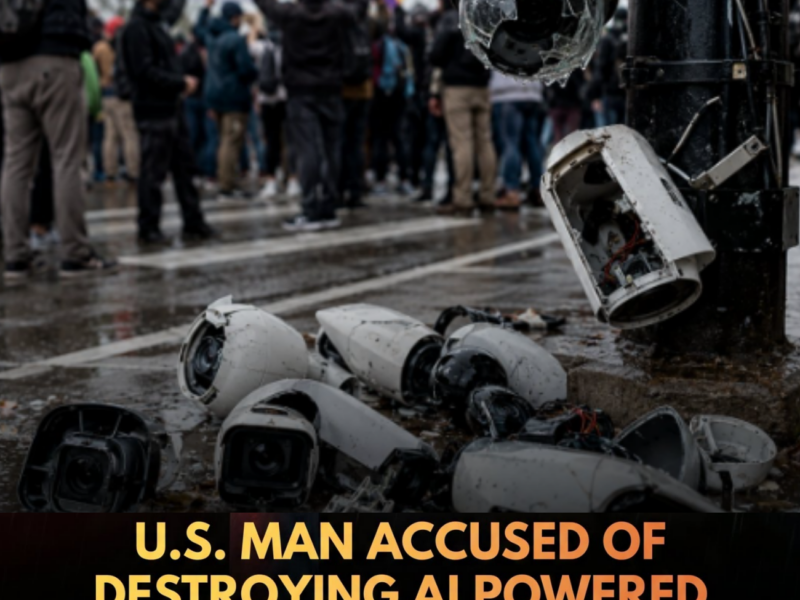
BREAKING: U.S. Man Pleads Not Guilty to Destroying AI-Powered Cameras, Claims Mass Surveillance Violates Fundamental Rights
Man Accused of Taking Down AI-Powered Cameras Fights Charges, Calls Surveillance a Threat to Freedom
THE WAR AGAINST THE WATCHERS: HOW ONE ENGINEER’S ARREST IGNITED AMERICA’S BIGGEST BATTLE OVER AI SURVEILLANCE
The cameras never blink.

Day and night, through rainstorms and heat waves, they stand above American roadsides, mounted on poles and intersections, silently recording the movement of millions of vehicles.
Most drivers never notice them.
Some do.
And a growing number are beginning to ask a question that once belonged only to science fiction:
Who is watching us?
That question now sits at the center of one of the most controversial criminal cases in America.
A Virginia engineer stands accused of dismantling and damaging a network of AI-powered surveillance cameras that law enforcement agencies say help solve crimes and protect communities. Prosecutors describe the alleged acts as deliberate destruction of public-safety infrastructure.
His supporters see something very different.
To them, the case is not simply about damaged equipment.
It is about privacy.
Freedom.
Government power.
And the future of life in a society where artificial intelligence may soon be capable of tracking nearly every movement people make in public.
The defendant, 41-year-old Jeffrey Scott Sovern, has pleaded not guilty to multiple felony charges.
His case has become something larger than a criminal proceeding.
It has become a flashpoint in America’s escalating battle over surveillance.
And depending on who you ask, he is either a vandal—or a warning.
THE DAY THE CAMERAS ARRIVED

The transformation happened gradually.
There was no dramatic announcement.
No nationwide rollout.
No singular moment when Americans collectively agreed to live under constant digital observation.
Instead, the cameras appeared one city at a time.
One county at a time.
One intersection at a time.
Local governments sought tools to combat crime.
Police departments searched for ways to do more with limited resources.
Technology companies offered solutions.
Among the most prominent were automated license plate reader systems powered by artificial intelligence.
The promise sounded compelling.
A vehicle involved in a robbery could be identified within minutes.
A stolen car could be located quickly.
A kidnapping suspect could potentially be tracked across multiple jurisdictions.
The technology seemed capable of turning roads into investigative networks.
Supporters saw innovation.
Critics saw surveillance.
Both sides had reasons for concern.
THE RISE OF THE DIGITAL EYE

The new generation of camera systems differed dramatically from traditional security cameras.
Older systems generally recorded footage that had to be reviewed manually.
AI-powered systems could do much more.
They could identify license plates.
Recognize vehicle makes and models.
Categorize colors.
Log travel patterns.
Store data.
Search databases.
And provide information rapidly to investigators.
To supporters, these capabilities represented a revolution in crime fighting.
To opponents, they represented something equally revolutionary—and potentially dangerous.
For the first time, technology made it possible to create detailed records of people’s movements at an unprecedented scale.
The implications were profound.
Not because citizens were doing anything wrong.
But because the collection itself raised difficult questions.
Who controls the data?
How long is it stored?
Who can access it?
What safeguards exist?
And what happens when technology advances faster than the laws governing it?
THE ALLEGATIONS
According to prosecutors, Sovern allegedly targeted multiple AI-powered license plate reader cameras over several months.
Authorities claim the devices were systematically damaged or dismantled.
Investigators eventually connected the incidents and built a criminal case.
The allegations resulted in numerous felony charges.
Officials viewed the matter as straightforward.
Public infrastructure had allegedly been damaged.
Taxpayer-funded equipment had allegedly been destroyed.
Law enforcement resources had allegedly been disrupted.
From that perspective, the case appeared simple.
But public reaction was anything but simple.
A DIFFERENT NARRATIVE EMERGES
Almost immediately, the case became intertwined with a broader political and philosophical debate.
Supporters of Sovern argued that the cameras represented a growing surveillance apparatus that most citizens never explicitly approved.
They questioned whether ordinary Americans understood how extensively modern monitoring systems could track public activity.
Some described the technology as a step toward a future in which every movement could be cataloged and analyzed.
Others argued that constitutional protections were struggling to keep pace with technological change.
Civil-liberties advocates pointed to historical examples where surveillance powers expanded beyond their original purpose.
Their concerns were not necessarily about any single camera.
They were about scale.
A camera on one corner may seem harmless.
Thousands of interconnected cameras linked to powerful databases present a different question entirely.
THE PROMISE OF SECURITY
Law-enforcement officials see the issue differently.
For them, surveillance technology is not an abstract philosophical concern.
It is a practical tool.
Police departments routinely point to cases involving missing children, violent crimes, stolen vehicles, and fleeing suspects.
Investigators often face enormous challenges gathering evidence.
Technology can help close those gaps.
Supporters argue that AI-assisted systems allow officers to work more efficiently and solve crimes more quickly.
In that view, surveillance technology is not about monitoring innocent people.
It is about identifying dangerous individuals.
The distinction matters.
Yet it does not fully resolve the debate.
Because the same system capable of locating a dangerous suspect may also record millions of law-abiding citizens.
And that reality sits at the heart of the controversy.
THE CONSTITUTIONAL QUESTION
American history is filled with tensions between liberty and security.
The nation’s founders understood that government power can protect freedom.
They also understood that government power can threaten it.
That tension has never disappeared.
It merely changes form.
In previous generations, debates centered on wiretaps.
Telephone records.
Mail inspections.
National-security programs.
Today, artificial intelligence has become the newest battleground.
Legal scholars continue debating how constitutional principles apply to modern surveillance technologies.
Some court decisions have suggested limits on extensive long-term tracking.
Others have left significant questions unresolved.
The result is uncertainty.
Technology races ahead.
The law follows behind.
And society finds itself navigating territory few previous generations could have imagined.
AN AMERICA THAT IS ALWAYS RECORDING
The surveillance debate extends far beyond license plate readers.
Smartphones track locations.
Retailers collect consumer data.
Vehicles generate digital information.
Online platforms monitor user behavior.
Modern life leaves digital footprints everywhere.
For many Americans, the realization can be unsettling.
The average person may encounter dozens—or even hundreds—of data-collection systems in a single day without consciously noticing them.
This reality fuels growing concerns among privacy advocates.
If surveillance becomes ubiquitous, does society gradually accept monitoring as normal?
And if it becomes normal, where does it stop?
These questions are no longer theoretical.
They are becoming central to public policy discussions nationwide.
THE HUMAN DIMENSION
Lost amid the legal arguments and political debates is a human story.
Communities genuinely want safety.
Parents want children protected.
Victims want crimes solved.
At the same time, citizens value privacy.
They value autonomy.
They value freedom from unnecessary monitoring.
These desires are not contradictory.
They are both deeply American.
The challenge lies in balancing them.
Technology has made that balance more difficult than ever.
What happens when the tools that increase security also increase observation?
What happens when efficiency collides with privacy?
What happens when artificial intelligence gains the ability to connect countless data points into detailed behavioral patterns?
Those questions are no longer hypothetical.
They are unfolding now.
THE FUTURE IS ARRIVING FAST
Artificial intelligence is advancing at extraordinary speed.
Systems that seemed impossible a decade ago now operate routinely.
Facial recognition continues improving.
Predictive analytics grow more sophisticated.
Data processing becomes cheaper and faster.
The surveillance capabilities of tomorrow may dwarf those of today.
That prospect excites some experts.
It alarms others.
Both reactions are understandable.
Technology itself is neither inherently good nor inherently bad.
Its impact depends largely on how it is used.
And who controls it.
THE TRIAL BEYOND THE COURTROOM
Ultimately, the criminal case against Sovern will be decided through the legal system.
Evidence will be presented.
Arguments will be made.
Courts will determine the outcome.
But another trial is already underway.
A public trial.
A cultural trial.
A national trial over the meaning of privacy in the age of artificial intelligence.
The verdict in that broader debate remains far from settled.
Some Americans believe surveillance technology is an essential defense against modern crime.
Others fear it could gradually transform society in ways that are difficult to reverse.
Most citizens likely fall somewhere in between.
They want safety.
They want privacy.
They want both.
Whether that balance can be maintained may become one of the defining questions of the twenty-first century.
THE QUESTION NO ONE CAN ESCAPE
As AI-powered cameras continue spreading across highways, neighborhoods, parking lots, and city streets, one reality becomes increasingly difficult to ignore.
The technology is here.
The debate is not about whether surveillance exists.
It is about how much society is willing to accept.
The engineer standing trial in Virginia may ultimately be remembered for the specific allegations against him.
Or he may be remembered as a symbol of a much larger conflict.
A conflict between innovation and restraint.
Between security and liberty.
Between convenience and privacy.
The cameras continue watching.
The databases continue growing.
The technology continues advancing.
And across America, millions of citizens are beginning to ask a question that may define the future:
In a world where artificial intelligence can see almost everything, who decides what should remain unseen?
That question will outlast any single court case.
And the answer may shape the country for generations to come.