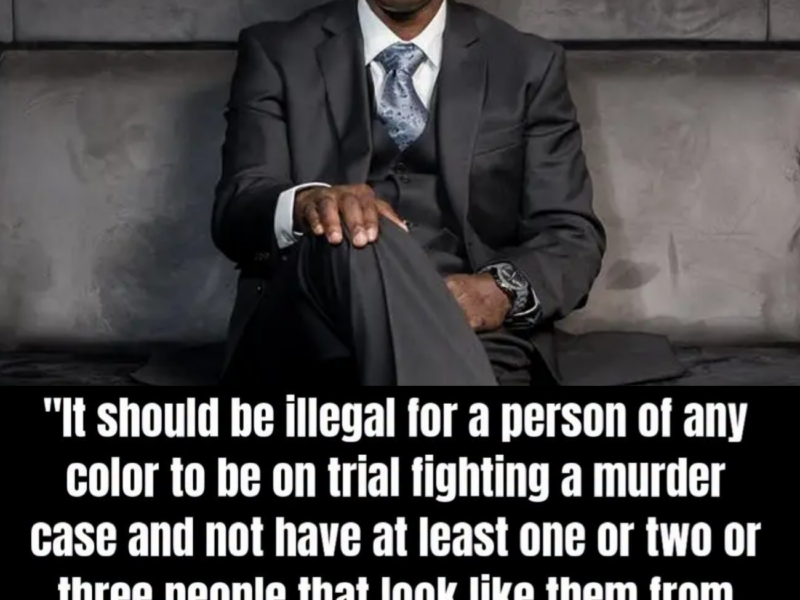
BREAKING: Willie D Ignites Firestorm With Controversial Claim About Race and Jury Composition in Murder Trials
Rapper Willie D Sparks Debate With Controversial Comments on Jury Diversity in Murder Trials
“Who Sits in Judgment: Inside America’s Endless Debate Over the Jury Box”

It began, as so many modern controversies do, with a single line — sharp, absolute, and impossible to ignore.
“It should be illegal for a person of any color to be on trial fighting a murder case and not have at least one or two or three people that look like them from their ethnicity judging them.”
The statement, attributed to rapper Willie D, spread quickly across social media feeds, comment sections, and talk radio segments where legal philosophy is often reduced to blunt instinct and lived experience. Some saw it as a raw expression of frustration with a justice system still struggling with representation. Others heard something more troubling: a suggestion that justice itself should be filtered through racial identity.
But beneath the outrage cycle — predictable, fast-moving, and often shallow — the quote touched something deeper and more structurally complicated in American law: the uneasy relationship between race, representation, and the idea of impartial justice.
To understand why a single sentence could ignite such a response, one has to step back from the noise and enter the architecture of the system itself.
The Jury Box as America’s Most Fragile Ideal
In theory, the American jury system is one of the most democratic institutions in the country.
Twelve citizens. Ordinary people. Peers of the accused. A verdict reached not by a judge alone, nor by the state in abstraction, but by a cross-section of the community.
It is a system built on a powerful assumption: that a group of strangers, if sufficiently diverse and properly instructed, can rise above personal bias and deliver a fair judgment.
But in practice, that assumption has always been under pressure.
From its earliest days, the American jury box did not reflect the full population of the country it was meant to represent. For long stretches of history, Black Americans, women, Indigenous people, and other groups were excluded entirely or effectively marginalized through legal mechanisms that shaped who could serve and who could not.
Even after formal exclusion ended, the question of representation did not disappear. It simply became more subtle, embedded in processes like jury selection, peremptory strikes, and the demographics of voter registration lists that feed jury pools.
And so, when someone speaks about who sits on a jury — and who does not — they are not speaking in abstraction. They are touching a long-running national tension between legal equality and social reality.
A System Built on Neutrality, Tested by Identity
American courtroom procedure is designed around one central promise: neutrality.
Judges instruct jurors to set aside personal experience, emotion, and identity. The law is supposed to be applied equally regardless of who stands in the jury box.
But critics of the system have long pointed out that neutrality is not the same as absence of perspective.
Every juror arrives with a worldview shaped by lived experience — including, but not limited to, race, class, geography, and exposure to law enforcement. Those perspectives inevitably shape how evidence is interpreted, even when jurors are instructed not to let them.
This is where the tension becomes difficult to ignore.
On one hand, the legal system insists that justice must be blind. On the other, society increasingly recognizes that “blindness” can sometimes obscure meaningful differences in how people experience authority, policing, and criminal accusation.
The question raised by Willie D’s statement — whether implicitly or explicitly — is whether representation in the jury box functions as a safeguard against bias or a form of bias itself.
And the answer, in legal scholarship, is anything but simple.
The Reality Behind Representation
Empirical studies of jury composition have long shown disparities between courtroom demographics and the communities they serve. In many jurisdictions, jury pools do not reflect the racial composition of defendants or the broader population.
This mismatch can occur for multiple reasons: differences in voter registration rates, eligibility rules, economic hardship exemptions, and systemic patterns that affect who gets summoned and who actually shows up for service.

Legal scholars have debated whether these disparities affect outcomes. Some research suggests that jury diversity can influence deliberations, particularly in cases involving contested narratives or subjective interpretations of intent. Other studies emphasize that the justice system already includes safeguards designed to minimize individual bias, regardless of composition.
Still, the perception of imbalance alone can have profound consequences.
A defendant who does not see themselves reflected in the jury box may feel the system is distant or unresponsive to their lived reality. Conversely, critics argue that explicitly prioritizing identity in jury composition risks undermining the principle that jurors are meant to be impartial arbiters, not representatives of identity groups.
It is within this tension that the quote lands with force — not as legal doctrine, but as cultural provocation.
When Frustration Meets Constitutional Boundaries
What makes the statement particularly explosive in a legal context is its framing: “It should be illegal…”
In the American constitutional system, jury composition is governed by principles that prohibit systematic exclusion of groups. The Supreme Court has repeatedly ruled that defendants are entitled to juries drawn from a fair cross-section of the community.
But the law stops short of requiring that any specific demographic be present on any individual jury. Instead, it focuses on process, not outcome — fairness in selection procedures rather than guaranteed representation in each case.
This distinction is crucial.
To require that juries contain members of a defendant’s specific racial or ethnic background would fundamentally reshape the logic of the jury system. It would shift the focus from impartiality across a population to representational matching in individual cases — a model closer to political representation than legal adjudication.
Legal scholars note that such a shift would raise immediate constitutional questions, particularly around equal protection and the prohibition of racial classification by the state in judicial processes.
But constitutional law is only one layer of the issue. The deeper conflict is philosophical.
Because underneath the legal arguments lies a more emotional question: what does fairness feel like?
The Emotional Core of the Debate
For many people, abstract legal fairness is not enough. Trust in institutions is shaped not only by rules, but by perception.
If a defendant feels that no one in the room understands their background, their neighborhood, or their experiences with law enforcement, the sense of alienation can be profound.
This is part of what makes conversations about jury composition so volatile. They are not just about law — they are about belonging.
And belonging, unlike legal procedure, cannot be standardized.
It varies from person to person, from case to case, from courtroom to courtroom.
The quote attributed to Willie D distills that emotional reality into a single demand: representation as a condition of legitimacy.
But in doing so, it collides directly with the legal system’s insistence that legitimacy comes from process, not identity.