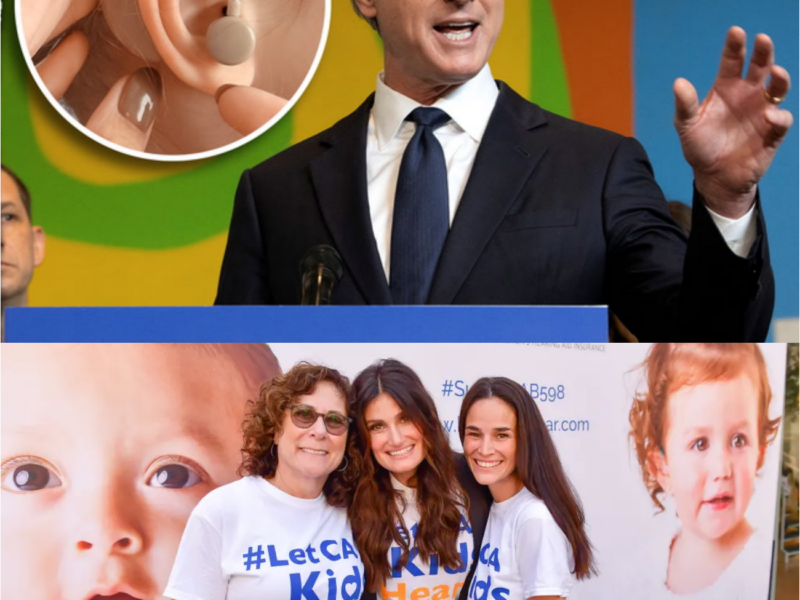
Gavin Newsom Unveils $23 Million Program to Help Children Access Hearing Aids Across California
Gavin Newsom Unveils $23 Million Program to Help Children Access Hearing Aids Across California
$23 Million for 300 Hearing Aids: How California’s Ambitious Program Became a Public Scandal

When Governor Gavin Newsom unveiled a bold initiative to provide hearing aids for children across California, it was hailed as a milestone in public health. In 2018, the state announced a $23 million program aimed at ensuring that every child with hearing loss could access the technology they needed to thrive. The promise was simple: no child should fall behind in school or social development because they could not hear.
Five years later, reality paints a starkly different picture. Official records reveal that only 300 hearing aids have been distributed through the program. At retail prices averaging $1,400 per device, that’s a total of $420,000 worth of hearing aids—less than 2% of the program’s budget. The remaining $22.5 million? Labeled broadly as “administrative and overhead costs.”
The Vision vs. The Outcome
The original vision was ambitious. Pediatric hearing aids are often prohibitively expensive for families, with some devices costing several thousand dollars. Advocates argued that a state-run program would level the playing field, especially in communities where private insurance coverage was inconsistent or nonexistent.
Instead of mandating private insurers to cover these essential devices—a step that could have reached thousands of children immediately—Newsom’s administration opted for a government-led approach. Lawmakers were convinced that a centralized system could provide efficiency, equity, and oversight. On paper, it seemed like a win-win: the state would pool resources, negotiate better prices, and distribute devices directly to families in need.
But behind the promise lurked logistical hurdles that would soon derail the initiative.

A Start Shrouded in Hurdles
The program’s rollout was slow. Initial bureaucratic steps required counties to apply for funding, submit implementation plans, and coordinate with audiologists and schools. Providers faced strict documentation requirements, and families reported waiting months just to determine eligibility.
By 2020, critics were raising alarms. The number of devices distributed remained in the low hundreds, and internal audits suggested that significant portions of the budget were being siphoned into administrative layers rather than reaching children. State officials defended the spending, citing the costs of staffing, outreach, logistics, and regulatory compliance.
Yet for many families, the difference between promise and reality was painfully clear. Children with hearing impairments continued to struggle in classrooms, some missing critical early intervention windows. The human cost, advocates say, is immeasurable.
The Numbers That Shock
At $23 million for 300 hearing aids, the math is impossible to ignore. Each device effectively cost $76,666 from the state’s perspective—more than 50 times its market value. Even accounting for overhead, training, and logistical support, such a figure suggests severe inefficiency.
Compare this to a retail purchase: $1,400 per hearing aid, totaling $420,000. The difference—$22.58 million—was absorbed by program administration. While overhead is a legitimate expense in any government initiative, the scale here raises urgent questions.
Where exactly did the money go? How many staff were hired, and what were their roles? Why was a state-run program chosen over insurance mandates that could have distributed devices immediately at far lower cost?

Political Choices and Controversy
Critics argue that Newsom’s political calculus played a role. By creating a state-led program, the administration could claim credit for addressing a pressing social need. Insurance mandates, while potentially more efficient, might have faced stiff lobbying opposition from private companies and complicated legislative negotiations.
Some policy analysts suggest that the program’s failure reflects a broader issue in California politics: large-scale public initiatives often prioritize optics over outcomes. Programs are announced with fanfare, yet the mechanisms for execution are underfunded, understaffed, or structurally mismanaged.
The hearing aid initiative is not just a cautionary tale of administrative inefficiency; it is a stark illustration of how political ambitions can misalign with practical realities, leaving vulnerable populations to bear the consequences.
Families Left Behind
For the families directly affected, the program’s shortcomings are personal and profound. Parents recount struggling to secure devices on their own, navigating complex insurance claims or paying out of pocket. Some children have experienced delays in speech development, academic setbacks, and social isolation—all preventable with timely access to hearing aids.
One parent described the frustration of waiting for months, only to receive a single device at the end of the process. “We were promised support,” the parent said. “Instead, we got bureaucracy. And our child fell further behind.”
Accountability and Oversight
Calls for accountability have intensified. Legislators and watchdog groups are demanding audits, transparency in spending, and reforms to ensure that state programs deliver measurable results. Some propose shifting to hybrid models that combine state oversight with private insurance coverage to balance efficiency and equity.
Yet despite the outcry, the program continues largely unchanged. State officials maintain that the administrative infrastructure is necessary for long-term sustainability, citing complex eligibility criteria, ongoing maintenance, and the need for trained audiologists.
Lessons for the Future
The California hearing aid program underscores a critical lesson for policymakers nationwide: the best intentions do not guarantee effective outcomes. Ambitious programs require careful planning, accountability mechanisms, and a realistic appraisal of costs versus benefits.
When public dollars are involved, transparency is not optional—it is essential. Families, taxpayers, and children’s futures depend on it. Programs that misallocate millions risk eroding trust, exacerbating inequality, and inflicting preventable harm.
Conclusion
Governor Newsom’s $23 million initiative began as a promise to ensure that no child in California would suffer due to lack of access to hearing aids. Yet, five years in, the stark reality is that only 300 children have received the devices, at a cost vastly exceeding market rates. The discrepancy between spending and delivery has ignited a debate over administrative efficiency, political priorities, and the true cost of state-run programs.
For the families waiting for support, the human toll is already evident. For taxpayers, the financial inefficiency is undeniable. And for policymakers, the story is a warning: ambitious plans must be matched by meticulous execution, or the cost of good intentions can become devastatingly high.