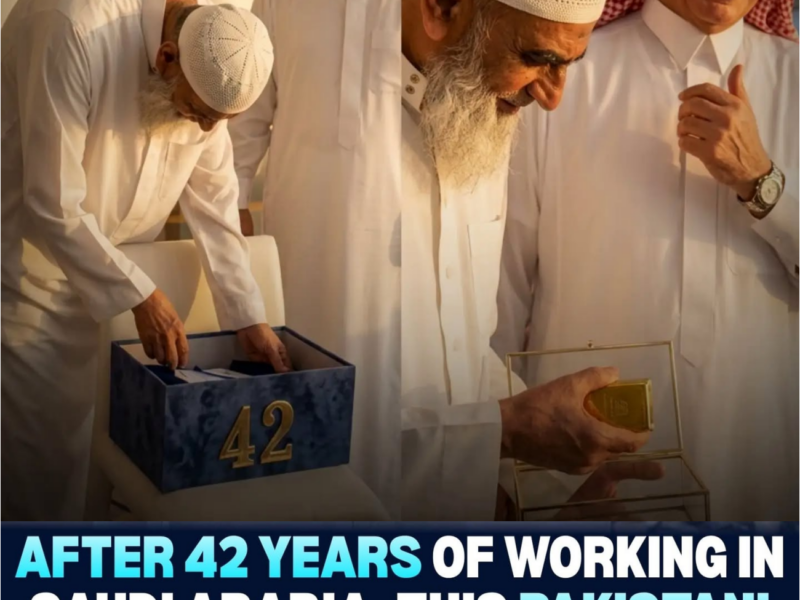
He Dedicated 42 Years to One Company—His Retirement Gift Was a Custom Gold Bar Worth $53,000
After 42 Years of Dedicated Service, Pakistani Employee Receives a $53,000 Custom Gold Bar as a Final Tribute to His Loyalty
The Currency of Commitment: Redefining Loyalty in a Transient World
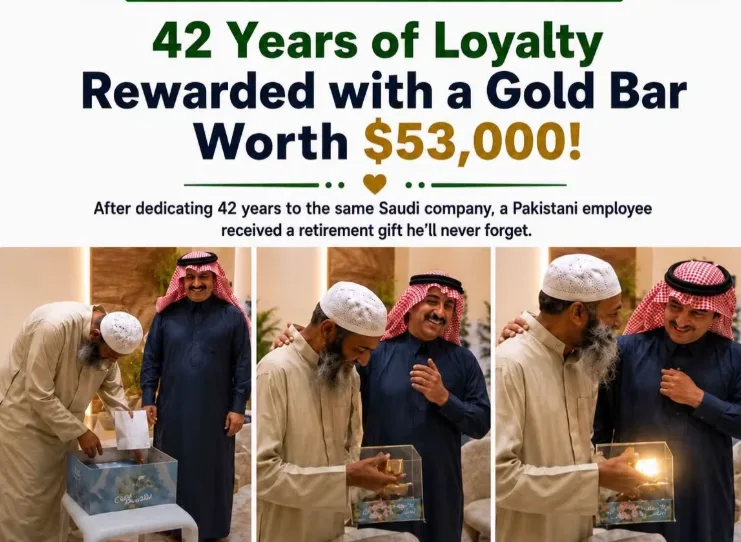
In the modern American workplace, the concept of a “career” has undergone a radical transformation. Gone are the days of the “company man” who spent four decades with a single firm, rising through the ranks while cultivating a relationship with their employer that resembled a marriage. Today, we live in the era of the “gig,” the lateral move, and the constant pursuit of the next best offer. Loyalty, in the eyes of many, has become an outdated currency, replaced by the cold, calculating metrics of quarterly performance and professional portability.
Yet, in March 2020, a story emerged from Saudi Arabia that punctured the bubble of our contemporary cynicism. An unnamed Pakistani employee, upon retiring after forty-two years of service to the company Al-Fanar, was presented with a custom-engraved gold bar valued at $53,000. While the monetary value was staggering, the true weight of the gift lay in the designation bestowed upon him by the company’s CEO: he was a “Golden Man.”
This story is not merely about a generous retirement gift. It is a profound meditation on the dignity of labor, the endurance of human connection, and the fading art of honoring the long-term commitment. For American readers navigating a landscape defined by transience, this event serves as a mirror, asking us to confront the value of our own dedication and the cost of a culture that often views people as replaceable assets.
The Longevity of Purpose
Forty-two years is not just a duration; it is an epoch. To work for one company for four decades is to witness the rise and fall of technologies, the shifting tides of industries, and the evolution of a nation. This Pakistani employee did not just “hold a job”; he lived a mission. He spent his life contributing to the industrial growth of a nation that was not his home, embedding himself into the foundation of Al-Fanar’s success.
In America, we are conditioned to view such longevity with a mix of awe and skepticism. We wonder: Did he get bored? Was he held back? Why didn’t he jump for a higher salary? But these questions reveal our own obsession with individual accumulation rather than collective contribution. The “Golden Man” understood something that we are increasingly losing: that there is a unique, quiet heroism in staying the course.
There is a profound satisfaction in mastering a role, in being the person who knows where the pipes are laid, how the machine hums, and why the history of the company matters. This is the bedrock of institutional memory. When we lose this kind of long-term dedication, we lose the internal rhythm of our organizations.
The Gold and the Message
It is easy to focus on the $53,000 gold bar. It is a tangible, flashy number that grabs our attention. But the gift was a vessel for a much more important message. By engraving the gold and labeling him a “Golden Man,” the company was doing something radical: they were validating his entire life’s work.
Too often, corporate recognition is performative—a plastic plaque on a wall, a generic email from HR, or a milestone reached with the cold efficiency of a spreadsheet. But when a company honors an employee with such profound intentionality, they are engaging in a sacred act of gratitude. They are acknowledging that the employee’s sacrifices—the missed family dinners, the long hours, the physical toll of labor—were not just “inputs” for a profit margin. They were the very fabric from which the company’s success was woven.
For the American workforce, where employees often feel like cogs in a massive, unfeeling machine, this highlights a critical deficit. Gratitude is the most undervalued management tool in our society. It costs nothing to truly see a person’s contributions, yet it is the rarest commodity in the corporate world.
The Cultural Mirror: What We Owe Each Other
This story offers a compelling contrast to the American “hustle culture.” In our country, we are told that the only way to be “successful” is to constantly reinvent ourselves. We celebrate the founder, the disrupter, the person who burns through bridges to build a new empire. We rarely celebrate the person who keeps the bridge stable for forty years so that others can cross it.
Saudi Arabia’s approach to this employee reminds us that the health of a nation and its industries depends on the invisible labor of those who build, maintain, and sustain. When an organization honors a long-term employee with such reverence, it does more than make one person feel appreciated; it signals to every other employee that they are valued as human beings, not just as human capital.
It poses an uncomfortable question to American CEOs and managers: If your most loyal employee retired tomorrow, would they be remembered for their contribution, or would they simply be replaced by an automated process or a cheaper hire? The “Golden Man” incident suggests that loyalty is not just a duty of the employee; it is a sacred trust held by the employer.
The Dignity of the “Golden Man”
There is a powerful humility in the figure of the Pakistani worker. He likely did not spend his forty-two years seeking the spotlight. He likely showed up, did the work, faced the challenges of a desert climate and a foreign land, and continued to serve. His story reminds us that greatness is often found in the mundane—in the persistent, quiet, and reliable performance of one’s duties.
In a culture that screams for attention, the “Golden Man” invites us to lower our voices and look for the value in consistency. We have a tendency to confuse fame with merit and volume with influence. But real influence is the person who remains standing when the storms of industry have passed.
The Evolution of Generosity
Generosity is often thought of as an act of charity, but here it was an act of justice. It was a rectification of a balance sheet that usually ignores the “human cost” of business. By giving him a gold bar, the company was essentially saying, “We know we cannot pay you for the time you gave us, because time is the only thing that cannot be bought. But we will provide you with a token that honors the impossibility of that transaction.”
This is a lesson for our own professional lives. We should strive to work for organizations that understand the weight of our years, and as leaders, we must foster environments where people feel seen. If we want a culture of loyalty, we must first be a culture of gratitude. We cannot expect people to give us their best years if we do not, in turn, give them our best respect.
Conclusion: A New Standard of Recognition
The story of the Al-Fanar retirement ceremony is a gentle, yet firm, challenge to the American status quo. It is not suggesting that we all work for one company until we die, nor is it suggesting that the only measure of a career is its length. Instead, it invites us to reconsider the human element in the professional relationship.
We are entering a future where machines and artificial intelligence will take over more of the labor we once performed. In such a world, the unique human capacity for loyalty, institutional memory, and dedication will become even more precious. We should stop treating these traits as remnants of a bygone era and start treating them as the most valuable assets we possess.
The $53,000 gold bar was a beautiful gift, but the true prize was the recognition that the man’s life mattered. Every American deserves to work in an environment where their forty-two years—or even their four—are viewed not as a commodity, but as a “golden” contribution.

If we choose to honor loyalty with the same intensity that we currently honor innovation and disruption, we might find that we build not just better companies, but a better, more humane society. The “Golden Man” has set the bar high, and it is a bar that every organization should strive to reach. It is time to stop taking the dedication of others for granted and start recognizing that the most valuable thing an employee gives their company is not their labor—it is their life.
How can we as individuals and as a society cultivate more genuine gratitude in the workplace to ensure that no one’s years of hard work go unnoticed?