
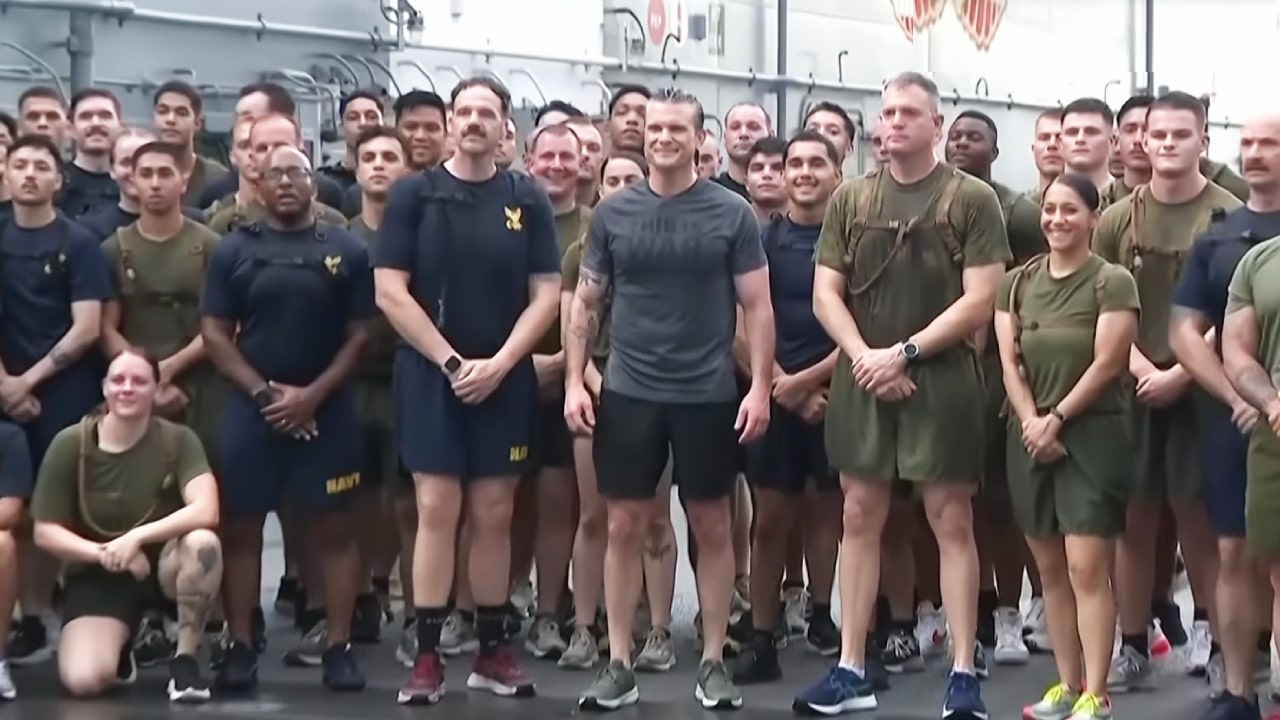
Hegseth’s Navy Publicity Stunt Sparks Ridicule and Social Media Backlash
Hegseth Under Fire After Navy Stunt Triggers Mockery Across the Internet
The Erasure of Merit: How Pete Hegseth’s “War on Warriors” is Decimating the U.S. Navy
By Global Investigative Desk

The United States military has long been the gold standard of meritocratic achievement. From the halls of the Naval Academy to the command centers of the Pacific, the doctrine has been simple: the best rise to the top, regardless of background. But in the spring of 2026, that doctrine is facing an existential threat. Defense Secretary Pete Hegseth, a man who styles himself the “Secretary of War,” has engaged in a systematic overhaul of the senior officer corps—a process that critics argue is effectively hollowing out the U.S. Navy in favor of political optics.
The Midnight Scrub
The most recent chapter in this saga unfolded in late May 2026, when news broke that Hegseth had personally intervened in a promotion list intended to elevate 22 officers to the rank of one-star admiral. According to sources close to the matter, Hegseth stripped nine officers from the list, including women and Black service members, replacing them with a selection that left the final slate exclusively male and overwhelmingly white.
The fallout was immediate. Navy officials, who had spent months vetting these candidates through rigorous, peer-reviewed boards, were left in the dark. There was no explanation, no justification, and no recourse. One official familiar with the process noted that Hegseth appeared to have “favorite MOS’s,” but that his real focus was race and gender. It was, in the words of a Pentagon insider, “felt loud and clear.”
A Pattern of Purges

This was not an isolated incident. Since his confirmation, Hegseth has fired or sidelined nearly three dozen senior officers. The list of those removed reads like a “who’s who” of military leadership: the first woman to lead the U.S. Naval Academy, Admiral Yvette Davids; the U.S. military representative to the NATO military committee, Vice Admiral Shoshana Chatfield; and even the Chief of Naval Operations, Admiral Lisa Franchetti.
For Hegseth, this is the fulfillment of a long-standing public promise. He has frequently railed against what he calls “so-called firsts,” arguing that diversity, equity, and inclusion (DEI) initiatives have corrupted the military’s fighting spirit. But the cost of this “war on DEI” is high. By overriding the professional judgment of career admirals, Hegseth is stripping autonomy from the service secretaries and creating a top-down culture of fear.
Legislative Blowback
The reaction from Congress has been swift and severe. Senator Jack Reed, the Ranking Member of the Senate Armed Services Committee, has openly condemned the actions as “unlawful and corrosive.” In a blistering statement, Reed noted that these officers were selected based on performance, not quotas. “Women and minorities make up fewer than twenty percent of the general officer corps, yet they account for nearly sixty percent of those Secretary Hegseth has fired or sidelined,” Reed noted. “That disparity does not happen by accident.”
The legal arguments are mounting. Under U.S. law, only the President has the authority to remove an officer from a promotion list—a power Hegseth has effectively usurped. This creates a constitutional tension that could, in the coming months, lead to a massive legal showdown over the limits of executive power within the Pentagon.
Future Scenarios: The “Hegseth Effect”

What happens to the Navy when its most experienced leaders are replaced by those whose primary qualification is loyalty to a political ideology?
The Erosion of Institutional Knowledge: The dismissal of nearly three dozen senior leaders creates a massive “brain drain” that cannot be filled overnight. Naval warfare requires decades of experience, and the loss of this mentorship layer will likely result in decreased operational readiness for years to come.
Recruitment Crisis: If the military is viewed as an institution where career advancement is based on arbitrary, opaque, or racially biased criteria, the pipeline of talent will dry up. Why would the best and brightest join a force that systematically purges them based on demographic checkboxes?
The Balkanization of the Pentagon: As Hegseth continues to force his will upon the services, we may see an unprecedented rift between the civilian political leadership and the uniformed military. If morale collapses, the very discipline that the U.S. military relies upon to function could be compromised.
Conclusion: A Military in Flux
Pete Hegseth’s tenure as Defense Secretary will be remembered as the era when the civilian oversight of the military moved from policy-setting to active ideological engineering. By turning the promotion of admirals into a battlefield for the culture wars, Hegseth has not only alienated the leadership of the U.S. Navy but has also cast a shadow over the future of the entire armed forces.
Whether this is a “necessary restructuring” as the administration claims, or a “betrayal of the meritocracy” as critics argue, the result is the same: the U.S. military is fundamentally changing. And as the world watches the growing tensions in the Indo-Pacific, the question of whether the Navy is being strengthened—or weakened—by these changes is one that every American should be asking.