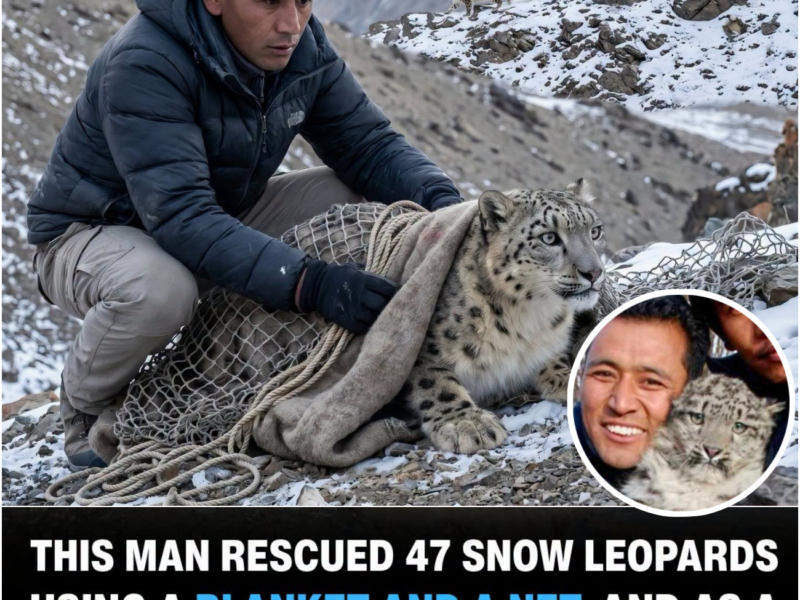
One Man Rescued 47 Snow Leopards Using Only a Blanket and a Net—And Helped Their Population Grow by 62%
He Saved 47 Snow Leopards With Just a Blanket and a Net—Then Their Population Began to Rise
The Guardian of the Ghost: Khenrab Phuntsog and the Art of Human-Wildlife Coexistence
In the rugged, high-altitude desert of Ladakh, India, where the air is thin and the terrain is carved from ancient, jagged stone, there exists a creature known as the “Ghost of the Mountains.” The snow leopard—elusive, camouflaged in slate-grey fur and patterned rosettes, and possessing an almost supernatural ability to traverse vertical cliffs—has long been a symbol of the wild. But for the people of Hemis National Park, this “ghost” was often a terrifyingly tangible reality: a predator that could strike at a village’s livestock, their primary source of wealth and survival.
For decades, the standard response to this conflict was grim: retaliation. When a leopard entered a corral, it often met a lethal end. Yet, in the village of Chilling, a man named Khenrab Phuntsog began to rewrite this script. Armed with nothing more than a blanket, a net, and an profound, intuitive understanding of the animal, Phuntsog has spent over twenty years mediating the friction between humanity and the wild. By rescuing 47 snow leopards, he hasn’t just saved individuals; he has catalyzed a 62% increase in the regional population, offering the world a masterclass in what grassroots conservation can actually achieve.
The Geography of Conflict
To understand the magnitude of Khenrab Phuntsog’s work, one must understand the environment. Hemis National Park is not a managed enclosure; it is a sprawling, harsh ecosystem where the boundaries between “civilization” and “wilderness” are functionally non-existent. When a snow leopard wanders into a village corral, it is not a “wild” animal invading a city; it is an animal seeking sustenance in its ancestral home, a home that now happens to contain the humans’ livelihood.
In many parts of the world, conservation efforts are defined by top-down bureaucracy—fenced-off parks, digital tracking, and heavy-handed enforcement. But in Ladakh, these methods are largely impractical. The mountains are too vast, the terrain too treacherous, and the local communities too dependent on their livestock to be managed by distant policy. The solution could not be imposed from the outside; it had to emerge from within.
The Tools of the Trade: Patience and Presence
The image of Khenrab Phuntsog using a blanket and a net to capture one of the world’s most formidable predators is a powerful one. It defies the modern American expectation of high-tech conservation, which often relies on sedation darts, GPS collars, and helicopter sorties. Khenrab’s method is radical precisely because it is so low-tech.
It relies on three things: deep observation, absolute stillness, and an acute understanding of the leopard’s psychology. A snow leopard in a confined, human space is not just dangerous; it is terrified. A panicked predator is a lethal one. Khenrab’s success comes from his ability to project a calm that the animal can sense. By using a blanket to obscure the leopard’s vision and a net to restrict its movement, he minimizes the trauma for the animal and the risk to himself.
This is conservation as an art form. It requires the ability to read the twitch of a tail, the dilation of an eye, and the subtle shifts in the leopard’s posture. It is a dialogue between human and beast, carried out in the silent, freezing dark of a mountain corral.
Trust: The Hidden Infrastructure of Conservation
Khenrab’s most important tool, however, is not the blanket or the net—it is his reputation. In Chilling village, Khenrab is not an outsider; he is a neighbor. When he arrives to help a villager who has just lost a sheep, he is not lecturing them on the intrinsic value of biodiversity; he is addressing the immediate, painful loss of their property.
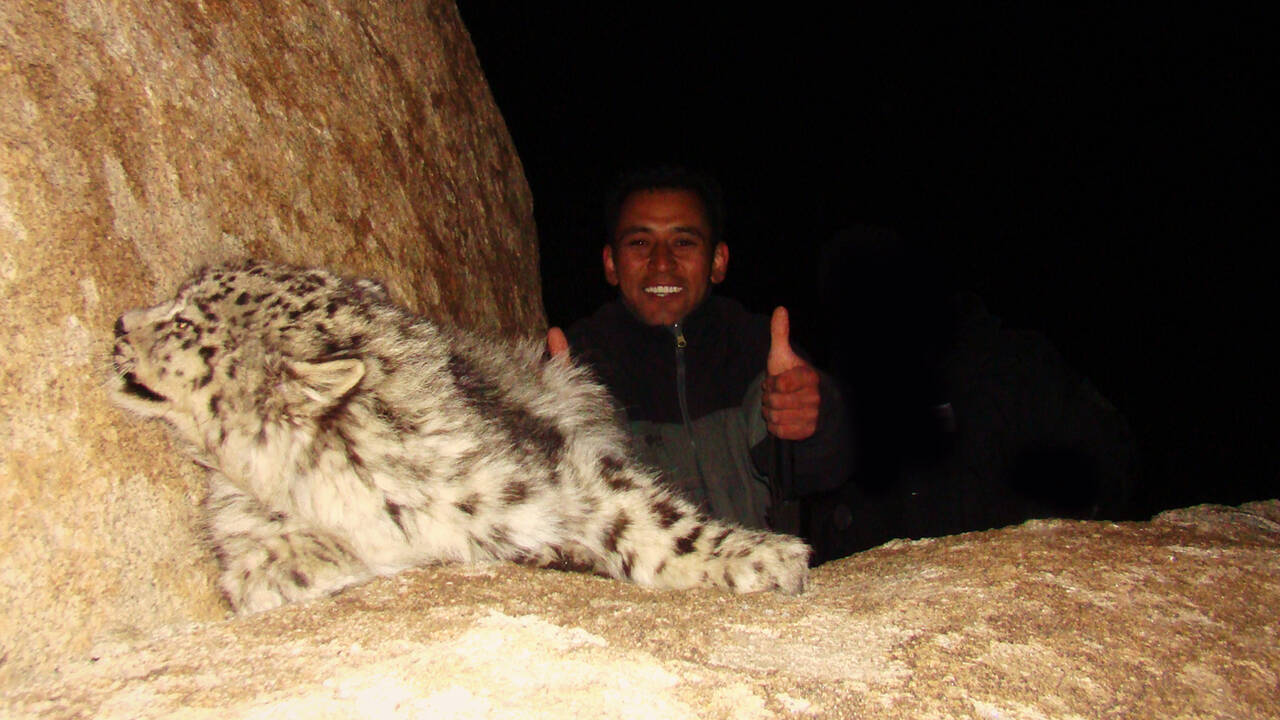
This is the “secret sauce” of his success. By providing a safe, reliable way to remove the predator without killing it, Khenrab allows the villagers to keep their moral and social dignity. He transforms them from “victims of a predator” into “participants in a conservation effort.” He gives the community a stake in the survival of the leopard.
This approach is profoundly appealing to American readers because it reflects the best of our own community-based values. We recognize that top-down edicts often breed resentment, whereas community leadership fosters pride. Khenrab has successfully turned the snow leopard from a liability into a point of regional pride.
A Legacy of Growth: The 62% Shift
The fact that the snow leopard population in the region increased by 62% is a statistical miracle. In the world of conservation, where we are accustomed to reports of decline and extinction, this number stands out as a beacon of what is possible. It proves that the “threat” of the predator is, in fact, manageable—and that our fear is often a greater threat to the animal than the animal is to us.
Khenrab Phuntsog’s work demonstrates that conservation is not a zero-sum game. The humans and the leopards do not have to exist in a state of perpetual war. Through thoughtful management, through immediate response, and through the cultivation of local trust, we can create space for both.
Why Khenrab’s Model Matters to the World
In the United States, we are currently grappling with our own coexistence challenges—wolves in the Rockies, bears in the suburbs, and the general sprawl of human development into wild spaces. We often look for technical fixes, expensive solutions, or legislative compromises. Khenrab’s story is a reminder that sometimes the solution is simply to have a person, trusted by their community, who is willing to walk toward the challenge when everyone else is pulling away.
His work is a testament to the idea that conservation is a human endeavor. It is not just about the species; it is about the people who live alongside them. If we can empower local leaders, honor local knowledge, and provide the infrastructure for coexistence, the “ghosts” of our mountains, forests, and plains can survive and thrive.
Conclusion: Walking Toward the Ghost

Khenrab Phuntsog’s life is a masterclass in courage. It is not the courage of a superhero, but the quiet, persistent courage of someone who understands the stakes and chooses to act. When he approaches a trapped, snarling leopard, he is not just saving an animal; he is protecting the future of his people and the integrity of the ecosystem that sustains them all.
For the American reader, Khenrab is an inspiration. He reminds us that even when the scale of a problem feels overwhelming, the solution often starts with one person. It starts with a simple, deliberate act. It starts with a blanket, a net, and a willingness to step into the dark.
The snow leopard remains a vulnerable symbol of a world that is losing its wildness. But as long as there are people like Khenrab Phuntsog—people who operate with trust, local wisdom, and an unyielding commitment to coexistence—there is hope. The “Ghost of the Mountains” is not fading away; under the watchful, capable care of its local guardian, it is once again beginning to roam free.