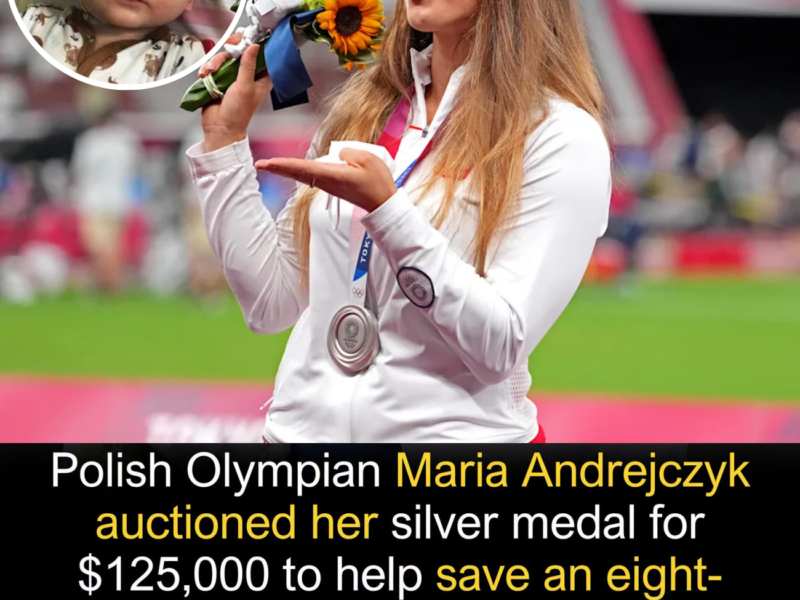
Polish Olympian Auctioned Her Silver Medal to Help Save a Baby’s Life—The Winning Bidder Paid $125,000 and Returned the Medal to Her
Polish Olympian Auctioned Her Silver Medal to Save a Baby’s Life—Then the Winning Bidder Gave It Back
The Silver Medal She Refused to Keep: How a Polish Olympian Turned Her Greatest Triumph Into a Baby’s Chance to Live

For most athletes, an Olympic medal is not just metal. It is proof. It is the answer to years of pain, sacrifice, discipline, failure, recovery, and private doubt. It is the object placed around the neck after a lifetime of mornings when the body hurts, evenings when friends are out celebrating, and lonely training sessions when nobody is watching. It is the dream made visible.
For Maria Andrejczyk, the silver medal she won in the javelin throw at the Tokyo Olympics should have been the reward for everything she had survived.
She had come within a heartbreaking two centimeters of an Olympic medal in 2016. She had faced illness. She had endured the physical and emotional toll of bone cancer. She had returned to competition not as a symbol, not as a headline, but as an athlete still hungry to prove that her story was not finished.
Then, in Tokyo, under the lights of the Olympic stage, she finally did it.
Silver.
One throw, one podium, one medal.
A lifetime condensed into a shining object small enough to fit in her hand.
But only days after reaching the kind of achievement most athletes spend their lives chasing, Andrejczyk looked at that medal and saw something different. She saw not only her own victory, but a chance to help someone else keep living.
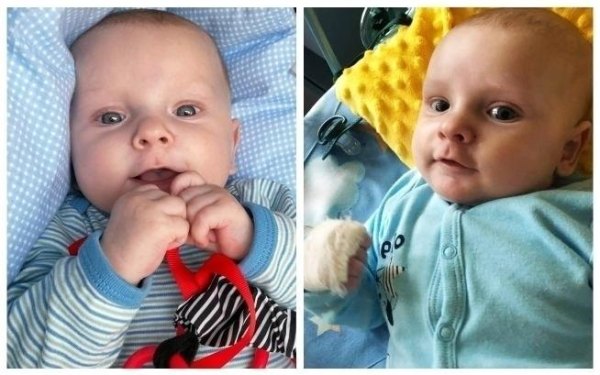
An infant named Miłoszek Małysa needed urgent heart surgery. His family was racing against time. The cost of treatment was overwhelming. The stakes were unbearable. For the child’s parents, every day carried the same terrifying question: would they raise enough money before it was too late?
That is when the Polish Olympian made a decision that stunned sports fans, melted hearts across Europe, and captured attention far beyond the world of track and field.
She put her Olympic silver medal up for auction.
Not because she did not love it. Not because it meant nothing to her. But because it meant so much that she believed it could do something greater than sit on a shelf.
The auction drew attention quickly. The story spread because it contained a rare kind of emotional force: a champion giving away the symbol of her greatest achievement so that a baby might have a chance at life. Then came the winning bid.
A Polish convenience store chain, Żabka, offered $125,000.
It was enough to help fund the child’s surgery at Stanford University Medical Center.
Then, in a final twist that transformed an already extraordinary act into something almost cinematic, the company gave the medal back.
They paid the money.
They helped the baby.
And they returned the medal to the woman who had earned it.
In an age when sports headlines are often dominated by scandal, endorsements, controversy, and billion-dollar contracts, Andrejczyk’s story landed like something from another time. It was simple. It was startling. It was human.
A woman won one of the rarest prizes in the world.
Then she tried to give it away.
And because she did, a child’s future became possible.
The story begins, as many Olympic stories do, years before the world ever learns the athlete’s name.
Maria Andrejczyk was not built by a single moment. She was shaped by repetition, injury, disappointment, and resilience. Javelin throw is one of those Olympic events that can seem deceptively simple to a casual viewer. An athlete runs, plants, twists, and launches a spear-shaped object into the air. The crowd watches it arc and fall. A number appears on the screen.
But behind that motion lies an unforgiving blend of strength, speed, timing, technique, and courage. The throw lasts only seconds, but the body remembers every hour that prepared it. The shoulder must be powerful but controlled. The legs must drive forward without collapsing. The release must be nearly perfect. Too early, and the javelin dies. Too late, and the throw is wasted. A tiny miscalculation can separate glory from obscurity.
In 2016, at the Rio Olympics, Andrejczyk came painfully close to a medal. Two centimeters.
Two centimeters is less than an inch.
In everyday life, it is nothing. It is the width of a coin, the thickness of a small object on a table, the difference most people would never notice.
In the Olympics, it can be the distance between standing on the podium and walking away with the ache of almost.

For an athlete, “almost” is one of the cruelest words in sport. It does not erase the achievement. It does not mean failure. But it lingers. It whispers. It returns during training, during recovery, during sleepless nights. It asks what could have been different. One better step. One sharper release. One cleaner motion. Two centimeters.
Andrejczyk left Rio without a medal, but not without a reason to continue. For some athletes, a near miss is devastating enough to break them. For others, it becomes fuel.
Her path, however, would not be a straight line back to the Olympic stage. Life had something more frightening than athletic disappointment waiting for her.
She later faced bone cancer, the kind of diagnosis that can change the meaning of every goal overnight. Suddenly, medals and rankings and competitions are no longer the only measurements that matter. The body that once existed as an instrument of sport becomes a place of uncertainty. Doctors, tests, treatment, waiting — these become part of the athlete’s world.
For fans, elite athletes often seem almost superhuman. They are faster, stronger, more precise. They perform under pressure and withstand pain most people would not choose. But illness strips away the illusion of invincibility. It reminds the world that even the strongest bodies are fragile. Even champions face fear.
Andrejczyk recovered. That fact alone would have made her return to sport remarkable. But returning was not enough. She kept reaching.
By the time she arrived in Tokyo for the postponed Olympic Games, she carried more than a javelin. She carried Rio. She carried illness. She carried every unseen moment when the journey could have ended quietly, without medals, without headlines, without applause.
Then came the throw that changed everything.
When she won silver, it was not merely an athletic result. It was a vindication. It was a comeback written in metal. The medal was hers — her first and only Olympic medal, the proof of a dream that had refused to die.
For many Olympians, the days after winning are a blur of celebration. Interviews. Photos. Calls from family. Messages from strangers. Sponsors. National attention. The medal travels everywhere. It is held, photographed, kissed, shown to children, passed carefully between relatives. It becomes an heirloom before it has even had time to gather dust.
But Andrejczyk did not allow herself to see the medal only as a private treasure.
Around the same time, the story of little Miłoszek Małysa reached her. He was an infant in need of heart surgery. His family was seeking help to pay for treatment abroad at Stanford University Medical Center, a place associated with advanced care but also with costs that can seem impossible for ordinary families.
For the parents of a critically ill child, fundraising is not abstract. It is not a campaign in the usual sense. It is panic organized into action. It is hope measured in donations. It is the unbearable task of asking strangers to help save the person you love most in the world.
There are few fears more primal than a parent watching a child need medical help they cannot afford alone. The family must become public at the most vulnerable moment of their lives. They must tell the world about their child’s condition, share photos, explain the costs, and hope that the compassion of strangers will move faster than time.
Andrejczyk saw that need and made a choice.
She could have donated money. She could have posted a message. She could have used her platform to encourage others to give. Any of those actions would have been generous.
Instead, she chose the one object that represented the highest achievement of her career.
The silver medal.
It is difficult to overstate what that meant.
An Olympic medal is not replaceable. It cannot be bought in a store. It cannot be ordered again if lost. It is not jewelry, not a trophy from a local event, not a plaque from a banquet. It is an artifact of history, tied to a specific athlete, a specific event, a specific moment in front of the world.
For Andrejczyk, it was also the medal she had nearly missed years earlier, then fought back through illness to win. It was the medal that proved she had endured. It was not one among many. It was the one.
And she was willing to let it go.

That decision carried a kind of moral drama that immediately captured attention. The public loves stories of generosity, but this was generosity with visible sacrifice. People could understand the stakes because the symbol was so clear. A medal is easy to see. A child’s medical bill is harder to imagine. By linking the two, Andrejczyk made the invisible urgent.
The auction became more than a sale. It became a test of what people value.
How much is a medal worth?
To a collector, it might be worth money.
To an athlete, it might be priceless.
To a desperate family, it might become a bridge between fear and possibility.
And to Andrejczyk, its value would be defined not by silver, not by sport, but by what it could do.
Her decision also challenged one of the most familiar myths of athletic achievement: that winning is the highest goal. Olympic coverage often teaches audiences to worship the podium. Gold, silver, bronze. National anthems. Flags. Tears. The medal is treated as the final answer, the sacred object at the end of the quest.
But Andrejczyk’s act suggested that the medal was not the end of the story. It was a beginning.
It was a tool.
It was leverage.
It was a way to turn personal glory into collective action.
For readers in the United States, where medical fundraising has become a painful and familiar feature of modern life, the story struck an especially powerful chord. Americans know the sight of families raising money for treatment. They know the pages, the campaigns, the viral posts, the desperate captions. They know how quickly health can become a financial emergency.
But this story came with a twist that seemed almost unbelievable: an Olympic athlete, just days removed from the podium, putting her medal on the line for a baby she did not know in the way family knows a child.
That is why the story traveled. It was not just about sports. It was about sacrifice. It was about what a person does when she has every reason to hold tightly to something and chooses, instead, to open her hand.
As the auction gained momentum, public attention intensified. People watched not only because they wanted the child to receive help, but because they wanted to know who would step forward. Would an individual collector buy the medal? Would a wealthy donor appear? Would the auction reach the amount needed?
Behind the uplifting headlines was a quieter tension. Fundraising for medical treatment is often a race against time, and stories like Miłoszek’s do not pause for sentiment. Awareness matters only if it becomes action. Sympathy matters only if it turns into money, logistics, treatment, and care.
Then Żabka entered the story.
The Polish convenience store chain submitted the winning bid of $125,000. In doing so, it pushed the fundraiser toward its life-saving purpose. The amount was not symbolic. It was practical. It was money that could help move a child closer to surgery.
For a corporate bidder, the moment carried public relations value, certainly. But the company’s next decision changed the nature of the story. Żabka did not keep the medal.
They returned it.
That final act created the kind of ending that feels almost scripted because it satisfies two emotional truths at once. The child received help, and the athlete did not have to lose the medal that embodied her life’s work.
The company’s message was clear through its action: the medal belonged with the champion. The money belonged with the mission.
Andrejczyk’s silver had done its job.

The result was a rare public moment in which everyone seemed to gain something meaningful. The baby’s family received critical support. The company became part of a widely admired act of generosity. The athlete kept the medal she had earned. And the public was reminded that human decency can still break through the noise.
But to understand why this story mattered so deeply, one must return to the symbolism of the medal itself.
Olympic medals are strange objects. Their material value is often far less than their emotional value. The metal can be weighed, measured, appraised. But the story cannot. A medal contains years of unseen labor. It contains the athlete’s family, coaches, injuries, losses, sacrifices, doubts, and private rituals. It contains the country that watched. It contains the child the athlete once was, dreaming of a future that seemed impossibly far away.
For Andrejczyk, the medal also contained survival.
When she spoke of it as a symbol of struggle, faith, and pursuing dreams despite adversity, she was not using empty motivational language. Her life had given those words weight. Struggle was not a brand. Faith was not a slogan. Adversity was not a dramatic caption. She had lived the distance between heartbreak and recovery, between illness and the Olympic podium.
That is why the auction was not a rejection of the medal. It was perhaps the deepest possible affirmation of its meaning.
If the medal represented overcoming, then using it to help a sick child was not a contradiction. It was an extension of the same idea. A symbol of survival was being used in the service of another survival.
The story also complicates the way we think about heroism.
In sports, heroism is usually measured in performance. The winning shot. The final sprint. The record-breaking throw. The comeback victory. Fans celebrate athletes because they do something extraordinary with their bodies under pressure.
But Andrejczyk’s most widely remembered act may not be the throw that won silver. It may be what she did after the competition ended.
That is a different kind of heroism. It does not happen in a stadium. It does not come with a scoreboard. It asks not, “How far can you throw?” but “What are you willing to give?”
The answer, in her case, was startling.

She was willing to give the one thing everyone expected her to keep forever.
There is also a sharp contrast between the public image of modern sport and the moral clarity of this event. Today’s elite athletics exists inside a massive commercial machine. The Olympics themselves are surrounded by sponsorships, broadcast rights, branding, national investment, and political complexity. Athletes become marketable stories. Their wins become content. Their emotions become clips. Their medals become images shared millions of times.
Yet here was an athlete cutting through all of that with a simple proposition: this medal can help save a baby.
No slogan could improve that. No marketing campaign could make it more powerful.
The power came from the risk of loss.
Had Żabka not returned the medal, Andrejczyk would have had to live with the consequences of her decision. She appeared prepared to do that. That is what made the story so moving. The happy ending was not guaranteed when she made the choice. She did not auction the medal knowing for certain it would come back. She acted before the twist.
That matters.
Generosity is easy when it costs nothing. It becomes something else when the cost is real.
The public reaction reflected that. People were astonished not only because she helped, but because she helped in a way that hurt. Or at least, in a way that could have hurt. She put something irreplaceable at stake.
In that sense, the returned medal did not erase the sacrifice. It illuminated it. The fact that she got it back does not mean she had not been willing to lose it. The willingness remains the moral center of the story.
For Miłoszek’s family, the medal’s journey was not symbolic in the same way. It was tied to survival. A child’s medical crisis narrows the world. Parents are not thinking in inspirational headlines. They are thinking about doctors, dates, flights, treatment plans, and whether their baby will get the chance to grow up.
The intervention of a public figure can change everything in such a campaign. Andrejczyk brought attention. The auction brought urgency. Żabka’s bid brought money. Together, they transformed a private nightmare into a national act of care.
That is one of the hidden truths of viral generosity: attention can become infrastructure. A story, when amplified, can move resources. It can connect strangers who would otherwise never meet. It can make one family’s emergency visible to thousands or millions.
But viral attention is unpredictable. Many families ask for help. Not all are heard. Not all campaigns break through. Not all stories find an Olympic medal at the center.
This is part of what makes the Andrejczyk story both beautiful and unsettling. Beautiful because it shows what is possible when compassion moves quickly. Unsettling because it reminds us that life-saving care can depend on extraordinary acts, public visibility, and the luck of being noticed.
Still, within that uncomfortable reality, her choice stands as a bright example of agency. She could not fix every medical crisis. She could not save every child. But she could do something for this child. She could use what she had.
That lesson is deceptively simple.
People often imagine generosity as something reserved for the wealthy or powerful. Andrejczyk had something rare, but it was not money in the ordinary sense. It was a symbol. She recognized that the symbol could be converted into help. She saw value not as something to possess, but something to activate.
In American terms, the story has the shape of a classic human-interest feature: the champion, the child, the impossible choice, the unexpected corporate gesture, the emotional return. It is easy to imagine it as a film scene. The athlete looks at the medal. The parents look at the medical bills. The auction clock ticks. The winning bid arrives. Then the twist: the medal is coming home.
But real life rarely arranges itself so neatly. That is why, when it does, people pay attention.
The suspense of the story lies not in whether Andrejczyk valued the medal. She clearly did. The suspense lies in whether the world would honor the spirit of her sacrifice.
Żabka did.
By returning the medal, the company completed the circle. It allowed the object to carry both meanings forever. Before the auction, the medal meant Olympic achievement. During the auction, it became a fundraising instrument. After its return, it became something even larger: proof that generosity can multiply.
Now, whenever Andrejczyk looks at the medal, she does not see only Tokyo. She sees Miłoszek. She sees the auction. She sees the moment her achievement left her hands and came back changed.
The medal is no longer just a record of where she stood on the Olympic podium. It is a record of what she chose to do after stepping down from it.
That is the part of the story that endures.
Athletes often speak of legacy, though legacy is a difficult thing to control. Records are broken. Medals are counted and compared. New stars emerge. Yesterday’s champions become names in archives.
But acts of character have a different lifespan. They are retold because they answer a question people keep asking in every generation: what does greatness look like?
Sometimes it looks like winning.
Sometimes it looks like letting go.
For Andrejczyk, greatness looked like understanding that the medal’s “true value” was not locked inside the object itself. Its value came from what it could make possible for another person.
That idea runs against much of modern culture, which teaches possession as proof of success. We are told to collect, display, protect, and monetize achievements. We are told that what we earn is ours, and that giving it up is loss.
But the Polish Olympian revealed another possibility: that an achievement can become more meaningful when shared, and that a prize can become more powerful when it is placed in service of someone else’s need.
The shock of the story comes from how rare that feels.
Many people say they would help if they could. Andrejczyk could, and she did. Many companies say they care about community. Żabka had the opportunity to prove it, and the company did so in a way the public could understand immediately. Many sports stories claim to be inspiring. This one did not need to claim anything. It simply was.
There is a reason people respond so strongly to stories involving children, illness, and sacrifice. They cut through cynicism. They force a confrontation with vulnerability. A baby cannot negotiate, strategize, or advocate in the adult sense. A baby depends entirely on others. When a child’s life is at risk, the moral stakes become painfully clear.
And there is a reason the Olympic medal mattered as the object at the center. If Andrejczyk had auctioned a signed shirt, the story would still have been kind. If she had donated prize money, it would still have been generous. But the medal made the sacrifice visible in a way nothing else could.
A medal is the thing athletes are supposed to keep.
That is why giving it up felt almost shocking.
It broke the expected script.
The expected script says: win, celebrate, cherish, protect.
Andrejczyk wrote a different one: win, notice, act, give.
Then Żabka added the final line: return.
The resulting story feels almost too clean for a world that often is not. Yet perhaps that is why it continues to resonate. It gives people an example of a public act that did not collapse into bitterness or controversy. It offers a moment where generosity was met with generosity, where sacrifice was honored rather than exploited.
Still, it would be a mistake to turn Andrejczyk into a flawless symbol rather than a real person. The power of her choice comes precisely from her humanity. She was not giving away something meaningless. She was not above attachment. She had every reason to want that medal near her for the rest of her life.
The medal represented her struggle against physical limits, her faith during uncertainty, and her dream after adversity. It represented the athlete who missed by two centimeters and returned. It represented the survivor who reached the podium.
To risk losing such an object required emotional courage.
And emotional courage is often quieter than athletic courage. It does not roar. It does not always look dramatic from the outside. It may look like a decision made in private, a message posted online, an auction created, a medal placed before the public with a purpose attached.
But that quiet courage can reshape lives.
Somewhere beyond the headlines was a family that could breathe differently because strangers responded. Somewhere, a child’s name became known to people who would never meet him. Somewhere, an Olympic medal became part of a medical journey.
And somewhere, a champion learned that the object she had earned could come back to her carrying more meaning than when it left.
That is the strange miracle of this story. The medal returned physically unchanged. It was still silver. It was still the Tokyo Olympic medal. It still belonged to Maria Andrejczyk.
And yet it was not the same medal anymore.
Objects absorb stories. A wedding ring is more than metal because of the vows attached to it. A flag is more than fabric because of the history people see in it. A medal is more than silver because of the struggle behind it.
After the auction, Andrejczyk’s medal carried another layer. It became connected to a baby’s fight, a family’s hope, a company’s gesture, and a public reminder that achievement can be transformed into service.
That transformation is what makes the story unforgettable.
In the years ahead, people may forget the exact distance of Andrejczyk’s throw. They may forget the competition details or the order of finishers. But many will remember the Olympian who auctioned her medal to help save a baby’s life — and the company that bought it only to give it back.
That is how legends are sometimes made, not through dominance, but through grace.
The most compelling stories in sports usually turn on a moment of pressure. A final shot. A last lap. A decisive throw. For Andrejczyk, the defining pressure came after the stadium lights faded. It came when she had to decide what her medal was for.
Was it a possession?
A memory?
A symbol?
A treasure?
Or could it become a lifeline?
She chose the lifeline.
In doing so, she reminded the world that the highest form of victory may not be standing above others on a podium. It may be using that moment of elevation to lift someone else.
That is why the story traveled across borders. It did not require fluency in Polish. It did not require knowledge of javelin throw. It did not even require deep familiarity with the Olympics. Anyone could understand the essential facts.
A woman won a medal.
A baby needed help.
She gave what she had.
A company stepped forward.
The medal came home.
And for once, the ending did not feel smaller than the act. It felt worthy of it.
There are many ways to measure an Olympic medal. Weight. Design. Market value. Historical significance. But Maria Andrejczyk found another measure: the life it might help change.
That measure cannot be displayed in a medal count. It cannot be ranked by country. It cannot be reduced to gold, silver, or bronze.
It belongs to a different category of achievement, one that sits beyond sport and closer to the heart of what people mean when they use words like honor.
The image is powerful: an athlete holding a medal that nearly left her forever, knowing it had traveled through an act of mercy and returned as something larger than an award. It is no longer only a reminder of how far she threw a javelin in Tokyo. It is a reminder of how far compassion can travel when someone is willing to release what the world tells them to keep.
In a culture hungry for heroes but quick to doubt them, Maria Andrejczyk offered a story that was difficult to dismiss. She did not merely speak about values. She converted her greatest athletic prize into action. She made sacrifice visible. She made generosity measurable. She made hope practical.
And when the medal came back, it did not weaken the story’s impact. It deepened it.
Because the real gift was never the silver itself.
The real gift was the willingness to let it go.
For Maria Andrejczyk, the Tokyo medal will always be a symbol of struggle, faith, and pursuing dreams despite adversity. But now it is also something else. It is a symbol of a moment when one person’s triumph became another family’s hope, when a company chose compassion over possession, and when the world was reminded that even in an age of noise, spectacle, and cynicism, a single act of selflessness can still stop people cold.
She had spent her life trying to win that medal.
Then she proved she was strong enough to give it away.
And because she did, the silver around her neck became worth far more than any auction price could ever show.