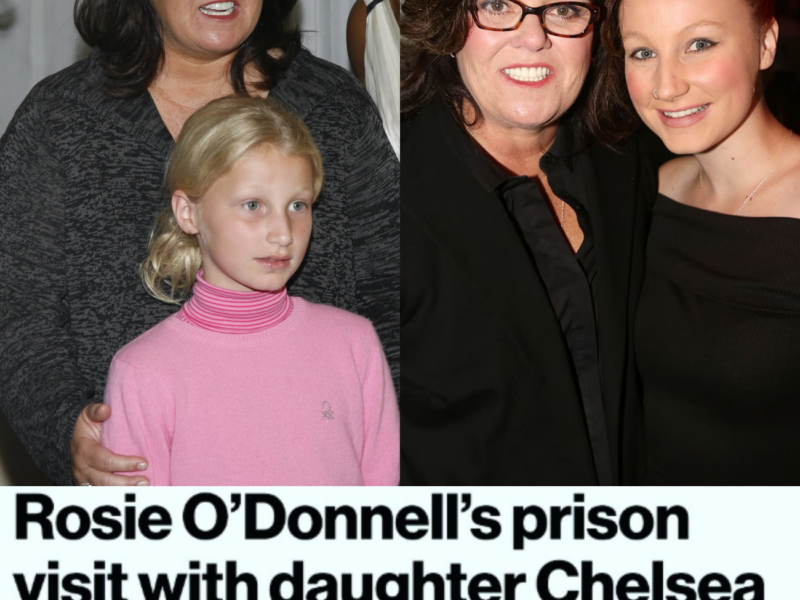
Rosie O’Donnell Reunites With Daughter Chelsea During Emotional Prison Visit After 10 Years of Silence
Rosie O’Donnell’s Emotional Prison Reunion With Daughter Chelsea Marked Their First Meaningful Conversation in 10 Years
Four Hours Behind Prison Walls: Rosie O’Donnell and the Daughter She Feared She Had Lost

The rules were delivered before mother and daughter were allowed to sit together.
One embrace at the beginning. One embrace at the end. No money could change hands. Their hands had to remain visible above the table. Their voices could not become too loud.
For Rosie O’Donnell, the instructions marked the beginning of a visit she had imagined in different forms for nearly a decade—but probably never in this setting.
On one side of the room sat a nationally recognized comedian, actor and former daytime television host whose career had unfolded under the glare of American celebrity culture. On the other sat Chelsea, her eldest daughter, now 28, incarcerated after years of personal turmoil, legal problems, addiction and estrangement from her famous mother.
Between them was not simply a prison table.
It was ten years of fractured conversations, public conflict, private disappointment and the kind of silence that can settle over a family until everyone involved begins to wonder whether it will ever be broken.
O’Donnell entered the prison not knowing what version of her daughter she would encounter. She did not know whether Chelsea would be guarded, angry, emotionally absent or unwilling to talk. Their relationship had deteriorated so severely that, according to O’Donnell, they had not shared a meaningful conversation lasting longer than 25 minutes in an entire decade.
Then the two women sat down.
They talked.
And they kept talking.
The visit lasted four hours.
For O’Donnell, it was the first time in years that Chelsea seemed consistently present—not merely physically in the same room, but emotionally engaged in a conversation that neither of them abruptly abandoned.
The reunion did not erase their past. It did not resolve Chelsea’s legal troubles. It did not magically transform a complicated mother-daughter relationship into an uncomplicated one.
But it offered something that had been absent for years: time.

Four uninterrupted hours behind prison walls became the unlikely setting for what may have been the most important conversation of their adult lives.
“It was the first conversation I’ve had with her in 10 years that lasted more than 25 minutes,” O’Donnell told Page Six while describing the reunion.
For a woman who had spent decades making audiences laugh, the story she told was not built around a punchline.
It was about a mother watching carefully for signs that the daughter she remembered might still be reachable.
It was about a daughter confronting the consequences of a turbulent decade.
And it was about a moment that arrived only after nearly everything else had failed.
A Visit Interrupted
The conversation might have continued longer.
Then came a tornado warning.
The visit was cut short as the facility responded to the possible danger. The carefully controlled reunion, already restricted by prison regulations, ended before Chelsea was ready.
According to O’Donnell, Chelsea cried.
That reaction startled her mother.
O’Donnell had spent years trying to understand Chelsea’s behavior, often experiencing her daughter as distant or emotionally unreachable. She had seen anger and resistance. She had witnessed chaos and withdrawal. But during the prison visit, when Chelsea became visibly upset that their time together had ended, O’Donnell saw something different.
She described it as an empathetic emotion—an indication that Chelsea cared about the connection they had just reestablished and understood the emotional meaning of its sudden interruption.
“That’s the first time I’ve seen, kind of, an empathetic emotion from her,” O’Donnell said.
The statement was hopeful, but it also revealed how deep the estrangement had become.
Most parents would not ordinarily view their adult child crying at the end of a visit as a breakthrough. For O’Donnell, however, Chelsea’s tears seemed to confirm that the four-hour conversation had mattered to both of them.
Chelsea did not appear eager to escape the room. She did not treat the meeting as an obligation. She wanted more time.
To O’Donnell, that desire represented growth.
“She’s growing up,” the comedian said. “And I hope that her future is brighter than this past decade has been.”
The remark carried a mother’s optimism, but it was tempered by hard-earned caution. O’Donnell was not announcing a perfect reconciliation. She was describing a fragile opening.
The difference mattered.

Families fractured by addiction, legal trouble and long-term estrangement rarely repair themselves through a single dramatic reunion. Progress tends to arrive unevenly. One conversation can be followed by silence. One apology can uncover another wound. Hope can coexist with fear, and love can survive even when trust has been damaged almost beyond recognition.
O’Donnell appeared to understand that.
Her words were not those of a mother claiming that everything had been fixed.
They were the words of someone who had finally seen evidence that repair might be possible.
The Daughter Behind the Headlines
Chelsea’s life has often entered public view through moments of crisis.
That visibility is partly the result of having a famous parent. Problems that might remain private in another family can become entertainment news, court coverage and social media debate when they involve a well-known television personality.
But behind the headlines is an adult woman whose troubles have been serious and consequential.
In February 2025, Chelsea appeared in court facing charges that included felony bail jumping, resisting or obstructing an officer, possession of methamphetamine and child neglect. She was sentenced to six years of probation and warned that incarceration remained a possibility if she failed to follow the conditions imposed by the court.
The warning became reality later that year.
In October, her probation was revoked, and she was sentenced to jail.
For O’Donnell, the incarceration was another painful turn in a relationship already shaped by years of instability. Yet it also created the controlled circumstances in which mother and daughter were finally able to remain in one place and speak for hours.
The irony was difficult to ignore.
Freedom had not brought them together.
Confinement did.
In the outside world, either woman could end a conversation. A phone call could be disconnected. A meeting could collapse. Old resentments could take control before the discussion had time to deepen.
Inside prison, the structure was different. There was a table, a set of rules and a defined period during which mother and daughter had almost nothing to do but face each other.
O’Donnell later transformed the experience into a poem.
“The guard explained the rules,” she wrote. “A hug hello and goodbye only / No money exchanged / Hands above the table / No loud voices.”
The language was spare, almost procedural, reflecting the cold orderliness of a prison visit. Yet beneath those rules was an intensely emotional encounter.
O’Donnell wrote that her heart skipped a beat when she saw Chelsea. She thought her daughter looked good. More importantly, she perceived what she described as a healthy calm.
For a family accustomed to uncertainty, calm itself could feel shocking.
It was not the dramatic kind of transformation often portrayed in films, where a troubled character suddenly appears redeemed and everyone instantly understands that the crisis is over.
It was quieter.
Chelsea sat across from her mother and remained engaged.
She talked.
She listened.
She appeared stable enough for the two women to move beyond a few tense minutes and into a sustained exchange.
That may sound ordinary. In their history, it was anything but ordinary.
The Limits of a Mother’s Love
O’Donnell has spoken candidly about the assumptions she carried into motherhood.
When she adopted Chelsea, she believed love might be powerful enough to overcome almost anything.
It is an idea deeply rooted in American culture: the devoted parent rescues the vulnerable child; a stable home repairs early suffering; affection conquers trauma; family devotion provides the cure.
O’Donnell now sounds less certain.
She has said Chelsea was “born addicted,” a description O’Donnell connected to her daughter’s lifelong struggles. At the time of the adoption, she believed love could heal every wound.
Years later, she has questioned that belief.
“When I was adopting, I thought, ‘Well, love can cure everything,’” O’Donnell said. “But I don’t know that that’s true.”
The admission is painful because it challenges one of the central promises parents often make to themselves: that if they love their children enough, sacrifice enough and remain present enough, they can protect them from catastrophe.
But addiction does not follow the emotional logic of a family story.
Neither does trauma.
Neither does mental or behavioral instability.
A parent can offer resources, affection, shelter and opportunities, yet still be unable to control the decisions of an adult child. That powerlessness can be especially brutal for someone accustomed to solving problems.
O’Donnell built a career through confidence, quickness and command. She could control the rhythm of an interview, shift the energy of a television studio and communicate directly with millions of viewers.
With Chelsea, celebrity offered no authority.
Fame could not force recovery.
Money could not guarantee stability.
Public influence could not create private trust.
Even love—abundant, persistent and painful—could not operate as a cure.
The prison visit appears to have helped O’Donnell recognize a more complicated version of hope.
Perhaps love does not cure everything.
Perhaps its role is not to erase consequences or repair another person by force.
Perhaps love is what remains available when the cure never arrives in the form a parent imagined.
It is the decision to show up, even after years of disappointment.
It is the willingness to sit at a prison table.
It is the ability to recognize a small sign of emotional growth without pretending that it resolves the larger crisis.
It is one hug at the beginning and another at the end.
Nearly Two Years of Sobriety
Amid the legal trouble, O’Donnell emphasized one development she considers significant: Chelsea has reportedly been sober for almost two years.
For the family, that period of sobriety represents more than a number. It is evidence of endurance through a chapter that has included court appearances, probation and incarceration.
Sobriety does not eliminate legal consequences. It does not restore lost years or automatically repair family relationships. It does not guarantee what will happen after release.
But it may help explain the calm O’Donnell believed she saw during the prison visit.
For years, addiction had been one of the forces separating mother and daughter. It could distort communication, intensify conflict and create an endless cycle of promises, crises, fear and disappointment.
Now O’Donnell says Chelsea is sober.
The reunion gave her the opportunity to encounter her daughter in that condition for an extended period of time.
The four-hour visit was therefore not merely their longest proper conversation in ten years. It may also have been one of the first sustained opportunities O’Donnell had to speak with Chelsea without active substance use dominating the encounter.
That distinction could explain why the conversation felt so different.
O’Donnell’s remarks suggested that she was not only listening to Chelsea’s words. She was studying her presence.
Did she seem attentive?
Did she show concern?
Could she reflect on the past?
Could she tolerate difficult emotions without withdrawing or lashing out?
When the tornado warning ended the visit and Chelsea cried, O’Donnell interpreted the reaction as evidence that something inside her daughter had shifted.
To outsiders, that conclusion may appear tentative. To a parent who has watched a child struggle for years, tentative evidence can carry enormous weight.
A single moment can become a landmark.
A calm expression.
A long conversation.
A tear at goodbye.
Ten Years of Distance
Estrangement is rarely created by one event.
It accumulates.
A family argument becomes a lasting grievance. A period of absence creates suspicion. Attempts at reconciliation fail. Private pain becomes public. Both sides begin anticipating disappointment before a conversation even starts.
Eventually, the relationship can become defined less by what is said than by what neither person believes can safely be said.
O’Donnell’s description of the past decade suggests that she and Chelsea had remained connected in some limited fashion, but not in a way that allowed for deep or sustained communication.
They may have exchanged words, but they had not truly talked.
The distinction is important.
A conversation lasting fewer than 25 minutes can remain on the surface. It can be consumed by logistics, defensiveness or conflict. There may be little opportunity to discuss regret, responsibility, childhood, addiction or the future.
Four hours changes the possibilities.
Four hours is long enough for small talk to run out.
It is long enough for silence to become less threatening.
It is long enough for two people to move through anger and reach the complicated material underneath it.
O’Donnell has not publicly disclosed every detail of what was discussed. That privacy may be significant. Although she intends to address their relationship in a future one-woman show, she has also said she wants Chelsea’s input and wants her daughter’s voice represented.
That approach suggests an awareness that their history does not belong to Rosie alone.
For years, Chelsea’s story has often appeared through the perspective of a celebrity mother, legal documents or sensational headlines. O’Donnell now says she wants Chelsea to participate in how the relationship is presented onstage.
“I’ve asked for Chelsea’s input,” she explained.
O’Donnell said she sent the material to her daughter and expressed a desire for Chelsea’s voice to be heard—not simply O’Donnell’s interpretation of what Chelsea might say.
The difference between those two approaches is substantial.
A parent telling a story about an estranged child can easily become the sole narrator, particularly when the parent has a larger public platform. By seeking Chelsea’s involvement, O’Donnell appears to be acknowledging that reconciliation requires more than speaking lovingly about someone.
It requires listening to how that person remembers the same events.
That process may be uncomfortable.
Chelsea’s version may not align with Rosie’s. Her memories may challenge the way O’Donnell has understood their history. She may identify wounds her mother did not recognize or describe choices differently.
But allowing those differences to emerge could be part of the repair.
A relationship cannot be rebuilt if only one person is permitted to define what broke it.
Turning Private Pain Into Theater
O’Donnell has long used personal experience as material.
Her public identity has combined comedy, confession and political commentary. Audiences have known her as a talk-show host, an actor, a mother, an activist and a cultural figure willing to speak openly about subjects many celebrities avoid.
The Chelsea story, however, presents a particularly difficult artistic challenge.
A one-woman show gives the performer control of the stage. She chooses the sequence, the tone and the conclusion. She can shape painful experiences into a coherent narrative.
Real family life is rarely coherent.
There are competing memories, unresolved injuries and people who may not want their most difficult moments transformed into entertainment.
O’Donnell’s decision to ask Chelsea for input therefore may be more than a gesture. It could determine whether the show becomes another source of conflict or an extension of their developing reconciliation.
The project also raises a question at the center of memoir and autobiographical performance: Who owns a family’s pain?
O’Donnell owns her experience of loving, fearing for and becoming estranged from her daughter.
Chelsea owns her experience of being adopted, growing up with a famous mother, struggling with addiction, becoming a mother herself and entering the criminal justice system.
Their stories overlap, but they are not identical.
A thoughtful performance would have to make space for that complexity.
O’Donnell seems to believe Chelsea may now be ready to contribute.
The optimism in that belief is striking. A decade of emotional distance is being reexamined not only through private conversations but through the possibility of collaboration.
The daughter who once seemed unreachable may help shape the story of how mother and daughter lost each other.
And perhaps how they began finding their way back.
A Mother of Five
Chelsea is one of O’Donnell’s five children.
The comedian is also the mother of Parker, 31; Blake, 26; Vivi, 23; and Clay, 13.
That larger family context complicates any account of the estrangement. A crisis involving one child rarely affects only the two people at its center. Siblings observe the conflict. They form their own opinions, carry their own fears and may struggle to understand why one relationship consumes so much emotional energy.
For O’Donnell, motherhood has unfolded across different stages at once.
She has adult children navigating their own lives and a younger child still growing up. She is simultaneously looking backward at decisions made decades ago and forward at the responsibilities that remain.
The prison visit with Chelsea therefore existed within a broader maternal life. O’Donnell was not simply revisiting a failed relationship. She was reconsidering what she once believed about parenting itself.
She had thought love could cure everything.
Now she appears to understand love as something less powerful but perhaps more durable.
Love could not prevent Chelsea’s incarceration.
It could bring Rosie to the prison.
Love could not erase the years when conversations ended quickly.
It could keep Rosie at the table for four hours when a real conversation finally became possible.
Love could not guarantee a bright future.
It could allow a mother to hope for one.
The Public and the Private Rosie
At the same time O’Donnell is confronting this deeply personal chapter, she is preparing another story for the stage.
Her current show, “Common Knowledge,” is set to open on Broadway later this month. The production touches on her childhood, her experiences as a mother and her move to Ireland after Donald Trump returned to office for a second presidential term.
The combination of topics reflects the way O’Donnell’s public and private identities have always intersected.
For her, family life is not entirely separate from politics. Childhood memories shape adult convictions. Motherhood influences decisions about safety and belonging. The political climate becomes part of the environment in which a parent decides where to raise a child.
O’Donnell has said she was not nervous about leaving the United States because she had read Project 2025 and believed its agenda posed a serious danger if implemented successfully.
“I knew the best thing for me to do would be to leave until it all got worked out,” she said.
Her move generated attention because O’Donnell has been one of Trump’s most visible celebrity critics for years. Their public feud predates his presidency and has periodically returned to the national conversation.
But O’Donnell framed the decision not as a publicity stunt but as a response to what she believed was an increasingly threatening political environment.
She has also argued that public sentiment in the United States has changed and that more Americans have become alarmed by the direction of the country.
Whether audiences agree with her political conclusions or not, the subject fits naturally into a show about fear, family and the limits of control.
O’Donnell could not control the election result.
She could decide where to live.
She could not control Chelsea’s choices.
She could decide whether to visit her.
She could not guarantee that her country or her daughter would move toward the future she wanted.
She could choose how to respond to uncertainty.
That pattern connects the seemingly separate elements of O’Donnell’s recent life: Broadway, Ireland, politics, addiction, motherhood and a prison reunion.
Each involves the same underlying confrontation.
What does a person do when love, influence and certainty are no longer enough?
No Easy Ending
The story of Rosie and Chelsea does not yet have a clean conclusion.
Chelsea remains behind bars. The long-term stability of her sobriety will be tested beyond the controlled structure of incarceration. The legal consequences of her actions remain real. Her responsibilities as a mother of four are part of a complicated future that cannot be solved through one emotional visit.
Rosie and Chelsea also still carry ten years of damaged trust.
A four-hour conversation can open a door.
It cannot reveal what will happen after someone walks through it.
There may be more visits. There may be difficult disagreements over the one-woman show. Chelsea may welcome the chance to contribute her perspective, or she may become uncomfortable with public attention. O’Donnell may continue to see growth, or she may encounter new setbacks.
Reconciliation is not a straight line, particularly when addiction and incarceration are involved.
Yet something happened inside that prison room that neither woman appears willing to dismiss.
For four hours, they stayed.
They spoke longer than they had spoken properly in a decade.
O’Donnell saw her daughter as calm and healthy-looking. Chelsea appeared emotionally affected when their time ended. A mother who had learned to protect herself from disappointment allowed herself to feel hope again.
The tornado warning that cut the visit short added an almost cinematic disruption, but the true drama had already occurred quietly at the table.
A mother had arrived carrying ten years of fear.
A daughter had arrived carrying the consequences of her own past.
They were permitted one hug.
Then they sat across from each other, hands visible, voices controlled, with nowhere to hide from the history between them.
For years, O’Donnell had wondered whether love could cure everything.
The prison visit did not provide that answer.
Instead, it offered a harder truth.
Love may not cure addiction. It may not prevent prison. It may not protect a family from estrangement, resentment or public humiliation.
But love can survive long enough to make one more conversation possible.
Sometimes that conversation takes place at home. Sometimes it happens in a hospital, a courtroom or a therapist’s office.
For Rosie O’Donnell and Chelsea, it happened behind prison walls.
The guard explained the rules.
The women followed them.
One hug hello.
Four hours of conversation.
A tornado warning.
Tears.
And one hug goodbye.
For the first time in ten years, the goodbye did not feel like proof that their relationship was over.
It felt like the beginning of whatever might come next.