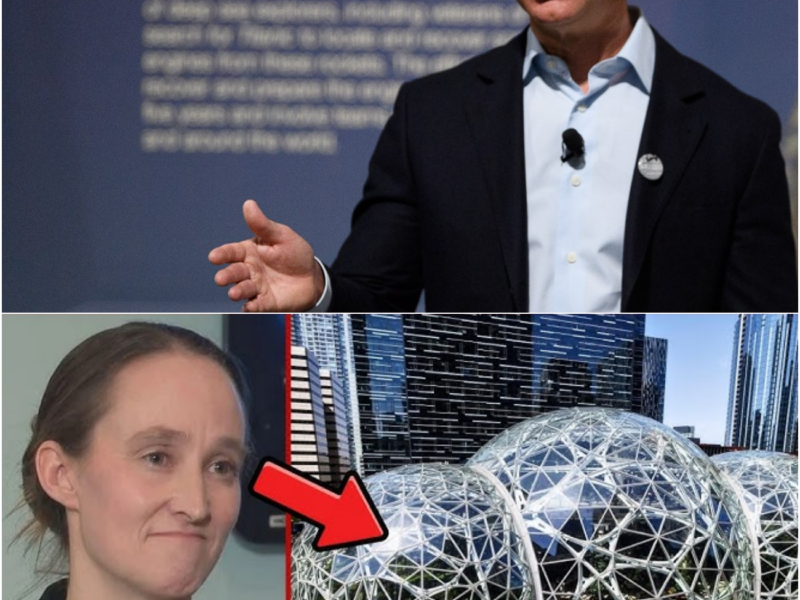
Seattle Mayor Appeals to Amazon as Major Job Cuts Shake the Region
Seattle Faces Economic Shock as Amazon Layoffs Spark Political Debate
The Great Seattle Exodus: How a Tech Giant Was Taxed Out of Its Own Home
The glass towers of downtown Seattle, once symbols of an unstoppable American economic engine, are falling silent. It is a slow, methodical erasure of a skyline, and the architects of this decline are not the companies leaving, but the city leaders who thought they could outmaneuver the math of the free market.
In 1994, a young visionary drove across the country, his wife behind the wheel, scribbling a business plan on a legal pad. He wasn’t picking a location at random; he chose Seattle because Washington State had no income tax and offered a fertile ground for software talent. For twenty-five years, that garage-based startup became the most valuable company in American history, transforming Seattle into a global tech capital. He built an ecosystem, redefined an industry, and employed 60,000 people. Then, in 2018, Seattle City Hall decided that success was a liability.
The city voted unanimously to pass a “head tax,” a direct penalty on large employers. They called it “fairness.” Amazon, the obvious target, called it a mistake. The company didn’t just complain; they acted. They halted construction on a massive office tower the very day the bill was debated. It was a warning shot that City Hall chose to ignore. By 2024, the fallout was undeniable: Amazon had moved over 14,000 employees to Bellevue, just fifteen minutes away, and their Seattle headcount plummeted to under 50,000.
This was not a mystery; it was a predictable, mathematical consequence of policy failure. As of the end of 2025, downtown Seattle’s office vacancy rate reached a staggering 35.6%, the highest in city history. The tax, designed to extract revenue, ended up hollow-casting the downtown core. The “Jumpstart” tax, meant to fund social services, fell $47 million short in 2024 because the very entities being taxed simply walked across the lake.

The tragic irony is that as the tax base shrinks, the city’s financial obligations balloon. Seattle’s general fund has surged 79% in a decade, and now, the city is forced to cannibalize its own social programs to plug a $175 million budget deficit projected for 2027. It is a classic case of fiscal suicide: by squeezing the goose that laid the golden eggs, the city has ended up with neither the gold nor the goose.
The Mirror of Decline: A National Warning
Seattle’s story is not an isolated anomaly; it is a preview of a national trend. From the streets of San Francisco, where vacancy rates hover near 33%, to the exodus of corporate hubs from Portland, the same pattern is emerging. When cities prioritize punitive taxation over organic growth, the market responds with its feet.
The economic fallout for Seattle will likely get worse before it gets better. As the city’s legislative staffers estimate, the deficit could climb to $300 million by 2029. The “triage budgeting” described by the city’s budget director is not a strategy; it is a desperate attempt to patch holes in a sinking ship. Every time a new “progressive” tax is proposed, the calculus for companies becomes even clearer: leave or die.

The future of American urban centers depends on the recognition that businesses are mobile entities. When local governments treat corporate presence as an infinite resource to be tapped, they ignore the reality that capital has a border—and in Seattle, that border is just fifteen minutes away in Bellevue. Unless city leaders shift from an adversarial stance to a partnership model, the skyline will continue to empty, and the promise of a thriving, tax-supported urban utopia will remain exactly what it has become: a fantasy written in empty office space.