She Had No Running Shoes, Only Bandages and Determination—Then This 11-Year-Old Won Every Race She Entered
An 11-Year-Old Girl Couldn’t Afford Running Shoes, So She Drew a Nike Logo on Bandages—Then Won Gold in All Three Races
She Had No Running Shoes—So She Drew a Nike Logo on Bandages and Won Three Gold Medals
At the starting line, the difference was impossible to miss.
Around her stood young runners dressed for competition, their feet protected by proper athletic shoes designed to grip the track, absorb impact and carry them through the punishing final seconds of a race.
Then there was Rhea Bullos.
She was 11 years old, small enough to disappear among the older athletes and the adults moving around the sports grounds. She had traveled from Balasan, a municipality in the Philippine province of Iloilo, to compete in a school athletics meet.
She did not arrive with expensive equipment.
She did not carry a pair of lightweight racing shoes in a branded bag.
She did not even have ordinary running shoes.
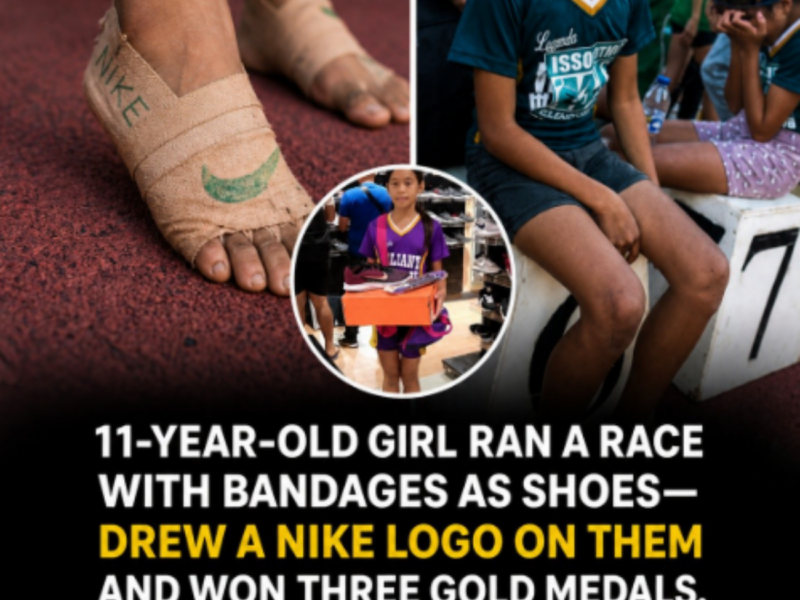
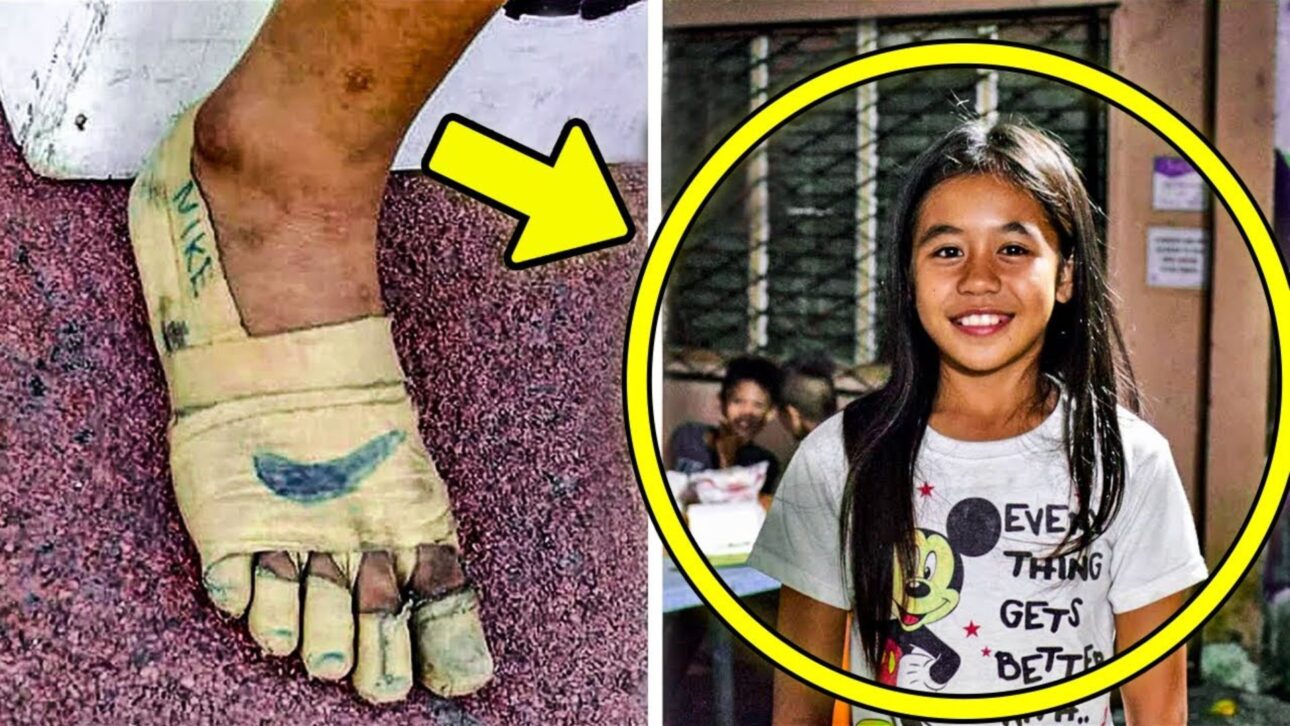
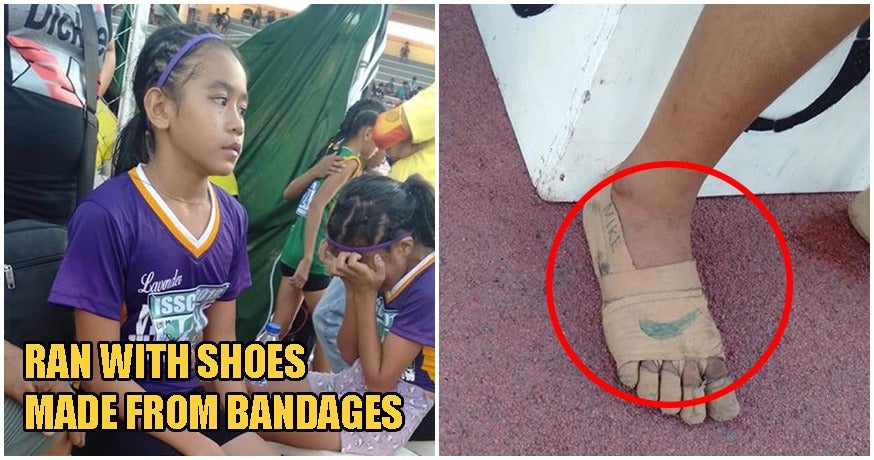
Instead, strips of beige strapping tape were wrapped around her bare feet.
The tape covered parts of her soles, heels and toes, creating something that looked like a crude imitation of footwear. Across one side, written by hand in dark marker, was a single word:
NIKE.
Above it was the familiar swoosh.
The logo was uneven. The letters looked as though they had been drawn quickly by a child. The tape was already beginning to collect dirt from the track.
But when the race official prepared the runners to begin, none of that mattered.
Rhea lowered herself into position.
She looked down the track.
Then she ran.
By the time the competition ended, the girl wearing bandages instead of shoes had entered three races.
She won the 400 meters.
She won the 800 meters.
She won the 1,500 meters.
Three events.
Three gold medals.
No running shoes.
The photographs that later spread around the world did not show a wealthy young prodigy standing inside an elite stadium. They showed a schoolgirl with medals hanging around her neck and tape wrapped around her feet.
The handmade shoes looked fragile.
The medals did not.
The Girl at the Starting Line
Athletic success is often presented as the final result of careful preparation.
Professional runners rely on coaches, nutrition plans, specialized clothing and precisely engineered footwear. Even at the school level, shoes matter. They provide support, traction and protection from heat, rough surfaces and repeated impact.
Rhea entered the Iloilo Schools Sports Council Meet without that protection.
She was not simply competing at a financial disadvantage. She was exposing her feet to the track itself.
Every stride placed pressure directly on skin separated from the ground by little more than tape. Every turn increased the risk of slipping. Every lap threatened to loosen the wrapping.
The bandages were not a creative fashion choice.
They were evidence of what she did not have.
But the hand-drawn logo complicated the image.
Someone had carefully written the name of one of the world’s most recognizable athletic brands across the homemade covering. The swoosh transformed the tape into a child’s version of professional footwear.
It was playful, but it was also deeply revealing.
Rhea knew what runners were supposed to wear.
She knew what the best athletes wore in advertisements and international competitions. She understood that the symbol represented speed, ambition and victory.
She could not afford the product.
So she created the symbol herself.
The result was both heartbreaking and defiant.
If she could not own the shoes, she could still claim the idea behind them.
She could still line up.
She could still race.
The First Test: 400 Meters
The 400 meters is often called one of the most demanding races in track and field.
It is too long to be a pure sprint and too short to allow a runner to relax into a comfortable pace. Athletes must begin aggressively, maintain speed through the curve and survive the final stretch as fatigue floods the legs.
For an 11-year-old running with taped feet, the event presented an immediate test.

There would be no time to adjust.
No gradual beginning.
From the moment the race started, Rhea had to commit.
She accelerated.
The other runners moved with her, their shoes striking the track in quick, controlled rhythms. Rhea’s taped feet hit the surface differently. There was less cushioning between her body and the ground. Every impact traveled upward.
Yet she continued.
She moved through the curve and into the final section of the race.
The 400 meters often exposes hesitation. Runners who begin too carefully cannot recover. Those who begin too quickly sometimes collapse in the final hundred meters.
Rhea found enough speed and enough control.
She crossed the finish line ahead of the field.
Gold medal number one.
At that point, the victory could have been treated as a remarkable upset.
A barefoot girl wearing makeshift coverings had defeated competitors with proper footwear.
But the meet was not over.
Neither was she.
A Longer Race
The 800 meters required a different kind of strength.
Two laps around a standard outdoor track can become a contest of positioning, patience and pain. A runner must decide when to conserve energy and when to attack.
Rhea returned to the starting area.
Her feet had already carried her through one demanding event. The tape had absorbed dirt and sweat. The improvised coverings were never designed to endure repeated competition.
She lined up again.
This time, the race would last longer.
The beginning of an 800-meter race can be chaotic. Runners accelerate to establish position, then settle into pace while watching one another. The real battle often begins during the second lap, when the body is tired and every athlete must decide how much remains.
Rhea stayed in the race.
She did not have the advantage of advanced equipment. She could not rely on shoes designed to return energy with each stride. She had only her training, her judgment and the willingness to continue when her legs began demanding that she slow down.
As the runners approached the finish, the girl with the hand-drawn swoosh moved ahead.
She won again.
Gold medal number two.
The first victory had shown that she was fast.
The second showed that the result was not an accident.
Rhea could sprint.
She could endure.
And she still had one race left.
The Race That Should Have Broken Her
The 1,500 meters is long enough for mistakes to become expensive.
A runner who starts too quickly may have nothing left for the final lap. A runner who falls too far behind may never close the gap. Success requires endurance, discipline and the ability to respond when the pace changes.
For Rhea, the race also meant more punishment for her feet.
She had already competed in the 400 and 800 meters. The tape had been forced repeatedly against the track. Beneath it, her skin had absorbed every landing.
She could have been satisfied with two gold medals.
Most athletes would have been.
But Rhea returned once more.
The runners began.
At first, the pace may have seemed manageable. Longer races often open with restraint. The athletes watch one another, waiting for someone to make a decisive move.
Lap followed lap.
Rhea remained among them.
The longer she ran, the more startling the scene became. The other competitors possessed at least one basic advantage she did not: shoes.
Rhea possessed something more difficult to measure.
She refused to accept that the missing equipment should determine the result.
The final portion of a 1,500-meter race is as much psychological as physical. The legs are exhausted. Breathing becomes difficult. The mind begins offering reasons to slow down.
Rhea kept moving.
When the decisive moment came, she found enough strength to separate herself from the field.
She crossed the finish line first.
Gold medal number three.
The girl with no running shoes had won every race she entered.
The Photograph
After the competition, someone photographed Rhea’s feet.
The image revealed details that race spectators might have missed from a distance.
The tape was stained from the track.
The wrapping was rough and uneven.
The word “NIKE” had been written directly across the side. The swoosh curved over the top.
These were not shoes that had been designed by engineers or tested in laboratories.
They were not shoes at all.
They were a solution created because a child wanted to compete and lacked the most basic equipment.
Another photograph showed Rhea with medals around her neck.
That contrast made the images almost impossible to forget.
The homemade footwear suggested deprivation.
The medals announced excellence.
The tape showed what poverty had denied her.
The gold showed what talent had achieved anyway.
The photographs began spreading online.
At first, they moved through local social-media circles. Then larger accounts shared them. News organizations picked up the story. Soon people far beyond Iloilo knew the name Rhea Bullos.
The images produced admiration, disbelief and anger.
Many viewers celebrated the girl’s determination.
Others questioned how an athlete capable of winning three events had been allowed to reach a major school competition without running shoes.
The story appeared inspirational.
It was also an indictment.
What the Viral Story Left Unsaid
It is easy to turn Rhea’s victory into a simple message:
Never give up.
Work hard.
Believe in yourself.
Those ideas are present in the story. They are not the entire story.
Rhea should not have needed to wrap her feet in tape to compete.
The lack of shoes was not a heroic challenge placed before her to make the victory more meaningful. It was a material disadvantage.
The inspirational framing can become dangerous when it encourages audiences to admire the way children survive poverty without asking why they must survive it.
Rhea’s achievement was extraordinary.
The conditions surrounding it should not be romanticized.
A child ran three races with almost no protection between her feet and the ground because proper athletic shoes were beyond reach.
Her determination made victory possible.
Her determination did not make the inequality acceptable.
The hand-drawn swoosh became a symbol because it captured both truths in one image.
She had almost nothing.
She acted as though she still belonged on the track.
The Price of Participation
Youth sports can appear simple from the outside.
A child runs.
A coach gives instructions.
A school organizes a meet.
But even the least complicated sport requires resources.
Athletes need transportation, uniforms, food, medical support and appropriate equipment. Those costs can exclude talented children long before anyone discovers what they are capable of doing.
Running is often described as one of the most accessible sports because it requires no court, field equipment or expensive club membership.
In theory, a runner needs only space and motivation.
In reality, shoes matter.
For children from low-income communities, even a basic pair can represent a significant expense. A growing child may need replacements frequently. Competition shoes can cost more than a family is able or willing to spend when food, housing and school necessities come first.
Rhea’s taped feet revealed the hidden cost of what looked like a simple race.
She had reached the starting line.
Many other children with similar talent may never get that far.
A Child’s Version of a Global Brand
The Nike logo made the photograph instantly understandable to viewers around the world.
The swoosh is associated with elite athletes, championship performances and enormous advertising campaigns. It appears on the feet of runners who have access to training centers, medical teams and sponsorship contracts.
Rhea’s version had been drawn with a marker.
The contrast was almost too perfect.
On one side was a global athletic company whose products symbolize professional performance.
On the other was an 11-year-old using bandages to imitate those products.
The handmade logo could have appeared mocking or bitter.
Instead, it looked hopeful.
It suggested that Rhea did not see herself as separate from the world of serious athletes. She had adopted its symbol and carried it onto the track.
The official shoes might have been absent.
The identity of a runner was not.
The logo also made the images highly shareable. People recognized it immediately. They did not need to understand the language or know anything about the meet.
They saw the tape.
They saw the swoosh.
They saw the medals.
The story required almost no explanation.
When the Internet Found Her
Viral attention can arrive violently.
One day, a person is known primarily inside a school, family or community. The next day, strangers across the world are discussing her life.
For a child, that shift can be especially overwhelming.
Rhea had entered the competition to run, not to become a symbol of poverty and perseverance. She had not developed a media strategy or attempted to attract sponsors.
She competed with what she had.
The photograph did the rest.
As the story spread, coaches, companies and donors began paying attention. People wanted to help the girl whose taped feet had carried her to three victories.
According to the account that became widely shared, the story eventually reached Nike. Rhea received proper running shoes and athletic gear. Coaches expressed interest. Scholarship opportunities and other forms of support were discussed.
The equipment arrived only after she had demonstrated what she could do without it.
That sequence gave the story its emotional force.
The world did not invest in Rhea before the race.
It noticed her after she had already paid the price of being overlooked.
The Arrival of Real Shoes
Imagine the difference between the bandages and an actual pair of running shoes.
The tape had to be wrapped carefully around bare feet. It could loosen, tear or shift. It offered little protection from impact and almost no structural support.
Proper athletic shoes fit around the foot. They cushion the landing. They help stabilize movement. They provide traction and reduce the direct punishment delivered by the track.
For most young athletes, putting on running shoes is unremarkable.
For Rhea, the first proper pair represented entry into a different athletic world.
The shoes did not create her ability.
They acknowledged it.
She had already won.
She had already proven her speed and endurance.
The new equipment removed one barrier between her talent and the future.
Yet the arrival of shoes also raised an uncomfortable question.
Why did a child need to go viral before receiving something so basic?
Why did she have to win three gold medals in tape before the world decided she deserved proper footwear?
The help was valuable.
The delay revealed the system’s failure.
Talent Hidden in Plain Sight
Rhea’s story resonated because it suggested that extraordinary ability may be hiding in places where few people are looking.
A child in a remote or under-resourced community may possess the potential to become an elite athlete. But potential alone does not produce a career.
Someone must notice.
Someone must provide training.
Someone must pay for travel and equipment.
Someone must create a path from school competition to higher levels of sport.
Without those systems, talent can remain invisible.
Rhea became visible because the photographs went viral.
Other young runners may be equally fast and equally determined without ever attracting a camera.
That is one of the harshest realities behind inspirational stories. The person who receives help is often not the only person who deserves it.
She is the one whose circumstances happen to be documented in a way the public cannot ignore.
The Coach’s View
A coach watching Rhea would have seen more than a moving human-interest story.
The results themselves would demand attention.
Winning the 400, 800 and 1,500 meters requires unusual versatility. The events test different physical abilities.
The 400 rewards speed and controlled aggression.
The 800 combines speed with tactical endurance.
The 1,500 demands patience, aerobic strength and a powerful finish.
An athlete who succeeds in all three has more than courage. She has range.
At 11 years old, Rhea was still developing physically. With consistent coaching, nutrition, recovery and proper equipment, her potential could extend far beyond a single school meet.
The viral story opened doors, but the next stage would require structure.
A gifted child needs more than applause.
She needs protection from excessive training, access to education and adults who can separate her long-term interests from the public’s hunger for a dramatic success story.
The medals proved that Rhea could run.
The attention created a new challenge: ensuring that the story helped her rather than consuming her.
What Victory Feels Like Without Shoes
The physical experience of Rhea’s races is difficult to reconstruct from photographs alone.
The tape would have reduced some friction, but it could not have replicated the cushioning of a shoe. The track would still have felt hard beneath her feet.
The 400 meters would have punished her through speed.
The 800 would have tested the durability of the wrapping.
The 1,500 would have multiplied every discomfort over distance.
She may have felt the tape tightening in some places and loosening in others. Dirt may have entered beneath the edges. Each turn may have forced the covering against skin.
Yet she continued through all three races.
Pain does not automatically produce greatness. Athletes are not stronger simply because they suffer more.
Rhea’s achievement came from the ability to compete despite the suffering, not because the suffering was somehow necessary.
Had she possessed proper shoes, the victories would have been no less meaningful.
They might have been safer.
The Moment the Story Changed
Before the photographs circulated, Rhea was a young athlete known to people around her.
Afterward, she became an international example of determination.
The shift changed the way others interpreted the race.
Without the viral image, the results might have been recorded simply as three school-level victories.
With the image, each gold medal became evidence in a larger narrative.
The 400 meters showed that poverty had not taken her speed.
The 800 showed that it had not taken her strength.
The 1,500 showed that it had not taken her endurance.
The story was repeated because it offered something audiences desperately wanted to believe: that individual determination could overcome almost any disadvantage.
Rhea’s performance supported that belief.
Her circumstances also exposed its limits.
Determination can carry a child across a finish line.
It cannot build an equitable sports system by itself.
The Danger of the Perfect Inspirational Story
The more dramatic a true story becomes, the more likely people are to simplify it.
Rhea can easily be transformed into a symbol rather than treated as a child.
Her taped feet become a lesson.
Her medals become a motivational slogan.
Her poverty becomes part of a satisfying emotional arc that ends when a company sends shoes.
But real life continues after the viral moment.
Shoes wear out.
Children grow.
Training requires time and money.
School remains important.
Athletic careers are uncertain.
One generous response cannot solve every structural problem surrounding a talented young athlete.
The public may share the photograph for a week and then move on. Rhea must continue living with the expectations created by it.
The story should inspire people.
It should also challenge them.
A society that celebrates children for succeeding without basic resources should ask why those resources were missing.
More Than a Marketing Moment
For Nike, the hand-drawn logo created an unusual association.
Rhea had turned the company’s symbol into an expression of aspiration without owning its product. Her image attracted more emotional attention than many carefully designed advertisements.
Responding with shoes and athletic clothing made sense.
It also carried commercial implications.
When a major brand supports a struggling athlete, the gesture can be both generous and beneficial to the company’s public image.
Those realities can coexist.
The important question is whether the support creates lasting opportunity for the child rather than merely closing the viral-news cycle.
Rhea needed shoes.
She also needed continued guidance, education and protection.
A pair of shoes could change her next race.
A sustained system of support could change her life.
Three Medals, Three Messages
Each of Rhea’s medals came to represent something larger than the result engraved on it.
The first represented possibility.
She entered the 400 meters visibly under-equipped and showed that she could win.
The second represented confirmation.
The 800-meter victory proved that her success was not a lucky moment.
The third represented endurance.
After two races, with taped feet and accumulated fatigue, she still controlled the 1,500 meters.
Together, the medals transformed the photograph from an image of hardship into an image of authority.
Rhea was not asking for sympathy.
She had already competed.
She had already won.
The world’s sympathy arrived after the medals.
The Competitors in Real Shoes
The other young runners are rarely discussed in retellings of Rhea’s story.
They become background figures—children with proper shoes who were defeated by the girl wearing tape.
But they were also young athletes who had trained and arrived hoping to win. Their presence helped reveal the scale of Rhea’s accomplishment.
The shoes gave them an equipment advantage.
They did not guarantee victory.
Running remains brutally honest. At the finish line, appearance, cost and expectation surrender to the clock.
Rhea reached the line first.
Again.
And again.
And again.
That is the detail no amount of sentimentality can replace.
The tape made the story famous.
Her performance made it real.
The Image People Could Not Forget
The most powerful photographs often contain contradiction.
A firefighter resting after disaster.
A graduate standing beside a parent who worked multiple jobs.
A child holding a trophy in a damaged neighborhood.
Rhea’s feet offered one of those contradictions.
They looked unprepared for competition.
The medals showed complete preparation.
The tape appeared temporary.
The victories were permanent.
The hand-drawn logo suggested imitation.
Her performance was authentic.
People could not stop looking because the image disrupted the usual relationship between wealth and achievement.
Elite-looking equipment did not win the races.
The child without equipment did.
What the Track Revealed
A running track is built to measure distance precisely.
Four hundred meters around.
Marked lanes.
Clear starting and finishing points.
But Rhea’s races measured more than speed.
They measured the distance between talent and opportunity.
On one side was an 11-year-old capable of winning multiple events.
On the other was a family and community where proper running shoes were not readily available to her.
The tape covered that gap temporarily.
The viral story exposed it.
The offers of shoes, coaching and scholarships attempted to narrow it.
Whether the gap would close permanently depended on what happened after public attention faded.
A Future That Suddenly Opened
Before the meet, Rhea’s options may have appeared limited.
She could run in local or school competitions with whatever equipment was available. Her talent might earn praise, but praise alone would not pay for shoes, travel or advanced training.
After the photographs spread, possibilities emerged.
Proper gear could reduce the risk of injury.
Coaches could help refine her technique.
Scholarships could connect athletic achievement to education.
The girl who had improvised shoes from tape suddenly had access to choices that had not existed before.
That transformation was uplifting.
It was also random.
The same performance without a photograph might have changed nothing.
The camera became almost as important as the stopwatch.
She Made Her Own Way to the Line
Rhea’s story is often summarized by saying she made her own shoes.
Technically, she made a covering.
The deeper truth is that she made her own way to the starting line.
She refused to let the absence of equipment become the final decision.
There is a kind of courage required simply to appear under those conditions.
Children are acutely aware of difference. An 11-year-old can see when everyone else has something she lacks. She can imagine the looks, the questions and the possibility of embarrassment.
Rhea arrived anyway.
She placed the tape around her feet.
She drew the logo.
She stood beside runners wearing real shoes.
Then she beat them.
The Finish Line Was Not the End
The three races ended with medals.
The larger story did not.
Rhea’s viral fame introduced her to a world that often celebrates disadvantaged children intensely and briefly. The challenge would be turning temporary attention into durable support.
A young athlete’s development takes years.
There will be losses as well as victories. Bodies change. Competition becomes stronger. Injuries happen. Academic responsibilities increase.
The girl who won in tape should not be required to win every time in order to remain worthy of help.
Her humanity matters beyond the inspirational image.
The world noticed her because she achieved something extraordinary under shocking conditions.
It should support her because every child deserves the tools to pursue talent safely.
No Shoes, No Excuses—and the Problem With That Phrase
The story can easily be turned into a slogan:
No shoes. No excuses.
It sounds powerful.
It is also unfair.
Rhea’s lack of shoes was a legitimate obstacle. She succeeded despite it, but other children should not be judged harshly if similar deprivation stops them.
Poverty is not an excuse.
It is a condition that changes what people can safely and realistically do.
Rhea’s victory demonstrates extraordinary resilience. It should not be used to suggest that everyone can overcome every disadvantage through willpower alone.
The correct lesson is not that equipment does not matter.
The correct lesson is that Rhea mattered even before anyone gave her equipment.
A Child, a Marker and a Global Audience
Somewhere before the races, a marker touched the tape.
The letters were drawn.
N-I-K-E.
Then the swoosh.
No one creating that homemade logo could have known millions of people would eventually see it.
It was probably intended for the track, not the world.
But the world recognized itself in the image.
Some saw childhood imagination.
Some saw poverty.
Some saw corporate symbolism.
Some saw raw athletic talent.
Some saw proof that determination can survive humiliation.
The photograph held all of those meanings at once.
The Shoes She Had Already Earned
When proper shoes finally reached Rhea, they were often described as a gift.
They were.
But they also felt like something she had already earned.
Three gold medals had made the argument more forcefully than any appeal could have done.
She did not have to promise that she would work hard.
She had already worked.
She did not have to claim she was talented.
She had already won.
The shoes arrived after the evidence.
That does not reduce the generosity of those who helped. It clarifies why the response felt so satisfying.
The new equipment was not charity offered to an unknown child.
It was recognition delivered to a champion.
The Race the World Finally Saw
Millions of children run.
Some run in organized competitions.
Some run through rural communities, crowded neighborhoods or schoolyards.
Some possess natural speed that will never be measured under official conditions.
Rhea’s talent happened to become visible.
The photograph made the world stop long enough to see what had been standing on the track all along.
An athlete.
Not merely a poor child.
Not merely a viral image.
An athlete capable of winning three different races.
The tape did not make her fast.
It made the world ashamed that speed like hers had been given so little support.
The Final Image
The image remains difficult to shake.
An 11-year-old girl stands on a track in the Philippines.
Around her are competitors prepared in the conventional way.
Her feet are wrapped in tape.
A logo associated with some of the most successful athletes on Earth has been drawn by hand across the bandages.
She does not own the real shoes.
She claims the symbol.
The race begins.
She runs the 400 meters and wins.
She returns for the 800 and wins again.
Then she enters the 1,500 and wins for a third time.
By the end, the tape is dirty.
The letters remain visible.
The medals are real.
Later, people will send shoes. Companies will respond. Coaches will notice. New possibilities will appear.
But before any of that happens, there is only Rhea at the starting line.
No sponsorship.
No professional gear.
No guarantee that anyone outside the stadium will ever know her name.
She runs anyway.
What Three Gold Medals Really Meant
The medals represented victory, but they also carried an accusation.
They asked what Rhea might achieve with consistent support.
They asked how many talented children remain undiscovered because they lack basic equipment.
They asked why the world often waits for a dramatic photograph before responding to need.
They asked whether admiration would last after the story stopped trending.
Rhea’s success did not solve those questions.
It made them impossible to ignore.
Nothing Was Going to Stop Her
The phrase sounds like the conclusion of a sports movie.
Nothing was going to stop her.
But several things could have stopped her.
The lack of shoes could have stopped her.
Embarrassment could have stopped her.
Pain could have stopped her.
Fatigue after the first two races could have stopped her.
The possibility of losing to better-equipped runners could have stopped her.
None of them did.
Rhea did not pretend the obstacles were absent.
She wrapped them in tape and stepped onto the track.
That is why the story traveled across continents.
It was not simply about a child winning races.
It was about the moment an obvious disadvantage failed to produce the expected result.
The runners with shoes did not win.
The girl with the marker-drawn swoosh did.
Three times.
The Girl Behind the Swoosh
The world may always remember Rhea Bullos through her feet.
That is understandable. The photograph is powerful.
But she should not be reduced to the bandages.
The tape was temporary.
Her talent was not.
The logo was an imitation.
Her determination was entirely her own.
The medals did not belong to Nike, the internet or the strangers who later offered help.
They belonged to Rhea.
She earned them one step at a time, striking the track with feet that should have been protected but were not.
The world gave her proper shoes afterward.
She had already shown the world exactly what kind of runner would be wearing them.
Three Races and a Different Future
The meet began as a school athletics competition.
For Rhea, it became a dividing line.
Before the races, she was a talented young runner without adequate equipment.
After the races, she was the girl who had won three gold medals in taped feet and attracted international attention.
The distance between those two lives was measured in 400 meters, 800 meters and 1,500 meters.
A total of 2,700 meters of competition.
Less than two miles.
Far enough to change her future.
The Lesson at the Finish Line
The easiest lesson is that courage can overcome hardship.
The harder lesson is that courage should not be required to compensate for every failure around a child.
Rhea deserved praise for running.
She also deserved shoes before she had to prove herself.
She deserved coaching before becoming a viral story.
She deserved opportunity because she was a child with talent, not because an image of her hardship happened to capture the public’s imagination.
Her victories remain extraordinary.
They should inspire action, not complacency.
The Hand-Drawn Logo and the Real Champion
Nike’s swoosh is designed to suggest motion.
On Rhea’s feet, the symbol became literal.
It moved around the track through three races.
It crossed three finish lines.
It appeared beneath three gold medals.
The company’s name had been written onto tape, but the power of the image came from the child wearing it.
The brand did not create the champion.
The champion created the moment.
What Remains
Years after the meet, people may forget exact dates, race times or the name of the competition.
They will remember the feet.
Tape wrapped around skin.
A logo drawn with a marker.
A child standing among competitors in proper shoes.
Then the finish line.
Then another.
Then another.
The image survives because it captures something both inspiring and deeply uncomfortable.
It shows how little Rhea had.
It shows how much she could do.
Three races.
Three gold medals.
No running shoes.
Just an 11-year-old girl who wanted to run—and who refused to let the world decide that tape around her feet meant she did not belong on the track.