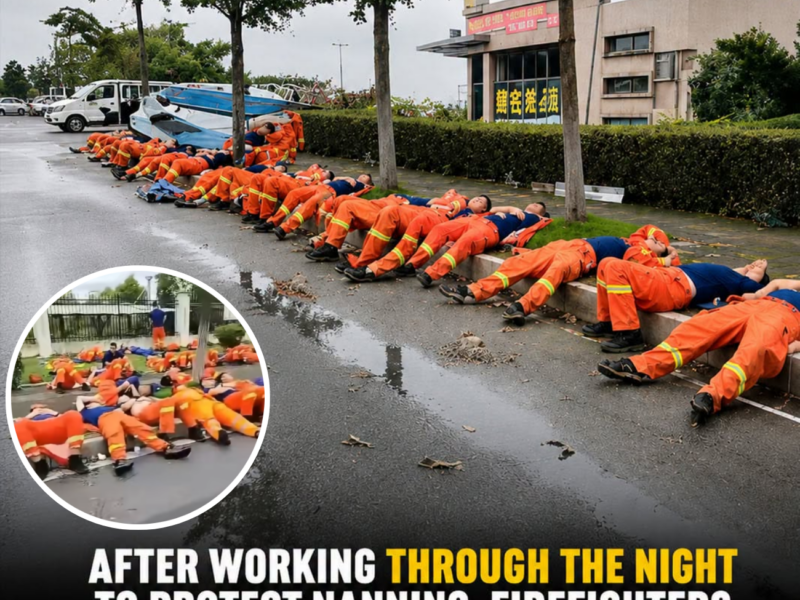
They Had No Time to Go Home—These Firefighters Slept on the Roadside So They Could Keep Defending Nanning
After Working Through the Night to Protect Nanning, Exhausted Firefighters Slept Beside the Road—Ready to Rush Back to the Levee at a Moment’s Notice
They Slept Beside the Road So They Could Return to the Levee: The Truth Behind a Photograph of Exhausted Firefighters
Before sunrise, the firefighters stopped wherever their bodies finally allowed them to stop.
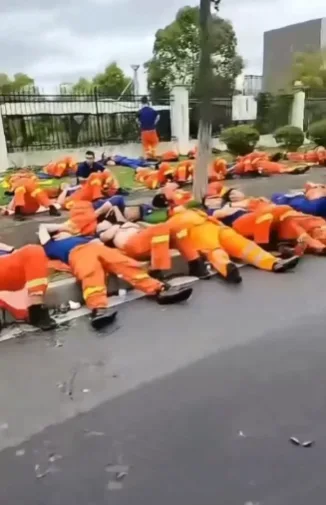
There were no beds waiting for them. No quiet dormitory. No private room where they could remove their uniforms, close a door and disappear from the emergency for a few hours.
There was only the roadside.
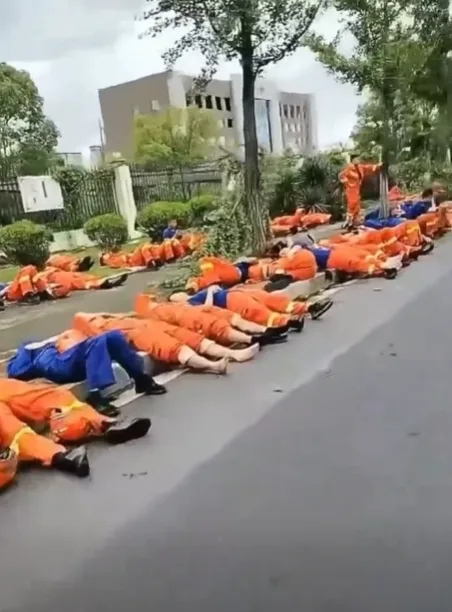
In the photograph, men in fire-rescue uniforms lie close to the pavement, their bodies arranged not with comfort in mind but with necessity. Some appear curled on their sides. Others rest flat against the ground. Their uniforms remain on. Their boots remain nearby or still attached to exhausted legs. They look less like people choosing to sleep than people whose bodies have temporarily shut down.
A few feet away, the road continues.
Beyond it lies the reason they cannot leave.
A river embankment near Beida Bridge in Nanning, the capital of China’s Guangxi region, had been under threat. Rising water had created dangerous conditions beside the levee. A sinkhole had to be filled. Seepage had to be controlled. Weak sections had to be reinforced before the water found a path through.
The work had continued through the night.
By approximately 6 a.m. on October 9, 2025, the immediate danger had been brought under better control. The exhausted firefighters and other emergency personnel began rotating out of the most active positions.
But they did not go home.
They lay down beside the road.
They remained close enough to the embankment that, if conditions changed, they could stand up, return to the levee and begin again.
Months later, the photograph would begin circulating in a different context. Severe flooding struck Guangxi again in July 2026, and the older image was shared as though it documented the new disaster.
The photograph was real.
The exhaustion was real.
The sacrifice was real.
But the date was wrong.
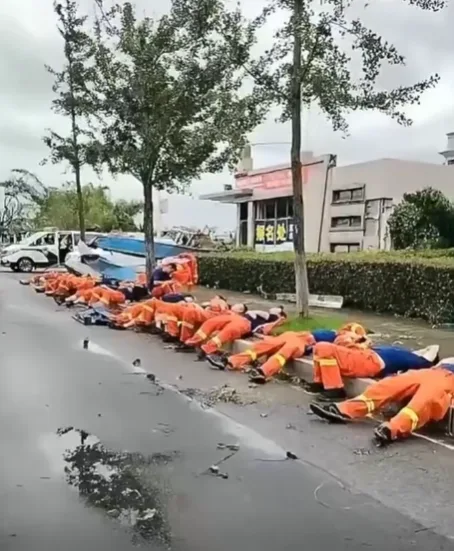
That distinction might seem small in the face of such a powerful image. It was not.
The photograph told two stories at once.
One was about firefighters protecting a city while most residents slept.
The other was about how disaster images lose their history when they are pulled into new crises, stripped of dates and made to carry events they did not witness.
The truth did not make the image less moving.
It made the sacrifice more precise.
The Hour Before Dawn
Flood emergencies rarely begin with the dramatic moment people remember.
They begin with measurements.
Water rises against a marker. A patrol notices a change in the current. Mud darkens. The ground softens. A thin stream appears where water should not be moving.
At first, the signs may seem manageable. Then the river pushes harder.
Near Beida Bridge in Nanning, rising water threatened an area beside the river embankment. Reporting from the period described emergency crews responding to a sinkhole and dangerous seepage near the levee.
A sinkhole beside a flood-control structure is not merely a hole in the ground. It can be evidence that water is moving beneath the surface, carrying soil away, hollowing out spaces and weakening the structure from below.
What appears stable above ground may already be failing underneath.
The danger is not always visible until it becomes severe.
Water can exploit cracks too small to notice. It can widen channels, loosen packed earth and turn a minor leak into a path capable of undermining an entire section of embankment.
That is why emergency crews move quickly.
They fill openings.
They stack materials.
They monitor seepage.
They reinforce the levee while water continues pressing from the other side.
The work is repetitive, physical and unforgiving. It demands constant attention because the river does not stop pushing when workers become tired.
During the operation near Beida Bridge, firefighters and other emergency personnel worked through the night. The response required continuous coverage, with crews rotating through duties so the site remained under watch.
Around 6 a.m. on October 9, the most immediate danger had reportedly been controlled more effectively.
The city had not been saved by a single cinematic rescue.
It had been protected by hours of labor in darkness.
By people lifting, carrying, filling and watching.
By workers who understood that a small failure in the embankment could become a much larger one if ignored.
When dawn approached, some of those workers rested beside the road.
Not because the emergency was over.
Because they needed to remain close to it.

Why They Could Not Leave
A fire-rescue official later explained that the crews were rotating and resting near the site so they could return immediately if the embankment deteriorated.
The location of their sleep was therefore part of the emergency plan.
The roadside was not simply where they collapsed.
It was where they remained on standby.
If water began forcing its way through again, there would be no time for firefighters to travel back from distant quarters. If the sinkhole expanded or seepage intensified, the resting crews might be needed within minutes.
They slept within reach of the danger.
That detail changes the photograph.
At first glance, it appears to show the aftermath of work—the moment when exhausted responders finally stop.
In reality, it shows a pause inside continuing work.
The uniforms remained on because they were not finished.
The men lay beside the road because they had not truly left the scene.
The emergency had entered a quieter stage, but it had not ended.
This is the part of disaster response the public rarely sees.
News coverage tends to focus on movement: boats crossing flooded streets, firefighters carrying residents, helicopters hovering above rooftops, rescuers breaking through doors.
Those images are necessary. They document the moments when danger becomes visible and action becomes dramatic.
But between those moments are long stretches of waiting, monitoring and exhaustion.
A levee may hold for hours while crews stand nearby, staring at water and searching for change.
A rescue team may work until its members can no longer safely continue, then rest briefly before returning.
Emergency workers may sleep in vehicles, on floors, beside roads or anywhere close enough to respond when the next alarm comes.
The photograph near Beida Bridge captured that invisible interval.

No one was being carried to safety.
No dramatic wave was visible.
No flames rose behind the firefighters.
The men were simply asleep.
That quietness made the image extraordinary.
The Picture That Returned During Another Flood
When severe flooding struck Guangxi again in July 2026, old images began circulating alongside current reports.
This is common during major disasters.
People search for photographs that express the scale of what is happening. Social-media accounts repost dramatic scenes. Images are copied from one platform to another. Captions are shortened. Dates disappear.
A photograph that feels emotionally true becomes attached to a new event.
The roadside image of the exhausted firefighters fit the emotional atmosphere of the July 2026 flooding perfectly.
It showed sacrifice.
It showed readiness.
It showed emergency responders giving everything they had to protect the public.
Many viewers had no reason to question it.
The uniforms looked current. The setting was plausible. Guangxi was experiencing serious flooding again.
But the image was older.
It came from the October 2025 flood-control operation near Beida Bridge in Nanning.
That correction did not expose a fake scene.
It restored the real one.
The men in the photograph had not been sleeping between shifts during the July 2026 disaster.
They had been resting beside the road during an emergency operation months earlier, after working through the night to protect an embankment.
Both disasters mattered.
Combining them helped neither.
Why the Date Matters
Some people react impatiently when an emotionally powerful photograph is corrected.
They argue that the larger message remains true. Firefighters really do work through disasters. Emergency crews really do sleep wherever they can. Guangxi really did experience severe flooding in July 2026.
Why focus on the date?
Because journalism depends on more than emotional accuracy.
A photograph is evidence of a particular moment.
When the date changes, the evidence changes.
The people pictured become associated with an event they may not have attended. The location may be misunderstood. The response may be credited to the wrong operation. The history of the actual emergency begins to disappear.
In this case, the correction also protected the details of the firefighters’ sacrifice.
The image did not need exaggeration.
It did not need to be described as showing workers who had labored nonstop for 24 hours unless reporting proved that every person pictured had done so.
Available accounts supported a round-the-clock response with rotating crews. They did not establish that every firefighter in the photograph had worked continuously for a full day.
That distinction is important.
Emergency responders can be praised without turning them into superhuman figures.
In fact, the photograph is powerful precisely because it shows their human limits.
They needed sleep.
Their bodies required rest.
The response system recognized that exhausted crews must rotate if the operation was to continue safely.
The men were not machines working endlessly without pause.
They were people pushing themselves through a dangerous night, then sleeping near the site because the city might need them again.
The truth is more moving than the myth.
The Physical Cost of Holding Back Water
Flood-control work attacks the body in ways a photograph cannot fully show.
Uniforms become damp and heavy.
Mud grips boots.
Hands repeat the same motions until muscles begin to fail.
Workers lift materials, carry equipment and move across unstable ground while trying to remain aware of changing water conditions.
The danger is not always dramatic.
A worker can slip.
The ground can collapse.
Water can break through a weak point.
Fatigue can slow judgment at exactly the moment when quick decisions are needed.
That is why shift rotation matters.
Rest is not evidence of weakness.
It is part of operational survival.
A firefighter who has worked through the night may want to continue, particularly when homes and communities remain at risk. But exhaustion changes coordination, reaction time and concentration.
The body eventually makes its own decision.
The roadside photograph captures that point.
The firefighters did not appear to have arranged themselves for a symbolic image. Their postures were unguarded. Their bodies had surrendered to sleep wherever space was available.
The photograph showed what service looked like after adrenaline faded.
The City Beyond the Levee
The embankment protected more than earth.
Behind every levee are streets, homes, businesses and people who may never see the structure holding water back from their lives.
Flood defenses are easy to ignore when they work.
Residents wake, travel to work and continue ordinary routines without thinking about the pressure building against a river wall.
Only when the system begins to fail does the levee become visible to the public imagination.
During the Nanning operation, emergency crews worked to prevent a local danger from becoming a wider disaster.
A sinkhole and seepage near an embankment can represent the beginning of escalation.
If the levee had weakened further, the response might have shifted from reinforcement to evacuation and rescue.
The firefighters resting beside the road knew that possibility remained.
Their location reflected it.
They were close enough to return before a small change became a large emergency.
For the public, the most dramatic image would have been a breach.
For the crews, success meant preventing that image from ever existing.
This creates a strange problem for disaster-response workers.
When they succeed, the public may never understand what was avoided.
There is no spectacular footage of a flood that did not happen.
No aerial image of neighborhoods that remained dry because workers reinforced the correct section of embankment in time.
Prevention leaves behind fewer dramatic pictures than catastrophe.
The roadside photograph offered rare evidence of the labor behind the absence of disaster.
A Photograph of Trust
There is another meaning in the image.
The sleeping firefighters were vulnerable.
Their eyes were closed. Their bodies were motionless. Their equipment was nearby. They trusted that other crews were watching the site while they rested.
Disaster response depends on that trust.
No individual can remain alert forever.
One team works while another recovers. Responsibility passes between shifts. Information must be communicated accurately. Workers must believe that when they lie down, someone else is standing watch.
The photograph therefore documents not only exhaustion but coordination.
The men could sleep because the operation continued around them.
They remained ready because other responders held the immediate line.
Later, roles would reverse.
The resting firefighters would wake, return to duty and allow others to stop.
Around-the-clock emergency coverage is built from these exchanges.
The public often imagines heroism as an individual act.
A firefighter enters danger.
A rescuer carries someone to safety.
A worker refuses to stop.
But large disaster operations survive through systems.
Heroism may involve knowing when to continue and when to rotate out.
It may involve trusting another crew enough to close one’s eyes beside the road.
The Myth of Endless Endurance
Stories about emergency workers often emphasize their ability to endure.
They worked without sleep.
They refused food.
They continued for 24 hours, 36 hours or longer.
Such claims may sometimes be true for individuals during extraordinary conditions. But they can also become part of a dangerous mythology.
The idea of the tireless rescuer is emotionally appealing.
It suggests total devotion.
It creates a simple measure of sacrifice: the longer someone works without rest, the more heroic he must be.
But endless work is not always effective work.
Exhausted responders can make mistakes.
They can injure themselves.
They can become another problem the emergency system must manage.
The available reporting on the Nanning operation described continuous shift coverage. It did not show that every person pictured had worked nonstop for 24 hours.
That does not diminish them.
It presents a more credible picture of professional emergency management.
The firefighters worked through the night.
They rested close to the levee.
They remained prepared to return.
Their commitment was measured not by pretending they did not need sleep, but by where they chose to sleep and why.
What Happens When Old Images Become New Again
The reappearance of the photograph during the July 2026 flooding illustrates how social media reshapes disaster memory.
When a major event occurs, online audiences seek images immediately.
The demand for visuals often moves faster than verification.
Posts that create strong emotional reactions are rewarded with attention. A photograph of firefighters sleeping beside a road is almost designed for that environment.
It requires little explanation.
It produces immediate admiration.
It can be paired with a dramatic sentence and shared within seconds.
The original context becomes an obstacle.
Dates and locations take space. Operational details slow the story. Uncertainty about shift length complicates the message.
Social media prefers simplicity.
They worked all night.
They collapsed beside the road.
They were ready to return.
The broad outline was true.
But once the image was attached to July 2026, viewers were no longer seeing the October 2025 operation.
They were seeing a new story assembled from old evidence.
This matters because disasters are historical events. Communities remember them through photographs. Officials study responses. Families connect images to their own experiences.
Misdated images blur those records.
They also create an opening for distrust.
When one photograph is shown to be old, some viewers may begin doubting authentic images from the current disaster. A small error can become evidence for people eager to claim that an entire emergency has been exaggerated.
Accuracy protects credibility.
It also protects the responders themselves from becoming symbols detached from their real work.
The Men Behind the Uniforms
The photograph does not tell viewers much about the individuals lying beside the road.
It does not show their names, ages or families.
It does not reveal what they thought about while working through the night.
Some may have been concerned about homes of their own.
Some may have been accustomed to disaster operations.
Others may have been confronting conditions they had not previously experienced.
Their identities are largely hidden by the collective image of the uniform.
That anonymity is common in emergency coverage.
A department is praised.
A rescue team is thanked.
The individuals become part of a larger force.
Yet each body in the photograph carried a separate experience of fatigue.
Each person had reached the point where the ground became acceptable as a bed.
Each would eventually wake and decide whether his legs were ready to stand again.
The image compresses those individual stories into one symbol.
The correction of the date returns at least part of their specificity.
They were not generic firefighters from an unspecified flood.
They were personnel involved in an October 2025 flood-control operation near Beida Bridge in Nanning.
They had worked to fill a sinkhole, reinforce the levee and manage seepage.
They rested close to the scene because the danger could return.
That is their story.
Before the Rescue Comes Prevention
When Americans think of firefighters, many picture burning buildings, ladders and smoke.
But fire-rescue organizations in many parts of the world respond to a wide range of emergencies, including floods, landslides, storms and structural threats.
During flooding, their responsibilities can extend far beyond dramatic rescues.
They may patrol embankments.
Move materials.
Assist with evacuations.
Search for weak points.
Transport supplies.
Monitor water.
Support engineering and public-safety teams.
The work near Beida Bridge belonged to this less visible side of emergency response.
There was no single trapped victim at the center of the story.
The potential victim was an area threatened by water.
The rescue was preventative.
It involved keeping the levee intact long enough to protect people who may never know how close the danger came.
This kind of work rarely produces a recognizable hero.
There is no moment when one person clearly saves the day.
Success emerges collectively, through labor repeated until the threat is controlled.
The sleeping firefighters became the face of that labor only after the work paused.
The Silence After a Night of Noise
The roadside scene likely felt different from the operation that preceded it.
During active flood control, there would have been movement, instructions and equipment. Workers would have been watching the ground and water, responding to changing conditions.
Then the immediate danger eased.
The pace slowed.
Exhaustion filled the silence.
This transition is one of the most difficult parts of emergency work.
During a crisis, adrenaline allows people to continue beyond ordinary limits.
When the pressure drops, the body demands payment.
Muscles tighten.
Hands shake.
Cold becomes noticeable.
Hunger returns.
Sleep arrives with force.
The men beside the road were experiencing that reckoning.
Their rest was not luxurious or complete.
They remained outside.
They remained in uniform.
They remained close to the site.
Even in sleep, they were part of the emergency.
The Public Sees the Rescue, Not the Recovery
The question raised by the photograph is larger than one flood operation:
What part of disaster response does the public see least?
The rescues themselves or the exhaustion between them?
Rescues receive attention because they contain visible stakes.
A person is trapped, then freed.
A boat arrives.
A child is carried through water.
The outcome can be understood immediately.
Exhaustion is harder to document.
It accumulates gradually.
It does not announce itself with sirens.
It appears in the way a responder lowers himself onto the ground, removes gloves or closes his eyes while still wearing a uniform.
The recovery between shifts is not separate from the rescue.
It makes the next rescue possible.
Without rotation and rest, emergency operations cannot continue safely.
The image near Beida Bridge forced viewers to confront that reality.
The firefighters’ stillness was part of the response.
The Emotional Power of an Accurate Caption
A corrected caption might appear less dramatic than the viral version.
October 2025, not July 2026.
Rotating crews, not confirmed nonstop 24-hour labor by every person shown.
Resting near the site, not necessarily collapsing after an uninterrupted day.
But accuracy does not flatten the story.
It sharpens it.
The firefighters had worked through the night to protect an embankment.
By dawn, the immediate danger was under improved control.
They lay beside the road while still in uniform.
They remained close because they might be called back at any moment.
Nothing more was needed.
The facts already contained suspense.
A weakening levee.
A sinkhole.
Seepage.
Night work.
Temporary control.
Responders sleeping within reach of a danger that might return.
The accurate version respects both the audience and the people pictured.
Disaster Memory and the Need to Remember Correctly
Floods recede.
Mud dries.
Damaged roads reopen.
But photographs remain.
They become part of how communities remember what happened.
An image may be shared on anniversaries, used in public reports or shown to younger generations. It can become evidence of courage, failure or loss.
That long life gives captions responsibility.
A wrong date may follow an image for years.
Eventually, the correction can become harder to recover than the mistake.
The photograph of the Nanning firefighters deserves to remain connected to the operation that produced it.
Not because the July 2026 floods were less serious.
Because both events deserve their own record.
The people working in July 2026 should be remembered through evidence of their own response.
The people who protected the Beida Bridge area in October 2025 should not disappear into a later disaster.
Historical accuracy is a form of respect.
The Heroism of Staying Close
The most striking part of the story is not that the firefighters slept.
It is where they slept.
They could have traveled farther away for greater comfort.
They remained beside the road because distance would cost time if the levee weakened again.
Their rest contained readiness.
They had not withdrawn from responsibility.
They had positioned themselves at the edge of it.
This is a quieter form of heroism than dramatic rescue footage usually shows.
It is not the moment of entering danger.
It is the decision not to go far after coming out.
It is lying down while knowing someone may wake you within minutes.
It is accepting that the ground will have to be enough.
When the Body Becomes the Final Equipment
Emergency operations rely on vehicles, pumps, barriers, protective clothing and communication systems.
But eventually, every response depends on the human body.
Hands lift.
Legs carry.
Eyes monitor.
Backs bend.
Lungs breathe through fatigue.
The photograph showed responders at the point when that final piece of equipment required maintenance.
Sleep was not a luxury.
It was the only way to prepare their bodies for another shift.
The roadside became an improvised recovery area.
The uniforms became blankets.
The pavement or ground became beds.
The men themselves became evidence of how much labor had already been spent.
What the Photograph Does Not Need
The image does not need false claims to become inspiring.
It does not need to say every firefighter worked 24 hours without stopping.
It does not need to place them in the July 2026 floods.
It does not need invented dialogue or exaggerated danger.
The photograph asks only that viewers look carefully.
These men had been working during the night.
They had been close to a threatened embankment.
They were tired enough to sleep beside the road.
They remained prepared to return.
The facts are sufficient.
The Moment Before They Woke
Every photograph freezes time.
This one captures a pause before the next unknown event.
Perhaps the levee held.
Perhaps crews continued monitoring until the threat passed.
Perhaps the sleeping firefighters woke gradually as daylight spread across the road.
Perhaps someone called them back sooner than expected.
The available account does not need to answer every question.
The uncertainty is part of the image’s power.
They were sleeping because the danger had eased.
They were sleeping there because it might return.
The Sacrifice Is Genuine
Correcting misinformation can sometimes feel like taking something away.
A dramatic story becomes less dramatic.
A heroic claim becomes more ordinary.
But this correction does the opposite.
It gives the firefighters back their actual night.
They protected Nanning during an October 2025 flood-control emergency near Beida Bridge.
They worked to fill a sinkhole, strengthen the embankment and control seepage.
They rested near the operation after the immediate threat had been brought under better control.
They were part of a rotating, around-the-clock response.
Their sacrifice does not become less meaningful because they were allowed to sleep.
It becomes more human.
The Roadside After Dawn
By daylight, the scene may have looked almost peaceful.
The water remained beyond the embankment.
The road remained open enough for emergency activity.
The firefighters lay motionless in uniforms designed for work, not sleep.
A passerby might have seen only tired men on the ground.
The photograph revealed more.
They were the temporary barrier behind the barrier.
If the levee failed, they would rise.
If seepage increased, they would return.
If the city needed them, the roadside rest would end.
That is why they stayed.
The Image We Should Remember
The photograph should not be remembered as an image from the July 2026 Guangxi floods.
It should be remembered for what it actually shows.
A group of exhausted firefighters resting beside a road near Beida Bridge in Nanning after a night of flood-control work in October 2025.
A threatened embankment had required urgent reinforcement.
A sinkhole and dangerous seepage had demanded attention.
By around 6 a.m., the immediate risk had been brought under better control.
The crews rotated.
Some lay down close to the site.
They did not know whether the levee would remain stable.
They knew only that, if it did not, they had to be near enough to respond.
What the Public Rarely Sees
Disaster coverage often ends when the dramatic footage ends.
But responders continue.
They clean equipment.
They count personnel.
They monitor water.
They eat when they can.
They sleep wherever space appears.
They wake and begin again.
The roadside photograph captured that continuation.
It showed the cost of readiness.
It showed that protecting a community is not always a dramatic act performed at the peak of danger.
Sometimes it is a body lying on the ground at dawn, still dressed for work.
Sometimes it is remaining close enough to hear the next call.
Sometimes heroism looks like sleep.
The Truth Behind the Photograph
The image traveled because people believed it represented sacrifice.
They were right.
It was misdated because people wanted it to explain a new disaster.
They were wrong.
Both statements can coexist.
The correction does not erase the emotion.
It directs it toward the people and moment that earned it.
In October 2025, near Beida Bridge in Nanning, firefighters and other crews worked through the night while rising water threatened the area around an embankment.
They filled a sinkhole.
They reinforced the levee.
They fought dangerous seepage.
By dawn, the immediate danger was under better control.
Then some of them lay beside the road, uniforms still on, close enough to return if the river tested the levee again.
Months later, during another season of flooding, their exhaustion became part of a different story online.
But the original story was powerful enough.
The date mattered.
The location mattered.
The distinction between continuous coverage and unsupported claims of individual nonstop labor mattered.
Most of all, the people mattered.
They were not anonymous symbols from any flood.
They were responders from one specific night, protecting one specific place, resting only as far from danger as duty allowed.
The public often sees the rescue.
The public remembers the breach, the boat, the siren and the person carried to safety.
What it sees less often is the moment after the rescue—or before the next one—when workers lie beside a road because there is nowhere else they can go without moving too far away.
That is what this photograph preserves.
Not the end of an emergency.
A breath between shifts.
A few hours, perhaps only minutes, of sleep.
And a group of firefighters who remained ready to stand up and return to the levee at a moment’s notice.