Thousands of Boats Are Being Abandoned Across America—The Reason Will Surprise You
America’s Marinas Are Filling With Forgotten Boats, and the Cause Is Raising Eyebrows
The Silent Fleet: Why Thousands of American Boats Are Rotting Away

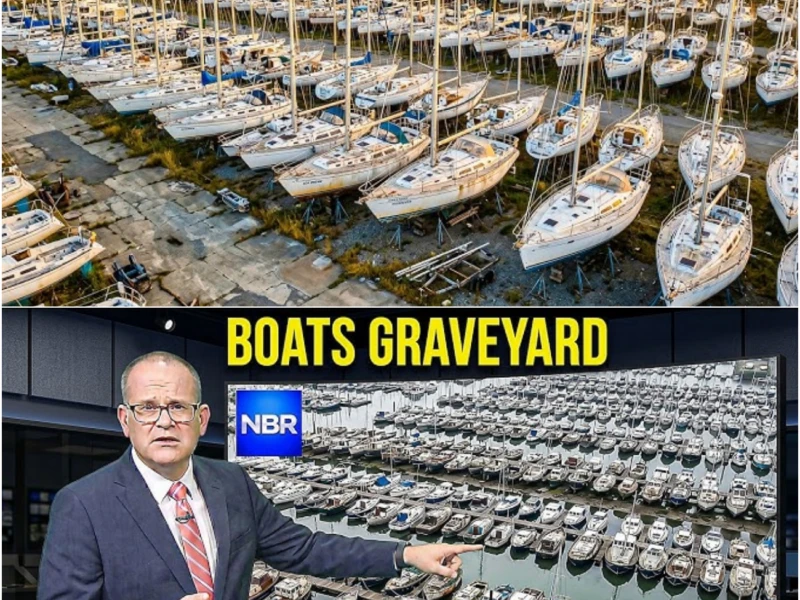
The American coastline has become a graveyard of dreams. If you stroll through almost any marina from the Florida Keys to the Pacific Northwest, you will encounter a haunting spectacle: thousands of once-pristine vessels sitting idle, their hulls stained, their rigging snapping in the wind, and their decks reclaimed by mold and neglect. This isn’t just a localized problem—it is a systemic rot that has turned the pride of American leisure into a multi-billion-dollar environmental and economic nightmare. The reason? A perfect storm of corporate greed, aging generations, and a financial trap that makes it cheaper to abandon a boat than to get rid of one.
For decades, the boating industry boomed, fueled by the massive output of fiberglass hulls between the 1960s and 1990s. These boats were built to last, but the owners who bought them have reached the end of their sailing years. As these original owners retire or pass away, they leave behind “ghost fleets”—vessels inherited by children who never wanted them and cannot afford the astronomical cost of maintenance. With lenders refusing to finance older hulls and insurance companies blacklisting boats in hurricane zones, owners find themselves trapped in a catch-22.
The financial reality is brutal. In many states, disposing of a 40-foot sailboat is an logistical, regulatory, and monetary horror show. Because these vessels contain heavy ballast and lead, they cannot be easily hauled or shredded like a car. The cost to salvage and properly dispose of a single neglected vessel can skyrocket to between $300 and $500 per foot. For a standard mid-sized sailboat, you are looking at a $20,000 bill just to make the problem disappear. For a struggling family, the choice becomes simple: walk away, leave the keys in the ignition, and let the marina deal with the wreckage.

The Corporate Takeover: Marinas as Profit Machines
The crisis is being accelerated by the “corporate-ization” of the American marina. Large investment groups have spent the last five years aggressively buying up independent docks, transforming them from community hubs into high-yield, premium-service entities. These corporations aren’t interested in the “DIY” sailor who tinkers with his engine and keeps his boat in good repair. They want the high-margin revenue of new yachts and wide-beam catamarans that come with service contracts worth thousands of dollars annually.
For older boats, the math is simple: they are a liability. A 30-year-old sailboat might net a marina $15 per foot per month in rent, but it occupies the same slip space as a newer vessel that could bring in $50 per foot. Consequently, marinas are quietly phasing out older boats through drastic fee hikes or outright bans, forcing owners into a corner. When an owner realizes their boat is effectively “homeless” because no dock will accept an older, low-yield vessel, abandonment becomes the final, desperate exit strategy.
The Environmental Time Bomb

What happens to these abandoned boats? They don’t just vanish. They sit, accumulating saltwater damage and electrical corrosion, until a major storm inevitably tears them from their moorings. In hurricane-prone regions, a single abandoned sailboat can turn into a lethal projectile, smashing into docks and other vessels, creating a “domino effect” of destruction. Taxpayers are increasingly left to foot the bill. In one recent case in Florida, the removal of a single neglected wreck cost taxpayers over $42,000—a bill that is becoming an all-too-common occurrence in local municipal budgets.
As we look toward the future, the scale of this “rot” is set to expand. We are seeing a generational turnover where the sheer volume of aging fiberglass vessels far exceeds the capacity of our current disposal infrastructure. If the industry does not shift toward a sustainable, federally-funded “end-of-life” program for these boats, our harbors will become increasingly hazardous, polluted, and inaccessible. We are witnessing the slow-motion collapse of an entire subculture, driven by the cold, hard reality that in modern America, it is often more profitable to let your property rot into the sea than to responsibly put it to rest.