Top Pharmacy Student Carries His Sick Disabled Mother Onto the Graduation Stage So She Can Witness the Moment She Sacrificed Everything For
Emotional Graduation Moment as Pharmacy Student Lifts His Disabled Mother to the Stage After Years of Sacrifice
On a humid graduation day in 2026 at Nguyen Tat Thanh University in Vietnam, the kind of heat that clings to skin and fabric alike, a quiet moment unfolded that would later travel far beyond the campus gates. It wasn’t announced. It wasn’t staged. And yet, within seconds, it became the moment everyone remembered.
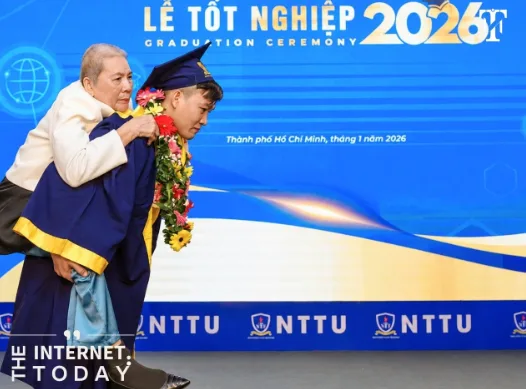
A young pharmacy graduate stepped onto the stage carrying his mother on his back.
Not as a gesture of symbolism. Not for applause. But because she could not walk.
And because he refused to let her miss what they had both sacrificed so much to reach.
Her name is not the headline. His is Phan Tri Dung. But inside that auditorium, for those few minutes, neither name mattered more than the bond between them.
What mattered was what they had endured to get there.
—
A JOURNEY THAT DIDN’T BEGIN ON GRADUATION DAY
To understand what happened on that stage, you have to understand what came before it.
Phan Tri Dung was not a student who arrived at graduation untouched by struggle. He was shaped by it—long before he ever put on a cap and gown.
In his final year of pharmacy studies, life did what it often does without warning: it broke the ground beneath him.
Just one month before his thesis defense, his father passed away.
There is a particular kind of silence that follows a loss like that. Not the absence of sound, but the absence of stability. The routines that once structured a life suddenly collapse. The future that once felt planned becomes uncertain.
For Dung, that silence was filled immediately with responsibility.
He did not take time off. He did not step back. He did not pause.
Instead, his days became something far heavier than any textbook could prepare him for.
Morning lectures. Afternoon internships. Evening hospital visits. Late-night bus rides home to check on his mother. Then the cycle repeated.
Again. And again.
No cameras followed him then. No audience watched. There was no applause for showing up to grief and continuing anyway.
Only exhaustion.
And obligation.
And love.

A MOTHER WHO ONCE STOOD IN HIS SHOES
There is another layer to this story that changes how it feels when you hear it.
Dung’s mother was not just a parent cheering from the sidelines.
She was a pharmacist herself.
She had once stood in lecture halls like the ones her son studied in. Once memorized formulas, drug classifications, treatment protocols. Once wore the same professional identity her son would eventually inherit.
Pharmacy was not just an academic path in their household.
It was legacy.
It was language.
It was identity.
And when illness later took away her ability to walk unaided, it did not take away what she had already built in him.
If anything, it made it more important.
Because what she had once practiced in a hospital or pharmacy counter, he was now determined to complete—not just for himself, but for her too.
—
THE MONTH THAT CHANGED EVERYTHING
The death of his father did not arrive gently. It arrived like most irreversible moments do—without permission.
For Dung, it meant more than grief. It meant structure collapsing overnight.
He became, in a matter of days, both student and caretaker.
Those who saw him during that period described a young man moving constantly. Never still. Never idle. Always transitioning from one responsibility to another.
Lectures to hospital.
Hospital to home.
Home to study.
Study back to lectures.
There was no dramatic declaration of struggle. No public display of hardship. Just persistence.
But beneath that persistence was something heavier: the quiet understanding that failure was not an option—not because of ambition, but because of family.
His mother needed him.
And he needed to finish what his father had believed he could complete.

A GRADUATION THAT BECAME SOMETHING ELSE
By the time graduation day arrived, Dung had already survived more than many would in an entire academic journey.
When his name was called, the expectation was simple: he would walk forward, receive his diploma, and step into the next chapter of his life.
That is what usually happens.
But what happened instead paused the room.
His mother was there, but she was not able to walk on her own.
Illness had taken that from her.
For a moment, there was hesitation—not from him, but from circumstance itself. The distance between where she sat and where he needed to go felt suddenly too wide.
Too final.
Too unfair.
And then he made a decision that would redefine the moment entirely.
He walked to her.
He lifted her carefully onto his back.
And he began to walk toward the stage.
—
THE WALK THAT SILENCED A HALL
Witnesses later described a shift in the atmosphere almost instantly.
Conversation faded.
Movement slowed.
Phones stopped mid-air.
The usual noise of a graduation ceremony—the rustling of gowns, scattered applause, quiet side conversations—was replaced by something else.
Attention.
Full, focused attention.
A young man carrying his mother across a stage designed for individual achievement suddenly turned that stage into something else entirely.
Not a celebration of one graduate.
But a visible record of shared sacrifice.
Each step forward carried weight far beyond physical strain.
It carried years of effort.
Years of labor.
Years of unseen sacrifice from a mother who once practiced pharmacy herself, now unable to stand without assistance.
And a son who refused to let that reality define the final chapter of her story.
—
SUCCESS REDEFINED IN REAL TIME
When he finally reached the stage, nothing about the ceremony followed its expected emotional script.
This was no longer just a graduation.
It was a reckoning with what success actually costs.
Because what the audience was witnessing wasn’t simply achievement.
It was continuity.
A transfer of legacy from one generation to another—not through words, but through presence.
Dung did not speak during that walk. There was no need.
His actions had already said everything.
That education is not only personal advancement.
That family sacrifice does not disappear when a degree is earned.
That sometimes achievement is not standing alone at the finish line—but refusing to leave the people who carried you there behind.
—
THE QUIET HISTORY BEHIND PUBLIC MOMENTS
After the ceremony, as images of the moment began to circulate, attention turned quickly to the deeper story.
Dung’s academic record reflected what those close to him already knew: he was not an accidental graduate. He was a top-performing pharmacy student, consistently disciplined, and deeply committed to his field.
But grades alone do not explain why someone carries their mother across a graduation stage.
Life does.
And in Dung’s case, life had been asking him for endurance long before it ever offered celebration.
The loss of his father had shifted everything. The illness of his mother had redefined daily life. Yet through it all, he continued moving forward—not as a symbol, but as a necessity.
There was no alternative version of him that stopped.
There was only the one that kept going.
—
A MOMENT THAT ESCAPED ITS OWN BORDERS
Within hours, the image of the graduation moment began circulating beyond the university.
Not because it was planned.
But because it was undeniable.
People responded not only to the visual impact, but to what it represented in a world where achievement is often presented as isolated success.
Here, success had weight.
It had history.
It had a mother on its back.
And it had a son refusing to set her down before the finish line.
—
WHAT REMAINS AFTER THE APPLAUSE
Long after the ceremony ended, what remains is not the sound of applause or the flash of cameras.
What remains is the image of a young man walking forward carrying someone who once carried him first.
It raises a question that lingers beyond the university gates:
What does success mean when it is built on sacrifice you did not make alone?
For Phan Tri Dung, the answer seems already written—not in words, but in action.
He did not walk across that stage alone.
And perhaps, he was never meant to.
Because some stories are not about reaching the end of a journey.
They are about who you refuse to leave behind while you get there.