What Life Is Really Like Inside the $500 Tiny Homes Changing Life for People Experiencing Homelessness
Inside the $500 Tiny Homes on Wheels Giving People Experiencing Homelessness a Safe Place to Call Home
What It’s Actually Like Living Inside Homeless People’s $500 Tiny Homes On Wheels

The Los Angeles sidewalk, lined with palm trees and indifferent commuters, hides a sprawling, silent crisis. For years, thousands of Americans have existed in the gaps of society, sleeping on cold concrete under the constant threat of violence, theft, and the elements. According to federal data from 2025, over 745,000 Americans are currently unhoused, with more than 161,000 in California alone. Amidst this, the wait for permanent housing in Los Angeles averages a staggering 867 days—nearly two and a half years of precarious, exposed survival .
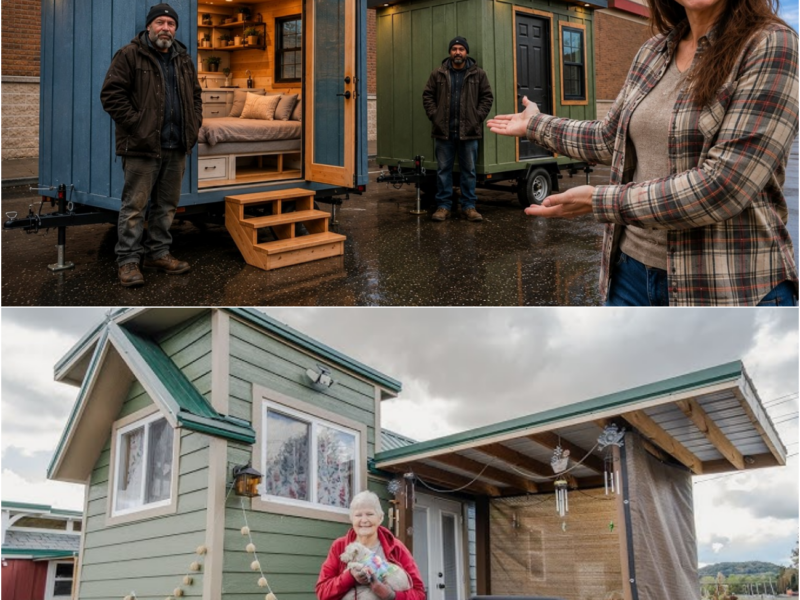
In this vacuum of official support, a radical movement has taken root. It began with Elvis Summers, a musician who watched a woman known as Smokey sleep in the dirt outside his apartment for years . In 2015, he decided he was done walking past. He spent less than $500 on lumber, built a small, 8-foot wooden house on wheels, and handed her the key . When she hung a sign on the door that read “Home sweet home,” it didn’t just mark the threshold of a structure; it signaled a transformation .
The Anatomy of Survival
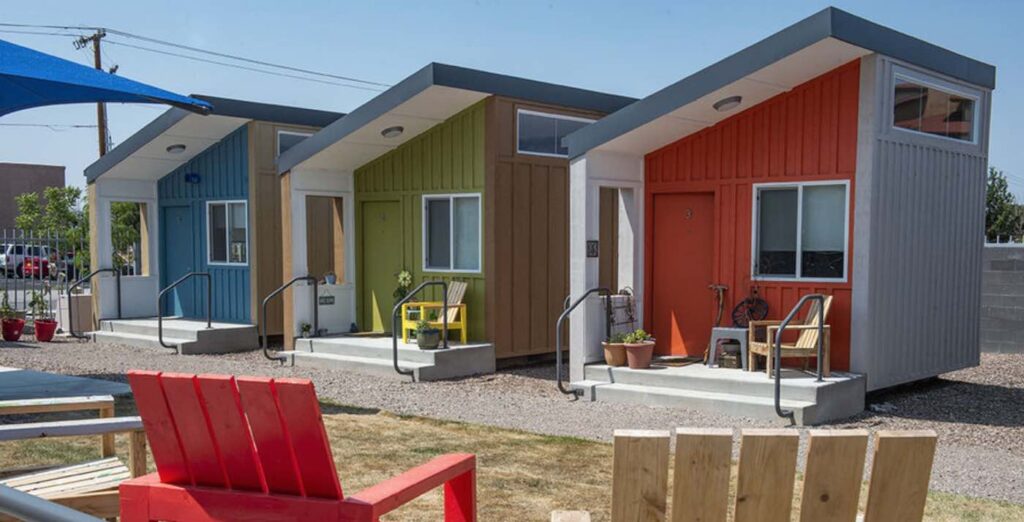
What does $500 actually buy in the world of survival? It is a stark, stripped-down architecture of necessity: a plywood floor bolted to a wooden frame, four walls sheathed in plywood, and a sloped roof to shed rain . There is no electricity, no plumbing, and barely enough room for a tall adult to stand upright . Yet, these dimensions—roughly 8 feet long by 4.5 feet wide—represent a luxury that is nearly impossible to quantify for those living in tents .
The most critical features are not the walls, but the wheels and the lock . A structure on wheels occupies a legal gray zone, making it significantly harder for city sanitation crews to classify it as illegal debris or an unauthorized structure to be demolished . It is a mobile, defensible perimeter in a landscape that otherwise treats the unhoused as invisible.

The Psychology of the Locked Door
To understand the impact of these homes, one must understand the cost of the tent. Residents speak of the “survival mode” required to sleep under an overpass, where the only barrier between a person and the world is a zipper . In those conditions, the brain never fully shuts down; it remains on watch for footsteps, flashlights, or sudden violence .
When a resident moves into a tiny home, the experience is immediate. One man, Kevin, told his benefactor, “That key you gave me to open that door, it reminded me what I was worth”. The plywood walls change the acoustic reality of the street. While residents can still hear the city—the passing cars, the footsteps—those sounds are now outside. In a tent, every noise was a decision: stay still or run. In the tiny home, a noise is just a noise . For many, it allows them to sleep through the night for the first time in years.
The Harshness of the Box
However, the romanticism of the tiny home ends the moment the weather turns. Plywood has almost no insulation value . In winter, the floor is an ice box, and the small interior volume, while cozy in concept, loses heat rapidly . Residents engage in a daily, high-stakes engineering game: using cardboard to insulate the floor, hanging fabric on walls to trap air, and carefully avoiding heaters that pose fire or carbon monoxide risks .

Summer brings the opposite extreme, where the plywood boxes become ovens, often reaching temperatures 20 degrees higher than the air outside . Daily maintenance is relentless. Condensation from a person’s own breath rots the wood and promotes mold, forcing residents to spend their mornings wiping walls and dragging bedding out to dry . There are no toilets, meaning a public restroom is often a 15-minute walk away, and water must be hauled in heavy five-gallon jugs .
Future Prospects and Policy Failure
Despite the hardships, the tiny home movement is proving to be a more effective launchpad than the institutional shelters it replaces. In Seattle, where tiny home villages have been integrated into broader social services, over 6,000 people have transitioned off the streets, with a 98% retention rate in permanent housing. Meanwhile, some conventional, high-budget programs in Los Angeles have seen nearly 40% of their placements return to the streets.
The reason lies in the nature of the “shelter.” Official shelters often come with curfews, forced separation of couples, bans on pets, and the constant threat of theft . A tiny home allows a resident to keep their partner beside them, their dog at their feet, and their belongings secure . Furthermore, because the home is stationary for weeks at a time, it provides an address—a critical piece of paper for job applications and caseworkers.
As we move toward 2027 and beyond, the debate over these structures will likely intensify. Some cities view them as a failure of policy, a “safety hazard” that justifies confiscation. Others are beginning to recognize that when the systems of the state stall for years, a $500 plywood box is not a desperate act—it is a rational, life-saving intervention. For a grandmother like Smokey, the difference between disappearing and starting over was not a complex government mandate; it was a neighbor with a hammer who decided they were finally done walking past.