Young Syrian Sister Protects Her Brother Beneath Earthquake Rubble—Both Children Are Miraculously Rescued Alive
Trapped in Earthquake Rubble, a Young Syrian Sister Protected Her Brother Until Rescue Teams Arrived
The Architecture of Love: Mariam, Ilaaf, and the Unyielding Bond Beneath the Rubble
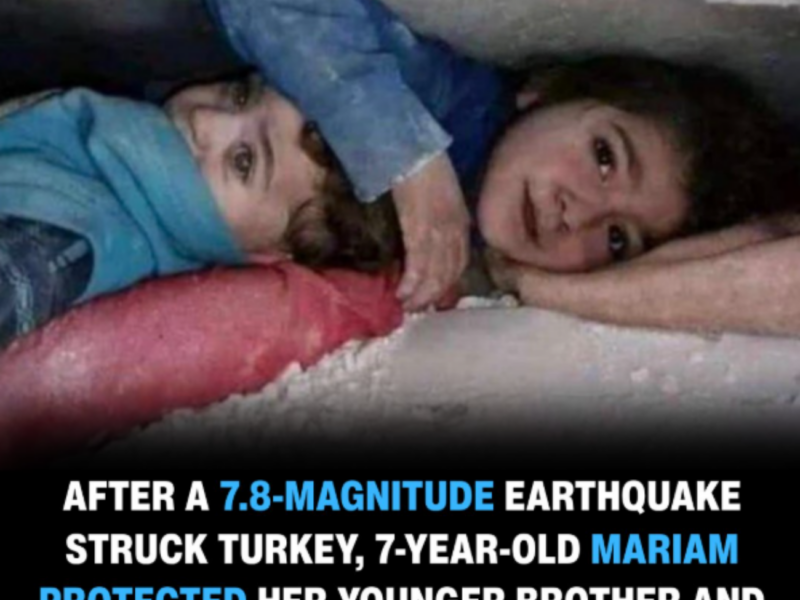
In the early morning hours of February 6, 2023, the earth beneath northwestern Syria and southern Turkey performed a violent, tectonic shift that would alter the course of thousands of lives in mere seconds. The earthquake, a cataclysm of seismic magnitude, reduced centuries of history and thousands of homes to tangled webs of rebar, concrete, and dust. Amidst the overwhelming scale of the destruction, where the sheer number of casualties threatened to numb the global conscience, a single image surfaced that pierced the darkness of the tragedy. It was a photograph of a young girl, Mariam, shielding her younger brother, Ilaaf, as they lay trapped beneath the debris of their family home near Harem.
To an American audience, thousands of miles removed from the immediate peril of the region, the story of these two children became more than just a news cycle item. It became a profound meditation on the nature of love, the instinct for protection, and the indomitable tenacity of the human spirit. In the crucible of the rubble, Mariam and Ilaaf performed a feat that is both biologically ancient and spiritually transcendent: they kept one another alive.
The Instinct of Protection: A Universal Language
When disaster strikes, the immediate human reaction is often described as the “fight or flight” response. For the adult, this usually manifests as a desperate search for safety. For Mariam, however, her instinct was not to flee, but to anchor.
Trapped in the suffocating darkness of a collapsed structure, the young sister did not succumb to the paralysis of fear. Instead, she performed an act of profound, instinctive maternal grace. By placing her body over her younger brother, she provided a physical and psychological barrier between him and the cold, crushing reality of their environment. In that narrow, dusty space, she became his sanctuary.
This behavior challenges our modern understanding of childhood. We often view children as beings who must be protected by adults. Yet, in the extremity of the Syrian earthquake, we saw a role reversal. Mariam, through her choice to protect Ilaaf, displayed a level of courage and self-sacrifice that we usually reserve for the most hardened heroes. This teaches us that the capacity for altruism is not learned through long years of instruction; it is woven into the very fabric of our being. It is a fundamental, unspoken promise we make to one another: I will stay, so you are not alone.

The Darkness as a Crucible
To understand the magnitude of their survival, one must contemplate the silence of the rubble. For hours—a duration that feels like an eternity when one is buried—these children existed in a state of suspended animation. There is a primal terror associated with being trapped, a sense of being forgotten by the world above.
The image that captured the world’s attention was not one of despair; it was one of deliberate, steady guardianship. The way Mariam’s hand rested on Ilaaf, the way her frame was positioned to deflect the weight of the ruin—these were not the actions of a child playing, but the deliberate decisions of a survivor.
For the American observer, accustomed to the comforts of safety and the relative stability of our infrastructure, the image of Mariam and Ilaaf forces a confrontation with our own vulnerabilities. It asks us: What would I do? Who would I reach for? The siblings’ survival was a victory against the indifference of nature. It was a protest against the reality of the destruction, a quiet assertion that even when the house falls, the bond of family remains upright.
The Global Echo: Why We Needed Them
The sharing of this story by public figures like Mohamad Safa turned a local tragedy into a global rallying point. In an age of digital disconnection, where we are often overwhelmed by the sheer volume of negative news, the rescue of Mariam and Ilaaf provided a pivot point.
Why does the survival of these children matter so much to a global audience? Because we are living in a time of great geopolitical anxiety, particularly regarding the Middle East. Often, the region is presented to Western audiences only through the lens of conflict, migration, or political instability. The story of Mariam and Ilaaf shifted the narrative. It reminded us that beneath the headlines of war and disaster, there exist human lives, human attachments, and human courage.
Their survival was a rare “miracle of the mundane”—the kind of victory that makes the impossible feel, for a fleeting moment, within reach. They became symbols of resilience, proving that even when a region is broken, the people within it are capable of incredible, defiant hope.

The Aftermath: The Responsibility of the Witness
Being a witness to such a story carries with it a certain responsibility. When we look at the photos of these children being pulled from the rubble, we are not merely spectators; we are participants in the global memory of the event.
The rescue of Mariam and Ilaaf was the beginning, not the end, of their journey. The trauma of such an event leaves indelible marks. As they moved into their recovery, the world watched, hoping for their healing. This speaks to the empathy that exists at the core of the American response to international disasters. Despite our differences, despite the distances, we remain deeply invested in the survival of the innocent. We recognize in Mariam and Ilaaf the faces of our own siblings, our own children, our own neighbors.
A Lesson in Resilience
The 2023 earthquake in Syria and Turkey was a tragedy of immense proportions, a disaster that scarred the landscape and the collective psyche of the region. Yet, in the middle of that scar, the story of the siblings remains a focal point of light.
Resilience is not the absence of tragedy; it is the presence of the will to survive it. Mariam and Ilaaf represent the very definition of resilience. They did not just survive because of the rescue teams, though those workers were the instruments of their salvation; they survived because they chose to hold on to one another.
Their story challenges us to prioritize the bonds we have in our own lives. In a world that is increasingly atomized, where we are often more connected to our devices than to the people in the rooms with us, the image of the sister protecting her brother is a corrective. It is a reminder that when the walls come down—literally or metaphorically—it is the person beside us, the one whose hand we hold, who makes the difference between despair and survival.

Conclusion: The Light Remains
Mariam and Ilaaf are no longer just two children from a village near Harem; they are part of the story of what it means to be human in the 21st century. Their survival is a beacon in the history of the 2023 earthquake, a story that will be told for generations to come as a testament to the power of familial love.
For the American reader, their story provides a perspective on the value of life that transcends borders. It asks us to cherish the protection we offer to others and to recognize the heroism that exists in the most humble of places. The architecture of the building they lived in may have failed, but the architecture of the love between them did not.
As the world continues to move forward, let us remember the siblings in the rubble. Let us remember that while the earth may shake and the structures we build may crumble, the most enduring human construction is the simple, powerful, and unyielding act of protecting the person we love. That is the true legacy of Mariam and Ilaaf—the enduring, unconquerable light of a love that survives even the darkest of days.