A34 Comet: Britain’s Most Perfect Tank — The Machine They Kept Hidden Until the War’s End! D
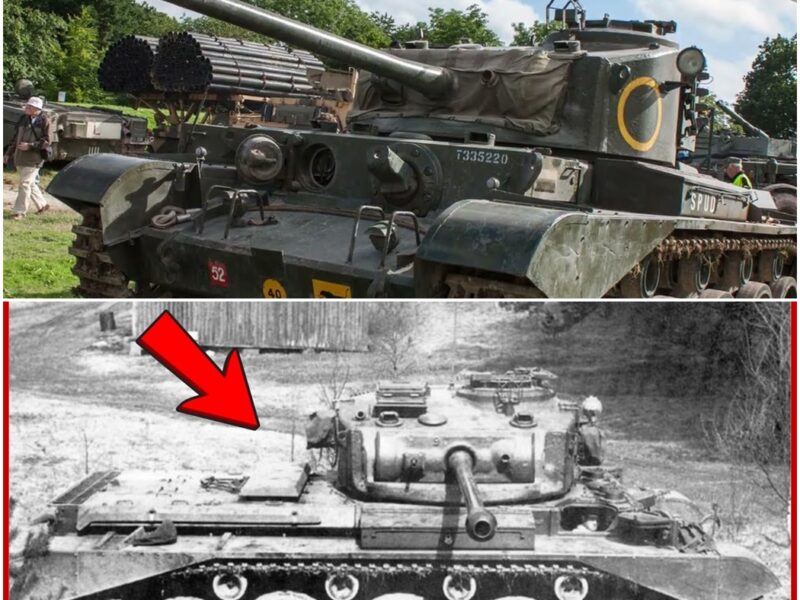
In the Tank Museum at Bovington, there is a vehicle that I find myself standing in front of for longer than any other machine in the collection. Not the Tiger, not the Matilda, not the Churchill with its infantry tank heritage and its long service record across three continents. The one I keep returning to is a British Cruiser tank that most people walk past without recognition.
A vehicle that entered service in December 1944, fired its guns in anger for the first time in March 1945, and then watched the war end two months later without having participated in a single major engagement. Its name is the Comet. Its designation is A34. And the question I want to spend time on today is not whether it was the best British tank of the Second World War.
The Tank Museum’s own assessment settles that, calling it the first Western Allied tank that was truly a match for the German big cats, but rather why it was the best, what it cost to get there, and what the story of its delayed arrival tells us about the five years of British tank development that preceded it.
Because the Comet story is not simply the story of a good tank that arrived too late. It is the story of what British armor doctrine got wrong for four consecutive years, what it took to understand those mistakes, and how the machine that finally corrected them was held back through production delays, retraining requirements, and the institutional caution of a command structure that had learned, painfully, not to trust its own tank designs until they had been proven.
Until the men who needed it most had spent another winter fighting in Cromwells and Shermans against Panthers and Tigers with guns that were marginal at best. If you find the specific, technical, human story of British tank development as compelling as I do, give this a like. Let us go through the Comet properly.
To understand what the Comet was, you first have to understand what it it not and what came before it. The British tank program of the Second World War produced in the first four years of the conflict a series of vehicles that can be divided into two categories.
Those that were adequate for the enemy they faced when they entered service, and those that were inadequate almost from the moment they appeared. The Matilda II, as I have discussed at length elsewhere, was genuinely formidable in 1939 and 1940 against the threats it encountered. The Churchill, despite its troubled early service, proved itself in Italy and Normandy as a reliable infantry support tank.
The Valentine was workable if unexciting. The cruiser tanks, the vehicles designed for speed and exploitation rather than infantry support, were a more complicated story. The Crusader was fast and unreliable. It broke down with a frequency that made it a logistics nightmare in the desert, where the distances were vast and spare parts arrived slowly.
Its 2-pounder gun, adequate against Italian armor in 1940, was increasingly marginal against the German tanks that arrived in North Africa from 1941 onwards. Its armor, 40 mm at the front in its later variants, was insufficient against the weapons it faced. Crews who liked the Crusader liked it for its speed.
They liked it the way you like a fast car that keeps breaking down with the specific affection of someone who knows the relationship is ultimately doomed. The Cromwell, which replaced the Crusader in British service from 1943, was a significant improvement. The Rolls-Royce Meteor engine, derived from the Merlin that powered the Spitfire, producing 450 horsepower in its tank form, gave the Cromwell a road speed of approximately 40 km per hour, and it was mechanically far more reliable than its predecessor. The crews who transitioned from Crusaders to Cromwells reported a quality of life improvement that went beyond the purely military. But the Cromwell had a fundamental limitation that its designers had built in from the start. Its turret ring, the circular mounting on which the turret rotated, was too small. The gun that the Cromwell needed to be competitive against the German armor appearing in
Normandy in the summer of 1944 was the 17-pounder, the most powerful British anti-tank gun of the period, capable of defeating the frontal armor of a panther at combat ranges. The 17-pounder was too large for the Cromwell’s turret. The turret ring that had been specified when the vehicle was designed could not accommodate it.
[sighs] The answer to this problem produced one of the more ungainly vehicles in British tank history. The A30 Challenger was a Cromwell hull with a new, much taller turret mounted on it. A turret large enough to house the 17-pounder, but so high that it created a vehicle whose silhouette was visible from considerable distance, and whose structural balance was compromised by the weight of the gun and turret combination sitting atop a hull not designed for it.
260 of them were built. They served in Normandy alongside the Cromwell regiments they were meant to support. Their crews were not entirely enthusiastic about what they had been given. The other answer was the Sherman Firefly, an American Sherman tank modified through considerable British engineering effort to mount the 17-pounder in its turret.
The Firefly worked. It was effective. And it was, in the most direct sense, an acknowledgement that British industry had not managed to produce from its own resources a cruiser tank capable of mounting the gun that the situation required. That acknowledgement, that you needed to take an American vehicle and rebuild it to carry your own gun, stings a little when you look at it honestly.
The design requirement that produced the Comet was issued in July 1943, after Kursk, after Sicily, after it was clear that the heavy armor the Germans were deploying in increasing numbers could not be reliably defeated by the weapons currently in service or planned for service.
The War Office wanted a cruiser tank, not an infantry tank, a cruiser, fast, mechanically reliable, capable of the exploitation and pursuit operations that the Cromwell had been designed for. But armed with a gun that could kill Panthers and Tigers at combat ranges, carrying armor thick enough to survive the weapons those tanks carried, and designed as a coherent whole rather than an improvised conversion of something that had been built for different purposes.
Leyland Motors were given the contract. They began with the Cromwell as their starting point, the same Meteor engine, the same mechanical layout, the same general philosophy. The improvements were specific and systematic. The Christie suspension was strengthened to carry the additional weight.
Return rollers were added to the track run. The hull armor was increased from the Cromwell’s maximum of 76 mm to a maximum of 101 mm on the turret front, a 33% improvement that made the Comet significantly harder to kill from the front at combat ranges. The turret was entirely new. And the turret is where the Comet story becomes technically interesting.
The problem with mounting the 17-pounder in a cruiser tank turret had defeated the Challenger design. The gun was simply too large, too long a breech, too much recoil, too great a demand on the turret ring diameter for a vehicle that needed to remain within the size constraints of a cruiser tank.
Vickers-Armstrong developed a solution that was elegant in its simplicity and effective in its results. They redesigned the gun itself. The weapon that emerged, designated the QF 77 mm HV, the HV standing for high velocity, was a 17-pounder that had been modified at both ends. The barrel was shortened slightly.
The cartridge case was made smaller, holding less propellant. The projectile remained the same, the same APCBC and APDS rounds that the full-size 17-pounder fired. The gun was physically smaller, lighter, and produced less recoil than its parent weapon, which meant it could fit in a turret ring that no full-size 17-pounder could have occupied.
The result was a gun that could penetrate 110-mm of armor at 1,000 yd with standard APBC ammunition, and 165-mm with APDS rounds. Those numbers need context to be meaningful. The Panther’s frontal hull armor was 80-mm, sloped at 55° from vertical, a geometry that increased its effective protection to approximately 140-mm against a direct frontal shot.
The Tiger’s frontal hull was 100-mm at a slight angle. At combat ranges, the ranges at which most tank engagements in northwestern Europe were actually fought, typically between 500 and 1,500 m, the Comet’s 77-mm gun could penetrate both. The Tank Museum’s assessment is precise on this point.
The Comet was the first Western Allied tank that was truly a match for the German big cats. There is a caveat worth stating honestly. The Panther’s gun, the 75-mm KwK 42 L/70, with its long barrel and high muzzle velocity, could penetrate the Comet’s frontal armor at ranges the Comet might not be comfortable with.
A Comet versus a Panther was not a guaranteed British victory. What it was, for the first time in the cruiser tank lineage, was a credible contest, a situation in which the British crew had a genuine chance of killing the vehicle facing them before it killed them, rather than needing to maneuver to a flank or wait for an opportunity that the tactical situation might not provide.
The Comet’s weight settled at 35 long tons, heavier than the Cromwell’s 27 tons, but considerably lighter than the Churchill’s nearly 40 tons in its later variants. The Rolls-Royce Meteor engine produced 600 horsepower in the Comet’s installation, giving a power to weight ratio of approximately 18 horsepower per ton, sufficient for a road speed of 32 mph and a cross-country performance of approximately 14 mph.
That road speed mattered more than it might initially appear. In the final months of the war in Germany, after the Rhine crossing, after the breakout from the bridgehead, after the collapse of organized German resistance in the west, the terrain was the Autobahn. The German motorway network, built in the 1930s under the four-year plan, was exactly what the name suggested: wide, well-surfaced, designed for sustained high speed.
A tank capable of 32 mph on a motorway was a different tactical proposition from a tank capable of 20 mph on a country road. The five crew members, commander, gunner, loader operator, driver, and hull gunner, worked in an interior that, by the standards of British tank design of the period, was considered workable.
The turret was cramped, as tank turrets always are, but the 77 mm gun’s reduced recoil and smaller cartridge case meant that the loader had somewhat more room to operate than his equivalent in a Sherman Firefly. The Merritt Brown gearbox, five forward speeds and one reverse, gave the driver a mechanical package that was familiar from the Cromwell and was generally regarded by the men who used it as reliable.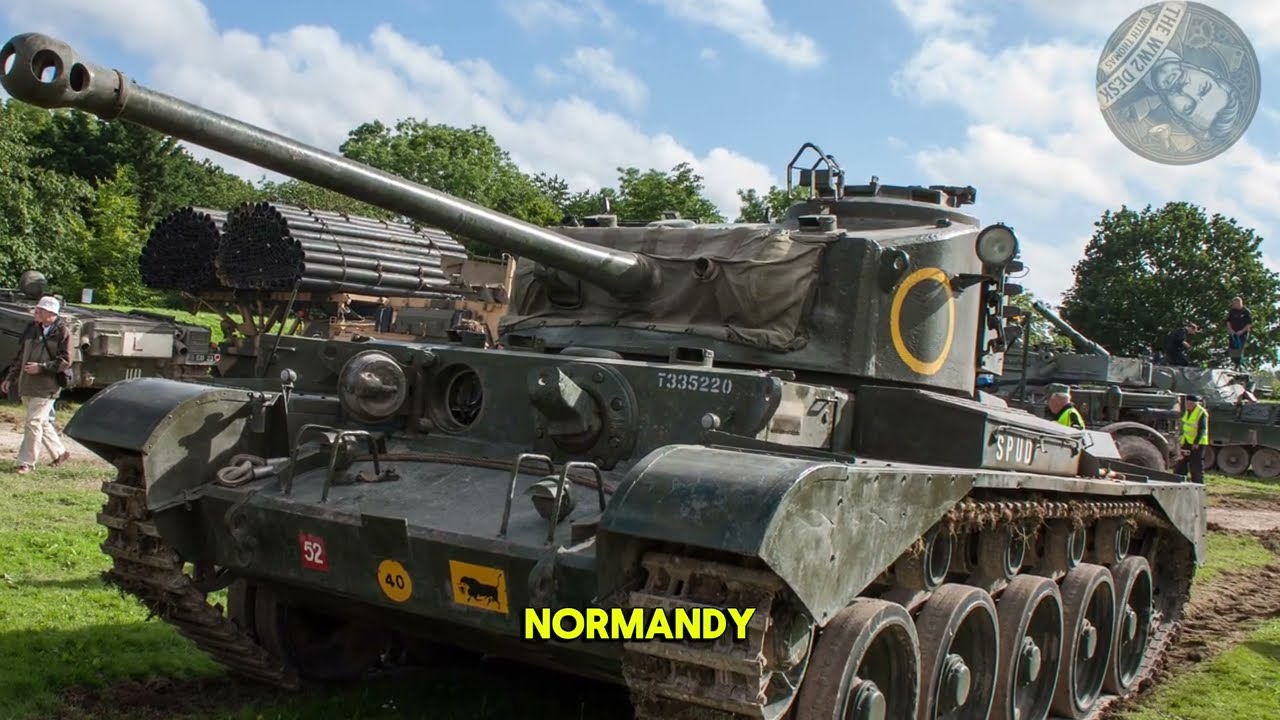
British tank crews of the period had learned to regard reliability as the most underrated of all armored vehicle virtues. After several years of driving machines that were fast, well-armed, and temperamental in the way that complicated engineering products tend to be when they are pushed beyond the pace that development programs would ideally allow.
Production began in September 1944. By December of that year, deliveries to the 11th Armoured Division had commenced. The division, the Black Bull as it was known from its formation sign, had fought through Normandy in Cromwells, had participated in the breakout and the advance to the Rhine, and was now being re-equipped with the best tank that British industry had yet produced.
The retraining requirement was significant. A crew that had spent months learning the specific characteristics of the Cromwell, its handling, its mechanical idiosyncrasies, the particular way its transmission responded to demand, was now required to absorb the differences of a new vehicle with a new gun whose ballistics required recalibration of every instinct that combat experience had built.
The gunnery training alone for men who had been accustomed to the 75-mm gun of the Cromwell represented weeks of adjustment before the 77-mm different trajectory and penetration characteristics became second nature. This retraining is one of the factors that delayed the Comet’s operational debut, and it is one of the factors that the official histories tend to mention briefly before moving on.
It deserves more attention. The British Army of late 1944 was not simply a collection of individual soldiers who could be handed a new vehicle and sent forward. It was an institutional organism, a system of trained crews, maintenance units, supply chains, and command procedures that had been built around specific equipment.
Changing that equipment required changing the whole system simultaneously, and the time required to do so properly was time during which the men who would eventually fight in Comets were still fighting in Cromwell’s against Panthers and Tigers with the same marginal armament they had carried into Normandy 6 months earlier.
The Comet went to war for the first time in March 1945 in the context of Operation Plunder, the crossing of the Rhine at Wesel. The operation began on the night of March 23rd to March 24th. British and Canadian infantry crossed the Rhine in amphibious carriers. Airborne forces, the British 6th and the American 17th Airborne divisions, dropped on the far bank in Operation Varsity, securing the high ground near Wesel.
Artillery fired from positions on the western bank. The scale of the operation was enormous. The British alone had stockpiled 60,000 tons of ammunition and 30,000 tons of engineer stores in preparation. When the Bailey bridge went up over the Rhine, a class 40 bridge capable of carrying the heaviest vehicles in the British inventory, the 11th Armoured Division crossed.
Its Comets drove over the bridge and into Germany. What happened next is one of the more remarkable chapters in the history of British Armoured operations, and it is one that receives almost no attention in the standard popular account of the war’s final months. The Comets raced from the Rhine to the Vaizey, from the Vaizey to the Elbe, river to river across northern Germany at speeds that the terrain and the quality of the Autobahn permitted, and that the Meteor engine and the Merritt Brown gearbox were built to sustain. The 11th Armoured Division, which had spent the summer of 1944 grinding through the bocage in Cromwell’s, was now covering ground at a pace that would have seemed fantastical to anyone who had watched the same formation move through Normandy. One account that I find particularly vivid, and which appears in multiple histories of the 11th Armoured’s final advance, describes the Comets on the Autobahn at full throttle, stowage flying off the rear decks, infantry passengers clinging to whatever
handholds they could find, the 35-ton vehicles screaming across the countryside at speeds approaching 30 mph. The German motorway network, built to demonstrate the efficiency of the Nazi economic program, was being used by British tanks as a racetrack. The division reached the Baltic in early May 1945.
The war ended before it had found a truly serious opponent for the Comet to engage. The Germans that encountered in those final weeks were, in most cases, not the concentrated armoured formations that the Panther and Tiger had been built to anchor. They were remnants, units that had been broken at the Rhine, scattered by the advance, and were either retreating eastward or attempting to surrender to British forces rather than Soviet ones.
The Comet participated in combat during those weeks. It destroyed vehicles, engaged positions, supported infantry in the specific, exhausting business of clearing towns and road junctions, but it never fought the battle it had been designed for, the sustained armoured engagement against concentrated German tank forces in which the 77-mm gun and the 101 mm of turret armour would have been tested against opponents fully capable of exploiting any weakness they found.
There is a question that hangs over the entire Comet story, and it is worth asking directly. Why did it arrive so late? The requirement was issued in July 1943. The prototype was ready in February 1944. Production began in September 1944.
The first deliveries reached the 11th Armoured Division in December 1944. The first combat use was March 1945. 20 months from requirement to first combat use for a vehicle that was in its designers description essentially a developed Cromwell, an evolutionary step rather than a revolutionary design. The Cromwell itself had been in production for more than a year by the time the Comet requirement was issued.
The Meteor engine was already proven. The Merritt Brown gearbox was already proven. The turret ring dimensions were the primary engineering challenge and the 77 mm gun that solved that challenge was developed in parallel. 20 months. And the vehicle that emerged was by the Tank Museum’s assessment the best British tank of the war.
The delay was not simple negligence or incompetence. It was the product of a specific institutional response to the accumulated experience of British tank development, an experience that had taught the army at considerable cost not to trust vehicles that had not been properly developed and proven before they reached the front line.
The Crusader had been sent to the desert before its mechanical reliability had been established and the men who crewed it spent as much time fixing it as fighting in it. The Churchill had been sent to Dieppe in August 1942 in its earliest form and 27 of the 29 that landed were disabled or destroyed without crossing the beach partly because of the terrain and the defenses but partly because the vehicle itself was not yet mature.
The Valentine had reached the desert in numbers because production was achievable not because the vehicle represented the best available design. By 1944 the British Army’s approach to new tank introduction had become systematically cautious. The retraining requirement for the Comet was taken seriously, more seriously arguably than the operational urgency demanded.
The decision to delay full deployment until the 11th armored division was completely re-equipped and its crews thoroughly trained reflected a preference for doing the job properly over doing it quickly. In the autumn of 1944, with the Normandy breakout achieved and the Allied armies advancing towards Germany, that preference was not obviously wrong.
The Cromwells and Fireflies in service were adequate, not ideal, but adequate for the operations being conducted. The Comet would be ready when it was ready. The German army’s surprise offensive in the Ardennes in December 1944, which pushed the Allied front back significantly in Belgium and produced the fiercest fighting the Western Front had seen since Normandy, would have been an ideal environment for Comets.
The 11th Armoured Division was not involved in the Ardennes fighting. It was still completing its retraining. The units that bore the brunt of the German breakthrough were equipped with Shermans and Cromwells. The Comet that might have changed the armored balance in Belgium in December 1944 was sitting in depots and training areas waiting for the retraining cycle to complete.
The 77 mm gun deserves a section of its own because it is the element of the Comet’s design that the standard accounts most consistently undervalue. The gun had a problem with its name. It was called the 77 mm, but its caliber was actually 76.2 mm, the same as the 17-pounder, the same as the American 76 mm gun, and the same as several other weapons in Allied service simultaneously.
The designation 77 mm was chosen specifically to avoid the confusion in ammunition supply that identical caliber numbers across different weapons would produce. The guns used different cartridge cases, different propellant charges, and different breech fittings. Three weapons that fired the same diameter projectile by entirely different means.
Calling one of them 77 mm was a logistics decision rather than a ballistic one. But the gun itself was rather good and good in a specific way that the standard comparison with the full-size 17-pounder tends to obscure. The 17-pounder was a superb anti-armor weapon. Its armor penetration was exceptional.
It could kill any German tank in service at combat ranges. What it could not do, reliably and effectively, was fire high explosive rounds. The gun had been designed around the anti-armor mission. The kinetic energy penetration that defeated steel by speed and mass. And the high explosive projectile, which performs differently from an armor-piercing one, and requires different design decisions in the propellant charge and fuzing, had been developed as something of an afterthought.
The 17-pounder’s high explosive round contained 480 g of explosive and was, by the assessment of the crews who used it, underwhelming. The 77-mm high explosive round contained 600 g. This was not a marginal improvement. It was a 25% increase in explosive content. A round that functioned in the infantry support role comparably to the Sherman’s 75-mm gun, which had been specifically designed around the high explosive mission, and was regarded by the infantry it supported as effective and reliable. The Comet’s 77-mm gun was, therefore, a genuinely dual-purpose weapon, capable of killing Panthers at combat range with APDS rounds, and capable of providing effective fire support to infantry with a high explosive round that actually worked. This combination had eluded British tank design throughout the war. The 2-pounder had been a pure anti-armor
weapon with no practical high explosive round at all. The 6-pounder had been similar. The 17-pounder had the anti-armor capability, but a marginal high explosive performance. The 75-mm fitted to some Cromwells had good high explosive performance, but limited anti-armor penetration against the heavier German vehicles.
The 77-mm gave crews both for the first time in a single weapon in a vehicle that was mechanically reliable and fast enough to exploit the opportunities that firepower created. The Tank Museum’s assessment that the 77-mm was a critical part of making the Comet the best British tank of the Second World War and the Western Allies first tank that was truly a match for the German big cats reflects exactly this combination of capabilities.
The Comet’s legacy extends beyond the war that it barely fought. It is, in the most direct technical sense, the machine that produced the Centurion. The Centurion program had been running in parallel with the Comet’s development, a heavier, more ambitious vehicle intended for the post-war era and the new threat environment that British military planners were already considering as the war in Europe entered its final phase.
The Centurion’s whole design, its turret concept, its gun arrangements, these were developed by engineers who were simultaneously developing the Comet, and the lessons of one program fed directly into the other. The Centurion was ready in prototype form in May 1945, just as the war in Europe ended.
Six prototypes arrived in Germany in the final days before the ceasefire. They were never fired in anger. The Centurion that would go on to serve in Korea, in Suez, in the Indo-Pakistani War, in the Six-Day War, in the Yom Kippur War, the tank that would be sold to 21 countries and remain in combat service in some of them into the 21st century was the direct descendant of the engineering program that had produced the Comet.
The lessons learned in making the A34 work, the turret ring dimensions, the gun balance, the suspension loads, the crew ergonomics, all of them fed into the A41 that became the Centurion. In that sense, the Comet’s legacy is considerably longer than the 8 weeks of combat it managed before the armistice.
[cough] The vehicles that the 11th armored division drove to the Baltic in May 1945, the Comets that screamed across the Autobahn with stowage flying off their decks, were the final expression of a design philosophy that had been developing since the Crusaders’ desert failures, through the Cromwell’s limitations, past the Challenger’s awkward compromise, to the specific engineering solution that the 77-mm gun and the strengthened Christie suspension represented. They were also the direct ancestors of the vehicle that would define British tank design for the next 40 years. The Comet at Bovington sits in the main hall, 35 tons of steel and engineering, finished in the dark green of the late war period. The turret is compact by the standards of what came before it, no taller than it needs to be, no wider than the 77-mm and its crew require. The hull has the family resemblance of the Cromwell, the same general lines, but heavier, more purposeful. The suspension beefed up to carry the weight
that 4 years of hard experience had determined was necessary. I sometimes think about what the crews of the 11th armored division felt when they first got into a Comet after months in Cromwells. The gun was bigger and better. The armor was thicker. The vehicle was heavier, but not slower.
And for the first time, for the first time in the careers of many of the men who drove it and commanded it and loaded its ammunition, they were sitting in a British tank that their gunnery instructors could tell them, honestly, would kill a Panther if they put the round in the right place at the right range.
That knowledge, the specific professional knowledge that your vehicle was capable of defeating what it was likely to face, is not a trivial thing. British tank crews had spent 4 years in vehicles where that knowledge was qualified, conditional, dependent on getting the angle right or the range close, or the shot to the flank that the tactical situation might not provide.
The Comet removed many of those conditions. It arrived in December 1944. The war ended in May 1945, five months, 1,200 produced, only one division completely re-equipped. The Rhine crossing and the race to the Baltic and then the ceasefire and the Berlin victory parade in July 1945, where Comets drove through the ruins of the German capital in the formal marking of what had been achieved.
The tank that should have fought in Normandy arrived in Germany. The tank that would have transformed the armored balance in Normandy was the foundation of the vehicle that served through Korea and Suez and beyond. The Comet was too late for the war it was designed for and too early for the peace it was designed to outlast.
The men of the 11th armored division drove it to the Baltic anyway, at 32 mph on the Autobahn, stowage flying, infantry clinging on. They were, by every account that survived them, rather proud of what they were driving. On the evidence of what the 77 mm and the Meteor engine and the 101 mm of turret armor could do, they had every right to be proud.