Black Prince: The British Tank the Germans Would Never Want to Face! The WW2 Desk with Thomas D
There is a vehicle at Bobington that stops people in their tracks. Not because it is the most famous tank in the collection, but because it is, depending on how you look at it, either the most formidable British tank of the Second World War or the most comprehensively useless one. Both assessments are accurate.
Simultaneously, the Black Prince, formerly designated the A43 Tank Infantry MarkV, carried 152 mm of frontal armor. To put that number in direct context, [music] the Tiger 1, the most feared German tank of the entire war, carried 100 mm on its hullfront. The Panther, which combined thick sloped armor with devastating firepower and was considered by many German commanders the finest tank Germany produced, had 80 mm of hull front at 55°.
The Black Prince, in terms of raw protection, was better armored than either of them. Its main gun was the Ordinance QF17 pounder, the most powerful anti-tank weapon the Allies fielded in the war. Capable of penetrating 163 mm of armor at 500 m with standard APCBC ammunition. 152 mm of armor that the 17 pounders round could not reliably penetrate, [music] combined with a 17 pounder gun that could defeat everything the Germans had in the field.
On paper, the Black Prince was the tank that German armor crews did not want to see coming towards them. It came towards them at 10 1/2 mph maximum on a road in ideal conditions. The Bedford engine that powered this 50ton vehicle produced 350 horsepower. That gives you a powertoweight ratio of 7 horsepower per ton.
The Tiger 1, the German vehicle the Black Prince was designed to defeat, managed 13 1/2. The Panther achieved 15.6. The Comet, the best British cruiser tank of the war, achieved approximately 18. A determined infantryman with a bicycle, could in the right terrain conditions, maintain pace with a Black Prince for a significant portion of the working day.
This is the specific technical and deeply human tension at the heart of the Black Prince’s story. Not simply that it was slow. Many successful tanks have been slow. But that the same program that gave it 152 mm of armor and the most capable anti-tank gun in the Allied arsenal also gave it an engine that was entirely inadequate for the weight of vehicle it was expected to move.
And the men who pointed this out during the design process were overruled. That overruling and the institutional logic behind it is what I want to spend time on today. Because the Black Prince’s story is not simply the story of a vehicle that arrived too late. It is the story of what happens when the right idea runs into the wrong engine.
And what that specific collision tells us about British tank development at the end of the war. Give this a like if the specific honest story of what Britain built and why is what you are here for. Let me begin with the problem the Black Prince was designed to solve. By the autumn of 1943, British armored doctrine was facing a contradiction it could not resolve within its existing equipment.
The Churchill tank, the standard British infantry tank, which had entered service in 1941 and had served through the North African and Italian campaigns, was proving itself in the specific role it had been designed for. It was wellarmored. It was mechanically reliable by the standards of British tank design of the period.
It could climb gradients and cross obstacles that left other tanks stranded. At the Maja Valley in Tunisia, Churchills went up slopes that German commanders had considered impossible for armor on the Italian peninsula. The vehicle’s ability to work in terrain that made conventional armored operations extremely difficult, made it in certain conditions genuinely invaluable.
The Churchill’s problem was its gun. The QF6 pounder, the main armorament of most Churchill variants through the middle period of the war, was adequate against the Italian armor the vehicle had initially faced against the German Panza 3 and early Panza 4. It was competitive against the Tiger, which appeared in Tunisia in early 1943.
It was insufficient against the Panther, which appeared in Italy in 1943 and would dominate the Normandy battlefield in 1944. It was essentially irrelevant at anything beyond point blank range. The British were not without solutions to this problem. The Sherman Firefly, an American Sherman tank modified to mount the 17 pounder in a redesigned turret, had demonstrated that the gun could be installed in a tank, though at considerable cost in loader comfort and ammunition stowage.
The A30 Challenger was an attempt to mount the 17 pounder in a cruiser tank hull, which produced a vehicle whose turret was too tall and whose structural balance was compromised by the weight of the gun and turret combination. The A34 Comet, the 77 mm armed cruiser tank I have discussed previously, was the most successful answer to the firepower problem in the cruiser lineage.
But the infantry tank lineage had no equivalent answer. The Churchill’s turret ring, the circular mounting on which the turret rotated, [music] was too small for the 17 pounder. You could not simply drop the new gun into the existing vehicle. The turret ring needed to be widened and widening the turret ring required widening the hull.
And widening the hull meant, in effect designing a new vehicle rather than modifying an existing one. [clears throat] In September 1943, Vauxhall Motors was asked to produce a version of the Churchill that could carry the new gun. The requirement was designated A43. The vehicle it would produce would be named the Black Prince.
And the decision that shaped everything about what the Black Prince became was made in that initial specification. A decision that the director of the Royal Armored Corps and several other senior figures immediately and specifically objected to. The first prototype would use the existing Bedford engine, the underpowered, inadequate, entirely insufficient Bedford engine that had been powering the Churchill since 1941.
An engine producing 350 horsepower in a vehicle that now weighed 50 long tons. The objectors pointed out with the specificity that technical objections require that this would make the A43 slower than the Churchill it was supposed to improve upon. They were brushed aside. The first prototype completed in January 1945 had a top speed of 10 1/2 mph, proving their case exactly.
The dimensions of the Black Prince are worth describing in some detail because they tell you something specific about the engineering decisions that produced it. To accommodate the 17 pounders wider turret ring, the hull was widened to 11 ft and 3 1/2 in, approximately 8 1/2 in wider than the Churchill.
This created a vehicle that was no longer within the British railway loading gauge that constrained the width of tanks that needed to be transported by train. The Black Prince to be moved by rail required special arrangements. This was not a fatal problem. The Sherman Firefly had similar constraints, but it was a logistical complication that added to the vehicle’s operational burden.
The wider hull required wider tracks, 24 in, compared to the Churchill’s previous track width, which added further to the overall ground contact footprint and to the weight. The suspension system, originally designed for the Churchill’s 40 ton battle weight, was modified with additional springs to cope with the extra 10 tons. The modifications worked in the sense that the vehicle could move without the suspension collapsing.
They did not work in the sense of making it feel to anyone who drove it like a vehicle that had been properly designed for its own weight. The turret that sat on this widened hull was entirely new. And this is the component that makes the Black Prince’s story interesting rather than simply melancholy.
The new turret was substantially larger than the Churchill’s existing turret, specifically to accommodate the 17 pounders breach mechanism, and the practical working space a loader needed to operate with it. The turret ring diameter was wide enough, a point that the TOG2’s design history had demonstrated was the critical constraint on mounting the 17 pounder in a turret to allow the gun to be installed without the compromises that had plagued the A30 Challenger.
The 17 pounder sat in the Black Prince’s turret with more elegance than it had managed in almost any other British vehicle, which meant [clears throat] that the most important component of the vehicle, the gun and its installation, was right. The [clears throat] 17 pounder fired the same APCBC and APDS ammunition as the Sherman Firefly.
At 500 m, APCBC penetrated 163 mm of armor. APDS, the discarding Sabo round that was just entering service in the final months of the war pushed that figure considerably higher with muzzle velocities approaching 4,000 ft per second. In practical terms, the Black Prince’s gun could kill every German armored vehicle in service in 1944 and 1945 at the ranges at which most tank engagements in Northwest Europe were actually fought.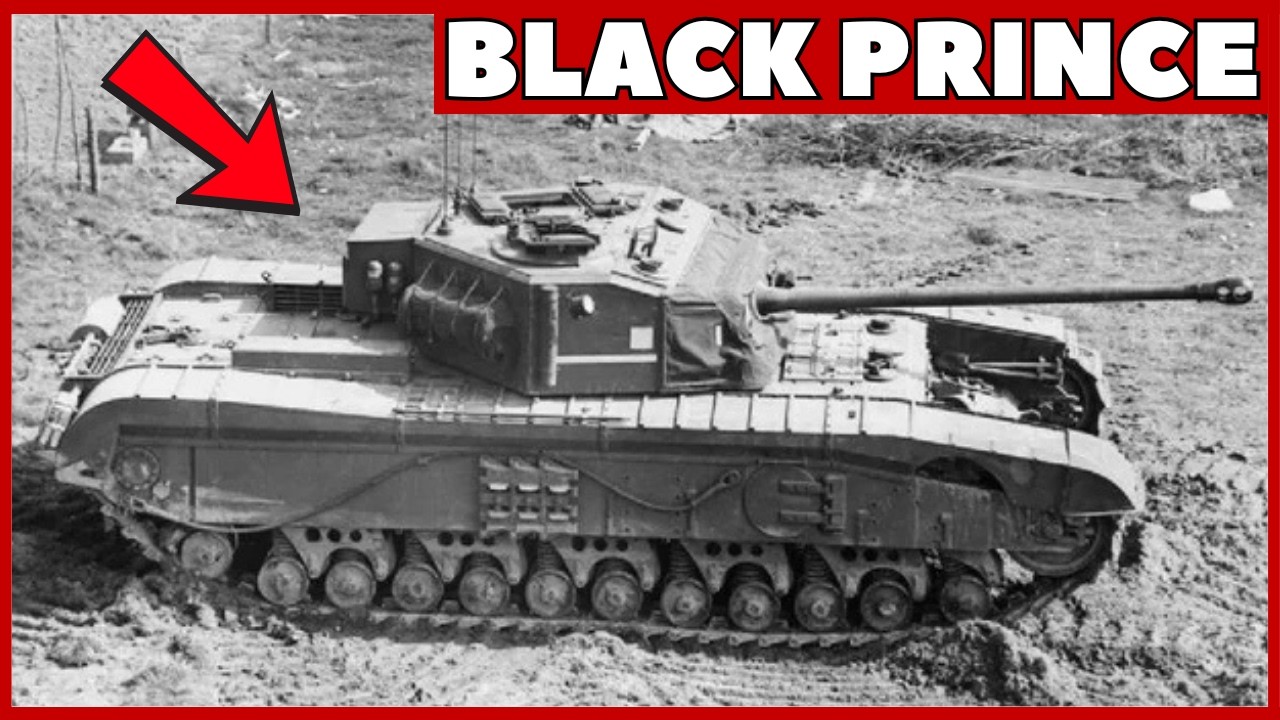
The combination of that gun with 152 mm of frontal armor produced on paper a vehicle that German armor crews would have found deeply uncomfortable to engage. Not because it was fast. It was not fast, but because at the ranges where the Black Prince’s gun was lethal, most German anti-tank weapons could not reliably penetrate its frontal armor in return.
A Tiger 1 with its 88 mm gun could penetrate the Black Prince’s hull front at approximately 500 m with its standard AP ammunition. Beyond that range, the Encounter favored the Black Prince. The Panther’s 75 mm gun struggled against 152 mm of vertical armor at any practical combat range. The problem was reaching those ranges without being outflanked by a determined man on a brisk walk.
There is an institutional story here that deserves more attention than the vehicle itself usually receives. Because the decisions that produced the Black Prince’s specific combination of extraordinary armor, formidable firepower, and catastrophically inadequate mobility [music] were not accidents.
They were the products of specific, documented, contested choices made by specific people in specific circumstances. The director of the Royal Armored Corps, the officer responsible for the British Army’s armored vehicle requirements, pointed out in the autumn of 1943 that fitting the Bedford engine to a 50 ton vehicle was going to produce something slower than anything the Army currently operated. He was not wrong.
The Churchill Mark 7, which the Black Prince was supposed to improve upon, had a road speed of approximately 15 mph. The Black Prince carrying an additional 10 tons on the same engine achieved 10 12. The counterargument that overruled him was essentially one of timeline. The army needed a Churchill type vehicle with 17 pounder capability as soon as possible.
Developing or sourcing a new engine, even the Rolls-Royce Meteor, which was producing 600 horsepower in the Cromwell and the Comet, would take time. The Bedford was available immediately. The first prototypes would use the Bedford and later production models would receive a more powerful engine. This argument was institutionally coherent and practically disastrous.
It was coherent because the timeline pressure was real. The army in the autumn of 1943 was looking at the prospect of operations in northwest Europe. The Normandy campaign that was then in planning and needed a heavy infantry tank with adequate anti-armour capability before those operations began.
Waiting 18 months for the right engine meant not having the vehicle at all for the campaign it was being designed for. It was disastrous [music] because 10 and a half miles per hour is not a road speed that allows a tank to be tactically useful in anything beyond the most static defensive or deliberate assault situations.
A vehicle that cannot keep pace with infantry in the advance. That cannot reposition when flanked, that cannot exploit a breach in the enemy line is a vehicle that can only be used in specific, carefully controlled conditions. The Black Prince at 10 1/2 mph was an extraordinarily capable pillbox.
It was not a tank in the operational sense that the campaigns of 1944 and 1945 required. The plan for production was in its initial form ambitious in the way that wartime procurement plans often were. If testing went well, 300 of the 17 pounder variant would be ordered with deliveries to begin in May or June of 1945. They would then be followed by a version powered by the Meteor engine, which would have produced in a 50 ton vehicle a powertoweight ratio of approximately 12 horsepower per ton.
Still not exceptional, but sufficient for a useful road speed in the region of 20 to 25 mph. [clears throat] The meteorineed Black Prince would have been a fundamentally different vehicle from the Bedford engineed prototype. [clears throat and cough] 12 horsepower per ton in a 50 ton chassis with 152 mm of frontal armor and a 17 pounder gun would have produced something that had no exact equivalent in any army’s inventory at the end of the Second World War.
The nearest comparison, the German Tiger 2, the Kernig Tiger, weighed 68 tons, carried 150 mm of frontal armor at a 10° slope, and achieved a road speed of approximately 25 mph on its Maybback engine. The Black Prince, meteor engineed and in production, would have been a broadly comparable vehicle, heavier than any conventional tank the Allies had fielded, better armored than almost anything the Germans had produced, and armed with the gun that the tactical experience of the war had confirmed was the decisive anti-armour weapon in the Allied infantry. This vehicle never existed. The prototype that was built used the Bedford engine. Testing proceeded through the spring of 1945. In May of that year, Germany surrendered. The 300 Black Princes that were supposed to begin delivery in May or June were never ordered because the enemy they were designed to fight no
longer existed. Six prototypes. That is the entire production run of the A43 Black Prince. There is something worth examining in the gap between what the Black Prince was and what it was supposed to become. Because that gap illuminates a broader question about British tank development at the end of the war.
The pattern that produced the Black Prince, adequate armor, adequate gun, inadequate engine in the initial version with a better powered variant planned but never built is a pattern that appears repeatedly in British armored vehicle development from 1940 onwards. The Crusader was sent to the desert before its mechanical reliability was established.
The Churchill was sent to DEP before its design had matured. The A30 Challenger was built with a turret too tall for its hull because the schedule pressure did not allow for a better solution. In each case, the institutional response to the pressure of ongoing operations was to deploy what was available rather than wait for what was needed.
Sometimes this produced vehicles that were adequate despite their flaws. Sometimes it produced vehicles that were inadequate and knew it. The Black Prince falls into the second category. Not because the concept was wrong, but because the engine chosen for the prototype made the concept impossible to demonstrate in its full potential.
The question the Black Prince implicitly asks is whether the British tank development system of the Second World War was capable of learning from its own iterations quickly enough to produce the right vehicle at the right moment. The answer across the full arc of the war is a qualified yes.
The comet, [music] which I have discussed in a previous video, was the correct answer to the cruiser tank problem, and it arrived in time for the Ry crossing. The Centurion, the direct successor to both the Comet and the Black Prince’s design philosophy, was essentially correct and arrived in prototype form before the war ended.
But the Black Prince itself, the answer to the infantry tank problem, the vehicle that combined Churchill level protection with the 17 pounder that every British tank in the field needed, arrived at Vauxhall’s factory floor in January 1945, moving at 10 12 mph, 6 months before the war ended and 300 units short of the production run that had been planned.
At Bobington, the surviving prototype sits in the collection with the same proximity to the Comet and the Centurion that it had in the design sequence. The last of the infantry tanks adjacent to the first of the main battle tanks, separated from both by the specific and irresolvable problem of the Bedford engine.
>> [clears throat] >> The 17 pounders performance deserves its own treatment because it is the component of the Black Prince that was genuinely unambiguously correct and because it represents the specific engineering achievement that the rest of the vehicle failed to adequately support.
The Ordinance QF17 pounder entered British service in 1942 as a towed anti-tank gun. It was from its first deployment at Lalamagne considered the most effective Allied anti-tank weapon of the war, by the crews who used it, by the commanders who requested it, and by the German vehicle crews on the receiving end of it.
Its standard APCBC round fired at a muzzle velocity of approximately 2,860 ft/s [music] penetrated 122 mm of armor at 500 m against a 60° plate. the standard test angle used in German armor specifications. Its APDS round, which appeared in the final period of the war, fired at 3,950 ft pers, a muzzle velocity that [music] gave it penetration figures against the most heavily armored German vehicles at ranges that no previous British anti-tank weapon had managed.
A Panther’s 80 mm front slope was penetrable by APDS at ranges beyond 1,000 m. A Tiger’s hull front was penetrable at similar distances. The 17 pounder was the gun that German armor crews had spent the middle years of the war not wanting to face, and the Black Prince mounted it in a turret that gave the loader more room to work than any previous [music] British installation.
The specific installation details matter. In the Sherman Firefly, the other significant British vehicle to mount the 17p pounder in a turret, the gun’s length had required the radio to be moved to a box on the turret exterior. The loader had to work in a confined space that the brereech dominated, and the commander’s position was compromised by the gun’s breach sweep.
The Black Prince’s wider turret had no such problems. The 17 pounder sat in it as the gun had been intended to sit with adequate loader space, a proper commander’s position, and a turret that rotated on a ring large enough to mount the weapon without the structural compromises that smaller turret rings imposed.
In this respect, the gun installation, the Black Prince, was the most correct solution to the 17 pounder in a turret problem that British industry produced during the war. The Comet’s 77 mm was a capable weapon, but it was a modified 17 pounder rather than the full specification gun. The Fireflyy’s installation was operationally effective, but ergonomically compromised.
The Black Prince’s installation was right in a way that neither of the others fully achieved. It moved at 10 1/2 mph. There is a final question worth sitting with, the question the title poses, which is whether the Germans would truly not have wanted to face this vehicle. The honest answer is that German armored doctrine by 1945 was not producing many vehicles capable of killing the Black Prince from the front at medium ranges.
The 17 pounders APDS round at 1,000 m penetrated armor that the standard German anti-tank weapons of the period struggled to match. The Tiger 2’s 88 mm gun could penetrate 152 mm of vertical armor at approximately 500 m, a range that, given the Black Prince’s own gun capability, would have been extremely costly for the Tiger 2 crew to achieve.
At longer ranges, the engagement physics tilted towards the Black Prince. What German armor crews would actually have done encountering a Black Prince in the field conditions of 1945 is rather more complex than the specification sheet suggests. They would have done what they did against every slow, heavily armored opponent.
Used mobility and terrain to maneuver to the flanks where the Black Prince’s side and rear armor considerably thinner than its frontal plate was vulnerable. They would have used anti-tank guns rather than tanks because towed guns have tactical flexibility that a 10 12 mph vehicle cannot easily counter. They would have used the same techniques that had worked against the Churchill which the Black Prince resembled in every tactical respect except its firepower.
The German armor crews who would not have wanted to face the Black Prince were specifically the ones in front of it on a road in a straight line with no room to maneuver which in the terrain of 1945 Germany, the autobarn, the Ry plane, the open agricultural land of the north, described some situations and not others.
The Black Prince at Boington sits at the end of a lineage that stretches back to the Valentine and the Matilda and the Churchill. It is the final expression of a design philosophy. The infantry tank, the slow, heavily armored vehicle designed to walk alongside foot soldiers and absorb whatever was thrown at it that the Second World War had shown was necessary and the postwar world would show was obsolete.
The Centurion that succeeded it abandoned the distinction between infantry and cruiser tanks entirely, producing a single vehicle that was fast enough for the cruiser role and armored enough for the infantry role. The Black Prince never fought. Its six prototypes were evaluated, assessed, and ultimately cancelled by a war that ended before the production order was signed.
The one that survived to Boington is a 50ton question mark. An answer to a problem that was correctly identified. correctly specified in terms of firepower and protection and then given an engine that made the answer impossible to deliver before the problem disappeared. In another timeline, one where the meteor engine had been specified from the beginning, one where the production order had been placed 6 months earlier, one where the war in Europe had lasted into late 1945 rather than ending in May, the Black Prince might have been the vehicle its specification promised. 152 mm of armor, the 17 pounder, a meteor engine producing 600 horsepower in a 50ton chassis. That vehicle would genuinely have been something that German armor crews did not want to face. The vehicle that was actually built moved at 10 1/2 mph and fired the right gun from inside the right armor and
solved every problem except the one that mattered most in the field. It is in the end the most perfectly British story in the entire history of British tank development.