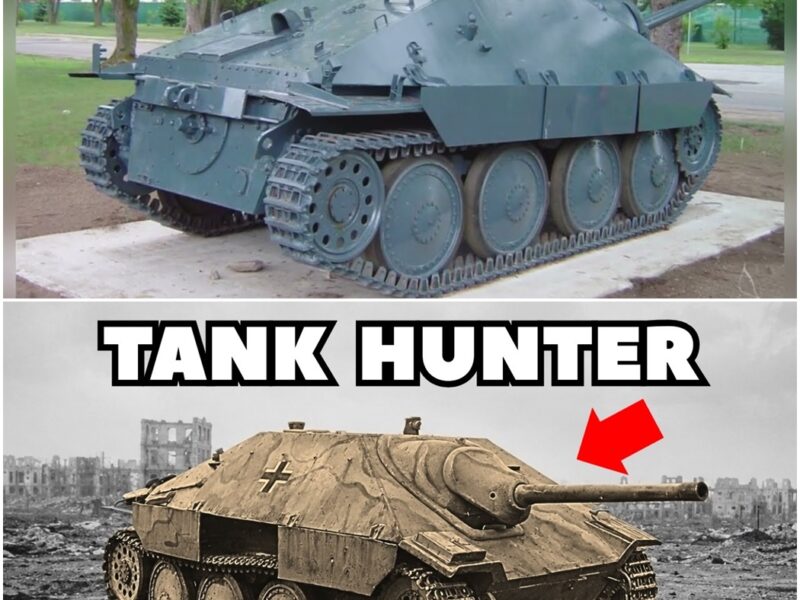
Blind tank destroyer that kept the ENTIRE front in FEAR | Hetzer D
Hello friends. Today the focus of our attention is the legendary German Hetzer, a machine that became a symbol of ambush warfare. Technically, it is a light anti-tank self-propelled gun, but in reality it became the benchmark of ambush weapons. How did it happen that a self-propelled gun hastily assembled from outdated Czech parts became the most dangerous nightmare for Soviet and Allied tank crews in 1944? Why was this nimble hunter virtually blind on its right side? Why did factory workers secretly remove the muzzle break? And what feature did the Germans copy from the Soviet SU-85? We will analyze the hidden technical nuances of this machine. I recommend watching this video until the end. The final details will make you look at the combat value of this little wasp in a completely different way. The year is 1943. The Eastern Front is bursting at the seams. Along the roads of Europe through mud and dust, columns of German
self-propelled guns are moving. The Marder family is the workhorse of the German anti-tank units. A long gun barrel, an angular silhouette, an open-topped fighting compartment. The soldiers inside can see the sky above. In good weather, this is almost pleasant. In bad weather, it is a death sentence.
The Marder was designed to be quick and cheap. The Germans took the outdated chassis of the Czech Pz.Kpfw. 38 (t) tank, mounted a powerful anti-tank gun on it, and called it a solution to their problem. Side armor was only 15 mm. The top was completely open. Any nearby exploding artillery shell fragment, any bullet fired from high ground, and the crew paid for this compromise with their lives.
A trained artillery gunner is not just someone with a military ID. It represents at least 2 years of training, specific skills, and experience that cannot be passed on in a single week at a training ground. Yet such valuable personnel were lost repeatedly. Not because the vehicle was poorly armed, but because it was almost completely unprotected.
By the end of 1943, the Wehrmacht High Command recognized this. But the crisis had another dimension, and it was far more acute than the loss statistics. In November 1943, British and American bombers struck Berlin. More precisely, they targeted one specific address in Berlin, the Alkett company plant, the largest manufacturer of assault guns in Germany.
These were the workshops where the Sturmgeschütz III and Sturmgeschütz IV, the main workhorses of the German self-propelled artillery, were assembled. Following the raid, most of Alkett’s production workshops were disabled. This was not just an industrial accident. It was a catastrophe that instantly threatened the entire production plan for self-propelled artillery for 1944.
By then, Alkett’s assault guns also covered anti-tank duties. They were a versatile tool on the battlefield. Now, that tool was suddenly in critically short supply. The High Command looked at the production plan figures, then at the front-line reports, and then back at the figures. And at that moment, they remembered Prague.
The Prague-based BMM factory, Böhmisch-Mährische Maschinenfabrik, was at that very moment producing those same outdated Marder IIIs. A modest enterprise in an occupied city with no high-technology or special status. It was simply a factory that knew how to work with the Czech PZ.38(t) chassis better than anyone else.
The High Command set a task. Create a new anti-tank self-propelled gun. It had to be inexpensive, simple to produce, and this time properly armored. The deadline was minimal, resources were scarce, and the situation on the fronts could not wait. BMM’s engineers took up their pencils and leaned over their drafting tables.
And that is when something very interesting came to light. They had already been working since 1943. It was back then, months before Berlin sent an official request, months before the high command even formulated the task, that the engineers of the Prague BMM plant were already working on a new vehicle.
They did so on their own initiative without an official order and with no guarantees that anyone would ever need it. It is important to understand this correctly. They did not wait for permission. They simply saw the same problems as everyone else. They saw how the Marders returned from the front or failed to return.
They realized that the Pz.Kpfw. 38(t) tank chassis they worked with daily could be used differently and better. So, they started designing. When the official request from Berlin finally arrived in December 1943, BMM already had something to show. The project was presented to the military commission that same December.
Very little time had passed since the air strike on Alkett, yet the Prague designers were already standing before the acceptance commission with finished blueprints. The commission approved the project and then began what is known in mechanical engineering as the modeling phase. BMM built a full-scale wooden mock-up of the future self-propelled gun.
A life-sized wooden mock-up is neither a toy nor a prop. It is a working tool. It is used to check the layout, exactly how the four crew members will fit inside, where the pipes will run, where the gun breech will sit, and whether the loader will slam his elbow into an armor plate. These represent hundreds of small decisions that will either save the crew later or make their work unbearable.
The mock-up immediately demonstrated the main difference from the Marder. The new vehicle was lower, wider, and completely enclosed. Completely enclosed is the key phrase here. On the Marder, the crew sat in an open-topped compartment. On the new vehicle, there was armor over the crew’s heads.
While this sounds like an obvious requirement, it was precisely what complicated the entire design because armor means weight, and weight puts stress on the chassis. And here, the BMM engineers made a fundamental decision. They chose not to simply take the lower hull of the PZ.38(t) tank with the turret removed as they had done with the Marder’s.
While that approach was quick and cheap, it was unsuitable for a fully armored vehicle as the chassis simply would not have withstood the increased weight. Therefore, they completely redesigned the chassis, strengthening and widening it. From the original PZ.38(t) tank, they essentially kept only the transmission and certain suspension components.
Everything else was brand new. The hull was redesigned, the suspension was reinforced, and the geometry was changed. The result was a vehicle that was simultaneously lower and more stable while still maintaining an acceptable internal volume in the fighting compartment for a four-man crew to operate. This was the balance the engineers had spent months searching for, and they found it.
Now, the issue of the name remained to be resolved. This marked the beginning of a story that deserves a separate account on its own because in just over a year, this vehicle went through four official names. Four. The ordnance department assigned it a long technical designation that took up an entire line in documents.
The armed forces came up with their own shorter version. Then a code appeared followed by yet another name. The final point in this confusion was personally made by Adolf Hitler via a special decree in December 1944, Hetzer. In German, Hetzer refers to baiting or coursing, a hound hunt where a pack of dogs corners a wild beast.
A Hetzer is the one who leads this hunt. It does not just mean a hunter in a general sense, but specifically the one who chases down, pursues, and prevents the quarry from escaping. The name turned out to be highly accurate. But before it appeared, the machine still had to be built, which required solving a problem that German designers had never faced before.
There is one question asked by almost everyone who sees the Hetzer in a museum for the first time. It is so small. How could it even work? The vehicle’s height was just over 2 m, and the whole length was about 4 and 1/2 m. For comparison, the Soviet T-34 tank belonged to roughly the same dimensional class, but looked far more imposing.
Next to it, the Hetzer seemed like an anomaly, a tiny squat box with a long gun barrel. Yet it was precisely within this box that the vehicle’s main secret lay. Armor is not just about the thickness of the metal. It is about geometry. German engineers in 1943 to 1944 understood this very well, far better than was ever explained to the general public.
Take a wooden board and try to drive a nail into it at a right angle. It will enter easily. Now tilt the board at a 60° angle and try again. The nail will slip or penetrate far worse. The same principle applies to an armor-piercing shell. A shell flying into sloped armor either ricochets or expends significantly more energy to penetrate than when striking a vertical plate of the same thickness.
This is known as effective armor thickness. The upper glacis plate of the Hetzer’s hull was 60 mm thick, but it was sloped at an angle of 60° from the vertical. Calculating this into effective thickness, a horizontally flying shell met resistance equivalent to approximately 120 mm of vertical armor.
This provided a level of protection typical of heavy vehicles, yet at the weight of a light self-propelled gun. The lower glacis plate was thinner, 40 mm. However, it was also angled at 40°, which provided real protection far exceeding its nominal thickness. The sides and rear were more modest, 20 mm.
Here, the engineers made a deliberate compromise. The Hetzer was not meant to take hits to its sides. In fact, it was not supposed to expose its sides at all. Ambush tactics assumed that the enemy would only see the front of the vehicle or not see it at all. And this is where a question arises that is rarely asked aloud. If sloped armor angles offered such a massive advantage in protection, why weren’t all tanks built this way? Why did the Marder, for instance, have almost vertical side armor? The answer is prosaic. Sloped armor complicates the whole design. It narrows the internal space and creates geometrical problems when placing equipment. For a large vehicle with a spacious fighting compartment, this is manageable. For a small one, it is a puzzle that must be solved anew at every stage of the design process. BMM solved this puzzle. The Hetzer’s hull was completely welded. There were no rivets that, upon a heavy impact, could snap off and fly inside
the fighting compartment like bullets. All armor plates were joined by welding, a standard that German industry had mastered well by that time. At the same time, the vehicle’s weight reached 16 tons. For comparison, the Marder III weighed about 11 tons. Five extra tons was the price of full armor protection.
The engineers compensated for this weight increase by replacing the engine. Instead of the 125 horsepower engine, the Hetzer was equipped with a 160 horsepower engine. As a result, despite the increased weight, the Hetzer could reach a speed of at least 42 km/h on the highway. Furthermore, during testing of a captured Hetzer by Soviet specialists, the vehicle reached 46.
8 km/h on a dirt road, which came as a surprise even to the testers themselves. Its range was up to 185 km on roads and up to 130 km cross country. Enough to take up a position, do the job, and retreat. The small armored box turned out to be far more serious than it appeared from the outside. But the most difficult question was yet to come.
Armor is protection, but what about this machine’s primary tool? When the BMM engineers set about positioning the gun, they quickly ran into some inconvenient mathematics. A 75 mm anti-tank gun is no small object. The barrel length is 48 calibers, which means 48 * 75 mm, resulting in nearly 3 m and 60 cm for the barrel alone.
Add to that the breech mechanism behind the mounting line, the aiming gear, and the space for the loader, who had to physically reach the breech and insert the shell. And all of this had to fit inside the fighting compartment of a small, light, self-propelled gun. The traditional method of mounting a gun in an armored vehicle involved a gun carriage, a massive structure that held the weapon and allowed it to be traversed horizontally and vertically.
It was reliable and proven, but bulky. For the Hetzer, such a mount simply would not fit. And that was when they remembered the Cardan mount or gimbal frame. The idea had been proposed back in early 1943. The essence of it was that the gun was not attached to a massive mount, but rather inside a special movable frame integrated directly into the glacis armor plate of the hull.
The gun pivoted within this frame, up, down, slightly to the right, and slightly to the left, while a movable armored mantlet covered the embrasure from the outside. The German High Command initially rejected this idea. It was too unusual, too unproven, and the design looked unreliable on paper. But then, salvage teams brought in captured Soviet self-propelled guns, the SU-85 and SU-152.
Soviet designers had used precisely this type of gun mounting scheme, and it worked. It worked wonderfully. After studying the Soviet vehicles, the German Ordnance Department changed its mind. The Kardan frame with its movable armor cover was approved for use on the Hetzer, on the medium Jagdpanzer IV, and Jagdpanzer IV/70 tank destroyers, and later on the Jagdpanther heavy tank destroyer.
Externally, this movable armored mantlet received the informal nickname Saukopf, sow’s head or pig snout, from the soldiers due to its characteristic rounded shape. However, the Kardan mount created a geometric problem. The Hetzer’s fighting compartment was extremely narrow. To allow the driver to sit at the front left and steer the vehicle properly, the gun had to be offset to the right of the hull center line.
Not in the center, but specifically to the right. This resulted in asymmetrical horizontal traverse angles. The gun could only turn 5° to the left, but up to 10° to the right. Vertically, the barrel could elevate to a maximum of 12°. For an anti-tank self-propelled gun firing direct shots at targets at distances from 400 to 1,000 m, these angles were sufficient.
Such a vehicle does not fire indirectly over several kilometers. It strikes precisely and directly at what lies right in front of it. Now, regarding the gun itself. The gun was named the Pak 39/2, anti-tank gun model 39, variant two. In terms of design and ballistics, it was identical to the guns mounted on late modification Pz.Kpfw.
IV medium tanks and Sturmgeschütz assault guns. An armor-piercing shell left the barrel at a velocity of 790 m per second. At a range of 1,000 m, it could penetrate 88 mm of armor at a 30° angle of impact. An APCR sub-caliber shell accelerated to 990 m per second and penetrated 97 mm at the same distance.
At a distance of 500 m, these figures were 96 and 120 mm, respectively. The gun was equipped with a muzzle brake, a component designed to absorb part of the recoil during firing and reduce the load on the mechanisms. And this is where something occurred that was never recorded in any official decree.
When the first Hetzers entered combat in the summer of 1944, an unpleasant reality emerged. The vehicle was low, meaning its line of fire was very close to the ground. Upon firing, the muzzle brake expelled gases to the sides and downward. These gases kicked up a thick cloud of dust right in front of the vehicle.
The gunner would lose sight of the target, and the dust cloud over the position could be seen from hundreds of meters away, giving away the vehicle’s position instantly. For a self-propelled gun whose entire tactics relied on surprise and stealth, this was unacceptable. They did not wait for an official decision.
Workers at the BMM plant began removing the muzzle brakes from the guns right on the factory floor, without any orders from above, simply because feedback from the front had reached Prague, and everyone understood the issue. From the beginning of autumn 1944, Hetzers began leaving the factory without a muzzle brake.
A small detail, but it speaks volumes about how communication between the front lines and production actually functioned during those final years. The vehicle was ready, the gun was in place, and the armor had been calculated. Only the final question remained. Who would produce all of this and how in the required quantities? April 1944, the BMM factory in Prague.
The first serial Jagdpanzer 38 seconds roll off the assembly line. These are not mock-ups or prototypes, but real combat vehicles, complete with guns, armor, and engines. The workers look at them with that special feeling that only comes when something that existed on paper for a long time finally turns into steel.
But there was no time to celebrate. The military order for 1,944 was set at 1,000 vehicles for the year, which translated to roughly 83 to 84 self-propelled guns per month. For the BMM plant, this was a serious workload, but theoretically achievable. Theoretically. Because by summer, it became clear that the capacity of a single Prague plant would not suffice.
In July 1,944, a second factory was brought into production, the Škoda plant in Pilsen, 90 km from Prague. Two factories, two cities, and two production chains that had to be synchronized. And at that point, the Wehrmacht High Command changed its requirements. Not 1,000 vehicles a year, 1,000 vehicles a month.
This is not a typo. It was indeed 1,000 self-propelled guns every 30 days. Working at absolute capacity, BMM and Škoda combined could produce between 100 and 110 vehicles a month. The High Command was demanding 10 times more. This was not a manufacturing task. It was mathematical science fiction. What do you do when an order is impossible to fulfill? You work as fast as you can.
You lengthen shifts, simplify what can be simplified, identify bottlenecks in the supply chain to try to widen them, and deliver 110 vehicles instead of 1,000, simply because more is physically impossible. And so production continued through the second half of 1944, unstable and with interruptions, but it went on. And then came January 1,945.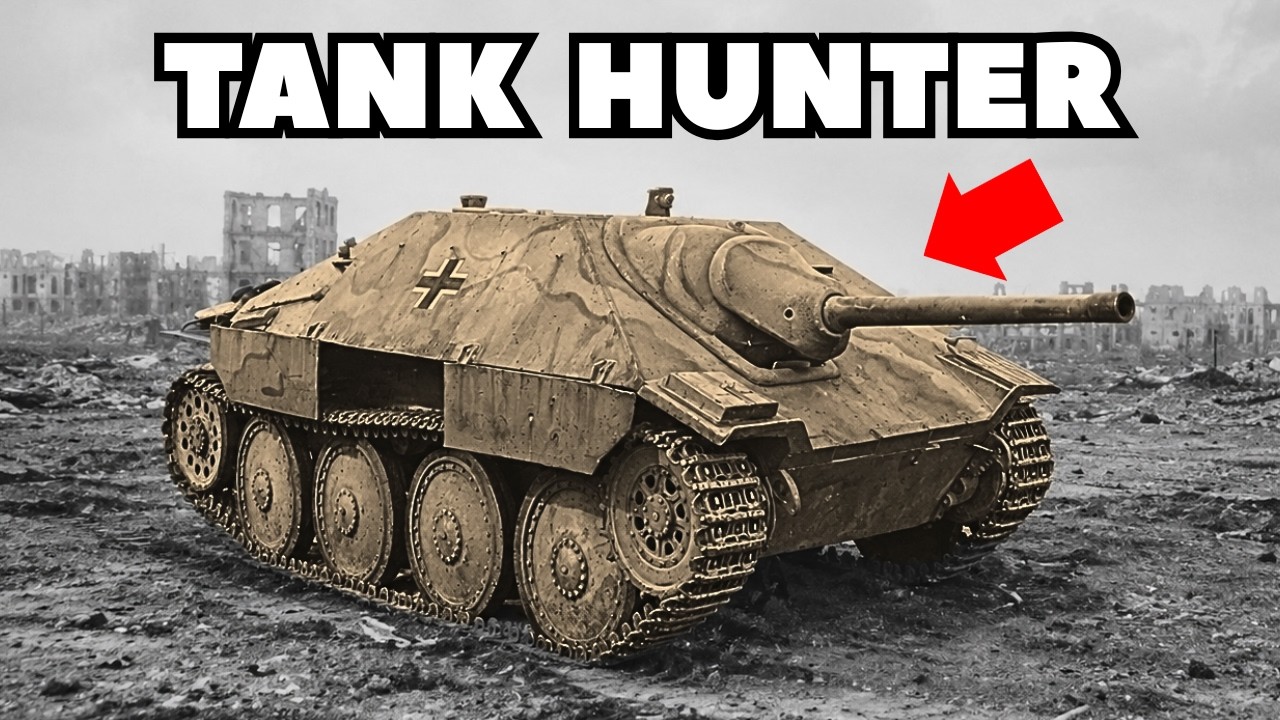
434 self-propelled guns in a single month. 289 from the BMM plant, 145 from the Škoda plant. This stands as the absolute record for Hetzer production over its entire manufacturing run. It is a figure that still raises the question, how? How did two relatively modest factories in occupied Czechoslovakia, operating under severe shortages of materials and labor, manage to deliver a result in January 1945 that was four times their usual output rate? There is no answer in the documents.
There is only the number. And then there is the context. January 1945 was when Soviet forces launched the Vistula-Oder Offensive, advancing several hundred kilometers westward in just a few weeks. It was a time when Berlin was less than 600 kilometers away in a straight line, and when everyone understood that the remaining time was measured not in months, but in days.
Apparently, it was this realization that provided those extra 320 vehicles above the norm. But the January record proved to be the final surge. In February 1945, American aviation began systematic strikes on the industrial targets of Czechoslovakia. The factories in Prague and Pilsen were bombed.
Production lines broke down and component deliveries were disrupted. In March, the output rate dropped, and in April 1945, despite all efforts, only 117 vehicles were assembled. The total figure for the entire production period from April 1944 to May 1945, precisely a year, was 2,584 Hetzer self-propelled guns in the anti-tank configuration.
In addition to these, 20 flamethrower vehicles under the designation Flammpanzer 38(t), Hetzer Bison self-propelled guns with a 150-mm infantry gun, and over 180 Bergepanzer 38 armored recovery vehicles were built on the same chassis. The grand total was 2,827 units of all modifications. For comparison, only 1,347 units of the famous Tiger I heavy tank were produced during its entire run.
There were twice as many Hetzers built at a lower cost, smaller dimensions, and lower material consumption. The vehicles left the workshops, were loaded onto flat cars, and headed to the front. There, the Hetzer finally had the opportunity to prove that all the calculations of the BMM engineers were correct.
July 1944, the Eastern Front. Two battalions were the first to receive the new vehicles, the 731st anti-tank battalion and the 743rd anti-tank battalion. Both were part of the general headquarters reserve of the Wehrmacht, meaning they were units that the high command could redeploy to the most dangerous sectors at its discretion.
Each battalion consisted of 45 vehicles, three companies of 14 self-propelled guns, and another three vehicles in the battalion headquarters. These two battalions were the first to take the Hetzers into battle. It was then that the issue with the muzzle break, which we discussed earlier, came to light.
But in addition to this technical problem, the first engagements yielded something far more important. They demonstrated exactly how this machine was meant to be fought. The Hetzer was not a tank in the classical sense. It was not intended for open field charges, breaking through prepared lines, or engaging in tight formations.
Its element lay elsewhere. Find a position, camouflage, wait. The low silhouette of the vehicle, just over 2 m high, allowed it to hide where larger armor would be visible from afar. Behind an embankment, behind a ruined wall, in a tree line, or on the reverse slope of a hill with only the gun barrel showing above the horizon.
Its camouflage paint scheme made the Hetzer part of the landscape. The enemy would appear in the gun sight. A shot, one at most two, then an immediate retreat, a change of position, a new hiding place, and waiting once more. This was the tactic military theorists call ambush operations.
But in practice, it looked different from the textbooks because the Hetzer was fast enough to change positions before the enemy could get their bearings. 42 km/h on roads is not racing speed, but for a vehicle operating in forests and villages, it was more than enough. A typical combat scenario unfolded roughly like this.
An enemy column or group of tanks is moving along a road or through a field. The Hetzer sits in cover. Its crew sees the targets, but the targets do not see the crew. The first shot goes into the lead or trailing vehicle of the column to create a traffic jam. While the enemy maneuvers and tries to figure out where the shooting is coming from, a second shot hits another target.
Then, full throttle, and the vehicle is already in a new position 200 m away. The enemy opens fire on the spot where the Hetzer just was. There is no one there anymore. Soviet tank crews faced this tactic in the summer and autumn of 1944. They quickly recognized a key feature of these encounters. An unfamiliar vehicle appeared, struck, and vanished before they could react.
Small, fast, and stinging. They did not know what it was called. Captured documents showed various designations: Jagdpanzer 38, Leichter Panzerjäger 38, and other letters and numbers. The official name, Hetzer, had not yet been finalized at that point. Therefore, Soviet tankers gave the vehicle their own name, wasp, osa.
Small, almost unnoticeable. It stung painfully and unexpectedly, disappearing before you could swat it. It is difficult to come up with a more accurate nickname. In August 1944, Hetzers began entering service with the anti-tank companies of the Wehrmacht’s infantry and Jäger divisions, as well as Waffen SS units.
The vehicle ceased to be a tool used only by specialized battalions. It became a mass anti-tank asset for the infantry. Where an infantry division previously relied on towed anti-tank guns, a self-propelled gun with an armored crew and an engine now appeared. From the beginning of 1945, even improvised units, the Volkssturm, the national militia formed from civilians, and units hastily assembled from sailors sent ashore, began receiving Hetzers.
In the final months of the war, these vehicles literally plugged the gaps where everything else was in short supply. But for now, it is autumn 1944. The machine is in service, the tactics are established, and the main question on everyone’s mind is, what happens when the Hetzer meets the best tanks of its time face to face, and has no option to simply slip away? There is a way to understand a vehicle’s combat capabilities through dry penetration tables.
And then there is a way to understand them through a concrete question. At what distance can this machine destroy you, and at what distance can you destroy it? For a tank crew, this is not abstract mathematics. It is the boundary line between life and their job. Let us start with the Soviet vehicles.
In the autumn of 1944, the Red Army’s primary tank was the T-34-85, armed with an 85-mm gun, which was considered one of the best medium tank weapons of that period. Alongside it operated the KV-85 heavy tank, also armed with an 85-mm gun. This is what happened in an encounter with a Hetzer. An 85-mm armor-piercing shell fired at the Hetzer’s front armor from a distance of over 400 m ricocheted, glancing off without penetrating the armor.
This occurred precisely because of the geometry discussed earlier. The 60-mm plate angled at 60° simply deflected the shell. Meanwhile, the Hetzer could destroy a T-34-85 with an armor-piercing shell from a distance of 700 m. A difference of 300 m is an immense margin in real combat. It meant that a Soviet tanker who spotted a Hetzer half a kilometer away knew that his shells were still useless, while the enemy’s shells were already lethal.
Now, the Western Allies. The American M4 Sherman series and the British Cromwell series tanks, which formed the core of the Allied armored forces on the Western Front, had far more modest front armor than the Soviet vehicles. Their guns could not penetrate the Hetzer’s front armor even at close ranges, literally point-blank, whereas the Hetzer could knock these vehicles out from a distance of about a kilometer.
This is an asymmetry that is difficult to overstate. Naturally, the Hetzer had its weak spots. The sides consisted of 20 mm of almost vertical armor, and the rear had the same 20 mm. Any tank shell of that period could penetrate these surfaces with little effort. Therefore, Hetzer crews operated under a simple rule.
Exposing the side or rear meant losing the vehicle. Keep the enemy in front of the frontal arc or retreat. And here is a nuance that is frequently overlooked. The Hetzer was not invulnerable. Rather, it was appropriately protected for its specific tactics. The difference is fundamental. A vehicle operating from ambush that fires first almost always faces the enemy frontally.
A vehicle caught by surprise or forced to retreat exposes its flank. The former means survival, the latter means the end. Now, let us discuss one specific adversary that deserves a separate mention. The British Churchill heavy infantry tank. A heavily armored vehicle designed specifically to absorb hits.
The front armor of the late modification Churchills reached up to 152 mm. The Hetzer could not penetrate it from a kilometer away. At that range, the PaK 39/2 shell simply lacked the energy to pierce such armor. But from 600 m it could. And this is where an interesting situation arose.
The Churchill moved at about 20 km/h on a good road, whereas the Hetzer reached 42 km/h. While the Churchill crossed those 400 m to close the distance from a kilometer to 600 m, the Hetzer crew had ample time to fire off several shots, assess the situation, and change position if necessary. Distance and speed, these were the factors that decided the outcome of such encounters.
The sub-caliber shell of the Pak 39/2 accelerated to 990 m/s, penetrating 120 mm of armor at 500 m. This put it on equal footing with the Churchill and even offered a slight advantage. All of these are figures from testing grounds and charts, but behind them lie concrete fronts, specific battles, and the decisions of commanders.
And the Hetzer managed to fight on all the major arenas of the final year, from the Hungarian plains to the Ardennes forests. By the autumn of 1944, Hetzers were fighting on two fronts simultaneously. This deployment itself tells the story of where the Wehrmacht felt the greatest pressure. But let us begin with the East, because that was where the Hetzer was employed the most, Hungary.
The autumn and winter of 1944 to 1945, Soviet forces were approaching Budapest, the capital of Germany’s only remaining ally in Central Europe. The battles for Hungary were of fundamental importance to the German command, not only because the last oil fields available to Germany were located there, but also because the Hungarian front tied down significant Soviet forces, diverting them from the drive to the west.
For this very reason, Hungary became the only ally with whom the Germans shared Hetzers. In December 1944 and January 1945, the Hungarian army received 75 vehicles. By comparison, these self-propelled guns were not supplied to any other German allies, neither to Romania before its exit from the war, nor to Finland, nor to Italy.
Only to Hungary, and only because the battles for Budapest were too critical to hold back equipment. Concurrently, Hetzers were operating in East Prussia. East Prussia was a distinct theater of operations. Dense forests, narrow roads, and small towns with stone structures. It was a terrain where large armored formations lost their advantage, whereas small maneuverable vehicles that knew how to operate in confined spaces found themselves in their element.
With its small dimensions and ambush tactics, the Hetzer was better suited for this theater than any other German self-propelled gun of the period. The same applied to Pomerania and Silesia. Dense urban areas, industrial plants, and railway junctions. Fighting in such environments did not take place in open fields, where firing range decided everything.
Instead, it involved short distances, unexpected angles, and silhouettes flashing around corners. Now, the West. December 1944, the Ardennes. The German command launched its last major offensive on the Western Front, an attempt to break through the Allied lines in Belgium and Luxembourg, and reach the port of Antwerp.
This operation entered history as the Ardennes Offensive, or the Battle of the Bulge. Hetzers took part in this operation. The Ardennes Forest, with its dense woods, narrow winding roads, and villages whose streets could barely accommodate a single vehicle, was the ideal environment for the Hetzer’s tactics.
Allied tanks, American Shermans and British vehicles, moved along these roads in columns, while Hetzers waited in position. Allied armor losses during the Ardennes Offensive were substantial. Pinpointing exactly how many vehicles were knocked out specifically by Hetzers is difficult as the documentation from that winter survived only in fragments.
However, the participation of these self-propelled guns in one of the most unexpected offensives of the final year is clearly documented. And now, a figure that puts everything into perspective. April 10th, 1945. Less than a month remains before Germany’s capitulation. On this day, 915 Hetzer self-propelled guns are listed in the active units of the Wehrmacht and Waffen SS.
Of these, 827 are directly involved in combat operations. Out of these 827 vehicles, 726 are fighting on the Eastern Front and only 101 are on the Western Front. 726 against 101. This ratio speaks directly. The German command considered Soviet armored forces to be an incomparably more serious threat than the Allied forces in the West.
That was where the best machines were sent and that was where the primary anti-tank reserves were directed. Seven out of every eight Hetzers in April 1945 stood between the advancing Soviet forces and what was left of Germany. Another rarely mentioned fact is also quite curious. In the final months, two companies of Hetzers, 28 vehicles, were part of the Russian Liberation Army under the command of General Vlasov.
This was a formation that fought on Germany’s side crewed by Soviet citizens who had defected. These 28 vehicles represent a separate page in the Hetzer’s history, one that is usually mentioned only in passing. April 1945. The vehicles are still in service and the crews are still fighting. But the history of the Hetzer did not end with the final shot of the final day.
And this perhaps is the most unexpected turn in the entire story. May 1945. The roads of Czechoslovakia, Germany, and Hungary are littered with abandoned equipment, including Hetzers. Some are intact with full ammunition loads, simply left behind by crews who had nowhere else to go. Others are knocked out with punctured side armor thrown tracks.
The conflict has ended. It would seem that the story of the Hetzer should have concluded here. But something unexpected happened. Switzerland, a neutral country that did not participate in World War II on either side, began updating its military motor pool after the end of hostilities. The Swiss Army was small, and the country’s mountainous terrain dictated its own requirements for armored vehicles.
They had to be compact, maneuverable, and capable of operating on narrow mountain roads under conditions of limited visibility. The Hetzer fit perfectly. In 1946, Switzerland purchased a batch of self-propelled guns from Czechoslovakia. Initially, former captured German vehicles, and later ordered new ones manufactured on the Czech Slovak base.
The Swiss designation for the vehicle was G-13. Externally, it was almost identical to the Hetzer with minor equipment modifications to meet Swiss standards. The Swiss Army operated these vehicles until 1970. Think about that. A self-propelled gun designed in 1943 during a wartime crisis, based on a tank chassis that was already considered obsolete by then, served in the active units of a European army until the early 1970s.
This was an era when second generation main battle tanks were already in service. This demonstrates one thing. The design was so successful that time was in no hurry to discard it. Czechoslovakia, in turn, went further. On the base of the Hetzer, Czech Slovak engineers developed their own modification.
A self-propelled gun designated the ST-1. The vehicle received new armament and several design changes, but the fundamental layout, the low hull, sloped armor, and glacis mounted gun remained the same. The Czechoslovak army used these vehicles until the early 1950s. The country in whose occupied capital the Hetzer was created became its primary post-war operator.
History has a way of arranging such ironies. Today, surviving Hetzers stand in museums across several countries. One of the most famous examples is located in the Tank Museum in Bovington, Great Britain. Several other vehicles are in museums in the Czech Republic, Germany, and the United States.
They are a rarity. Of the nearly 3,000 vehicles produced, only a handful have survived to this day. Those who have seen the Hetzer in person, in a museum, often report the exact same impression. The vehicle is small, surprisingly small. When you stand next to it, it barely reaches the shoulder of an adult.
It is hard to believe that within this volume sat four crew members, a gun with an ammunition capacity of 41 rounds, an engine, a transmission, and fuel tanks for 185 km of travel. And that is precisely where the Hetzer’s main paradox lies. This machine was not the best in terms of firepower. The Jagdpanther, with its 88-mm gun, penetrated more armor and did so at greater ranges.
The Jagdtiger, with its 128-mm gun, was a complete monster of firepower. But, the Jagdpanther weighed 46 tons, while the Jagdtiger weighed 75 tons. Their production was complex, expensive, and slow. Only about 415 Jagdpanthers were built, and just 88 Jagdtigers. There were 2,584 Hetzers produced in the anti-tank variant.
This is the answer to why armored vehicle specialists call the Hetzer the best light anti-tank self-propelled gun of World War II. Not because it was the most powerful, but because it was right. It struck the right balance between protection, armament, mobility, and cost.
The right tactics, the right solution at the right moment. A small, squat machine born out of crisis, out of a shortage of time and resources, and out of the desperation of late 1 1943, turned out to be a more durable concept than all the giant projects being developed alongside it. Sometimes, the correct answer is not the biggest one. It is the most precise.