Chieftain: The British Tank Built to Stop the Red Army — Why Did Moscow Fear It? D
In the winter of 1967, a new vehicle appeared on the tank ranges of the British Army of the Rine in West Germany. The Soviet military liaison mission, the officially sanctioned intelligence unit that both sides maintained in each other’s occupation zones in Germany, a peculiar holdover from wartime cooperation that had survived into the Cold War, noted its presence immediately.
They had been expecting it. Soviet military intelligence had been tracking the development of the British FV4201 for several years. What they had not been expecting, what the photographs and the technical assessments that came back through Moscow’s intelligence channels apparently did not fully prepare them for was what the vehicle looked like in person. It was extraordinarily low.
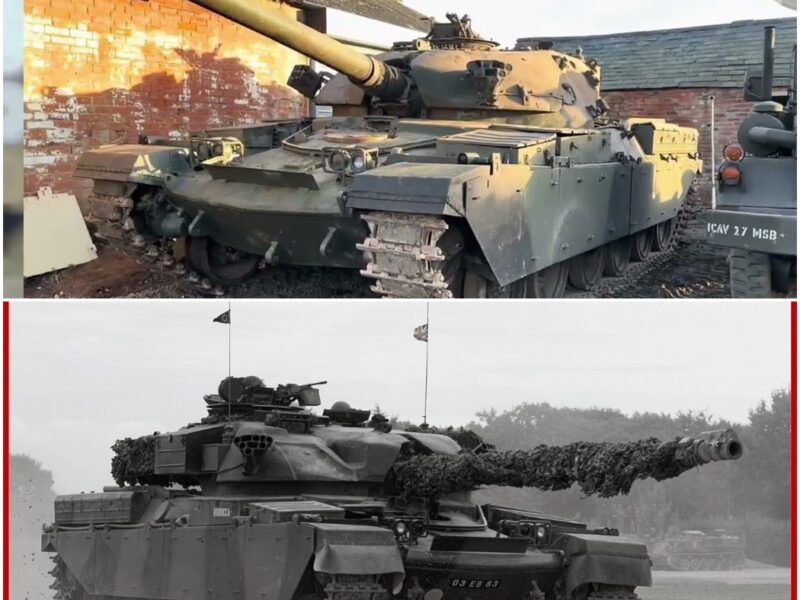
The silhouette that the Chieftain presented on the West German tank ranges was unlike anything that the Warsaw packed armored vehicle designers had produced. The hull sat close to the ground. The turret, rather than rising high above the hull, as Soviet turret design tended to do, was shallow and heavily sloped, a rounded shape that presented almost no vertical surface to an incoming round at any angle.
And the driver’s hatch, rather than sitting at the front of the hull in the conventional position, was almost horizontal. Because the driver of a chieftain did not sit upright in his seat, he reclined. He lay back at an angle that British soldiers described with characteristic understatement as simply a bit like driving lying down in a position that reduced the hull height by several critical inches.
Those inches, the inches that the reclined driver’s position saved by allowing the hull to be made lower, represented in the specific geometry of armored vehicle design, the difference between a frontal armor that was adequate and a frontal armor that was potentially invulnerable at the ranges at which most tank engagements were fought.
The Soviet military liaison mission took their photographs and sent them home. Moscow studied them carefully. What they were looking at was a vehicle that the British army had built on a specific and documented premise that in any conventional war in Europe, the British would be outnumbered, heavily, perhaps catastrophically outnumbered.
The Warsaw packed armored divisions that would pour through the Fulder Gap and across the North German plane in the event of a Soviet offensive were by every reasonable assessment more numerous than the NATO forces that would attempt to stop them. The British Army of the Rine, the B AOR, would be fighting a defensive battle, outnumbered on ground of the enemy’s choosing.
The Chieftain was built for that battle. Every design decision it embodied was made with that specific brutal defensive calculus in mind. Let me explain what that calculus actually produced. Give this a like if the specific technical and strategic story of Cold War tank design is what you’re here for. The requirement that produced the chieftain was issued by the War Office in 1958.
It came from a set of lessons that the British Army had been processing since 1945. Lessons about what tanks needed to do in a European land war against a peer opponent. Lessons that the specific experience of fighting German armor from 1940 to 1945 had taught with considerable directness. The primary lesson was about firepower.
Throughout the Second World War, British tank crews had consistently found themselves outgunned by German vehicles. The Panther’s 75mm long-barreled gun, which could defeat virtually any Allied tank at combat ranges. The Tiger’s 88 mm, which had the same capability with even more dramatic effect at extended distances.
The experience of operating in tanks where the question of whether your gun could kill the vehicle facing you was genuinely uncertain. That experience had produced in the British Armored Corps an institutional determination that it would not be repeated. The Centurion, which had replaced the wartime tanks in British service, carried a 105 mm gun, the L7, which was so effective that it was adopted by virtually every other NATO army, including the Americans, who installed it in the M48 and M60.
But by 1958, as the new requirement was being written, British armored planners were looking at what Soviet tank design was producing and concluding that the L7, impressive as it was, was not going to be sufficient for the threat they were planning against. The T-54 and T-55, which formed the bulk of Soviet armored strength, were manageable.
But the T-62, which appeared in Soviet service in 1961, carried a 115 mm smooth boore gun. And beyond the T62, British intelligence was already detecting the outlines of vehicles that would become the T64 and eventually the T72. The War Office specified a 120 mm rifled gun for the new tank. Not an upg version of the existing weapon, not a modification of the L7, a completely new gun designed from the outset to fire the most capable anti-armour ammunition that British engineering could produce at a muzzle velocity that would defeat whatever Soviet armor the next generation of vehicles might carry. This decision to equip a main battle tank with a 120 mm gun made Britain the first Western nation to mount a weapon of that caliber on a production tank. It would be 15 years before the Americans
reached the same conclusion when the M1 Abrams was designed with a 105 mm gun and then progressively rearmed with a 120 mm weapon in the 1980s. Germany went through the same progression with the Leopard series. Britain in 1967 when the Chieftain entered service was already where the rest of NATO would not arrive until the 1980s.
The gun that was installed, the Royal Ordinance L11 A5, fired a range of ammunition types whose development continued throughout the Chieftain’s service life. The initial APDS round gave way to APFSDS, armor-piercing fin stabilized discarding Sabo, which by the time the Chieftain was at the peak of its development in the 1970s and early 1980s, could penetrate armor that no contemporary Soviet tank was capable of reliably defeating from the front.
H the armor is where the chieftain’s design becomes most interesting and where the specific choices made by its designers reveal most clearly the battle they were designing for. The glasses plate the sloped front face of the hull was 127 mm thick angled at 72° from vertical. That geometry is the key to understanding what the number means in practice.
An armor plate angled at 72° from vertical presents to an incoming round on a horizontal trajectory, not its own thickness, but a considerably greater effective depth of steel. The calculation accounting for the oblquity of the shot, the elongation of the path through the armor, and the tendency of an impacting round to ricochet or break up on a steeply angled surface gives the chieftain’s glasses an effective protection equivalent to approximately 388 mm of vertical armor.
388 mm against a Soviet T62’s 115 mm gun. The T62’s APFSDS round, fired at a muzzle velocity of approximately 1,600 m/s, could penetrate approximately 240 mm of vertical armor at 1,000 m. Against the Chieftain’s equivalent protection of 388 mm at the same range from the front, it could not reliably penetrate.
This is the specific tactical reality that the Soviet military liaison missions photographs from the BAR ranges were conveying to Moscow. The chieftain in a hull down defensive position hull concealed behind a crest only the turret exposed presented a target that the standard Soviet tank guns of the 1960s and early 1970s could not reliably defeat at combat ranges.
AT62 engaging a Chieftain from the front at 1,000 m was in a situation where the T-62’s gun could potentially defeat the Chieftain’s turret armor at the right angle and the right range. While the Chieftain’s L11 A5 could defeat the T62’s frontal armor with high confidence across a wide range of angles and distances.
The tactical asymmetry was real, documented, and understood by both sides. The reclined driver’s position, that detail that made the Chieftain’s silhouette so distinctive on the West German ranges, was the engineering solution to a specific problem in armored vehicle design that had not previously been properly addressed.
A tank driver sitting upright requires a hull tall enough to accommodate his head and shoulders above the level of the hull floor. That height determines the minimum height of the entire front of the vehicle because the driver’s compartment is at the front and the hull must be tall enough to protect him.
The front of the hole is the surface that determines the oblquity angle of the frontal armor. The steeper the slope, the more protection per unit of thickness, but the taller the hole must be to maintain a given slope across a given vertical height. The British solution was elegant in the specific way that good engineering tends to be.
If the driver’s height was the constraint, reduce the driver’s effective height. By reclining the driver, tilting his seat back so that he lay at approximately 30° from horizontal rather than sitting upright, the hull height could be reduced by several inches without any loss of internal space for the driver’s body.
Those inches, translated into the geometry of the sloped armor above the driver’s compartment, allowed the glasses to be angled more steeply without increasing the vehicle’s overall height. more slope, same thickness, lower profile. The driver, for his part, operated the vehicle through a set of controls arranged for the reclined position with a periscope above him providing his view of the outside world.
It was by most accounts from the men who experienced it deeply uncomfortable for extended periods and produced a specific and unpleasant form of back pain that Chieftain drivers came to regard as an occupational hazard. Whether it was worth the protection it provided is a question that the chieftain crews who operated in defensive positions in West Germany were perhaps best positioned to answer.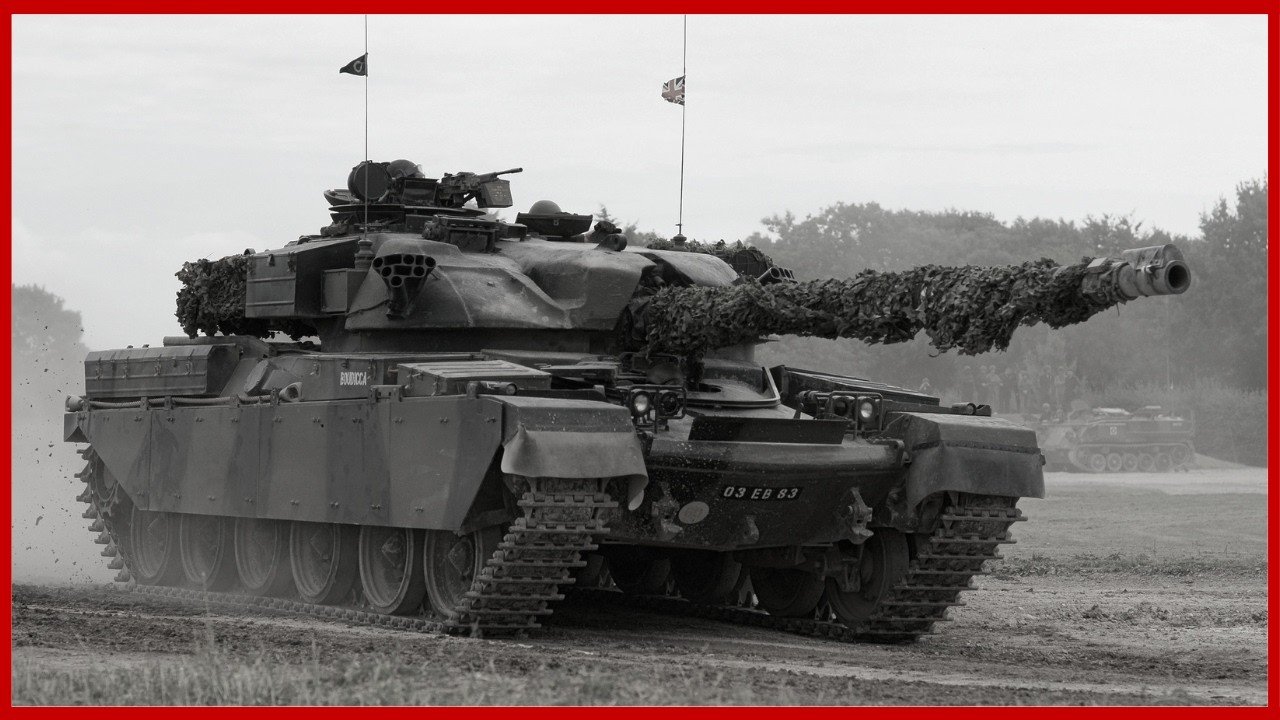
Their answer reported consistently in the accounts that have been preserved from the BAR period was broadly yes with some very specific reservations about the engine. The Leland L6. There is no honest account of the Chieftain that can avoid the Leland L6 for long, and I have no intention of trying.
The engine was a multifuelled two-stroke opposed piston design. Six cylinders, each containing two pistons moving in opposite directions within the same cylinder bore with no cylinder head, producing combustion between the two opposing pistons. In theory, this configuration produced high power density from a compact package and could run on any fuel from diesel to kerosene to petrol to aviation fuel, a requirement that NATO had specified for new engine designs in 1957 on the grounds that a tank that could run on any available fuel would be more flexible in a supply constrained wartime situation. In practice, the Leland L6 was the source of the most sustained engineering frustration in the history of the British Army’s Cold War armored forces. The nickname that Chieftain crews gave their vehicle was the mobile coffin. Not a reference to the armor, which was genuinely impressive, a reference to the
engine. The L6 in its early versions was plagued by four specific recurring failures. cracking of cylinder liners, failure of cylinder lip seals, piston ring breakages, and cracking of the rear gear case. Each failure mode produced either loss of power, loss of mobility, or loss of the engine entirely.
In the early years of the Chieftain’s service with the BAR, the operational availability of the vehicle, the percentage of the fleet that was functional and ready to operate at any given time, was significantly below what its role required. The REM mechanics who maintained the Chieftain fleet developed over years of practical experience a body of knowledge about the L6’s failure modes that was detailed, specific, and not entirely printable.
The fault, when it became impossible to attribute to crew error, which took longer than it should have, was accepted to lie with the engine itself. A series of modification programs addressed the problems progressively. new cylinder liner seals, modified pistons, revised lubrication systems, improved fan drive arrangements.
By the time the final version of the L6 was producing 750 horsepower in service, many of the original failure modes had been substantially reduced and experienced units had developed maintenance procedures that kept the fleet operational at acceptable rates. But the reliability improvement came late, came incrementally, and came at the cost of years of REM manh hours that could have been applied elsewhere.
The removable engine pack, a Chieftain design feature that allowed the power unit to be extracted and replaced in the field, reduced the operational impact of each individual failure, but did not address the fundamental frequency of failure that the early engine’s design had produced.
The crews, who were told that each chieftain would need to kill a minimum of 10 Soviet tanks before being overrun, were operating vehicles that sometimes struggled to start on cold mornings in the West German winter. That figure, 10 Soviet tanks per chieftain before being overrun, was not an abstraction. It was the specific calculation that Ba planning was built around.
And it tells you more about the strategic context of the chieftain’s existence than any amount of specification comparison. The British Army of the Rine was not planning to win a conventional war against the Warsaw Pact. It was planning to make a conventional war so expensive that the Soviet Union would not choose to fight one. The deterrent logic was explicit.
If each chieftain destroyed 10 T62s before being lost, the exchange rate was favorable enough that a Soviet advance would consume its armored strength before reaching its objectives. Whether this calculation was correct, whether the chieftain’s defensive capabilities were sufficient to produce that exchange rate against Soviet tank crews operating in offensive conditions was a question that thankfully was never tested in practice.
What the Soviet military planners knew from their intelligence assessments and from their own testing of analogous weapons against analogous armor was that the calculation was not unreasonable. The T64, which entered Soviet service in the 1960s as the primary armored vehicle assigned to units that would face NATO forces in the event of a European war, was assessed by Western intelligence as broadly comparable in capability to the Chieftain.
not inferior, not dramatically superior, comparable, which given that Soviet armored doctrine relied on numerical superiority rather than qualitative dominance, was a situation that Soviet planners found less comfortable than they would have liked. The T72, which appeared in Warsaw pack service from the early 1970s, was assessed as an improvement over the T64 in some respects, notably reliability and ease of production, but not as a step change in the capability balance against the Chieftain.
CIA intelligence assessments of the period, which have been declassified and are now available, consistently showed that Soviet planners understood the Chieftain’s gun to be a serious threat to their vehicles, and that the vehicle’s frontal armor required the use of specific tactics and specific ammunition types to defeat at practical combat ranges.
The fire control system is where the Chieftain’s story becomes genuinely pioneering and where the gap between British and Soviet tank capability in the 1970s was clearest. The Chieftain was the first production tank in the world to be fitted with a laser rangefinder as standard. Introduced in the Mark 5 variant in the mid 1970s, the laser rangefinder replaced the previous optical coincidence rangefinder and gave the Chieftain’s gunner the ability to measure the precise distance to a target with a precision that the previous system could not match, particularly at the longer ranges and in the poor visibility conditions of the West German winter that BAR exercises consistently encountered. The improved fire control system, IFCS, integrated the laser rangefinder with a digital ballistic computer to produce automatic gun elevation adjustments based on the measured range, the ammunition type selected, and atmospheric conditions. It was the first
digital fire control computer installed in a production tank anywhere, not just in NATO, anywhere. The first tank in the world with a digital fire control computer was a British one sitting in West Germany in the 1970s waiting for the Soviet Third Shock Army. The thermal observation and gunnery site toggs added thermal imaging capability which gave the Chieftain the ability to acquire and engage targets in complete darkness, in smoke, and in conditions of poor visibility that had historically given the attacker the advantage of setting the terms of engagement. A Soviet tank advance through the West German night, which Soviet doctrine favored as a method of reducing the effectiveness of NATO air power, would find itself engaging chieftains that could see them clearly while remaining essentially invisible in return. By the time the Stillbrew armor package was added in the 1980s, an additional composite armor array applied to the turret front and
around the driver’s hatch area, named after the two engineers who developed it, the Chieftain had accumulated so many upgrades to its original specification that the Mark 5 variant bore only a family resemblance to the vehicle that had entered service in 1967. The Iran story deserves its own section because it tells you something about how the chieftain was evaluated by the one customer that had the most comprehensive experience of using it in actual combat.
The sha of Iran, Muhammad Resa Palavi, purchased 707 chieftains between the mid 1960s and the Islamic Revolution of 1979. The deal was one of the largest single export orders for any tank in the Cold War period, and it came with a specific additional dimension. Israeli engineers had been involved in the Chieftain’s development program, working alongside British engineers on aspects of the fire control system and the ammunition in exchange for a planned Israeli purchase of the vehicle. The British government cancelled the Israeli sale in 1969 for reasons of Middle Eastern political sensitivity that the Israelis found deeply unsatisfying and that the British foreign office regarded as unavoidable. The Iranian chieftain saw combat from 1980 onwards in the Iran Iraq war. A conflict that lasted 8 years, consumed approximately 1 million lives, and provided the most sustained operational test of cold war tank designs that any
conflict between the two superpowers client states produced. Iraqi forces operated T62s and eventually T72s. Iranian forces operated chieftains supplemented by M6’s from their American supplied infantry. The chieftain’s performance in the Iran Iraq war was mixed in ways that reflect the specific conditions of that conflict rather than fundamental design failure.
In defensive operations, the role for which the vehicle had been designed. The chieftain’s combination of firepower, armor, and fire control gave Iranian crews consistent advantages in engagements where they could choose their ground and engage at range. In offensive operations, particularly in the chaotic conditions of Iranian infantry assaults supported by armor across open desert, the mobility limitations and maintenance challenges that had characterized the vehicle since its BAR days reasserted themselves. An Iranian senior officer in an assessment that has been quoted in multiple Western military analyses of the conflict described the T72’s maneuverability and firepower as superior to the chieftains. This assessment reflects a specific operational experience offensive operations in desert conditions against a mobile numerically superior opponent. That was not the operational scenario the Chieftain had been designed for. The
vehicle that had been built to sit hull down behind a West German ridge line and defeat Soviet armor at ranges beyond a kilometer was a different proposition from a vehicle asked to advance across open desert against Iraqi T72s supported by artillery and air power. The Chieftain’s place in the lineage of British tank development sits at a specific and interesting point.
After the Centurion, which had proven itself a genuinely world-class vehicle, and before the Challenger one, which incorporated many of the Chieftain’s design innovations alongside the Chobam composite armor that represented the next generation of protection technology, the Chobam armor, the composite armor package that was eventually installed in the Challenger 1 and the American M1 Abrams, was developed using a Chieftain automotive system as its test vehicle.
The program that produced Chobam began in October 1969 using a test vehicle built on Chieftain mechanical components. The first prototype of the new armor configuration was produced in February 1971. The technology that would eventually make the Challenger one and the M1 Abrams significantly more survivable than any previous generation of Western tank.
The composite armor package that became the standard protection system for NATO main battle tanks from the 1980s onwards was validated on a chassis derived from the Chieftain. The Chieftain that Soviet planners feared in the 1970s was in this sense the foundation of the vehicles that they would have feared even more in the 1980s.
The progression from Chieftain to Challenger 1 to Challenger 2 is a continuous line of development. Each generation building on the lessons of the previous one. The same institutional understanding of what British armor needed to do in a European defensive war driving each successive design specification. The 900 chieftains that served with the British army never fired their guns in anger against the opponent they were built to fight.
The Soviet Third Shock Army never crossed the inner German border. The 10 kill calculation, each chieftain accounting for 10 T62s or T72s before being lost, was never tested in the specific conditions of a Warsaw packed breakthrough into West Germany. What was tested consistently over two decades of NATO exercises and BAO training was whether the vehicle’s crew could operate it effectively in the conditions they were likely to face.
The BAO crews who lived with the Chieftain throughout the 1970s and early 1980s developed a specific and documented relationship with it that combined genuine professional pride in its capabilities with an equally genuine frustration with its limitations. The gun they trusted, the armor they trusted, the engine they maintained with the specific resigned competence of professionals who have made their peace with a tool that does not quite work as well as it should, but works well enough to get the job done with sufficient effort and attention. The Soviet military intelligence analysts who studied the chieftain from the photographs taken by the military liaison mission and from the intelligence gathered through the ordinary channels of cold war espionage knew what they were looking at. a vehicle with a gun that could kill their tanks. Armor that their standard weapons struggled to penetrate from the front. Fire control technology that was in the 1970s significantly ahead of anything
the Soviet Union had deployed in production numbers. They did not know about the engine. Or rather, they may have known through the channels that intelligence services used to establish such things that the L6 had problems. What they could not know from the outside was the specific texture of those problems as experienced by the REM mechanics who lay underneath the vehicles on freezing West German mornings, or by the drivers who memorized the specific sequence of actions that gave a cold L6 its best chance of starting on the first attempt, or by the crews who understood that the vehicle’s formidable combat capabilities would only be available if the maintenance had been done correctly and completely. That gap between the specification that Moscow feared and the operational reality that BAR managed daily is the full Chieftain story. Not the gun which was genuinely as capable as advertised. Not the armor which was
genuinely as protective as the geometry suggested, the gap between those capabilities and the engine that was supposed to make them available wherever they were needed. The British Army managed that gap for nearly 25 years until the Challenger 1 appeared in the mid 1930 80s with a Rolls-Royce CV12 engine that actually worked as intended.
When it did, the Chieftain’s crews, most of whom had by then spent years maintaining their relationship with the L6, discovered what it felt like to operate a British main battle tank with a reliable power plant. The reaction by multiple accounts was something between relief and righteous indignation.
The Chieftain that Moscow feared was real. The vehicle that earned that fear, 120 mm gun, 388 mm of effective frontal protection, laser rangefinder, digital fire control computer, thermal imaging was as formidable as the specification suggested. The engine that was supposed to carry it to the battle was for most of its service life the most significant constraint on how formidable that specification could actually be in practice. Both of these things are true.
Both of them are the chieftain.