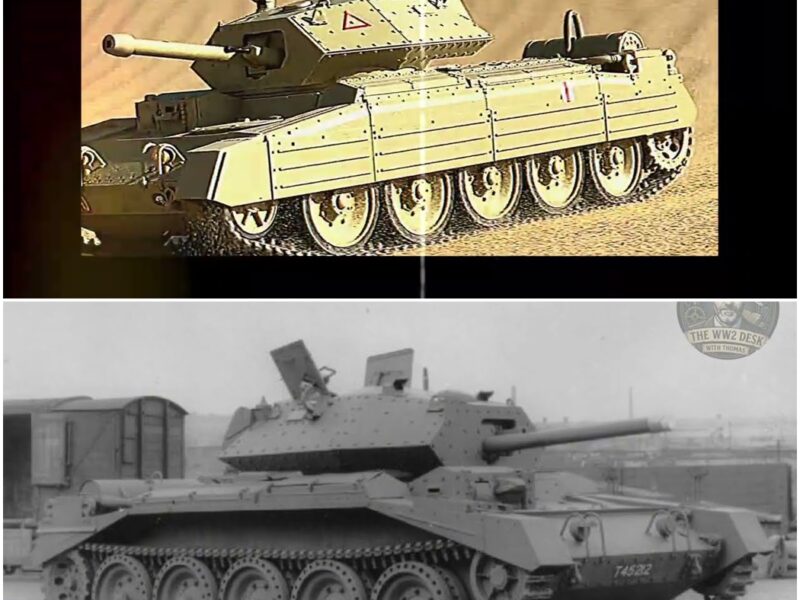
Crusader Tank: Britain’s Fastest Desert Tank Had One Fatal Flaw Nobody Could Fix! The WW2 Desk with Thomas D
21 tanks, one regiment, one month of operations. The Queen’s Bays, one of the oldest cavalry regiments in the British Army, filed a mechanical breakdown report in January 1942 that I have read several times, and each time it lands with the same specific weight. They had been operating 22 Crusader tanks during the Axis counteroffensive.
Of those 22 vehicles, 21 broke down for mechanical reasons before the fighting was over. Not destroyed by enemy fire, not abandoned in retreat, broken. Sitting in the desert sand with engines that had seized, fans that had failed, oil pouring from places too inaccessible to reach without a workshop that the desert did not provide.
The failure rate was 77%. In the same period, the regiment’s American-built M3 Stuart tanks recorded an 11% failure rate. The Stuart was not a better tank than the Crusader in most respects. It was slower. Its gun was less powerful. Its armor was comparable, but it had one quality that the Crusader, for all its speed and elegance and genuine tactical capability, could not match.
It worked. Its air-cooled engine did not overheat. It did not require water that evaporated in 40° heat. It did not have oil leaks in inaccessible places. It did not have a cooling fan chain drive that snapped under the stress of hard cross-country running across ground that made the Libyan desert look like a well-maintained road.
This is the Crusader’s story. Not the story of a bad tank, because the Crusader was, in many respects, a good one. The story of what happens when a genuinely capable machine is sent into an environment that exposes the one flaw its designers had not solved, and how that flaw, multiplied across 5,000 vehicles and 2 years of desert fighting, cost lives in ways that the specification sheet could not capture.
Give this a like if detailed, honest, primary source British military history is what you are here for. The cruiser tank concept was a British invention and its logic was straightforward in the way that concepts which later proved mistaken often appear straightforward at the time of their invention.
British armor doctrine of the 1930s divided tanks into two categories with different roles and different design requirements. Infantry tanks, heavy, well armored, slow, would walk alongside foot soldiers and absorb enemy fire. Cruiser tanks, lighter, faster, more lightly armored, would exploit breakthroughs, conduct deep raids, destroy enemy supply lines, and pursue a defeated enemy.
The Matilda was the paradigmatic infantry tank. The Crusader was the culmination of the cruiser lineage. The design brief for a cruiser tank was in its essence a brief for speed above protection. The vehicle needed to move faster than the enemy could respond to it. Armor that stopped the tank was armor that defeated the purpose of the tank. This logic was not unreasonable.
It had sound precedents in the cavalry doctrine from which British armored thinking descended and in the operational experience of the First World War’s later campaigns where mobile forces that could exploit breakthroughs had proved their value. What it produced in the specific case of the Crusader was a vehicle whose designers had made speed their primary achievement and whose other qualities, protection, reliability, firepower, was subordinated to that achievement.
Nuffield Mechanizations and Aero Limited received the development contract for the A15 in 1939. The man responsible for the overall program was Lord Nuffield himself, William Morris, the automobile manufacturer who had moved into armored vehicle production and who brought to tank design the instincts of a man who had spent his career building engines for roads rather than for deserts.
The engine he chose for the Crusader was the Liberty V12, a design of American origin adapted for British use producing 340 horsepower in a tank that weighed 19 tons. The power to weight ratio was, on paper, excellent. The desert had opinions about paper. The Liberty had been designed as an aircraft engine in the First World War.
It had been adapted for tank use across the 1920s and 30s, and by the time it was installed in the Crusader, it had accumulated considerable service history in British armored vehicles. What that service history had consistently demonstrated, and what the decision to use it in the Crusader appears not to have fully incorporated, was that the Liberty ran hot, needed precise water management, and had a cooling system that was adequate for the climatic conditions of England, and somewhat less adequate for the climatic conditions of the Libyan desert in summer. 40° C, sometimes more. Sand that got into everything. No established railway network to move broken vehicles to workshops. Supply lines that stretched hundreds of miles across terrain that wore tracks, stressed transmissions, and deposited fine abrasive particles into every system that depended on close tolerances to function. The Crusader had been designed, tested, and accepted for service in England. It
met its specification. The specification had not fully imagined the Western desert. The first time the Crusader went into action, Operation Battleaxe, June 1941, it demonstrated both what it could do and what would kill it with a clarity that the subsequent two years of desert fighting never significantly altered.
Operation Battleaxe was Wavell’s attempt to relieve Tobruk, where the garrison had been under siege since April. The British force committed included nearly 200 tanks, of which approximately 100 were Crusaders from the 7th Armoured Division, the Desert Rats, veterans of the earlier campaigns against Italy, are now facing Rommel’s Africa Corps for the first time in significant numbers.
The speed of the Crusader was immediately apparent and immediately useful. In the fluid maneuvering engagements of desert warfare, where visibility was long and the ability to close rapidly or disengage quickly was operationally decisive, the Crusader’s 27 mph gave British commanders options that heavier, slower vehicles could not provide.
In the early exchanges around Halfaya Pass and Capuzzo, Crusader troops demonstrated what the vehicle was supposed to do. Move fast, hit hard, exploit. Rommel, who understood armored warfare as well as any commander of the period, noted the Crusader’s speed with professional respect. A vehicle that could move at that pace across desert terrain was a genuine tactical threat, not something to be taken lightly.
But the operation failed, and the breakdown reports that came back afterwards told a story that the speed statistics did not. Engines overheating in the afternoon sun, cooling fan chain snapping under the stress of cross-country driving on ground that was not what English tank parks looked like, oil leaking from joints between the engine block and the cylinders in places that required the engine to be removed to reach, a process that took a workshop with the right equipment, the right tools, and the right spare parts, none of which were available forward of the main logistics base, water evaporating from the cooling system faster than the desert allowed it to be replaced, sand, fine, penetrating, abrasive Libyan sand finding its way into every system that had a gap wide enough to admit it, which in a vehicle designed to British tolerances and tested in British weather was most of them. The official report from the 2nd Armoured Brigade, produced after the
fighting in early 1942, described the problem in language that carries a very specific kind of frustration. A variety of leaks in oil, water, and air systems, many of which occur in places so inaccessible as to require workshops resources and many hours for repair. Neither are available in the desert.
That sentence is the Crusaders operational history compressed into 31 words. The machine had been to be fast. It had been designed to fight. It had not been designed to be repaired in the field by three men with improvised tools in 40° heat while the enemy was 40 mi away. The REME mechanics who maintained the Crusader fleet in North Africa occupy a specific and under-appreciated place in the history of this vehicle.
The Royal Electrical and Mechanical Engineers were the core responsible for keeping British armored vehicles operational. In the desert, this meant working in conditions that were genuinely hostile, not as an abstraction, but in the specific, daily, accumulating way that hostile working conditions affect human capability.
Heat that made metal components too hot to handle with bare hands, sand that contaminated lubricants within hours of a change, spare parts that had been stolen or lost in transit from the UK, an early and persistent problem that ate into the available supply before the tanks even reached the regiments.
And that, once exhausted, had to be cannibalized from vehicles that were already broken. The Crusader that broke down in the morning might, by the afternoon, have had its serviceable components removed to keep three other Crusaders running. The vehicle left behind was written off, not because it was unrepairable in absolute terms, but because the resources available in the forward area made repair impossible within the operational time frame.
The Queen’s Bays breakdown report gives you the specific texture of this problem better than any general account can. 21 mechanical failures from 22 vehicles. Five of them attributed to fan related problems including overheating. Four to undefined engine issues that likely included the same cause. Three to track and running gear failures.
Others to a range of problems that the mechanics had categorized with the professional precision of men who had seen each of them many times before. What the report does not capture, because reports do not capture these things, is the specific experience of a REME fitter who had been working for 16 hours in temperatures that would shut down a British factory.
Lying under the hull of a Crusader with a torch and an inadequate spanner trying to reach an oil leak in a location that the vehicles designers had evidently not prioritized for field maintainability. Knowing that the regiment needed the tank operational by morning. The REME mechanics of the desert campaign left an institutional legacy of creative improvisation that British armored maintenance culture has never entirely forgotten.
Some of what they improvised worked. Some of it held together for exactly long enough. Some of it failed in ways that sent the tank back to the workshop it had just left. The Crusader’s armament problem ran parallel to its reliability problem and compounded it because a tank that is unreliable but well-armed can at least fight effectively when it is working.
A tank that is unreliable and under-armed offers its crew the worst of both conditions. The Crusader Mark I and Mark II carried the Ordnance QF 2-pounder as their main armament, the same 40 mm gun that equipped the Matilda and the Valentine and which had been adequate against Italian armor and early German tank variants but which was becoming progressively less adequate as the German armor in North Africa improved.
The Panzer III and its later variants with the long-barreled 50 mm gun was not a comfortable opponent for a Crusader carrying a 2-pounder. The Panzer IV with its short-barreled 75 mm was worse. The 88 mm anti-aircraft guns that Rommel routinely deployed as anti-tank weapons were, at any practical combat range, simply lethal. The Crusader’s frontal armor on the Mark I was 40 mm.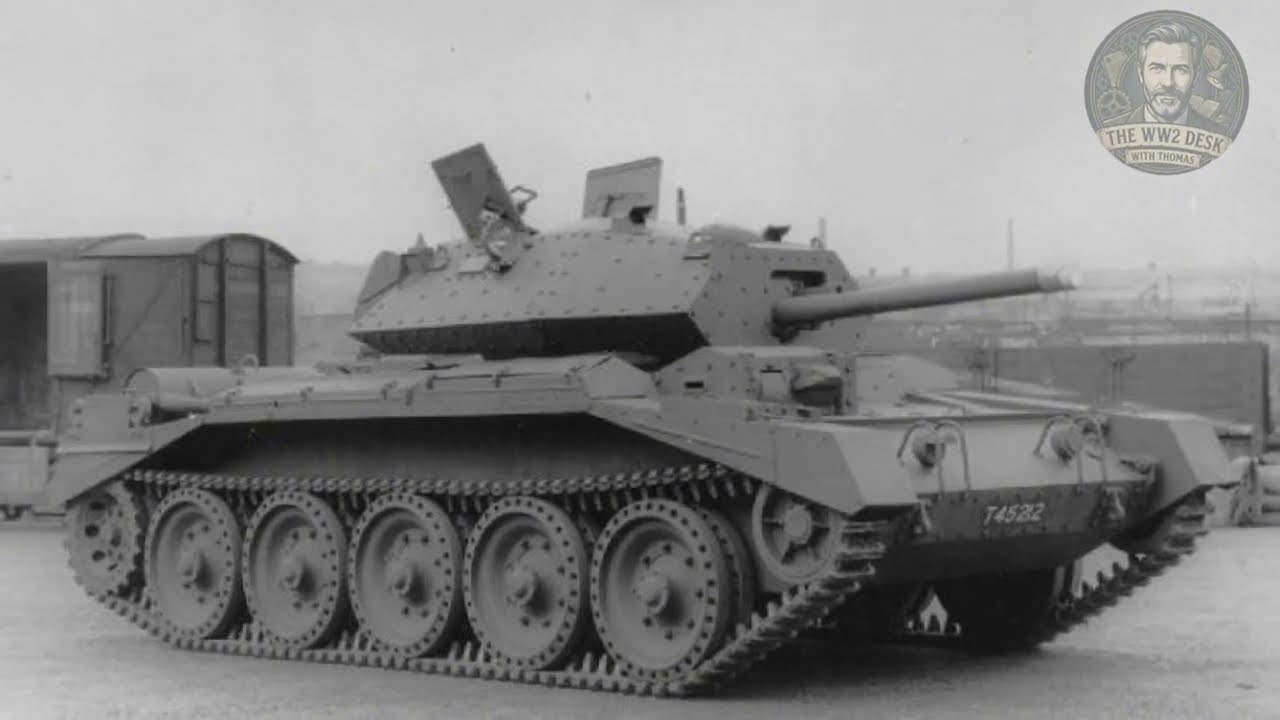
Rommel’s standard anti-tank guns at the ranges of typical desert engagements penetrated 40 mm without particular difficulty. The armor problem and the gun problem were, in a sense, consequences of the same design priority. A vehicle optimized for speed had to be light. A light vehicle carried thin armor. Thin armor made the vehicle vulnerable.
A vulnerable vehicle needed its speed to survive, which placed the entire operational logic of the Crusader on an assumption that speed would always be available. When the engine seized or the fan chain broke or the oil leaked in the inaccessible location that required a workshop to reach, the speed was gone.
And with the speed gone, the 40 mm of frontal armor was all that remained between the crew and the German guns. The brew-up problem was the most brutal expression of this vulnerability. When a Crusader was penetrated by enemy fire, it had a tendency to catch fire rapidly, documented consistently enough that the term became standard in the slang of British tank crews throughout the desert campaign.
The ammunition stowage was unprotected. Hot metal penetrating the hull could ignite it. The petrol-fueled Liberty engine contributed to the fire risk in ways that diesel engine vehicles did not face to the same degree. A Crusader that was penetrated was, more often than not, a Crusader that burned. The men who crewed these vehicles knew this.
They had seen what happened to tanks that were hit. They climbed in anyway every day because the job required it. The fix arrived partially and belatedly in the form of the Crusader Mark III. The 6-pounder gun, the Ordnance QF 57 mm, had been available in prototype form since 1941 and had entered production in 1942. Installing it in the Crusader required a redesigned turret and produced an immediate secondary consequence.
The turret was now too small for the full complement of three turret crew. The solution adopted was to reduce the crew to three men total, commander, gunner, and driver, and to require the commander to act as his own loader. The wireless operator position was eliminated. The commander was now simultaneously commanding the vehicle, operating the radio, and loading the gun.
In the middle of a fast-moving desert engagement, this was not a trivial demand. Commanding a tank in the desert required constant situational awareness, watching for enemy vehicles, communicating with the regiment, directing the driver, controlling the gun. Loading the 6-pounder simultaneously meant taking eyes and attention away from that situational awareness at precisely the moment when situational awareness mattered most.
The tank that received the right gun ended up with the wrong crew configuration as the price of installing it. This was not carelessness. It was the product of the specific constraint that the Crusader’s original turret ring imposed. The circular mounting was too small for the 6-pounder to be installed without reducing the space available for crew members.
Widening the turret ring meant redesigning the hull, which meant effectively designing a new tank. The correct response was to design a new tank, which the British were indeed doing simultaneously. The immediate response, install the gun in the existing hull, reduce the crew, was the field expedient that kept the Crusader in the fight.
The Crusader Mark III also introduced the Liberty engine Mark IV, which fixed most of the cooling fan problems that had produced the 77% breakdown rate in the Queen’s base. The shaft drive that replaced the chain drive for the cooling fans was a more robust solution that did not snap under desert operating conditions. The updated water pumps were better suited to the temperatures involved.
The Mark III Crusader was a substantially more reliable vehicle than the Mark I or Mark II. It entered production in May 1942. 144 were complete by July. The first 100 participated in the second battle of El Alamein in October 1942, the battle that turned the tide of the North African campaign. The timing is everything.
The vehicle that worked properly arrived at El Alamein. The vehicle that had been breaking down in the desert for 18 months arrived at El Alamein as well, alongside the Shermans and Grants that were replacing it. The Crusader fought at El Alamein and in Tunisia. It was not replaced entirely until the North African campaign ended in May 1943.
5,330 Crusaders were built. That number makes it the most produced British cruiser tank of the entire war. 5,330 vehicles, most of them carrying the Liberty engine in its earlier, less reliable forms, most of them going to North Africa, where the conditions that the engine was worst suited for were most consistently present.
The REME mechanics who kept them running were, by the accounts of commanders at every level of the desert campaign, performing something close to miracles on a daily basis. The official histories are careful to note that for every Crusader destroyed by enemy fire, at least as many were lost to mechanical breakdown.
And that the breakdown figure may significantly understate the maintenance burden, which represented hours of skilled REME labor that could not be directed elsewhere while it was being spent keeping the Crusader fleet operational. The comparison with the German Panzer III is instructive, not because the Panzer III was a dramatically superior vehicle in absolute terms, but because it had been designed with desert operations in mind to a greater degree than the Crusader had been.
The Panzer III in North Africa was not immune to breakdown. German REME equivalents, the Werkstatt, the workshop companies, faced similar challenges in similar conditions. But the German vehicles had been modified for tropical use before deployment in ways that British vehicles had not. Air filters had been improved.
Cooling systems had been adapted. The result was not perfect mechanical reliability. Nothing in the desert was, but it was better than the Crusaders. And the operational difference between 77% breakdowns and something lower was the difference between a regiment that could fight and a regiment that was waiting for its workshop.
Rommel’s logistics were frequently more precarious than the British logistics he faced. His supply lines were longer. His fuel was scarcer. His spare parts were harder to replace. He had his own version of the breakdown problem. But his tanks worked more reliably in the specific conditions of the desert, and that reliability gave him options that British commanders watching their Crusaders sit broken in the sand while the REME worked through the night did not always have.
The Crusader variants that followed the gun tank tell their own story about what the vehicle actually was. Because the qualities that made it difficult as a fighting tank made it useful for everything else. The Crusader AA Mark I and Mark 2 mounted twin or quadruple 40 mm Bofors guns in an open-topped turret providing anti-aircraft protection to armored formations on the move.
The speed that had been the gun tank’s primary military asset was equally valuable in an anti-aircraft role. A fast vehicle that could keep pace with the armor it was protecting was considerably more useful than a slower vehicle that fell behind. The Crusader ARV, armored recovery vehicle, used the same hull and drivetrain to tow and recover broken-down tanks.
The mechanical reliability of the Mark 3 engine making it suitable for work that the Mark 1 would not have survived. The vehicle that had spent two years breaking down in the desert was, once its engine had been fixed, pressed into service recovering the vehicles that were now breaking down instead.
The Crusader gun tractor, a further variant, towed the 17-pounder anti-tank gun and its crew in the final stages of the North African campaign and into the Italian campaign using the speed and mobility of the Crusader’s drivetrain for a role that required exactly those qualities and did not require the vehicle to fight.
The Crusader, in other words, had a second career in the roles that played to its strengths and did not expose its weaknesses. This second career was longer and in some ways more successful than the first. The vehicle that had been unreliable as a gun tank became serviceable as a tractor, a recovery vehicle, an anti-aircraft platform because in those roles the consequence of a breakdown was a logistical problem rather than a tactical catastrophe.
What the Crusader represents in the wider story of British armor development is worth examining directly because the lessons it taught were specific and documented and shaped what came after. The fundamental problem was not the Liberty engine. The fundamental problem was a development and procurement system that accepted a vehicle for desert service without ensuring that the vehicle had been tested under desert conditions.
The Liberty’s cooling fan chain drive, the component most consistently identified in breakdown reports as the primary cause of overheating failures, was a known weakness. It had been noted. It had been discussed. It had not been resolved before the vehicle went to war because the pressure of the operational requirement was greater than the pressure to solve the engineering problem.
This is a pattern that appears repeatedly in British armor development of the early war period, not unique to the Crusader, but most visible there because the Crusader’s environment was most unforgiving of the failure to solve it. The Crusader Mark III, with the shaft drive replacing the chain drive, fixed the cooling problem. The question that the Mark I and Mark II’s operational history poses is why the shaft drive was not in the vehicle from the beginning, given that the chain drive’s vulnerability was identifiable through analysis before the tank went to the desert rather than through the breakdown reports that came back afterwards. The answer is, as it often is in military procurement, complicated. Development timelines, manufacturing constraints, the pressure of an operational requirement that needed to be met now rather than in 6 months when the better solution was ready. The army needed cruiser tanks in North Africa. The Crusader was available. The Crusader went. 5,330
of them. The crews who drove them through Operation Battleaxe and Operation Crusader and the First Battle of El Alamein, the men who climbed into vehicles that had a 77% breakdown rate and fought anyway because the regiment needed its tanks and the regiment’s tanks were Crusaders, those men were not served well by the system that put them there.
They are served somewhat better by an honest account of why. The Crusader was fast. It was genuinely fast. 27 mph on a desert road was a tactical asset that commanders valued and that Rommel respected. It was, in the Mark III with the six-pounder, adequately armed for the opponents it faced in the final stages of the North African campaign.
It was, in its later mark with the fixed cooling system, considerably more reliable than the vehicle that had gone to war in 1941. But the Crusader that went to war in 1941, the Mark I and the Mark II with their Liberty engines and their cooling fan chain drives and their oil leaks in places too inaccessible for field repair, that vehicle asked its crews to trust a machine that the desert was quietly destroying.