Daniel Chatto Was The Most Boring Man Sarah Could Find — That Was The Whole Point D
On the morning of the 14th of July, 1994, in a small, dark, City of London church called St. Stephen Walbrook, next to the Mansion House and a short walk from the Thames, the granddaughter of King George VI was married to a man whose name the British press had spent eight years not learning. Her name was Lady Sarah Frances Elizabeth Armstrong-Jones.
She was 30 years old. She wore a Jasper Conran gown of white georgette, a corseted bodice, long sleeves, a square neckline lifted from a Holbein portrait. The dress of a painter who had chosen her reference points deliberately. Beside her stood three bridesmaids in nearly identical gowns from the same designer.
Zara Phillips, daughter of Princess Anne, Lady Frances Armstrong-Jones, Sarah’s half-sister, and family friend Tara Noble-Singh. The Queen of the United Kingdom and the Duke of Edinburgh were in the pews. The Queen Mother was there. Princess Anne was there. Charles, Prince of Wales, and Diana, Princess of Wales, were there.
Six weeks after the prince had confirmed his affair with Camilla Parker-Bowles on national television. About 200 people filled the church, which was close to the most it could hold. The door opened. The man standing in it was 37 years old. His name was Daniel Chatto. He was the son of a working actor and a theatrical agent.
He had taken an art foundation course at the City and Guilds School of Art in London before reading English at New College, Oxford. He had had a brief screen career across the early 1980s. Small parts in period dramas and television films. A named role as Tip Dorrit in a Dickens adaptation in 1987, and then nothing. He had become a painter.
He had no title. He had no estate. He had no peerage. He walked the aisle and married her. And he became, by every measure the British press had been trained for two centuries to apply, exactly nothing new. That was the whole point. St. Stephen Walbrook was built between 1672 and 1679 to designs by Sir Christopher Wren at a cost of 7,692 lb.
It sits at 39 Walbrook, directly beside the Mansion House in the city. Nikolaus Pevsner, the architectural historian, placed it among the 10 most important buildings in England. Its dome, 63 ft high, carried on eight arches sprung from 12 Corinthian columns of Portland stone, was Wren’s own rehearsal for the dome at St. Paul’s.
Sir John Summerson described it as the pride of English architecture. The Samaritans were founded there in 1953, when the rector, Dr. Chad Varah, installed a telephone in the crypt for people in emotional crisis. It’s a parish church, a working city church, open on weekdays, used for civic functions and private occasions.
It holds about 200 seated. Westminster Abbey, where Lady Sarah’s brother David had married the year before, seats 2,000 for major occasions. The ratio isn’t incidental. It’s the first argument the Chatto strategy ever made in public. The ceremony was officiated by Reverend Varah himself, 81 years old, still rector, the man who had set up that telephone line four decades earlier.
It lasted 30 minutes. When the couple came out, their driver wasn’t ready. Daniel and Sarah stood at the door of the church and waited. Then a car arrived and they were gone to the reception at Clarence House. To understand why Daniel Chatto was the answer, you need to understand what question Sarah Armstrong Jones was born into.
Her mother, Princess Margaret, had spent the 1950s as the most written about woman in Britain. Celebrated for her glamour, her night life, the Margaret set of aristocratic companions who gathered at the Café de Paris and the Mirabelle. Her romance with the divorced Group Captain Peter Townsend, which the government and the church told her she couldn’t pursue, was front-page news across the world.
Her marriage in 1960 to society photographer Antony Armstrong Jones produced a couple the press photographed from every angle and in every register. Glamorous, then troubled, then openly estranged. They formally separated in March 1976. The divorce was finalized on the 11th of July 1978. The first senior royal divorce since Henry the VIII.
At that moment, David Armstrong Jones was 16 and Sarah was 14. Her father had built his career from 1952 as a society photographer for Tatler, progressing to Vogue and The Sunday Times. Phillips auction house in cataloging his work decades later described him as someone who had established a reputation for portraits and documentary photography from the early 1950s and who, by marrying Princess Margaret, had become as likely to appear in front of a camera as behind one.
He was photographed everywhere. So was she. The children of this union grew up at Kensington Palace under continuous external observation with holidays at Sandringham and Balmoral where Sarah spent time painting landscapes and somewhere in the middle of it all deciding what kind of life she was going to try to build.
Her brother David went toward visibility. He built a public profile as a furniture designer took the role of honorary chairman at Christie’s under the name David Linley and became the version of the Armstrong-Jones children who could be placed in a society feature. Sarah went somewhere else. But the going somewhere else required structure.
A person’s temperament alone isn’t enough. You need the right architecture. The Chatto household was structurally the opposite of everything Sarah had grown up inside. Tom Chatto born Thomas Chatto St. George Sproul on the 1st of September 1920 in Elstree, Hertfordshire was an actor. He appeared in Quatermass 2 in 1957.
He was in Battle of Britain in 1969. Through the 1970s he played the narrator in The Rocky Horror Show on stage. When his son Daniel was born on the 22nd of April 1957 Tom was in the middle of a working actor’s career of television appearances and supporting parts. He died on the 8th of August 1982 when Daniel was 25.
The agent in the family was Daniel’s mother. Roz Chatto was born Rosalind Joan Thompson on the 12th of February 1923 in Orsett, Essex. She married Tom in 1947 and adopted the professional name Roz Chatto. She built and ran the theatrical agency Chatto and Linnit Limited alongside the theatrical producer Michael Linnit.
A biography of the actor Alan Bates describes the firm as a highly respected London theatrical agency. Tom Conti was among its clients. Roz Chatto died on the 5th of June 2012 in Kensington. She was 89 and she had been working for most of those years. The name Chatto in this context has nothing to do with Chatto and Windus, the publishing house.
Different family entirely, different history, different business. The only connection is two letters of a surname. Daniel took a one-year art foundation course at the City and Guilds School of Art in London before reading English at New College, Oxford. His acting career ran from 1980 to 1987. Smaller roles, working parts, the kind of credits that demonstrated craft without generating celebrity.
In 1981, he played Guy in Merchant Ivory’s Quartet. In 1982, he played Prince Andrew in a television film called Charles and Diana: A Royal Love Story. A piece of casting that, given the context of the 1994 wedding, sits in the record with a certain widely documented irony. He appeared in The Shooting Party in 1985, sharing the set with a young Colin Firth.
He and Firth were also both in a 1985 television film called Dutch Girls. Firth in the central ensemble, Daniel in a supporting role. A biography of Firth, written years later, identified Daniel in the cast with a brief note, “He was later to wed Sarah Armstrong Jones and become Princess Margaret’s son-in-law.
His last screen credit was 1987. Tip Dorrit, in a BBC adaptation of Little Dorrit, filmed from Dickens. After that, he became a painter. Not transitionally, not as a supplementary identity, as a primary practice, the thing he has done in the decades since. The screen career was small by design or by circumstance, and in either case, it remained small, which made it a perfect piece of what would follow.
In 1983, on the set of a Merchant Ivory film called Heat and Dust, the trajectories crossed. She was working in the wardrobe department. Her father was simultaneously employed as production photographer on the nearby Passage to India filming, and a family connection had produced the internship. Daniel had a minor role in the cast list of Heat and Dust, a party guest.
They were both doing jobs. They met where people meet when they are doing jobs. Tatler’s reconstruction of the courtship records that it was in 1986 that they were first photographed together at gallery openings and art world events. The engagement was announced on the 5th of May, 1994. From the set of Heat and Dust to the announcement, 11 years.
From the first public photographs to the wedding, eight. Eight years is a long time to be with someone the press can’t file cleanly. He wasn’t a lord. He wasn’t a diplomat. He wasn’t a businessman with an estate or a politician with a constituency or a military officer with a commission that generated ceremonial occasions.
He was a painter and former actor, the son of a working actor and a working agent, with a deed poll filed on the 26th of June, 1987. Enrolled formally on the 18th of September of the same year. That changed him from Daniel Chatto St. George Sprawl to Daniel St. George Chatto. He had rearranged the syllables of his own name 7 years before the wedding.
Nothing about that name in its final configuration announced anything to the photographers who had been trained to recognize rank, title, and estate. Every year from 1986 to 1994 in which the engagement wasn’t announced, in which Sarah Armstrong-Jones didn’t appear in society columns as the intended wife of an earl or a baronet or a diplomat is a year the strategy accumulated.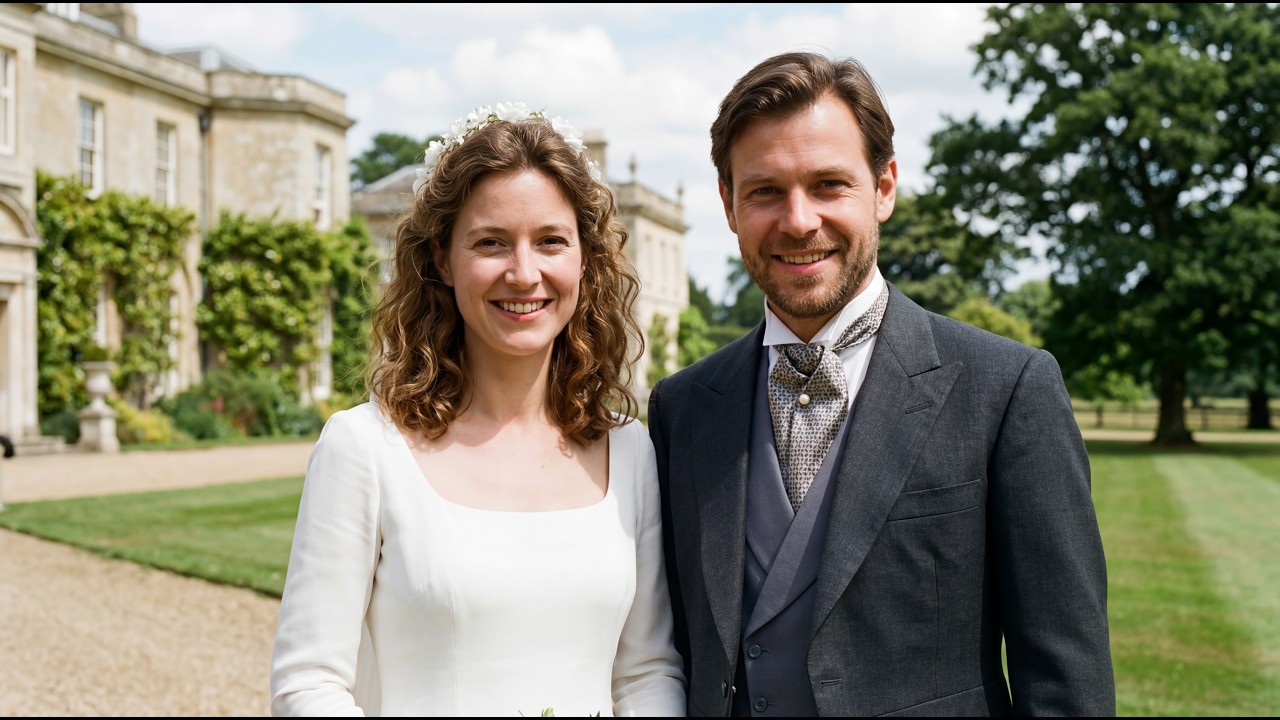
The strategy wasn’t announced. It was simply lived in plain sight for 8 years until the press ran out of alternative explanations and concluded that this was in fact the man. The 14th of July, 1994 was a Thursday. The Snowdon Floral Tiara, made from three diamond floral brooches that Lord Snowdon had given Princess Margaret as a wedding gift, adapted into a headpiece, was anchored in Sarah’s hair with greenery threaded through the flowers.
The Conran gown’s neckline came from a Holbein portrait. The Royal Order of Sartorial Splendor, a respected fashion history resource, noted the dress’s lineage. A painter’s inspiration for a painter’s dress. The bridesmaids gowns matched in line and fabric. No detail was casual. Princess Margaret attended.
The Queen and Prince Philip sat in the front pews. The Queen Mother was there. Princess Anne and Prince Edward were there. Charles and Diana were there together for the first time since the Dimbleby interview, and the press noted it. But the story they were in wasn’t the story of the day.
The story of the day was the bride’s dress, and the smallness of the church, and the fact that it was the first royal wedding St. Stephen Walbrook had ever hosted. The reception was at Clarence House. They honeymooned in India, returning to the country where they had met. What happened in the years that followed was the absence of almost everything that the British press had been designed to cover.
Daniel Chatto hasn’t given a memoir. No book appears under his name in any publisher’s catalog. No tabloid front page in the 31 years since the wedding has carried either of their names as a primary subject in any scandal. He hasn’t become a celebrity arts panelist, a brand ambassador, a columnist, a public intellectual, or a paid face for any commercial enterprise that appears in the record.
The audit isn’t just negative. It’s implausibly clean for someone married into the family he married into at the moment he married into it. What he did instead was work. Country Life described him in a profile published years later as an artist, former actor, and faculty member of the Royal Drawing School.
He teaches there, passing on the making and use of traditional paints, fresco, oil, wax, egg, gum, and glue tempera in a course documented by former students in enough detail to establish that this is a real practice done seriously year on year. He exhibits at Long & Ryle in London. His painting is landscape focused, drawn from life, tending toward what one profile describes as the wild, the wind-blasted, and the epic.
He works from observation. He is a painter in the way that people who have decided to be painters are painters, consistently, without announcement, because it’s what they do. Sarah Chatto exhibits at the Redfern Gallery in London under the name Sarah Armstrong Jones, not her married name, continuously since 1995.
She won the Winsor & Newton Prize in 1988 and the Cresswick Landscape Prize in 1990. In a recent solo show at the Redfern, over three-quarters of her pieces sold. She became vice president of the Royal Ballet in 2004, the position her mother had previously held as president, and was named president herself in 2024.
None of this reaches the press in the way that a memoir or a scandal or a paid television appearance would reach it. All of it’s real and documentable and continuously ongoing. Samuel David Benedict Chatto was reportedly born in 1996. Arthur Robert Nathaniel Chatto in 1999. Neither son holds a royal or noble title.
Both attended Eton College and subsequently the University of Edinburgh. Samuel works as a sculptor. Arthur served with the Royal Marines. When line of succession tables list them, they appear as Samuel Chatto and Arthur Chatto, 29th and 30th, or wherever the current count places them, without any attached designation that the press would find useful.
This is what the strategy built. Not an absence achieved by hiding, but an absence sustained by the structural absence of the materials that scandal requires. The interview that can be taken out of context. The estate that can be photographed from the air. The title that places you on a target list.
The strategy was tested twice in 2002 with no warning and no way to rehearse. Princess Margaret died on the 9th of February, 2002 at King Edward the 7th Hospital in London. She was 71. The cause was a stroke. She had suffered a series of strokes since 1998 and the health of her final years had been managed with increasing difficulty.
Her death required her daughter and son-in-law to step forward into a formal public grief at the center of the royal family’s visible mourning. The Queen Mother died 7 weeks later on the 30th of March. Her funeral was held on the 9th of April, 2002. The same day Princess Margaret’s ashes were interred in the King George the 6th Memorial Chapel at Windsor.
Two national ceremonies in one spring. The Chatto household was present and visible at both. What the record does not contain from either occasion is a doorstep statement, a sympathetic profile offering authorized access to the private grief, or a subsequent interview about the losses and what they meant.
They appeared. They stood where the occasion required them to stand. They left. Tatler, writing about Sarah Chatto many years later, described her approach to royal occasions in terms that function as a professional assessment. She gets the work done and celebrates the family. That is a description of someone who has learned over a long time what visibility costs and what it can be safely withheld.
31 years on from St. Stephen Walbrook, the case for Daniel Chatto is the case for what didn’t happen. And what didn’t happen is the entire reason Sarah Chatto is the one royal of her generation the audience has nothing to forgive. She was the granddaughter of King George VI. She was the niece of the Queen.
She was the daughter of the most written about royal of the post-war decade and one of the most celebrated portrait photographers of the same era, whose marriage to a princess made him as likely to appear in front of a camera as behind one. And on the 14th of July, 1994, in a Wren church the press could barely place on a map, she married a 37-year-old painter whose father had spent his working life as an actor in British films and whose mother had run a theatrical agency in London.
She put on a Jasper Conran dress that audiences would still be calling the most beautiful royal wedding dress 30 years later. And she walked back out as Sarah Chatto. He had not become anything new. He had no title. He had no peerage. He had a painting practice and a teaching post and a job he continued doing the morning after the wedding as if his wife weren’t the daughter of Princess Margaret of England.
That was the strategy. That was the whole strategy. He had no title. He brought no estate. He brought a working family who had been in the office every morning for two generations. And he brought a name that signified to two centuries of trained British press attention exactly nothing of the kind they were equipped to cover.
Daniel Chatto stood at the door of a small church on a Thursday morning in 1994 and he held it open for her. He has been holding it open ever since. Subscribe for more stories like this.