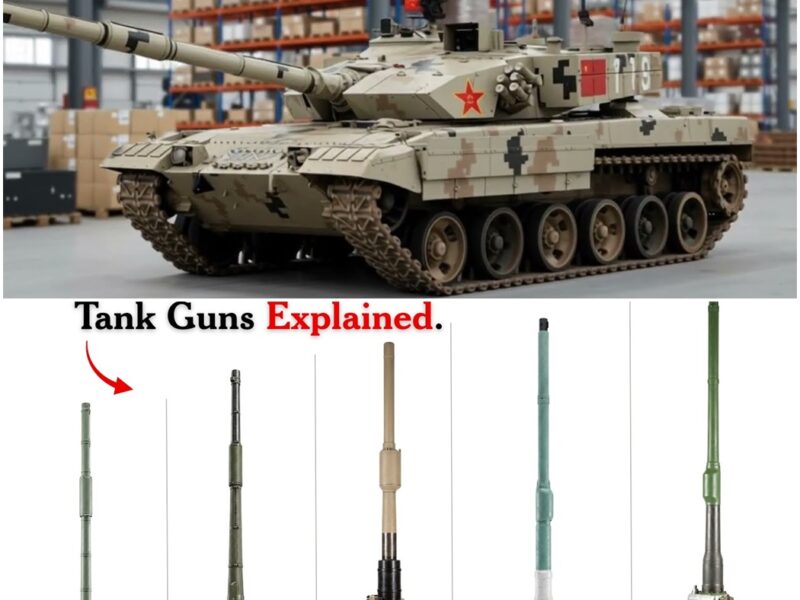
Every Battle Tank GUN Explained In Service D
Today, we’re breaking down every gun on main battle tanks currently in service. Who uses what, how they actually work, and which ones are now dominating in a real fight. Stay with us because Britain has finally ditched its iconic rifled gun for the new Challenger 3, and it changes everything you thought you knew about modern armored warfare.
Starting with D-10T. The Russian D-10T is a 100 mm high-velocity rifled cannon built originally for medium tanks. You will find this exact weapon bolted onto the T-54/55, the Chinese Type 59, and it packs a serious punch with a barrel featuring 40 right-hand grooves. A well-drilled crew sweating inside the turret can comfortably crank out a practical rate of fire sitting in the 5 to 7 rounds per minute range.
The ammunition menu is basically a buffet of destruction for a gun of its era. You get classic armor-piercing, improved ballistic capped rounds, high-explosive armor-piercing composite rigid, discarding sabot, and fin-stabilized shape charge options. This gives the gunner tools for everything from cracking open enemy armor to blowing apart concrete bunkers.
Later variants refined things progressively. The D-10T added single-plane stabilization so crews could fire on the move with some confidence, and the D-10T2S went to full two-plane stabilization along with minor tweaks to the recoil system and mantlet. This made the tank vastly more lethal on the move without messing with the original ballistics.
What keeps the D-10T relevant today is its mechanical toughness. It tolerates rough handling, long service, and maintenance conditions that would embarrass a more complex system. The ammunition range lets operators pick the right tool for the job, and the compact manageable recoil load suits smaller turrets without complicated mounting solutions.
But, there is a problem. The 100 mm diameter strictly limits the maximum length-to-diameter ratio of kinetic penetrators. You simply cannot make the tungsten dart long enough to defeat modern composite armor. Crews trying to take on top-tier main battle tanks have to sneak up for point-blank ambushes or strictly aim for the side armor.
Worse yet, the ancient Soviet fire control systems usually wired to this gun completely lack thermal sights and laser rangefinders, meaning your targeting math is stuck in the Stone Age. U-5TS, Russia 115 mm smoothbore designated as 2A20. This gun completely changed the game as the very first smoothbore tank gun to enter active service on a T-62 main battle tank.
And the decision to go smoothbore was driven by pure physics. Rifling spins a projectile for stability, which is great for some rounds, but it also limits the muzzle velocity you can achieve with fin-stabilized kinetic penetrators and reduces the effectiveness of shaped charge warheads. Removing the rifling and letting fins do these stabilizing work solved both problems at once.
The barrel runs to roughly 5.7 m fitted with a prominent bore evacuator to pull propellant gases out of the turret after firing. Early armor-piercing fin-stabilized discarding sabot projectiles were quoted at around 300 mm of rolled armor at 1,000 m, which was a significant step beyond what contemporary 100-mm rifled guns could offer at the same range.
At the time, that was impressive enough to cause genuine concern in NATO intelligence assessments. The standard ammunition mix covers fin-stabilized kinetic penetrators, high-explosive antitank rounds, and high-explosive fragmentation shells. Later upgrade packages added tube-launched antitank missiles fired through the barrel on refitted T-62 M tanks, which extended the gun’s reach and gave older hulls a capability they were never designed to carry.
The problem with this gun today is a combination of three things working against each other simultaneously. The manual loading system limits sustained rate of fire, which matters in fast-moving engagements. The 115-mm caliber sits awkwardly between the 100-mm supply chains it replaced and the 125 mm chains that came after it.
So, operators running T-62s are managing a logistics island that nobody else shares. And the ballistic envelope, while credible against rear and side aspects of older main battle tanks, cannot reliably defeat the frontal armor of modern designs except through very specific weak spot targeting. Those still operating T-62 are effectively compensating with tactics rather than overmatch.
And that is exactly the kind of position no tank crew wants to be in. Royal Ordnance L7, NATO 105 mm rifled. If one gun defined what Western tank firepower looked like through the Cold War’s middle decades, it was the Royal Ordnance L7. This 105 mm 52 caliber rifled gun was designed to deliver high muzzle velocity and tight dispersion in a package compact enough to drop into existing medium tank turrets.
And it succeeded so completely that almost every major Western nation ended up using it in one form or another. The horizontal sliding breech and efficient recoil system keep travel under about 300 mm, which enables well-drilled crews to sustain rates around 8 to 10 rounds per minute. The ammunition family is enormous. Armor-piercing, fin-stabilized discarding sabot, high-explosive anti-tank, high-explosive squash head, high-explosive fragmentation, smoke, and modern multi-purpose programmable rounds in later service configurations. That flexibility made it useful from pure tank versus tank combat all the way through and support and obstacle clearing. The list of platforms that mounted the L7 or its licensed derivatives is almost comically long. The Centurion from Mark 5/2, the German Leopard 1, the American M48A5 and M60 series through the M68 barrel, the early M1 Abrams before the 120 mm upgrade,
Sweden’s Stridsvagn 103, Japan’s Type 74, Israel’s Shot Centurion and Magach upgrades, early Merkava variants and T-54/55 refits. Essentially, if a country wanted to modernize aging tank stock cheaply during the 1960s through the 1980s, the answer was usually some version of this gun. But, there is a ceiling problem.
As modern composite armor technology advanced rapidly, the 105 mm bore diameter slammed into a wall. Practical kinetic penetrator length and chamber pressure became irrelevant. Frontline users were eventually forced to adopt 120 mm smoothbore to achieve true armor overmatch. On top of that, most surviving L7 cannons are still sitting inside older tanks with highly outdated optics, meaning the aging fire control system severely bottlenecks the actual performance of an otherwise fantastic barrel. KBA-3. This is Ukraine’s domestic take on the 125 mm smoothbore gun developed for the T-84 and Oplot series. And it starts from a solid base because it is broadly derived from and compatible with the Russian 2A46M -1 family. Ukraine’s engineers did not reinvent the wheel here, but they did refine it purposefully, adding a thermal sleeve, a modern fume extractor, and careful attention to barrel straightness and stabilizer integration. All aimed at
reducing dispersion, particularly when firing on the move. The gun uses a two-piece ammunition system fed by a carousel autoloader under the turret floor, carrying around 43 rounds total with approximately 28 in the mechanized loader. The automatic rate of fire comes in around 7 to 9 rounds per minute.
With manual backup available at a considerably slower pace if the autoloader is damaged or depleted. That two-piece separate loading design is a legacy of Soviet architecture, and it brings both efficiency and constraints along with it. Ammunition coverage is a no joke. Armor-piercing fin-stabilized discarding sabot, high explosive antitank, high explosive fragmentation, high explosive with delayed fuzing for fortifications, and laser-guided gun-launched missiles for engaging tanks or low-flying helicopters at extended ranges. Ukraine has also worked on compatibility with Western-designed advanced rounds and missiles, which gives the gun a potential upgrade path that older Soviet guns simply do not have. Most of the problems on this gun are completely inherited from the old Soviet architecture. The carousel autoloader’s geometry imposes strict length limits on penetrator rods, which means the very longest next-generation armor-piercing fin stabi- lized discarding sabot designs that Russian upgrades have
chased cannot simply be dropped in. Ammunition is also stored close to the crew compartment, which raises survivability concerns whenever the armor envelope is breached. A problem that has come into sharp focus given Ukraine’s combat experience since 2022. And while 125-mm rounds are plentiful in post-Soviet supply chains, it sit completely outside the NATO 120-mm standard, complicating integration with Western partners on a logistical level.
ZPT-98. This is China’s 125-mm smoothbore gun developed for its third-generation main battle tanks, principally the Type 99 and export variants including the VT4 with later versions of the Type 96 family also reported to use related designs. Like the KBA-3, it traces its lineage back to the Soviet 2A46M, but China pursued a higher pressure longer barrel development path rather than a direct copy with the barrel running between 48 and just over 50 calibers depending on the variant. Longer than the standard 2A46’s 48-caliber figure and intended to extract more muzzle velocity from the same cartridge dimensions. The carousel autoloader holds 22 ready rounds and cycles at around six to eight rounds per minute in automatic mode with manual loading as a fallback. Standard ammunition covers tungsten core armor-piercing fin stabilized discarding sabot including the domestic DTW-10
125-2 round, High explosive anti-tank, high explosive fragmentation, and likely gun-launched guided projectiles for extended anti-armor engagements. Open Chinese sources estimate the DTW10 penetration at roughly 510 mm of homogeneous armor at 1.5 to 2 km. That sits broadly in line with late Soviet 3BM142 class projectile, which puts it in credible territory against many legacy armor arrays, but leaves a gap compared to the best current Western long rod penetrators.
But, there’s a problem. The asymmetric recoil layout and turret floor carousel share the same accuracy limitations as the Soviet 2A46 family, and ammunition stored beneath the crew carries the same survivability risk. Chinese domestic ammunition has improved noticeably over two decades, but the consensus is that penetrator technology still trails the latest Western sixth-generation rounds, meaning the ZPT98 closes the gap rather than eliminating it.
2A46 family, also called the D-81, is the gun that put 125-mm firepower into mass production and kept it there. It forms the backbone of Soviet and Russian main battle tank armament across T-64, T-72, T-80, and T-90 chassis, and its production run spans decades and multiple significant variants, each one addressing problems the previous version left behind.
The original 2A46 was tailored to the T-64 and T-80 autoloaders. Then the 2A46-1 adapted the mounting to fit the different carousel geometry of the T-72, keeping ballistics identical but changing the mechanical integration. The 2A46-2 went further by modifying the chamber and fire control interface to support tube-launched anti-tank guided missiles like the 9M112 Cobra, turning the barrel into both a cannon and a missile launcher in a single installation.
Later, the M models introduced chrome-lined bores for longer barrel life, tighter manufacturing tolerances to reduce dispersion, a chronic problem on early examples, and a barrel design that allowed field replacement without pulling the breech from the turret. The M4 and M5 iterations stiffened the barrel further and adjusted the breech to accept longer armor-piercing fin-stabilized discarding sabot projectiles.
And those versions are the ones found in T-80U, T-90A, T-72B3, and T-90M tanks. The associated ammunition covers the standard three-round mix of kinetic penetrators, high explosive anti-tank, and high explosive fragmentation, plus multiple generations of gun-launched missiles. However, many fielded rounds on this gun still correspond to threat levels from one to two decades ago because the carousel’s strict length limits slow the adoption of very long next-generation rods.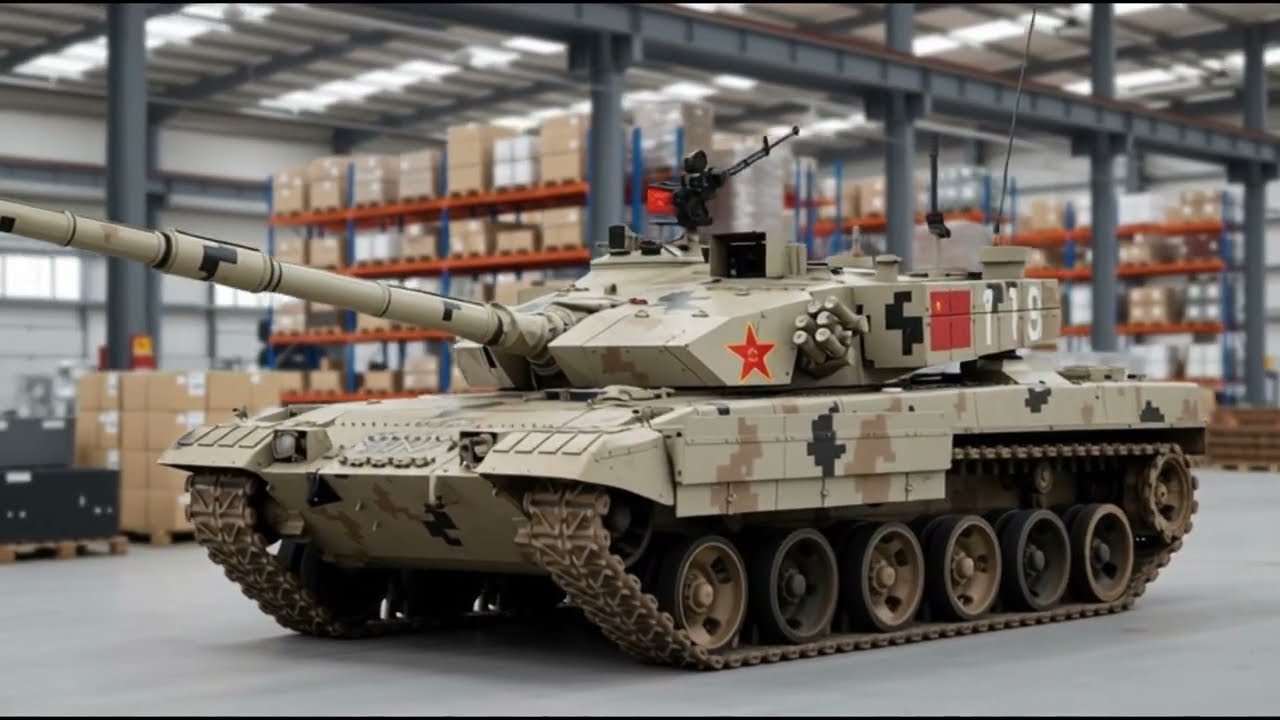
The problems are equally well documented and they have not fully gone away despite decades of refinements. Early dispersion issues, the penetrator length ceiling imposed by the carousel, and the ammunition is stored directly adjacent to the crew, a layout that has proven catastrophically vulnerable when armor is breached under combat conditions.
IMI MG251 and MG253. These are highly specialized 120-mm L44 smoothbore cannons developed entirely in-house. Rather than licensing the Rheinmetall gun and adapting it locally, Israeli Military Industries developed the MG251 and MG253 domestically to meet the specific requirements of the Israeli Armored Corps, which means the gun is tuned from the ground up for Israeli operational conditions and the Merkava’s particular architecture.
The MG251, mounted on Merkava Mark 3 variants, uses a 5.3-m barrel with the total gun system coming in at roughly 2,900 kg. It is designed to function across an ambient temperature range of -40 to +70°C, which covers everything from a Negev summer to a cold mountain night. And the recoil system operates at a nominal 300 mm stroke with a maximum just under 350 mm.
Recoil force at zero elevation runs around 500 kN, which Israeli engineers balanced carefully against the Merkava’s heavy turret mass. The MG253 on Merkava Mark IV and the Turkish M60T Sabra upgrade takes that recoil problem and addresses it directly by moving to a nominal 430 mm stroke and a maximum of 530 mm.
Peak recoil force drops by roughly 40% compared to the MG251. That reduction is what made it practical to integrate a powerful 120 mm gun into an older M60 hull without redesigning the turret ring. Ballistically, the barrel length and muzzle velocity stay the same, so nothing is sacrificed on the performance side.
Both guns fire the full NATO 120 mm ammunition range plus specialized Israeli rounds, including advanced kinetic penetrators, shaped charge warheads, and multi-purpose cartridges designed to handle structures, infantry, and light armor without swapping ammunition types mid-engagement. But, there’s a problem.
Sticking to the L44 barrel length permanently caps the absolute maximum muzzle velocity compared to massive L55 class guns that Germany and others have moved to, which pushes more of the performance burden onto ammunition development rather than raw tube length. Royal Ordnance L30, Britain’s 120 mm rifled gun is the reason Challenger II ammunition is not interchangeable with any other tank in service.
That is either a frustrating limitation or a deliberate design choice depending on your perspective. And understanding what the L30 actually is makes that trade-off make more sense. The barrel is a monoblock electroslag refined steel tube swage auto frettaged for internal strength with right-hand twist rifling at one turn per 18 calibers and chrome plating across both the bore and the chamber.
Expected barrel life runs around 500 effective full charge shots when using the high energy stick propellants the gun was designed around. That propellant system is the root of the interoperability issue. The L30 uses separate combustible charge cases rather than the unitary metallic cartridge that every other 120 mm smoothbore in NATO uses.
The sliding block breech incorporates an elastomeric obturation ring to seal against those combustible charges which leaves no metal cartridge case in the turret after firing and simplifies charge handling in a confined space. Ammunition is centered on the CHARM 1 and CHARM 3 armor piercing fin stabilized discarding sabot rounds.
Both using depleted uranium long rod penetrators for penetration performance alongside high explosive squash head for multirole work. The rifling actually benefits the squash head round specifically because spin distributes the plastic explosive filler more evenly across the target surface before it detonates improving the shock effect against armor and structures alike.
The long range accuracy the L30 achieves is its most consistently praised quality. The rifled bore and high energy propellant combination gives it a flat trajectory at ranges where smoothbore guns are starting to feel the effects of projectile drift and velocity drop. And CHARM 3 with depleted uranium is considered highly competitive at the distances Challenger 2 is designed to engage from.
The problem with this gun is simple and impossible to ignore. The rifled barrel, separate combustible charges, and bespoke CHARM ammunition put the L30 in a logistics and development category entirely its own. When NATO partners are working to standardize 120 mm smoothbore rounds, Challenger 2 cannot share ammunition with them.
Cannot benefit from the wider industry investment in smoothbore kinetic and programmable rounds. And any future gun upgrade is a complete system redesign rather than a barrel swap. CN 120-26. France 120 mm smoothbore gun for the Leclerc main battle tank, and the number that defines it in most discussions is 12.
Roughly 12 rounds per minute in practice, which is the highest sustained rate of fire of any Western main battle tank gun currently in service. That figure is coming from the turret bustle autoloader that the entire gun system was engineered around from the start. The barrel is a 52-caliber tube, approximately 6.
9 m long, chrome-plated for wear resistance, fitted with a thermal sleeve and muzzle reference system, and closed by a vertical sliding breech. Where most 120mm smooth-bores use an external fume extractor to clear propellant gases from the bore, the CN-120-26 takes a different route. French service Leclercs use turret overpressure to handle gas management, and the Emirati tropicalized version adds a compressed air scavenging system at the muzzle end.
The result is a cleaner barrel profile with no extractor bulge, but the gas handling becomes dependent on turret systems functioning correctly, rather than a self-contained barrel mechanism. The ammunition is standard NATO 120mm covering full pressure armor-piercing fin-stabilized discarding sabot and multi-purpose high-explosive anti-tank rounds.
With effective tank-on-tank range quoted out to about 4 km, internal ballistics consistently places the CN-120-26’s chamber pressures in line with Rheinmetall L/44 standards, which means it can safely fire current high-pressure kinetic rounds without stressing the tube. Important keeps the gun competitive with German and American peers using the same ammunition technology.
The autoloader carries 22 ready rounds in the bustle, with 18 more stowed in the hull for reloading the carousel. In a sustained fight, crew management of that ready rack is critical because burning through 22 rounds is not a long process at 12 per minute, and replenishing from hull storage takes time and attention. The problem is the small user base.
France and the UAE are essentially it, which limits the ammunition development investment, meaning the CN12 does not benefit from the same scale of industry backing that the Rheinmetall ecosystem enjoys. CN08, South Korea’s 120 mm smoothbore is the gun inside the K2 Black Panther, and it represents a deliberate decision to go domestic rather than continue licensing from Rheinmetall.
The result stays within the NATO envelope, so the gun can use any standard NATO round, but the internal architecture pushes past standard L44 and even L55 pressure figures in meaningful ways. It has a maximum chamber pressure of around 744 MPa, which sits above the classical L44 and L55 baselines.
That extra pressure is matched to the domestic K279 armor-piercing fin-stabilized discarding sabot around, which leaves the muzzle at approximately 1,800 m/s. The gun system weighs around 3.1 tons and is fitted with a conventional fume extractor and thermal sleeve. The gun feeds from a bustle type autoloader, which keeps the three-person crew configuration consistent and eliminates the human loader variable from reload time.
Combined with K2’s advanced fire control system and active suspension that keeps the gun platform stable even on rough terrain. The long high-pressure tube delivers very flat trajectories and competitive downrange energy against heavy armor without demanding a larger turret ring.
The problem with the gun circles back to the same issue facing any relatively new primarily single-user system. There is limited publicly verified data on long-term barrel life at those elevated pressures, dispersion figures across extended round counts, and how K279 actually compares to the latest Western sixth-generation penetrators under controlled test conditions.
The longer L55 tube also creates more forward overhang of the gun, adding stress on the stabilizer and making tight terrain management more demanding for the driver. 2A82-1M, Russia’s 125 mm smoothbore. This is the gun specifically designed for the new T-14 Armata, and it is the most significant step change in Russian tank gun design in decades.
Starting from the earlier 2A82 development, the 1M variant optimizes for higher muzzle velocity and lower dispersion simultaneously. Using a protective bore coating and new manufacturing processes to hold barrel integrity at elevated internal pressures that would have caused problems for 2A 46 construction standards.
The autoloader and ammunition stowage system that feeds it holds around 45 rounds total, with approximately 32 in the loader, cycling at roughly 10 to 12 rounds per minute, depending on the ammunition mix being used. That rate puts it well ahead of standard 2A46 autoloader speeds and in the same range as the French CN120 at its best.
The performance figures that I pay the most attention are the muzzle energy numbers. The 2A82-1M exceeds the Rheinmetall 1 20-mm L55 in muzzle energy, which gives it the headroom to exploit very long rod kinetic penetrators. The vacuum one round penetrates approximately 900-mm long, with nominal penetration credited at around 1,000-mm of rolled homogeneous armor equivalent at 2 km in public data.
Whether those numbers hold up in verified testing rather than manufacturer claims is the standing question in every serious analysis. Beyond kinetics, the ammunition menu covers programmable and specialized round. Guided missiles, including Invar M at 5 km range and the advertised Sprinter concept at 12 km.
High explosive anti-tank, high explosive fragmentation, and air burst shells for mixed target sets. JSW L44 Type 10. This is a new generation 120-mm smoothbore developed entirely by Japan Steel Works specifically for Type 10 main battle tank. And the design priorities it reflects are different from what most other nations chose.
Japan studied 50 and 55 caliber barrel options before settling on an approximately 44 caliber production tube. Not because the longer barrels were beyond Japanese capability, but because the requirement explicitly prioritized a lighter, more compact gun that still delivered full power performance over chasing maximum muzzle velocity at the cost of weight and length.
The bustle autoloader holds about 14 ready rounds with additional stowage elsewhere bringing the total to the mid-30s. Reload cycles stand at around 4 seconds in typical demonstrations with some live fire of 2 to 3 and 1/2 seconds in optimized conditions. For a 120 mm system, those are extremely fast numbers and they are very significant because Japanese operational doctrine values rapid suppression and mobile firepower over brute force single shot penetration margins.
The Type 10 armor-piercing fin-stabilized discarding sabot round is where domestic development focused most seriously. It is a relatively lightweight but very high velocity long rod penetrator designed to leave the muzzle at around 1,600 to 1,700 m/s with a penetration in the high 300 to low 400 mm range at 2 km.
That puts it in the same bracket as late third generation Western penetrators and keeps it credible against contemporary armor threats. Because the gun stays within the NATO 120 mm standard, it can also fire earlier Japanese made equivalents of Western rounds like the DM33, which adds flexibility in training and logistics planning.
Its compact autoloader gun package is tailored precisely to Japan’s terrain constraints. Very fast shot-to-shot cycles for a 120 mm system and a modern domestic ammunition family that keeps pace with current armor threats without needing imports. But, there is a problem. 14 ready rounds is a small rack by global standards and a sustained engagement drains it faster than most crews would like, requiring careful ammunition management that adds cognitive load in a firefight.
The overall tank is also optimized for a lighter protection philosophy rather than brute force gun jewels. So, the gun and the platform share a design trade-off that prioritizes mobility and speed over maximum armor and maximum penetration. Rheinmetall RH120 L44. This is the gun that set the Western standard for the last 40 years, and no gun in the modern era has been fitted to more frontline tanks or fired more rounds in actual combat than this.
It is mounted on almost every early Leopard 2 variant, all M1A1 and M1A2 Abrams tanks, the Korean K1A1, and Japan’s Type 90. With the American M256 carrying the same tube and ballistics in a different mount tailored to US ammunition and recoil systems. The barrel is a 44 caliber, roughly 5.
3 m cold-drawn chrome-plated tube fitted with a glass-reinforced plastic thermal sleeve and fume extractor closed by a semi-automatic sliding wedge breech. The M256 version keeps those fundamentals but uses combustible cartridge cases matched to American ammunition production, while European variants use metallic cases. Total weapon weight without mounting sits just over 3 tons with the bare barrel around 1.2 tons.
Light enough for integration across a wide range of holes without crushing the front end weight balance. The ammunition ecosystem is the gun’s greatest long-term unfair advantage. Standard 120 mm NATO rounds including DM53 and DM63 leave the L44 at roughly 1,670 m/s, delivering muzzle energies in the high single-digit megajoule range and effective tank-on-tank engagement envelopes out to 3 to 4 km.
The programmable DM11 high-explosive round designed for use against infantry in defilade and light structures runs through the same tube without modification. The limitation tied to the gun’s long legacy is straightforward. .44 calibers leaves muzzle energy on the table compared to longer tubes, but that gap is manageable with modern high-pressure ammunition.
And the reinforced L44A1 barrel variants that handle elevated pressures while staying backwards compatible with the entire existing ammunition stock. But it is also exactly why several nations upgraded their Leopard 2 fleets to the L55, which brings us directly to the next gun. Rheinmetall RH-120 L55. The L55 is the L44 with 1.
3 extra meters of barrel and a clear performance mandate. Extract more energy from the same 120 mm cartridge, particularly from modern long rod kinetic rounds, without touching the chamber geometry, the turret ring, or the ammunition supply chain. It was developed to upgrade the Leopard 2A6 and later variants, and it now sits on the most advanced Leopard 2A8 and the new Britain’s Challenger 3.
The physics simply work. A longer barrel means the propellant gases push on the base of the projectile for more of its travel, which sustains acceleration further down the bore. Pairing the L55 with DM53 or DM63 raises muzzle velocity to roughly 1,750 m/s versus approximately 1,670 m/s from the L44 with the same round.
The gun has roughly 15% higher muzzle energy over L44 with current rounds and up to 30% over older legacy kinetic ammunition, which translates directly into a longer effective engagement range and a larger penetration margin against composite armor arrays. The barrel weighs approximately 1.35 tons with a total weapon weight around 3.
36 tons without protection hardware. It retains the same chrome-plated bore and standard chamber pressure limits and is designed with future interior ballistics profiles in mind, meaning new propellants that sustain elevated pressure across more of the bore length rather than peaking sharply.
Any Leopard 2 variant can comfortably upgrade to this gun. The L55 drops into the existing turret ring, crew drills stay identical, and every round in the NATO 120 mm inventory remains compatible. DM11 programmable high-explosive, the latest kinetic penetrators, and multi-purpose rounds. All of it works without retraining or new logistics infrastructure, but there are trade-offs.
The longer, heavier barrel shifts the center of mass forward, increasing front overhang and putting more stress on the gun mount and stabilizer during aggressive movement. In dense urban terrain or heavily forested areas, the extra 1.3 m of barrel ahead of the turret face creates clearance problems that L44 equipped tanks handle more easily.
The reinforced L55A1 variant pushes pressure limits further still to exploit future high-pressure ammunition, but doing so at high sustained rates accelerates barrel wear and raises life-cycle maintenance costs compared to the already well-optimized L44 standard. Those are real costs, and militaries weigh them against the penetration margin the longer tube provides.
Thanks for watching. See you in the next video.