Every Submachine Gun Used by Germans in WW2 d
Germany had the reputation of the most organized, most mechanized, most well-equipped army of World War II. That reputation deserves a closer look because by the middle of the war, German soldiers were being handed weapons manufactured in countries Germany had already conquered. And before the end, they were carrying direct copies of weapons they called inferior.
So, how did that happen? And which weapons made the list? We have the MP 28/2. This is the direct ancestor of almost every German submachine gun that followed, designed by Hugo Schmeisser and built on the earlier MP 18. It fired 9 mm Parabellum from a side-mounted box magazine and used a simple open-bolt blowback action.
The Germans exported it widely before the war, and it served with police and second-line troops throughout the conflict. Next, we have the Erma EMP, also called the MPE. Heinrich Vollmer designed this one in the late 1920s, and it became a significant export weapon before Germany rearmed openly.
It fired 9 mm from a straight stick magazine and featured a distinctive wooden stock with a barrel jacket. The Spanish used it extensively during their civil war, which gave German officers their first real look at modern submachine gun tactics in action. Next, we have the MP 34. This also appears as the MP 34 {parentheses} ö.
The ö standing for “österreich”, meaning Austria. This was a Bergmann design manufactured by Steyr, and it was a beautifully made weapon, arguably over-engineered for a war that was about to become very industrial. It fed from a right-side magazine and could accept both stick and drum magazines, robust, accurate, and expensive to produce at a time when Germany needed cheap and fast.
Next, we have the MP 35, also known as the Bergman MP 35. Designed by Emil Bergman, this was another high-quality pre-war weapon that ended up primarily in the hands of the Waffen SS. It fired 9 mm and used a right-side feeding magazine, which was becoming a less popular layout as the war progressed.
Solid construction, smooth operation, and completely the wrong direction for a nation that would soon be desperately short of manufacturing capacity. We have the MP 38. This is where German submachine gun design made a serious leap forward, or at least sideways. Developed by Erma, it was one of the first submachine guns designed specifically for mechanized troops, with a folding metal stock intended for use in tight vehicle spaces.
It fired 9 mm from a 32-round box magazine. The MP 38 had no manual safety, which caused enough accidents that its successor addressed the problem directly. Next, we have the MP 40. If you have seen one German submachine gun in a film, it was probably this one, and it was incorrectly called a Schmeisser.
Hugo Schmeisser had almost nothing to do with it. The MP 40 was a refined version of the MP 38, adding a manual safety and simplifying production significantly. It fired 9 mm from a 32-round double-stack single-feed magazine, which caused feeding issues under heavy fouling. Somewhere around 1 million were produced, making it the backbone of German infantry firepower.
Let us continue with the MP 41. Hugo Schmeisser finally gets his name in lights here. He designed this one by combining the MP 40 receiver and mechanism with a traditional wooden stock and his own fire selector, allowing both semi-automatic and full auto fire. It was produced in limited numbers and used mainly by the Waffen SS and some police units.
The German army was not interested in the wooden stock and production ended quickly. A rare weapon and genuinely interesting precisely because of its rarity. Next, we have the Garret Potsdam. By 1944, the war was going badly and Germany began producing near exact copies of the British Sten Mark II, a weapon they had been capturing and despising for years.
The Garret Potsdam was a faithful reproduction in 9 mm intended to be used by agents and resistance fighters operating behind Allied lines. It was deliberately made to look identical to British production examples. There is something historically pointed about copying a weapon you called crude when the enemy first introduced it.
We have the MP 3008, also called the Garret Neumünster. This was Germany’s desperate late-war simplification project, a crude pipe and stamped steel submachine gun derived from the Sten concept built in small workshops and garages as conventional manufacturing collapsed. It fired 9 mm and used standard MP 40 magazines.
Production was decentralized by necessity, quality was inconsistent, and several different manufacturers produced their own minor variants. It represents German war economy in full collapse. Next, we have the ZK 383, captured in Czechoslovakia and designated the MP 383 in parentheses T.
The T standing for Czechish or Czech. This was a well-built pre-war Czech design manufactured by Zbrojovka Brno, chambered in 9 mm Parabellum. It featured an unusual variable rate of fire achieved by swapping a weight inside the bolt. Genuinely clever engineering. The Waffen SS used it extensively and it remained in production for German forces throughout the war.
Let us continue with the Beretta MAB 38, designated by the Germans as the MP 739 in parentheses I, the I for Italian. This was one of the finest submachine guns of the entire war, full stop. It fired 9 mm Parabellum from a 40-round magazine through a dual trigger system, one trigger for semi-auto, one for full-auto.
Beautifully machined, accurate, reliable, and everything German industry had moved away from by 1942. Germany acquired large numbers after occupying Italy in 1943. Next, we have the Beretta Model 38/42, designated the MP 738 in parentheses I. This was Beretta’s simplified wartime version of the MAB 38 with manufacturing shortcuts that reduced cost without seriously compromising performance.
It retained the dual trigger design and fired 9 mm. Germany captured and used significant qualities after the Italy armistice, and Italian Social Republic forces continued producing it under German occupation. Still a better weapon than most of what Germany was making at the time. We have the FNAAB 43.
This was an Italian-designed weapon produced by Fabrica Nazionale de Armi di Brescia, hence FNAAB. And it is one of the more obscure submachine guns of the war. It featured a built-in compensator and a folding stock, fired 9 mm, and had a genuinely advanced internal mechanism with semi-automatic capability built in.
Germany captured stocks after the Italian armistice and issued them to occupation forces in Italy. Produced in relatively small numbers, it is rare even in historical collections today. Next, we have the MAS 38 captured from France and designated the MP 722 in parentheses F, F for Französisch, French.
The MAS 38 was a peculiar weapon in almost every sense. It fired the 9 mm French long cartridge, which was not interchangeable with standard 9-mm Parabellum, making it a logistical headache. The bolt travels at a downward angle inside the receiver, which is unusual and somewhat baffling. Germany used captured stocks primarily with occupation troops in France who could still access French ammunition.
Let us continue with the Schmeisser-Bayard MLE 1934, designated the MP 740 in parentheses B, B for Belgian Belgian. This was a Belgian-designed weapon produced by Anciens Établissements Pieper, chambered in 9-mm Bayard Long, again not standard 9-mm Parabellum.
Hugo Schmeisser had design input on this one, which is historically interesting given his name was constantly misapplied to weapons he had nothing to do with. Germany captured and issued Belgian stocks, though the non-standard cartridge limited its usefulness significantly. Next, we have the Danish Bergmann M/32, designated the MP 741 in parentheses D, D for Danish Denmark.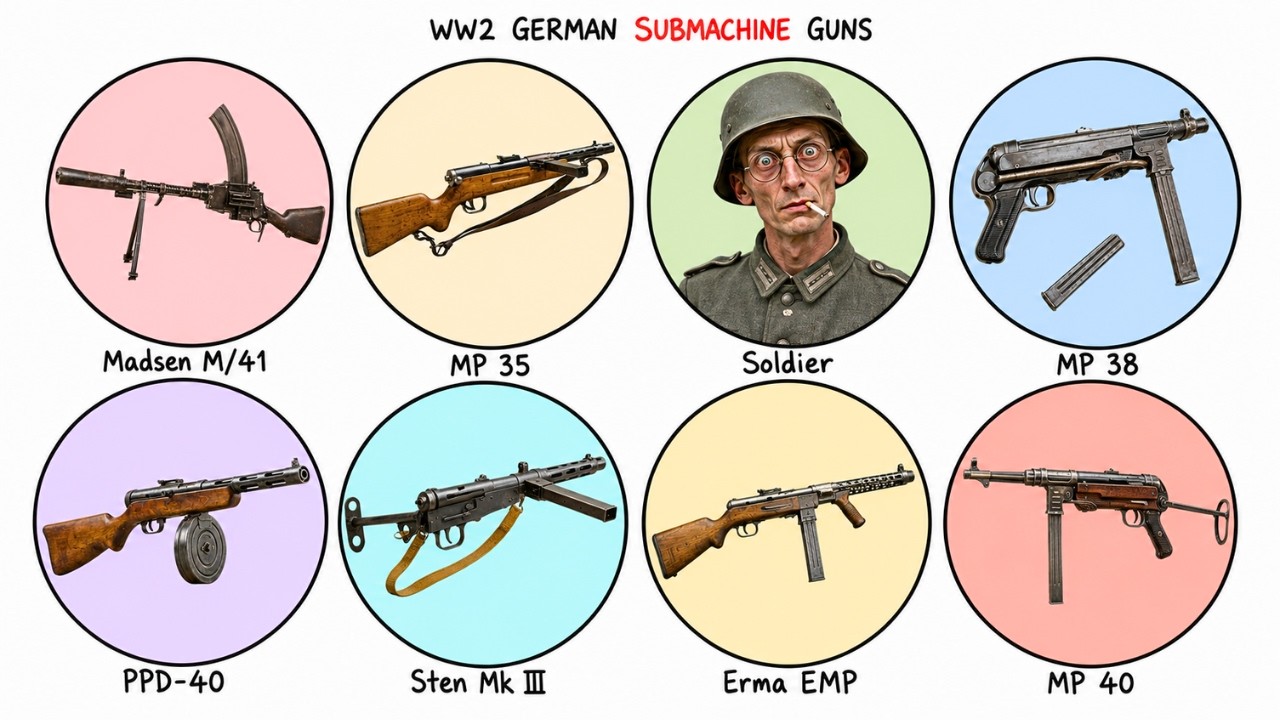
Denmark fell in April 1940 under 6 hours, leaving its military equipment largely intact and available for German capture. This was a 9-mm weapon produced in Denmark under license from Bergmann, mechanically related to the MP 35. German occupation forces and police units used it in Denmark and Norway.
A decent weapon and one that cost Denmark almost nothing to surrender given how brief the campaign was. We have the Mauser M/41 or M/42, also designated the MP 746 in parentheses D. The Danes produced these during the German occupation for German forces, which is a remarkable situation by any measure.
Chambered in 9-mm Parabellum, the Mauser featured a distinctive curved magazine and robust Danish construction. The occupied Danish arms industry continued operating under German direction, and these weapons ended up in the hands of the very forces that had occupied the country. History has some grim ironies.
Next, we have the Suomi KP/31, designated the MP 746 in {parentheses} F. F here standing for Finnish Finnish. The Suomi was arguably the best submachine gun in the world when the war began. It fired 9 mm Parabellum fed from a 71 round drum magazine and was exceptionally accurate and reliable even in extreme cold.
Finland sold licenses and weapons to Germany, and German forces used captured and purchased examples extensively on the Eastern Front. The Soviet Union was so impressed by it that the PPSh drum magazine is directly derived from the Suomi design. Let us continue with the PPD-40, designated the MP 715 in {parentheses} R. R for Russia’s Russian.
The Pistolet-Pulemyot Degtyaryova was the standard Soviet submachine gun before the PPSh replaced it. Germany captured large numbers during the early campaigns in the East and issued them to second line and occupation troops. It fired the Soviet 7.62 by 25 mm Tokarev cartridge, creating a separate ammunition supply requirement.
Effective enough, but the weapon it replaced was simply better in every practical way. Next, we have the PPSh 41, designated MP 717 in {parentheses} R. Germany captured so many of these that it became official policy to issue them, and they discovered the weapon was genuinely excellent.
The PPSh 41 fired 7.62 by 25 from a 71 round drum or 35 round stick magazine at a cyclic rate of roughly 900 rounds per minute. German soldiers preferred it to many of their own weapons, and entire German units on the Eastern Front were equipped almost exclusively with captured PPSh 41s.
That says something. We have the PPSh-41 9-mm conversion designated MP 41 in parentheses R. Germany captured such enormous quantities of PPSh-41s that specialized workshops converted them to fire 9-mm Parabellum to simplify the ammunition supply chain. Converted weapons used standard MP 40 magazines with an adapter, though reliability was mixed.
The conversion program ran throughout the latter part of the war and converted tens of thousands of weapons. When you have captured enough of something, converting it becomes more practical than finding a different source of ammunition. Next, we have the PPS 42 designated MP 718 in parentheses R.
The PPS 42 was designed under siege in Leningrad in 1942, literally designed and produced inside a city that Germany was actively trying to starve into surrender. It fired 7.62 by 25, used a 35-round curved magazine, and was built almost entirely from stamped steel. Germany captured examples and used them primarily on the Eastern Front.
There’s a particular historical weight to using a weapon designed specifically in response to your own siege. Let us continue with the PPS 43 designated MP 719 in parentheses R. The PPS 43 was the refined version of the PPS 42 with a folding stock and further production simplifications. It was one of the most cost-effective and reliable submachine guns of the entire war.
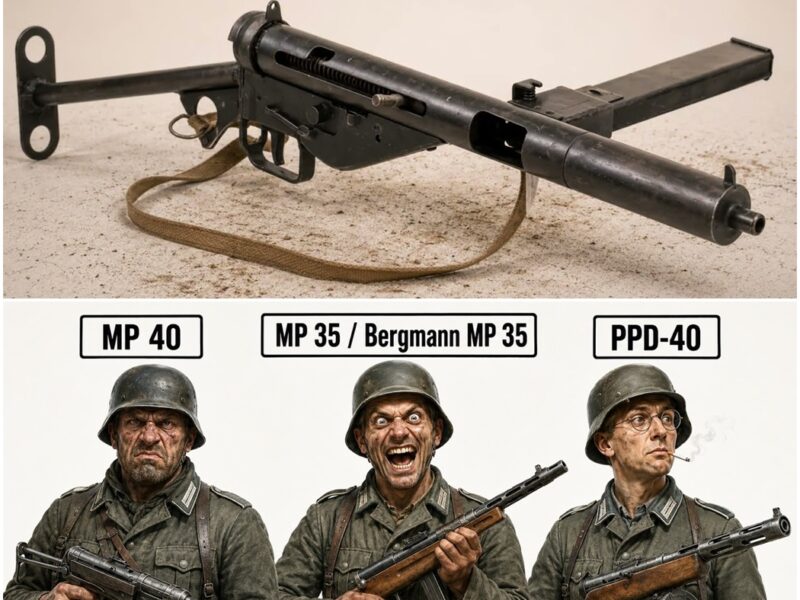
Germany captured and issued quantities of it, again primarily on the Eastern Front where Soviet weapons were available in volume. The PPS series demonstrated that you could build an exceptional weapon quickly, cheaply, and under the worst possible manufacturing conditions. We have the Sten MKII designated MP 749 in parentheses E, E for English, English.
The British Sten was designed to be cheap, fast, and simple, and it succeeded on all three counts, though British soldiers famously had mixed feelings about it. Germany captured large numbers in various campaigns and issued them to occupation forces. The irony is that Germany was simultaneously copying the Sten domestically because the design was so easy to reproduce.
Capturing them from the enemy while replicating them at home is a form of tribute the British probably did not appreciate. Next we have the Sten MK3 designated MP750 in parentheses E. The MK3 was an even more simplified version of the Sten with a fixed barrel sleeve and a one-piece tubular receiver welded directly to the barrel jacket.
Germany captured examples from British forces and air drops to resistance groups and issued them in the same secondary roles as the MK2. Functionally very similar, slightly cruder in construction, and completely adequate for the purpose both nations were using it for.
Next we have the Sten MK3 designated MP750 in parentheses E. The MK3 was an even more simplified version of the Sten with a fixed barrel sleeve and a one-piece tubular receiver welded directly to the barrel jacket. Germany captured examples from British forces and air drops to resistance groups and issued them in the same secondary roles as the MK2.
Functionally very similar, slightly cruder in construction, and completely adequate for the purpose both nations were using it for. Let us continue with the Thompson M1928 and M1928A1 collectively designated under the MP760 series. The Thompson was an American weapon Germany primarily encountered through captures in North Africa and Western Europe.
It fired the large and powerful .45 ACP cartridge from 20 or 30-round box magazines or the famous 50-round drum. Heavy, expensive, and a logistical challenge for German forces using it outside their standard ammunition supply. Effective in close quarters, but not practical at scale for German use.
Finally, we have the M3 Grease Gun, designated MP 763 in parentheses A. A for Amerikanisch, American. The M3 was the American answer to the same problem Germany solved with the MP 40, a cheap stamped steel submachine gun for mass production. It fired .45 ACP from a 30-round magazine at a deliberately slow cyclic rate of around 450 rounds per minute, which actually improved controllability.
Germany captured examples in Western Europe and North Africa. It is telling that both sides independently arrived at the same design philosophy. Metal tubing, stamped parts, and simplicity over elegance. 27 submachine guns, 12 of them not German, captured, converted, copied, and pressed into service by a nation that could not build enough of its own.
If you want every pistol and revolver Germany carried in the same format, that video is already on the channel. Subscribe and you will not miss what comes next.