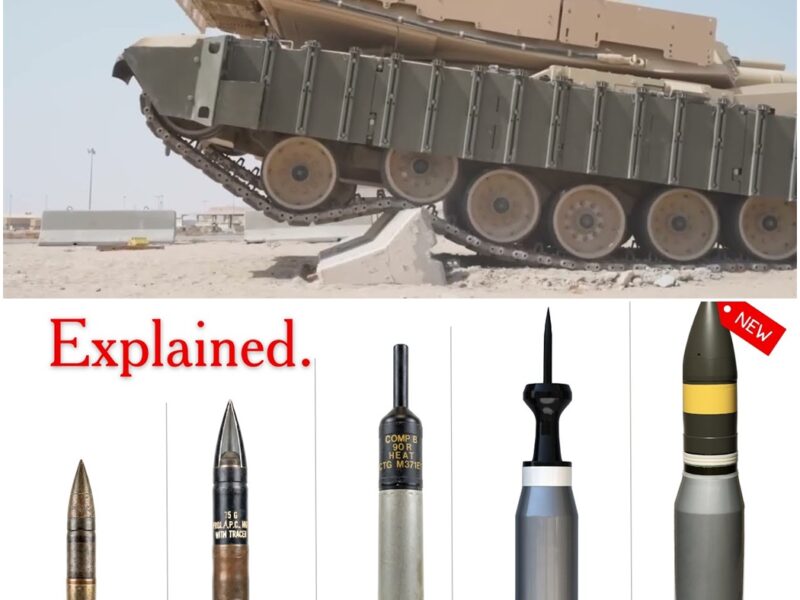
Every TANK Ammo EXPLAINED In 17 Minutes D
A tank gun is just a tube. What actually decides whether that tank wins or loses is what you load into it. And throughout history, armies got that choice catastrophically wrong. Showing up to battles with rounds that simply bounced off the armor in front of them. So engineers went back to work over and over again.
They built new rounds to defeat new armor, then built new armor to stop those rounds, then built new rounds to defeat that armor. That cycle has been running for over a century. And by the end of this video, you will understand every round that came out of it. Every type, every mechanism, every trade-off. Starting with armorpiercing or AP.
The first tanks rolled onto the battlefield in 1916, and for the first time, infantry had to figure out how to kill a vehicle wrapped in steel. The answer they came up with was almost embarrassingly simple. Take a solid block of hardened steel, shape it like a bullet, fire it as fast as the gun can manage, and hope it hits something vital. That is armor piercing.
No explosive charge, no internal mechanism, just raw kinetic energy transferring from a dense slug into whatever it hits. When AP penetrates armor, it does not explode inside the tank. Instead, it creates damage through spooling fragments of the armor plate itself, shearing off the inner face at high velocity and tearing through everything in the crew compartment with the round itself often fragmenting on the way through and adding to that shrapnel cloud.
Against the thin steel of early tanks, AP worked fine. Then tank armor got thicker and more importantly it got angled and that is when AP started failing. Fire a pointed steel slug at a flat plate and the energy drive straight in the round either penetrating or failing based purely on speed versus thickness.
But angle that plate tilt it at 60° the way the T34’s hole was designed and suddenly the effect of thickness doubles. Worse the geometry of a pointed nose hitting a sloped surface tends to make the round deflect. It skips off. All that energy goes sideways and the tank survives. German crews learned this lesson the hard way against Soviet T-34s on the Eastern front.
And the fix was a cap. A soft steel cap fitted over the nose of the AP round. That is APC, armorpiercing cap. The cap seems counterintuitive at first because you’re putting softer material on the front of a penetrator. But the soft steel is not there to penetrate. It is there to grip.
When an APC round hits angled armor, the cap deforms on contact and instead of deflecting, it bites into the plate surface and pulls the harder penetrator behind it into alignment with the armor face. The round squares up and drives through. The angle problem that crippled the AP round was now solved, but solving one problem created another.
A blunt nose means drag, so the round slows down faster through the air, and at longer ranges that lost velocity means loss penetration. Engineers looked at the cap and asked, “Can we make this aerodynamic without losing the grip?” The answer was to add a second cap on top of the first armorpiercing capped ballistic capped or APCBC.
The outer cap is pointed and streamlined, cutting through air cleanly and preserving the rounds velocity all the way to the target. On impact, it shatters, completely useless for penetration, but it has done its job. Underneath it, the soft inner cap is ready to grip the armor. Two caps, two different jobs.
One does aerodynamics, one does penetration. This became the dominant anti-tank round of World War II. The German 88 mm on the Tiger and King Tiger fired this round. The Soviet 122 mm on the IS-2 fired it. And the British 17 pounder, arguably the best Allied anti-tank gun of the war, fired it.
If a tank was killed in a major engagement between 1942 and 1945, there is a good chance this is what killed it. The rounds could also carry a small explosive charge inside timed to detonate after penetration to maximize damage to the crew compartment. These are called armor-piercing high explosive or APE.
The Soviet Union made heavy use of AP throughout the war, and many argue it made their tank guns more lethal post penetration than their German counterparts. In theory, it sounds perfect, but in practice, the hollow center weakened the round and reduced penetration. As composite armor made penetration harder and harder to achieve, APE was eventually phased out because if the round does not get through, the explosive inside means nothing.
Armor-piercing composite rigid or APCR. The first subcaliber round was APCR called HVAP, high velocity armor piercing in American service. The design is straightforward. A jacket of lightweight steel surrounds a core of tungsten carbide, one of the densest materials available. The jacket fills the barrel diameter so the propellant gases push correctly, while the tungsten core is what actually penetrates.
Tungsten carbide is roughly twice as dense as steel. So, it concentrates the impact force onto a far smaller point and penetrates significantly deeper than a steel slug of the same size would against the same plate. The problem was that the jacket stayed on all the way to the target.
That lightweight shell still created drag. Not as much as a full steel round, but enough to matter. And at range, APCR bled off velocity faster than expected. Long-d distanceance performance was disappointing. The jacket was the problem, and the challenge became figuring out when to get rid of it. The answer, the moment it leaves the barrel.
Armor-piercing, discarding Sabo or APDS. This round uses a jacket designed to separate the instant it clears the muzzle. The jacket, now called a Sabot, peels away in sections, usually three petals, and falls clear. What continues downrange is just the dense penetrating core, small, sleek, unencumbered.
The Sabbath’s only job was to fill the barrel and let the propellant gases push efficiently, and once the round is out of the gun, it is dead weight, so it leaves. The result is a round that benefits from a large gun’s propellant charge and high exit velocity, but then flies downrange with the aerodynamic profile of a much smaller projectile.
Velocity retention improves dramatically, and penetration at long range improves with it. APDS was a substantial leap forward, fielded by the British on the Centurion and remaining standard through the 1960s and into the early Cold War. But the core was still relatively short, and engineers had identified a clear relationship between a penetrator’s length and its ability to cut through armor.
The longer the rod, the deeper it goes, which raised the obvious question, how long can you make it? Armor-piercing fins stabilize discarding Sabot or APFSDS. This is the round sitting in the breach of every main battle tank on the planet right now. The penetrator in the round, called a long rod or dart, takes the subcaliber concept to its logical extreme.
The dart may be only 27 mm in diameter, but can be 800 to 1,000 mm long, nearly a meter thinner than your thumb and longer than your arm. Made from tungsten alloy or depleted uranium, flying at 1,700 m/s. When that dart hits armor, the pressure at the tip is so extreme, measured in gigapascals that the steel of the armor behaves like a fluid. The dart does not crack through.
It bores through with both the dart tip and the armor surface flowing around each other under the impact. The dart drives forward until it punches through or loses all its energy. And the damage on the other side is catastrophic. Spool, fragments of the dart itself, and a superheated pressure wave tearing through the crew compartment in milliseconds.
But a long thin dart creates a serious problem with spin. The rifling in a gun barrel imparts spin to a projectile. And for a short round, that spin creates gyroscopic stability. The round flies true. For a very long, very thin rod, however, spin is destructive. The rod begins to precess, wobble on its axis, and eventually tumbles, hitting the target sideways and rendering that 800 mm penetrator useless.
The solution was fins, a set of stabilizing fins at the rear of the dart, like the fletching on an arrow, that create aerodynamic stability without requiring spin. But fins and rifling are enemies because a spinning dart with stabilizing fins, is fighting itself. So tanks switch to smooth ball guns.
No rifling, no spin with the fins doing all the stabilizing work. The American M1 Abrams, the Germany Leopard 2, the Russian T72, T80, T90, the new Challenger 3, the South Korean K2 Black Panther. Every modern main battle tank uses a smooth ball gun specifically to fire APFSDS correctly. The one hold out, the Challenger 2, used a rifled gun for decades, which required its rounds to carry counter rotation fins to cancel the spin.
The Challenger 3 has now switched to the smooth boore, putting it in line with every other NATO tank. High explosive squash head or HESH. No jet, no dart, no penetration at all. The ammo defeats armor by attacking it from the inside. The round carries a large mass of plastic explosive inside a thin steel shell.
On impact, the shell collapses and the plastic explosive spreads, squashes across the surface of the target like putty before the base fuse detonates it. When that explosion fires, it sends a powerful shock wave through the armor plate. The wave traveling through the steel at the speed of sound and metal, hitting the inner face and reflecting.
On that reflection, it creates tensile stress the armor cannot absorb, and the inner face fractures and launches inward. Lethal chunks of steel tearing through the crew compartment. The outside of the target may show nothing but a scorch mark. Inside, catastrophic fragmentation. It is also extraordinarily effective against concrete where the same mechanism shockwave spo works on reinforced structures, bunker walls, and field fortifications.
And here’s where this round becomes genuinely interesting in the context of everything we have discussed. While spin from a rifled gun disperses a high explosive anti-tank jet and ruins its effectiveness, spin actually improves HESH performance. The rotation spreads the plastic explosive across a wider area of the target surface before detonation.
A larger spread means a larger pressure wave and more spool means more damage. This is the reason the Challenger 2 kept its rifled L30 gun while every other NATO tank switched to smoothboard decades ago. British armored doctrine relied heavily on HESH for both anti-armour and bunker busting work.
And switching guns meant abandoning the round. In case you didn’t know, HESH is also known as H in American service, which means high explosive plastic. High explosive or H. This is the oldest and simplest chemical energy round. A large explosive charge packed inside a thin steel casing with a foos on the nose.
On impact, it detonates the casing fragments and the blast and shrapnel clear everything in the immediate area. It does not kill tanks. It kills everything else. Infantry, light vehicles, artillery positions, field fortifications, supply lines, anything not wrapped in serious armor.
The fuse matters as much as the explosive. A point detonating fuse fires on impact. Ideal for direct hits on hard targets, a delay fuse fires a fraction of a second after impact, letting the round punch through a wall or thin roof before the explosion goes off inside. So effective against buildings, bunkers, and trench lines.
A timed fuse detonates the round at a preset moment after firing, regardless of what it has hit. Which is why early anti-aircraft guns used them to create shrapnel bursts at altitude and fill the sky around bomber formations with lethal fragments. The problem with timed fuses was that they required knowing the target’s altitude in advance, get the timing wrong, and the shell detonates nowhere useful.
The proximity fuse changed that. A small radio transmitter in the nose of the shell continuously broadcast a signal. When that signal reflects off a target, an aircraft, a ship’s superructure, or even the ground, and the reflection is strong enough, the fuse fires. The shell does not need to make contact and does not need a preset time.
It just needs to fly close enough. Against bomber formations in World War II, the difference was stark. Without proximity fuses, anti-aircraft guns needed an estimated 20,000 rounds or more to bring down a single aircraft. And with proximity fuses, that figure dropped to the hundreds. A single well- aimed shell flying near its target became reliably lethal rather than a lucky hit.
The technology was so valuable that the Allies classified it as one of the most important secret weapons of the war. kept off the European mainland for years specifically to prevent captured shells from giving the Germans the design high explosive anti-tank or heat. This round works on a principle called the shaped charge effect or the Monroe effect.
Inside the warhead is a metal cone, typically copper with its open end facing toward the target and behind the cone is a concentrated explosive charge. When the fuse fires, the explosion collapses the cone from the base inward, accelerating the copper into a jet that moves at 8 to 10 km/s.
That jet punches through armor purely through kinetic force, not heat, not melting. The name is misleading. The copper in a functional heat round never actually melts. It simply moves fast enough that steel cannot stop it. What makes it genuinely different from every armor-piercing round is this. AP penetration depends on velocity.
So, slow the round down and it fails. Its penetration depends on the explosion inside the round. A high explosive anti-tank warhead sitting still on a workbench would punch through the same thickness of armor as one fired from a gun at full velocity. The gun is only there to deliver the round to the target.
This made it the obvious choice for any platform that could not accelerate a heavy dart to useful velocity. Anti-tank missiles, RPGs, helicopter launched rockets, and recoilless rifles. You do not need a 120 mm smooth ball firing at 1,700 m/s. You just need to get the warhead close enough to detonate. For tanks, the West added something called high explosive anti-tank fins stabilized for smooth boore guns, which became critical in the midold war when Soviet heavy tanks like the IS-3 presented armor thicknesses that kinetic rounds of the era could not reliably defeat. But this ammo had problems and most of them mattered so badly. The first is standoff. A heat warhead needs a specific distance between the point of detonation and the armor face for the copper jet to fully form before it makes contact. Too close and the jet has not developed too far and it starts to disperse and lose coherence. To control that distance, heat rounds use a probe, a thin metal spike on the nose that makes contact
with the target surface and triggers detonation at the correct moment before the main body of the round arrives. The second vulnerability is spin. A heat jet fired from a rotating round disperses outward. the rotation bleeding focused energy away from the central axis and dropping penetration significantly.
Another reason the world moved to smooth ball guns. The third and most important vulnerability is armor specifically designed to defeat it. Spaced armor. Placing a thin outer layer in front of the main hull triggers early detonation, letting the jet form and dissipate before it reaches the real armor underneath.
Explosive reactive armor or erra takes this further. When struck, reactive tiles explode outward and physically disrupt the heat jet before it can penetrate. Explosive reactive armor became standard on Soviet tanks from the 1980s onward and effectively neutralized most heat warheads of the time.
The West answered with a tandem charge. Two warheads, one behind the other. The first detonates the reactive armor tile and milliseconds later, the second warhead, now facing exposed armor with no reactive protection, penetrates cleanly. Tandem charge became the standard for anti-tank missiles and RPG warheads.
The RPG29, the Cornet missile, the Javelin, all tandem. Today, against a modern main battle tank with composite armor, explosive reactive armor, and an active protection system. Heat is a primary anti-armour round for tanks has largely been superseded by armor-piercing fin stabilized discarding Sabot.
effective against light armor, helicopters, and fortifications where its velocity independent penetration still shines. Against a fully equipped MBT, it is the wrong tool. Programmable rounds. The idea behind programmable ammunition is straightforward. Give the crew the ability to choose how the round behaves at the moment of firing based on the target in front of them.
The fuse in a programmable round contains a small computer. And before the round is fired, the gun’s fire control system transmits a setting to that fuse through contacts in the brereech or via an inductive ring around the barrel, programming it in the fraction of a second before it fires. Point detonate fires the round on contact.
Standard impact detonation against vehicles and direct targets. Point detonate delay punches the round through a surface before it detonates a bunker wall, a building facade, or the top of a vehicle. Airbus detonates the round at a specific distance from the muzzle calculated by the fire control system, exploding above infantry in a trench, behind a wall, or on the far side of a ridgeel line, reaching targets that direct fire simply cannot touch.
The US M1147 advanced multi-purpose round entered service with the Abrams in 2024, replacing four legacy round types with one, covering everything from anti-personnel to bunker busting to light vehicle defeat in a single 120 mm package. Germany’s DM11 does the same for Leopard 2 crews and Rhital’s programmable 120 mm rounds are now part of a 4 billion euro bundes ammunition contract.
Russia fields the 3 VOFF128 Telnik for the T90M, a programmable fragmentation round carrying 450 preformed fragments in a cone pattern, programmable through the T90M’s ballistic computer. One round, multiple solutions. That is where tank ammunition stands right now. Thanks for watching. See you in the next video.