FV101 Scorpion: The Little British Tank That Became the King of Armoured Reconnaissance! D
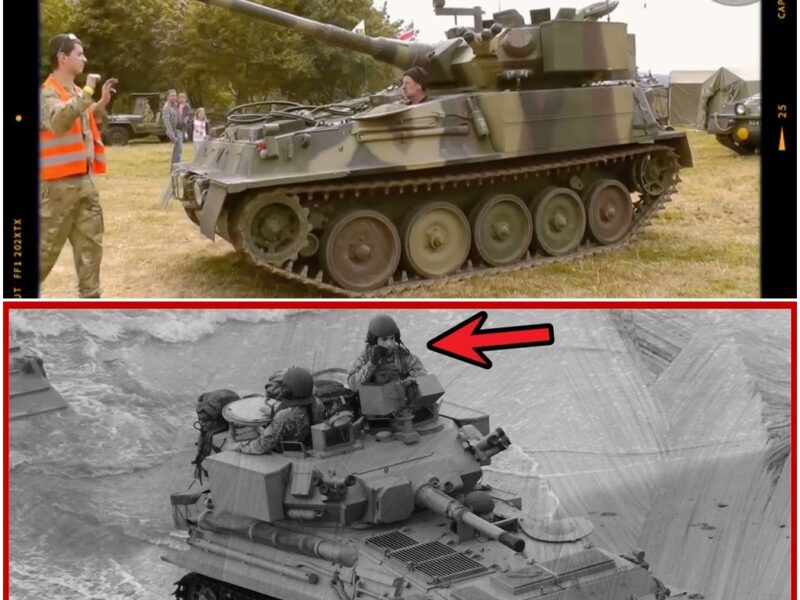
There is a photograph in the Imperial War Museum archive that I keep returning to. It was taken in June 1982 somewhere between San Carlos and Port Stanley on the Falkland Islands. The ground in the photograph is the color of cold tea, dark, saturated, the kind of ground that pulls at boots and swallows wheels and defeats every piece of military equipment that was not specifically designed with it in mind.
In the middle of this ground, apparently unconcerned, sits a small tracked vehicle. Its hull is close to the earth. Its turret is compact. A young Falkland Islander is perched in the commander’s hatch, providing local knowledge to the crew. The vehicle looks as though it has always belonged there. It weighs 8 tons.
It holds the Guinness World Record for the fastest production tank in history. And on the night of 13th to 14th June 1982, two of them alongside two of their siblings were the only armored vehicles in the entire British order of battle for the Falklands campaign, providing direct fire support to second battalion parachute regiment during the assault on Wireless Ridge.
The Argentine defenders watching the muzzle flashes that night had no way of knowing that the armored vehicles supporting the paras weighed less than a modern luxury SUV. This is the FV101 Scorpion. And its story is not simply the story of a small tank that performed beyond expectations in a war nobody had planned for.
It is the story of a philosophy of armored warfare. A deliberate, documented, institutionally argued rejection of the assumption that bigger is better that turned out to be correct in ways that the British army is still reckoning with 30 years after the vehicle left service. If the specific, honest, technically detailed story of Britain’s fastest and most unconventional armored vehicle is what brings you here, give this a like.
We are going to go through it properly. From the design requirement that produced it to the Pete bogs where it proved the requirement was right. Start where every vehicle story has to start with the problem it was designed to solve. In the early 1960s, the British Army had a reconnaissance problem. It was not unique to Britain.
Every army operating tracked armored vehicles in the cold war period faced some version of it. But the British version had specific characteristics shaped by the specific strategic situation the army found itself in. The British army of the Rine was deployed in West Germany as part of the NATO commitment to the defense of Western Europe against a potential Warsawpacked advance.
Its primary task in the event of a Soviet-led offensive was to fight a defensive battle that bought time for reinforcements to arrive and for the political and diplomatic processes of the alliance to operate. The Chieftain tank, which I have covered in detail in a previous video, was the vehicle that would fight that defensive battle.
Heavily armored, heavily gunned, designed specifically for the hullown defensive engagement at medium range that the terrain of West Germany favored. But before the chieftains could fight, someone had to tell them where the enemy was. The Soviet plan for a Warsaw packed offensive relied on speed and mass.
Large armored formations would advance simultaneously on multiple axes, attempting to penetrate NATO lines before the alliance could coordinate an effective response against this kind of attack. The warning time available to British commanders before the first Soviet armored vehicles reached effective gun range was measured not in days but in hours.
The reconnaissance force, the vehicles that operated forward of the main defensive line, finding the enemy’s approach routes, identifying the timing and direction of the main effort, providing the intelligence that allowed defensive resources to be concentrated at the right place at the right time was the critical link between strategic warning and tactical response.
And the vehicles the British army had available for that reconnaissance mission in the early 1960s were, by any honest assessment, inadequate. They were too heavy for the terrain they needed to cross. They were too slow to operate far forward and still have a credible chance of extracting themselves when contact was made.
They were logistically demanding in ways that complicated the already complex business of supporting a forward reconnaissance force. and they were not air transportable which meant that in any crisis requiring rapid deployment outside the European theater they could not get there. The requirement that went out under the designation combat vehicle reconnaissance tracted CVRT was an attempt to answer all of these problems simultaneously.
It was by the standards of military procurement requirements admirably specific about what it needed. Light enough to cross terrain that excluded heavier vehicles. Fast enough to survive contact by outrunning rather than absorbing. Air transportable in a C130 Hercules. Two vehicles per aircraft. Armed with a weapon capable of defeating the light armored vehicles that would form the enemy’s reconnaissance screen and critically the basis of an entire family of vehicles because the reconnaissance force needed more than just reconnaissance tanks. The requirement was in the assessment of everyone who studied it extremely demanding. The British Army wanted a great deal from a very small package. The contract went to Alvis Limited of Coventry in 1967. The company had been building armored vehicles for the British Army since before the Second World War. The Alvis Saladin and Sar were still in British service at the time of the contract. They had the institutional knowledge,
the manufacturing capability, and the specific understanding of British Army requirements that the program needed. The first major design decision, the one that shaped everything else, was the choice of hull material. Steel was the conventional choice. It was strong, it was familiar, it was available in the grades and thicknesses that armored vehicle production required.
But steel was also heavy, and weight was the enemy of everything. the CVRT requirement was asking for. Alvis chose aluminium. Aluminium armor at equivalent thickness to steel provides approximately 60% of the protection against a given ballistic threat, but it weighs roughly 1/3 as much per unit volume.
This means that for the same weight penalty, you can use considerably more of it. And for the protection level, the CVRT requirement specified, which was protection against small arms fire and artillery fragments rather than against anti-tank weapons, aluminium at appropriate thickness, was entirely adequate at a weight saving that made the difference between a vehicle that met the requirement and one that did not.
The first prototype appeared in January 1969. Testing ran through 1969 and into 1970, including trials in Norway, Canada, Abu Dhabi, and Australia, a deliberate program of assessment in the most varied climatic and terrain conditions that could be arranged. The British Army accepted the vehicle in May 1970. Production vehicles began rolling out of the Alvis factory in Coventry in early 1972.
The FV101 Scorpion entered service with the British Army in January 1973. The numbers that describe the Scorpion are worth presenting carefully because they are the numbers that produce the Guinness World Record. Combat weight 8.074 tons. For scale, a modern Range Rover Sport weighs approximately 2 1/2 tons.
Three and a third of them stacked on each other would equal one Scorpion. A British armored vehicle with a 76 mm gun, full nuclear, biological, and chemical protection, night vision equipment for all three crew members, smoke grenade launchers, and 40 rounds of main armament ammunition. Engine. The Jaguar J6, a 4.
2 2 L 6-cylinder petrol unit developed from the Jaguar car engine and modified for military service producing 190 horsepower at 4,750 revolutions per minute into 8 tons of vehicle that translates to a powertoweight ratio of approximately 25 horsepower per ton. The Chieftain main battle tank, the vehicle the Scorpion was designed to support, managed approximately 13 horsepower per ton.
The Centurion, which the Chieftain replaced, managed around 14. The Scorpion had nearly twice the powertoweight ratio of the main battle tanks it was designed to operate alongside. The result of that power-to-weight ratio applied to a vehicle with torsion bar suspension and five road wheels per side, giving a total track contact length that contributed to its remarkable ground pressure, was a verified top speed of 51.1 mph.
This figure was officially measured, officially submitted to the Guinness Book of Records, and officially recognized as the fastest speed achieved by a production tank. The record stood for years, ground pressure 5 lb per square in. A walking adult human produces approximately 7 to 8 lb per square in under each foot.
The scorpion’s tracks distributing 8 tons of vehicle across their contact area with the ground applied less pressure per unit area than a person walking. This is the specific characteristic that made the photograph in the Imperial War Museum possible. The image of a scorpion sitting on Forkland’s Pete that would have swallowed a chieftain to its turret ring in minutes.
The vehicle could ford water 3 ft 6 in deep without preparation and with the fitment of a flotation screen could swim propelled by its tracks moving at 4 mph through water rather than across it. It could climb a vertical obstacle of 20 in cross a trench of 6’9 in and operate in temperatures from -30 to + 50° C. Two of them fit inside a single Lockheed C130 Hercules with their crews and enough fuel and ammunition for immediate operations.
Not as a demonstration or a one-time achievement, as a routine loading configuration. The crew of three worked in conditions that the vehicle’s designers had calibrated very precisely to meet the mission requirements rather than the comfort requirements. The driver sat at the front left of the hull. the Jaguar engine occupying the space to his right.
Access was through a single piece hatch that opened forward, requiring a specific sequence of movements that Scorpion drivers learned to perform smoothly through repetition and came to regard as simply part of getting into the vehicle in the way that drivers of unusual machines always adapt to their particular access routines.
The driver’s controls were two tillers rather than a conventional steering wheel. Pull the right tiller and the right track slows or stops while the left continues turning the vehicle right. Pull both simultaneously and fully and the vehicle pivots on its own axis. A neutral turn that had specific tactical utility in the engagement and disengagement scenarios that reconnaissance operations regularly produced.
Slowing the whole vehicle onto a target with the tillers was in the Scorpion’s case the primary gun laying mechanism for large changes of bearing with the handc cranked turret used for fine adjustments. The driver was in consequence an integral part of the engagement process in a way that drivers of vehicles with powered turrets were not.
That handc cranked turret deserves specific attention because it is the element of the Scorpion’s design that is most frequently cited as a significant limitation and the characterization is only partially accurate. The British Army version of the Scorpion used a handc cranked turret traverse rather than an electric or hydraulic powered system.
The gunner turned a wheel by hand to swing the turret and the traverse rate was therefore limited by human strength and arm speed rather than by motor output. At first glance, this seems like an obvious disadvantage in any engagement requiring rapid traverse to a new target. In practice, the tactical scenarios for which the Scorpion was designed rarely involved the kind of rapid traverse situation that makes a powered system decisive.
The vehicle was expected to operate in hull down or fully concealed positions, acquire targets, engage and disengage, not to fight moving engagements at close range against multiple simultaneously presenting targets. For the engagement geometry of reconnaissance warfare, the handc cranked traverse was adequate while saving weight, complexity, cost, and maintenance burden.
Vehicles that the Scorpion was expected to fight had thin enough armor that the first shot was likely to be decisive, and the need to rapidly traverse to a second target before the first had been engaged was not the primary design scenario. The commander occupied the left side of the turret with a cupiller providing 360° observation through multiple episcopes.
The situational awareness that a vehicle operating far forward of friendly lines needed to survive in conditions where threats could appear from any direction. The gunner occupied the right side with a roof-mounted telescopic sight providing magnifications of one times and 10 times for target acquisition and engagement, plus a passive night sight for operations in low light conditions.
The driver had his own infrared driving periscope for night movement, a genuine, if limited, all-weather capability that placed the Scorpion ahead of many contemporaries when the vehicle entered service in 1973. The noise level inside the vehicle with the Jaguar petrol engine running was by multiple accounts considerable.
The intercom was not optional equipment. The CVRT family built around the Scorpion Hull is one of the more impressive examples of modular vehicle design in the history of British armored fighting vehicles and it deserves careful description because the family’s coherence was central to its operational value.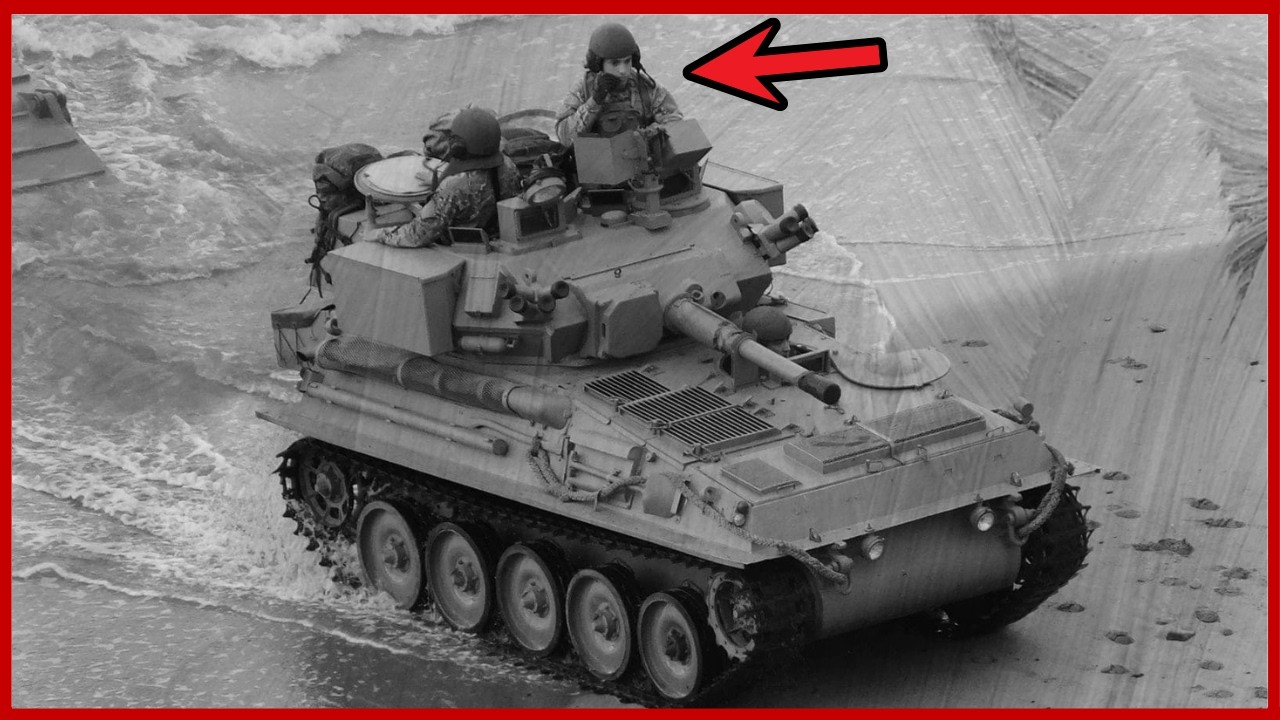
Seven variants were produced, all on the same basic hull, sharing the same engine, transmission, suspension, running gear, and a very large proportion of their detailed components. The FV 101 Scorpion itself with the 76mm L23A1 gun served as the fire support element. The vehicle that could suppress and destroy light armored opposition and provide direct fire to infantry without exposing the force to the kind of engagement that a pure reconnaissance vehicle needed to avoid.
The FV 107 scimitar replaced the 76 mm gun with a 30 mm Ren cannon. The Rarden was a different weapon to the Scorpion’s gun in almost every respect. Higher velocity, higher rate of fire, greater accuracy at medium ranges against light armored vehicles, and effective against low-flying helicopters. Where the Scorpion was the heavy hitter of the CVRT family, its gun providing genuine destructive capability against anything short of a main battle tank, the Scimitar was the precision instrument.
its 30 millimeter rounds capable of engaging targets with a rate of fire and accuracy that the 76 millimeter could not match. The FE102 Striker carried five Swingfire anti-tank guided missiles in a retractable launcher. The Swingfire was a remarkable missile in its own right.
It used a post-launch guidance system that allowed the operator to steer it onto a target even if the launcher vehicle was in complete cover when the missile was fired. The launcher head rose above the hull, the missile fired, and the operator tracked the target through a separate site while the missile curved around to reach it.
Engaging a striker with direct fire required a Soviet armored vehicle to expose itself to a missile that was already airborne and being guided, a tactical problem that had no clean solution. The FV 103 Spartan was a compact armored personnel carrier carrying four passengers in addition to its crew used to transport the Milan anti-tank missile teams that would be attached to the reconnaissance force.
The FV 104 Samaritan was an armored ambulance. The FV 105 Sultan was a command vehicle. The FV 106 Samson was an armored recovery vehicle capable of recovering and winching any vehicle in the family. Every one of these seven vehicles shared maintenance consumables, spare parts, and trained mechanics with every other one.
ARME forward repair section supporting a CVR regiment needed one set of engine spares, one transmission rebuild kit, one set of suspension components because every vehicle in the regiment used them. A mechanic who had been trained on the Scorpion could maintain the scimitar, the Spartan, the Striker, and the Sultan without additional vehicles specific training.
The operational availability figures for CVR regiments, the percentage of vehicles that were operational at any given point in time were consistently higher than those of units operating mixed fleets. Because the maintenance burden was so much more manageable, two vehicles from any CVR variant could be loaded into a single C130 Hercules.
An entire troop of four vehicles needed two aircraft. A squadron of 16 could deploy in eight. The strategic mobility implications of this were genuinely significant, not as a theoretical exercise, but as a capability that was actually used. The Falklands. This is where the vehicle becomes more than its specification.
On April 2nd, 1982, Argentine forces occupied the Falkland Islands. The British government’s decision to send a task force to retake them required, among many other decisions, a rapid and honest assessment of what armored vehicles could be transported to the South Atlantic, landed on beaches or through shallow water, and then operated across terrain that very few British Army planners had ever thought about in the context of armored warfare.
The Falkland’s terrain was the specific problem. The islands consist of approximately 12,000 km of largely roadless land. Much of it is underllayed by pete, deep, wet, compressible pete that supports the characteristic Faulland’s vegetation of tusket grass and short heath while swallowing wheeled vehicles and potentially anything tracked that lacked the scorpion’s ground pressure characteristics.
Movement across this ground was going to require either air transport or human legs for most of the campaign because the terrain between San Carlos, where the landing would occur, and Port Stanley, where the Argentines had their main force, was simply impossible for normal military vehicles.
The Chieftain was not seriously discussed as a Forkland’s vehicle, 55 tons, road dependent, physically incapable of crossing the terrain. It was not a question of whether to bring chieftains, but of what to bring instead. Two troops from B squadron, the Blues and Royals, were tasked to go south. They took four Scorpions, four scimitars, and one Samson recovery vehicle, nine vehicles.
The entire British armored capability for the liberation of the Falkland Islands. The vehicles were loaded aboard the motor vessel Elk while the crews, officers, and troopers of one of the most senior cavalry regiments in the British Army embarked on the SS Canra along with the bulk of the land force.
At Ascension Island, the vehicles were transferred to HMS Fearless for the approach to the islands. The landing at San Carlos on May 21st, 1982 brought the CVRT vehicles ashore in landing craft. The crew of one scimitar subsequently claimed with the understated humor that the Blues and Royals affected that they had been used as test equipment to measure the depth of the water before the following craft were brought in.
Whether the depth measurement was planned or opportunistic, the vehicle made it ashore. In the days that followed, the Scorpions and Scimitars performed a range of tasks that their designers had not specifically anticipated, but that their capabilities made perfectly suited for. Perimeter security in dugin positions around the lodgement area.
Logistics runs using the vehicle’s mobility across soft ground to carry supplies that wheeled transport could not reach. Reconnaissance ahead of the infantry as the force began its move towards Stanley and direct fire support when the infantry made contact with Argentine defensive positions. The specific ground pressure advantage that the Scorpion possessed was not marginal in the Forklands.
It was the difference between operating and not operating. Ground that stopped Land Rovers that stopped the tracked BV202 over snow vehicles when they moved off marked routes that would have stopped any heavier armored vehicle within minutes. The Scorpions and Scimitars crossed it, not without difficulty.
Not without the crews learning over days of operation which routes across the Pete were passable and which would swallow the vehicles if they deviated. But they crossed it. They were present at the objectives when the infantry arrived and they were in action when the infantry needed them. The battle of Wireless Ridge on the night of 13th to 14th June 1982 is the engagement that crystallizes the Scorpion story most clearly and it deserves the specific treatment that the standard narratives of the campaign rarely give it. The second battalion parachute regiment was tasked with the assault on Wireless Ridge, the last significant high ground between the British advance and Port Stanley. The ridge had been prepared by the Argentine defenders with the specific advantages that defenders in prepared positions hold over attackers crossing open ground at night. Machine guns covering the approaches, artillery registered on the likely assault routes. The darkness that was
supposed to help the attacking infantry also helped the defenders who had had time to learn their ground and position their weapons. Two scorpions and two scimitars from the Blues and Royals were tasked to support the assault. Their specific role was direct fire to put rounds onto the Argentine positions on the ridge at sufficient volume and accuracy to force the defender’s heads down while the paras crossed the open ground between their forming up positions and the enemy.
What the CVRT crews needed to do in practical terms was find positions that allowed them to engage the ridge while remaining on ground that their vehicles could cross, maintain fire while the infantry advanced, and be prepared to move when the tactical situation changed.
In the darkness, the muzzle flashes of the 76 mm and 30 mm guns were visible from considerable distance. The crack of the rounds impacting Argentine positions on the ridge was audible to the infantry advancing below. Argentine defensive fire directed initially at the infantry assault noticeably reduced when the vehicles opened up as the defenders were forced to split their attention between the approaching infantry and the armored vehicles firing from the flank.
The Paris reached and secured the ridge. British casualties were three killed and 11 wounded. Argentine casualties were 25 killed, 125 wounded and 37 captured. The commanding officer of two parah said afterwards that the Blues and Royals had saved lives at Wireless Ridge. Four troop of the Blues and Royals performed the same fire support role for the Scots Guards at the Battle of Mount Tumbleown on the same night.
The two engagements running essentially simultaneously as the British force made its final push on Port Stanley from multiple directions. The direct fire of the CVR T guns onto the rock positions of Mount Tumbleown gave the guards assault enough suppression to close with defenders who had been significantly reinforced.
During the campaign, one Scorpion struck an Argentine landmine. The mine destroyed a section of track and damaged the running gear, but did not penetrate the hull. The crew were uninjured. The vehicle was recovered by a Chinuk helicopter repaired by the Blues and Royals fitters and returned to service.
All nine CVRT vehicles that landed at San Carlos on May 21st, 1982 were operational on June 14th when the Argentine commander signed the instrument of surrender. The technical limitations of the Scorpion’s armor are frequently invoked to qualify assessments of the vehicle’s capability, and they deserve honest treatment because the qualification, while technically accurate, misses the operational logic entirely.
The aluminium alloy armor of the Scorpion provided protection against small arms fire and artillery shell fragments, against heavy machine guns at close range, against rocket propelled grenades, against anti-tank missiles, against the gun of any main battle tank. It provided no reliable protection.
This is a statement of fact. The vehicle’s armor was never designed to defeat these threats because a vehicle designed to defeat them could not simultaneously meet the weight, speed, and ground pressure requirements that defined the CVRT program. The question is not whether the Scorpion’s armor could stop a tank round.
The question is whether the Scorpion needed to be in a position where a tank was shooting at it. The reconnaissance mission the Scorpion was designed for was built around the principle that protection comes primarily from not being found rather than from being able to absorb fire after being found. A vehicle that can reach 51 m hour and cross terrain that excludes everything heavier than itself has a range of tactical options that armored vehicles cannot match.
And the most important of those options is the option to not be where the threat is. In the Falklands, the Argentine forces did not have weapons that could reliably defeat the Scorpion’s armor in the conditions the vehicle operated in. The landmine that struck one vehicle was the most serious threat encountered, and the hull withtood it in the Cold War scenario.
The vehicle was designed for the Soviet reconnaissance screen. BRDM2 armored cars and PT76 amphibious light tanks carried weapons that the Scorpion’s aluminium hull could not reliably stop at close range. But the PT76’s own hull carried 14 mm of steel armor. Against 14 mm of steel, the Scorpion’s 76mm Hesh was entirely lethal at any practical combat range.
The vehicle was not invulnerable. It was not designed to be invulnerable. It was designed to operate in conditions where invulnerability was not the primary survival strategy. And in those conditions, it worked. The Gulf War of 1991 added another chapter to the Scorpion’s operational record.
And in terrain as different from the Falklands as it was possible to imagine, British scorpions deployed to the Gulf as part of the British armored contribution to Operation Desert Storm. The desert terrain of Uwait and southern Iraq was in several respects close to ideal for the vehicle. Open ground with good visibility, firm surface that allowed the Scorpion to operate near its performance envelope, temperatures within the vehicle’s specified operating range.
The Jaguar petrol engine had by this point been replaced in most British vehicles by the Cummins BTA 5.9 L diesel which provided better fuel economy and significantly improved operational range. The original petrol engines fuel consumption having been one of the genuine operational limitations in the Falklands where fuel resupply across the Pete was a constant challenge.
The reconnaissance role that Scorpion crews performed in the Gulf was the reconnaissance role the vehicle had been designed for in West Germany two decades earlier, operating forward of the main force, identifying Iraqi positions and movements, providing the intelligence picture that allowed heavier forces to be directed to the decisive points.
The vehicle’s speed and low ground pressure, which had been decisive advantages in the Falkland’s soft terrain, were in the Gulf simply adequate characteristics for a desert where many other vehicles could also operate effectively. What the Gulf War confirmed in a different theater and against a different opponent was that the CVRT family as a coherent system with the Scorpion’s fire support capability complemented by the scimitar’s 30 mm raden and the Striker’s swingfire missiles was adaptable to operational environments its designers had not specifically anticipated. The export history of the Scorpion tells you with the directness of commercial decisions made by people spending real money how other armies evaluated what the vehicle offered. 23 countries ultimately operated CVRT family vehicles in one configuration or another. The list runs from Belgium, which bought 134 vehicles and operated them in the
central European terrain they had been designed for, to Venezuela, which operated them in conditions as different from West Germany as geography allows. Iran purchased 250 scorpions in the 1970s. A purchase that was followed in a less comfortable continuation of the relationship by the Islamic Revolution of 1979 and the Iran Iraq war of 1980 to 1988.
during which Iranian Scorpions saw sustained combat against Iraqi T62s and T72s. The Iranian experience confirmed the operational logic of the vehicle. Scorpions used in the reconnaissance and infantry support roles they had been designed for, operating on their own terms in terrain and at ranges that suited their capabilities performed effectively.
Scorpions used in the direct combat role against Iraqi main battle tanks at ranges where their 76 millimeter gun could not reliably penetrate. Used, in other words, as something they were not designed to be, suffered the predictable consequences of asking a tool to perform a function it was not designed for.
The lesson was not that the Scorpion was a bad vehicle. The lesson was that a vehicle designed for a specific mission will succeed at that mission and struggle at other ones, which is a statement about mission specific design rather than about the Scorpion specifically. The Scorpion was withdrawn from British Army service in 1994.
The retirement had multiple causes. the age of the fleet which had been in service for over two decades. The availability of the scimitar as a continuing CVRT platform that could perform many of the same functions and in one of those specific details that military history occasionally delivers without editorial comment.
The discovery that the vehicle’s insulation materials contained asbestos creating occupational health obligations that complicated continued operation. a vehicle that had held the world speed record for production tanks that had been the only armored element of the Forklands campaign that had served in the Gulf War that had been exported to 23 countries across six decades of service was retired because of its insulation.
The CVRT family concept proved considerably more durable than the specific vehicle that led it. The scimitar continued in service through Bosnia, Kosovo, and Iraq, accumulating a further generation of operational experience in conditions that continued to validate the fundamental logic of the program.
The British Army’s attempts to replace the CVRT family produced a series of programs FRES and eventually Ajax that have encountered difficulties, suggesting that what Alvis built in Coventry in the late 1960s was harder to improve upon than the replacement programs initially appreciated. The AX program’s troubled development is not a comment on the CVRT concept.
It is evidence that the concept was more carefully specified and more correctly implemented than has been generally acknowledged because the standard for replacement is what is being replaced and the CVRT family set a standard that proved difficult to meet with more modern technology, more modern manufacturing and significantly more budget.
I want to return to that Imperial War Museum photograph, an FV101 Scorpion of B Squadron, the Blues and Royals, on the Falkland Islands in June 1982. The ground is dark and saturated. The vehicle sits on it as though it was born there. A young Falkland Islander rides in the commander’s hatch.
The winter sky of the South Atlantic is visible above. 8 tons, 51.1 mph, 76 mm gun with 40 rounds, aluminium armor providing protection against small arms and fragments, full NBC system, night vision for all three crew members, two vehicles per C130 Hercules. The vehicle the British Army contracted in 1967, accepted in 1970, and fielded in 1973, answered a specific question about what a reconnaissance tank should actually be.
Not a small main battle tank, not a scaledown version of the Chieftain with its armor reduced to save weight. something designed from first principles around the specific mission. Finding the enemy, reporting what had been found, and surviving the process by being too fast and too light and too mobile for the enemy’s response to reliably catch.
The vehicle that resulted from that design philosophy fought in the Falklands when heavier vehicles could not get off the ship. It supported two parah at Wireless Ridge and the Scots Guards at Tumbleown. It served in the Gulf War in terrain as different from the Falklands as the Atlas allows. It was exported to 23 countries.
It was operated by armies with budgets ranging from the British Army’s NATO standard provision to the much more limited resources of smaller nations. And it performed in all of these contexts the mission it had been designed for. The officer who told the Blues and Royals after Wireless Ridge that they had saved lives knew what he was describing.
Eight tons of aluminium moving at speeds that heavier vehicles could not match across ground that heavier vehicles could not cross, providing the one capability that the entire Forkland’s campaign lacked until B Squadron arrived. Armored direct fire in the dark on the Pete for the Paris.