Judge Melville Gave Him 60 Minutes — Why Michael Jackson Wore Pajamas to the 2005 Trial D
The seat was empty at 8:34 in the morning. Judge Rodney Melville walked into the courtroom at Santa Barbara County Superior Court in Santa Maria, California, looked at the defense table, and saw nothing. No Michael Jackson. No explanation. Just his attorney, Thomas Mesereau, standing there with the particular stillness of a man trying very hard not to look as panicked as he felt.
It was March 10th, 2005, day nine of the trial. The accuser was scheduled to continue his testimony that morning, and the press had been camped outside since before dawn. More than a thousand media credentials had been issued for this case. Journalists from Japan, Australia, the United Kingdom, Switzerland.
Every major American cable network had a camera position. The infrastructure that had been built around this courthouse in Santa Maria was something closer to a small broadcast city than a press pool. Hundreds of people whose jobs depended on something happening here every single day were outside, waiting.
The machine was running. The man at the center of it all was somewhere else. Mesereau stood up. Your Honor, Mr. Jackson is at Cottage Hospital in Santa Ynez with a serious back problem. He does plan to come in. Melville looked at him. Then he asked whether Jackson’s doctor could be connected by phone. Mesereau said yes, he could arrange that.
Melville said no. What happened next took less than three minutes. At 8:37 a.m., Judge Melville issued a warrant for Michael Jackson’s arrest, ordered the forfeiture of his $3 million bail, and gave the attorney exactly one hour to produce him in court. His words, as they appear in the court record, “I’m issuing a warrant for his arrest.
I’m forfeiting his bail. I will hold the order for one hour.” CNN went live. MSNBC put a countdown clock on the screen. The question now being asked on television, in the parking lot outside the courthouse, and presumably in a hospital room 35 miles away, was the same one. Would Michael Jackson actually be handcuffed today? That morning had started badly before any of this.
Jackson had fallen while getting dressed at his rented house near Neverland, his back locked up. He was taken to Santa Ynez Valley Cottage Hospital sometime before court was scheduled to begin. His attorney, Brian Oxman, described it plainly. He tripped this morning and fell as he was getting dressed. His back is in terrible pain.
His spokesperson, Raymone Bain, made the same point from a different angle. He is not playing games. His back just gave out on him. Whether anyone in a position of authority chose to believe that on the morning of March 10th is a separate question. What mattered procedurally was this. Jackson had already been late to his own arraignment back in January 2004, and Melville had admonished him for it publicly, calling it an insult to the court.
Then, 3 weeks into this trial during jury selection, Jackson had gone to a hospital with flu symptoms and delayed proceedings for an entire week. Melville had accepted that reluctantly on a phone call with doctors. But he had made clear he was not going to keep accepting delays without consequences.
This was the third time, and Melville had decided he was done. At 8:45 a.m., a hospital spokeswoman confirmed that Jackson had been treated and released. He was on his way. The drive from Santa Ynez Valley Cottage Hospital to the Santa Maria Courthouse is 35 miles. Under normal conditions, that takes roughly 45 minutes.
Jackson had been given 1 hour from 8:37. The math was tight and left almost no room for anything going wrong on the road. Outside the courthouse, Mesereau was pacing the driveway with his phone pressed to his ear. Reporters watching him from behind the press barrier could read enough from his posture and movements to understand the calls weren’t going smoothly.
Fan groups had gathered behind the security fencing with signs and candles, which was normal for any given morning of the trial. The countdown clock on MSNBC kept moving. Inside the building, the gallery was full and the jury had not yet been brought in. Everyone was waiting for one of two outcomes.
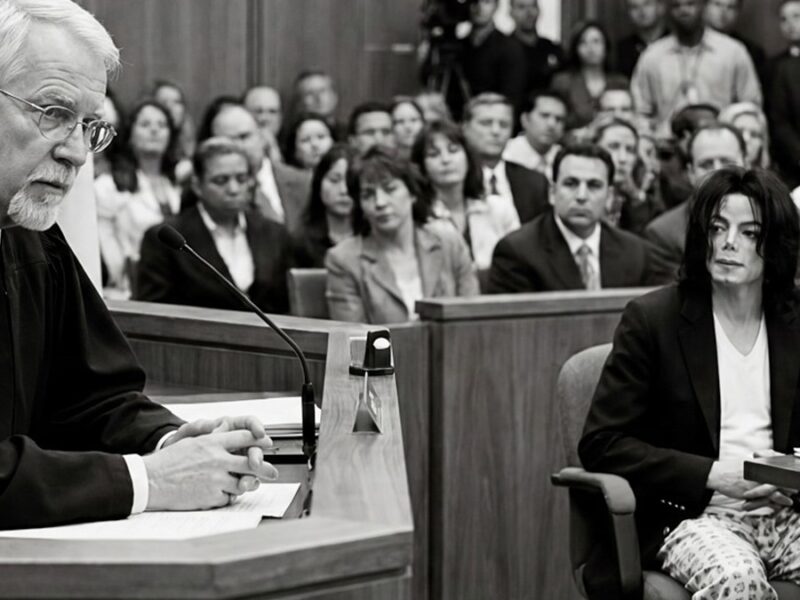
Jackson walking through the door or the judge calling the marshals. The motorcade pulled up at 9:58 a.m. 4 minutes after the deadline, a black SUV stopped at the entrance to the Santa Barbara County Courthouse. The doors opened. Two bodyguards stepped out first, then Joe Jackson, Michael’s father. Then Michael. He was wearing purple paisley pajama bottoms, white socks, slippers, a white t-shirt with a dark blazer thrown over it. His hair was loose and uncombed.
The bodyguards had their hands on his arms steadying him. He moved toward the entrance with the careful, deliberate steps of someone managing real physical pain. Not performing anything, not making a statement, not playing to the cameras. Just moving forward because he had decided to move forward.
There were hundreds of cameras waiting. Photographers lined both sides of the path from the car to the door. There was nowhere to look that wasn’t a lens pointed at him. He didn’t stop. He didn’t slow down to look at anyone. He walked through the doors. A few minutes after he entered the building, a white ambulance pulled quietly into the courthouse parking lot. It parked.
Nobody made much of it publicly at the time, but it was there. Inside the courtroom, Melville said nothing about the 4 minutes. He noted that Jackson was present and resumed the session. The day continued. The accuser’s testimony went on for hours. At the end of the afternoon, Melville rescinded the arrest warrant.
No statement, no acknowledgement, no explanation. Just dropped it. The matter was closed as far as the court was concerned. The press had a different reaction. CBS News ran a piece that afternoon with the headline High Noon in pajamas. Most coverage in the days that followed treated the morning as evidence of something unraveling.
That Jackson was erratic, unstable, that the pajamas were some kind of symptom or statement. The tabloids were predictable. Columnists who had been skeptical of Jackson from the beginning of the trial treated March 10th as confirmation of whatever they already believed. The cable news panel spent considerable airtime dissecting his appearance and almost none on the documented hospital visit that preceded it.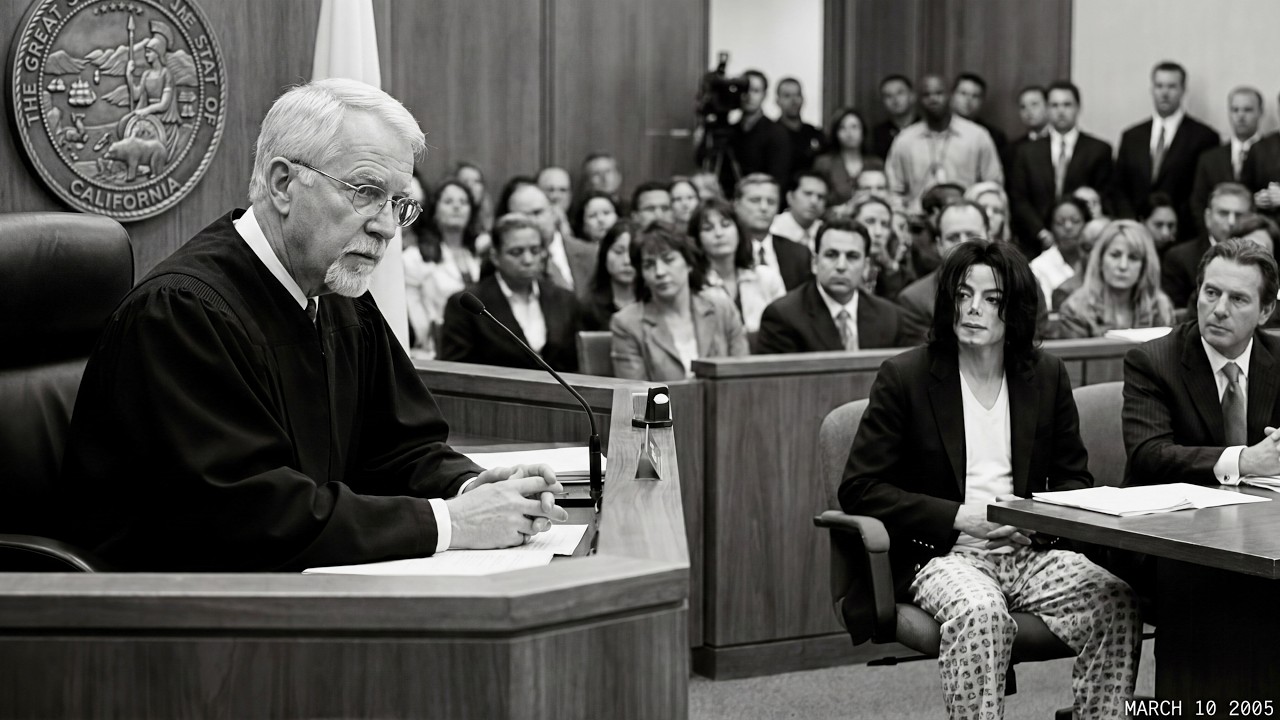
It’s worth noting what the press was set up to cover that morning. The accuser’s continued testimony, which would have been genuinely significant. The pajama story took over almost entirely. It’s hard to say whether that benefited Jackson or hurt him. What it clearly did was reduce a real and complicated morning to a single image that was easy to process and easier to mock.
What almost nobody reported with any real emphasis was the simpler version of events. A man with a hospital discharge record 35 miles from the courthouse under a court order with a hard deadline received news of that ultimatum while lying in a hospital bed and made a choice about what to do next. He could have stayed.
Not from weakness or stubbornness, but from a reasonable reading of his legal situation. He had documentation. He had a legitimate medical reason. And a competent appellate review would have examined those facts carefully. He had real options. He chose not to use them. He put on whatever was within reach and got in the car and covered 35 miles in time to walk through those doors. He was 4 minutes late.
The warrant was dropped. The trial continued for 14 more weeks after that morning. 140 witnesses, 4 months of testimony. Mesereau worked through the prosecution’s case with deliberate patience, challenging credibility, exposing inconsistencies, calling people who had spent genuine time around Jackson to describe what they had actually observed.
Macaulay Culkin testified. Chris Tucker testified. The defense argument stayed consistent from opening statements to closing. The accusations had financial motivation behind them. The key witnesses had verifiable credibility problems. And the prosecution had built its case on testimony it couldn’t adequately corroborate with independent evidence.
On June 3rd, 2005, the jury began deliberating. They took 7 days, roughly 30 to 32 hours of total deliberation time, working through jury instructions and testimony read backs across 10 separate counts. The indictment was 10 counts deep, conspiracy, multiple felony level accusations, and charges that, if they stuck, carried a combined sentence of nearly 20 years.
The kind of case that doesn’t just end a career, it ends everything. On June 13th, 2005, they came back. Judge Melville opened the envelopes himself and read the verdict forms silently before handing them to the clerk. The courtroom went quiet in the way rooms go quiet when something with real stakes is about to be said out loud and can’t be taken back.
Outside the courthouse, the crowd that had been there for months, fans, protesters, journalists, people who had made this trial their daily orbit, pressed against the barriers. The clerk read, “Not guilty on count one. Not guilty on count two.” She kept going. 10 counts. 10 times. The same two words each time.
Jackson showed almost no visible reaction while the verdicts were being read. He was still. When the last count was finished, Mesereau placed a hand on his shoulder. Two jurors wiped their eyes. One of them, speaking to reporters afterward, said the jury had tried to treat the case like any other, going through the evidence count by count, applying the same standard they would to any defendant. At 2:25 p.m.
, Melville addressed Jackson directly for the last time. “Mr. Jackson, your bail is exonerated and you are released.” Jackson pressed a tissue to his face. He embraced his attorneys. Then he walked out of the courtroom, got into a car with his family and security, and drove back to Neverland. Afterward, one of the jurors explained the decision in plain terms.
“We expected probably better evidence, something a little more convincing, and it just wasn’t there.” The morning of March 10th has been referenced many times in the years since, usually as a footnote, usually attached to some commentary about Jackson’s state during the trial period. The pajamas became a kind of shorthand, a detail that writers and anchors reached for when they wanted to imply something without committing to saying it.
What that framing consistently skips over is what the morning actually recorded. A man woke up in pain, fell while getting dressed, was taken to a hospital, received a 1-hour ultimatum while lying in that hospital, and then decided what to do. He got dressed in whatever was within reach and covered 35 miles and walked through those courthouse doors 4 minutes past the deadline. He was late.
The warrant was dropped. 95 days later on all 10 counts, the jury said not guilty. The photographs from that morning are still in the archives. They show a man in pajama bottoms, supported on both sides, walking forward across a concrete plaza lined with cameras and press. Every outlet that covered the trial used at least one of those images.
Most of the captions described what he was wearing. Almost none of them described what he was actually doing. He was showing up. That’s what he was doing. Under a warrant, 4 minutes past the deadline, in physical pain, with his bail already forfeited on paper, he got out of the car and he walked in.
That’s what the photographs show, if you look at them for what they are, rather than what they were meant to suggest. A decision, documented frame by frame, from the car door all the way to the courthouse entrance. Have you ever had a moment when everything about your situation said stay down, and you got up anyway? Not because the odds looked good, not because you had it figured out, but because walking through that door was the only thing that made sense to you.
Drop it in the comments.