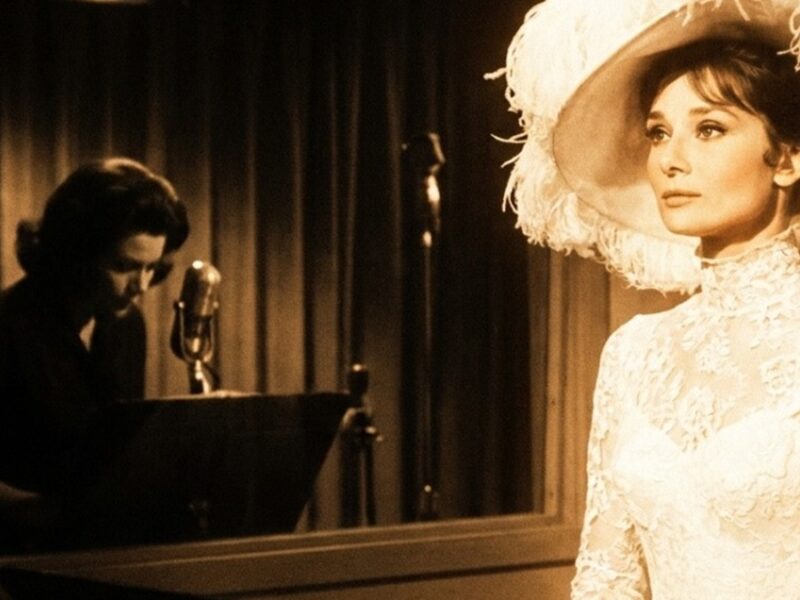
Marni Nixon Gave Audrey Hepburn Her Voice. Hollywood Made Her Pretend It Never Happened. D
She stood in front of the camera. The lights hit her face. The music swelled, and the voice that came out was not hers. Millions of people watched Audrey Hepburn become Eliza Doolittle. They saw her cry. They saw her fight. They saw her transform from a street girl into something close to royalty. But the voice singing those songs, the voice that made audiences hold their breath, belonged to a woman sitting invisible in a recording booth whose name wouldn’t appear in the credits.
A woman who had been threatened, silenced, and erased. This is the story of what really happened inside the most celebrated musical film of 1964. And it is not the story you were told. The year was 1963. Warner Brothers was preparing to spend $17 million, an almost incomprehensible sum at the time, on a film adaptation of the Broadway sensation My Fair Lady.
The studio needed a star, not just a talented actress, a name, a face that could fill seats in every country on Earth. They had a problem, though. The woman who had made the role of Eliza Doolittle iconic on Broadway, who had rehearsed it, perfected it, sung it eight times a week for years, was Julie Andrews.
And Julie Andrews, despite her extraordinary talent, had never made a film. To Jack Warner, the head of Warner Brothers, that made her a risk he wasn’t willing to take. So he made a decision that would define two women’s lives for decades. He passed over the woman who had built the role from the ground up, and he offered it to Audrey Hepburn.
Audrey was everything Jack Warner needed on paper. She had already won an Academy Award. She had made Roman Holiday, Sabrina, Breakfast at Tiffany’s. Her face was on magazine covers across the world. She was elegant, luminous, and bankable in a way that very few actors in Hollywood history have ever been.
But, there was a complication. Audrey Hepburn was not a singer. At least, not in the way Eliza Doolittle needed to be. When Audrey received the offer, she was fully aware of this. She was a woman of unusual honesty and self-awareness, and she did not pretend otherwise. But, the studio told her it was fine.
They told her they would work with her. They told her there would be vocal training, preparation, time. They told her she would sing her own songs in the film. Audrey believed them. She accepted the role, and she began to prepare. What followed was not a casual process. Audrey Hepburn did not take a few singing lessons and hope for the best.
She committed to the preparation with the same ferocious discipline she brought to everything in her career. For months before filming began, she worked with vocal coaches. She trained. She recorded. She listened to her own recordings and pushed herself harder. She was not a woman who accepted mediocrity in herself, and she poured everything she had into making her voice good enough for the role she had been given.
She was also operating under enormous pressure. The public reaction to Jack Warner’s decision had been brutal. Critics were outraged that Julie Andrews had been passed over. Hollywood insiders talked openly about the injustice. Every journalist who covered the production seemed to be waiting for Audrey to fail, waiting for proof that Warner had made a mistake.
So, she worked day after day, session after session, she worked. And when filming began, she believed she had been allowed to believe that what she recorded would end up in the finished film. That belief would turn out to be one of the most painful things that ever happened to her professionally. While Audrey was on set playing Eliza with everything she had, someone else was watching, listening, preparing.
Her name was Marni Nixon. If you have never heard that name, you are not alone. That, in a sense, was the entire point. Marni Nixon was Hollywood’s most accomplished ghost, a classically trained soprano with perfect pitch and the almost supernatural ability to match her voice to another woman’s face, another woman’s character, another woman’s emotional truth.
She had already done it twice before with staggering success. She had been the singing voice of Deborah Kerr in The King and I. She had been the singing voice of Natalie Wood in West Side Story. In both cases, audiences had sat in darkened theaters and believed completely that the voice they were hearing belonged to the face they were watching.
They had no idea. The studio made sure of it. Nixon had been threatened explicitly. Sign a non-disclosure agreement. Tell no one. If word gets out, you will never work in this industry again. She signed. She kept quiet because she had no choice. Because that was the deal you made with the machine that was Hollywood in the 1950s and 1960s.
You gave them your talent and in return, they gave you silence. You showed up. You delivered. You left. And you were never supposed to be heard from again. Not in any way that connected your name to the work. When My Fair Lady came around, Nixon was brought in again. The plan, at least initially, was to create a blend.
A composite of Audrey’s voice and Nixon’s, stitching together the best of both into something seamless. Audrey would contribute what she could and Nixon would fill in the gaps. That is what Audrey was told. That is what she understood was happening. It is not what happened. There is a detail from this period that once you know it, is almost unbearable to consider.
During the production of My Fair Lady, Audrey Hepburn and Marni Nixon shared a limousine to the studio every morning. Every morning. The two women sat together in the back of a car making conversation traveling to the same building each playing their role in the same extraordinary deception. One of them knew the full truth.
The other did not. Nixon later described Audrey as smart gracious and self-aware. She recalled Audrey saying in effect that she knew her voice wasn’t perfect that she was going to keep trying keep working keep pushing to make it good enough. Audrey was not in denial. She understood her limitations. But she had been told she would have a real chance.
What she didn’t know what no one had the honesty to tell her directly was that the decision had already been made. Somewhere in the executive corridors of Warner Brothers before Audrey had finished recording before the composite idea had been seriously pursued a decision had been made. The final film would feature Marni Nixon’s voice.
Almost entirely. Not a blend. Not a compromise. A replacement. Audrey recorded her songs. She gave everything she had to those recordings and then in post-production they were taken out. One by one. Track by track. The voice you would hear walking out of that film the voice millions of people would associate with Eliza Doolittle the voice that would be celebrated and remembered was not hers.
Audrey was reportedly devastated. That is not a dramatic overstatement. That is how people who knew her described her reaction when she understood what had been done. She had worked for months. She had trained. She had believed. And then they had taken her voice and replaced it with someone else’s. And they had done it quietly, without confrontation, in a cutting room she was never invited into.
In the years that followed, Audrey rarely spoke about it publicly. That was characteristic of her. A woman who preferred elegance to grievance, who did not make scenes, who kept her private wounds private. But in quieter moments, the truth came through. She admitted that she would never have accepted the role had she known her singing would be dubbed.
That sentence is worth sitting with. The role she is perhaps most associated with, the film that showcased some of the most extraordinary acting of her career, was a role she would have turned down if she had been told the truth from the beginning. She had not been told the truth. She had been told what Jack Warner needed her to believe in order to say yes.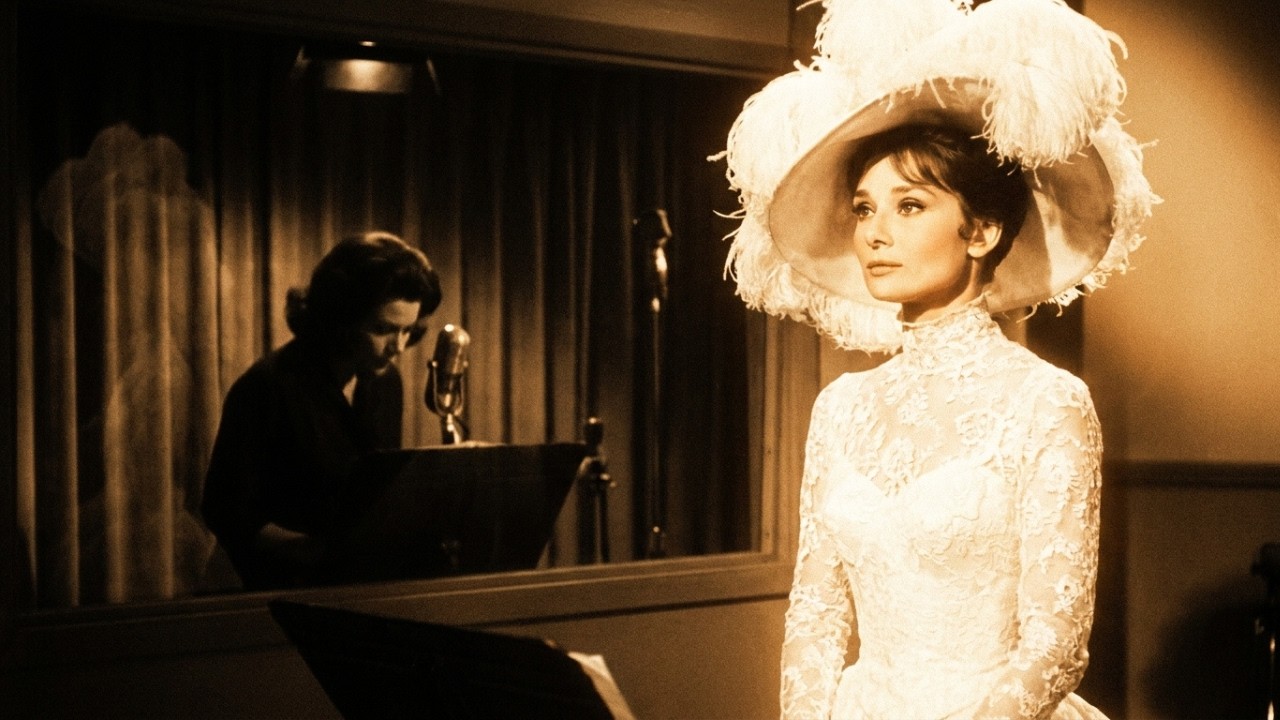
And once she had said yes, once she was committed, once the cameras were rolling, and the production machine was in motion, the truth came too late to matter. After My Fair Lady, Audrey drew a line. She announced, with quiet firmness, that she would not appear in another musical unless she could sing every note herself.
She never made another musical. My Fair Lady was the first and the last. The studio had not just taken her voice. They had taken away an entire genre. Meanwhile, Marni Nixon was back in her invisible life. She had delivered something extraordinary. The voice in My Fair Lady, I Could Have Danced All Night, Wouldn’t It Be Loverly, Show Me, was technically flawless.
It was the voice of someone who had spent decades training, a classically schooled soprano whose instrument was as precise and controlled as anything on an opera stage. But nobody knew. Nobody was supposed to know. Nixon had been told again to stay quiet. She had signed her agreements. She understood what happened to people who broke them.
And so, she went back to her regular life. The concert halls, the studio work, the teaching. While audiences around the world fell in love with a performance that was half hers and entirely credited to someone else. She received no screen credit. She received no acknowledgement in the press materials.
The soundtrack album that would sell millions of copies listed Audrey Hepburn as the performer of every song Nixon had actually sung. Marni Nixon’s name appeared nowhere. She did not even receive royalties. She had tried in previous films to negotiate something, some recognition, some financial share of the work she was doing.
She had asked for a percentage of West Side Story’s profits. She had been refused. Leonard Bernstein, moved by something like guilt or fairness, had quietly arranged for her to receive a fraction of his own personal royalties from the film’s music. But the studio itself had given her nothing. For My Fair Lady, the pattern repeated.
A flat fee, a contract with a silence clause attached, and then invisibility. She was threatened explicitly. The warning came from within the industry itself, from people with the power to make it real. “If word gets out, if your name appears, if anyone knows you were there, your career is over.” She had heard this before.
She believed it because she had watched it be enforced before. And so she said nothing. Years later, near the end of her life, Nixon would finally begin to speak. She gave interviews. She wrote a memoir titled With a Kind of Savage Irony, I Could Have Sung All Night. She described what it had felt like to be the voice behind some of the most beloved performances in cinema history.
To be everywhere and nowhere, heard by millions and recognized by none. “I was threatened that I wouldn’t work again if anybody knew.” she said. “But other people said it for me, so I was lucky.” Lucky. That was the word she used. My Fair Lady was released in October 1964. It was an immediate sensation.
Critics celebrated it. Audiences flooded into theaters. The film earned more than $72 million at the box office, a staggering return on its $17 million dollar At the Academy Awards, My Fair Lady received 12 nominations. 12. Best Picture. Best Director for George Cukor. Best Actor for Rex Harrison. Harrison, who in one of the great ironies of the entire production, had spoken rather than sung through every one of his songs, despite going through his own vocal training.
He had stood next to Audrey in scene after scene, rhythmically talking his way through melodies while she was expected to hit every note with operatic precision. Harrison had essentially talked his way through a musical, received standing ovations for it, and won an Oscar for it. Nobody questioned his voice.
Nobody replaced it. Nobody punished him for its limitations. The film won eight awards in total. Eight. It was the night’s dominant force. Audrey Hepburn received no nomination. Not one. The woman at the center of the film, the woman whose face was on every poster, whose performance carried every scene, who had worked and trained and given everything she had, was absent from the nominations entirely.
The Academy’s voters had made their verdict clear. The voice wasn’t hers. And therefore, somehow, neither was the performance. It was the cruelest possible outcome. She had been used for her name and her face and her fame. She had done her job. She had delivered a performance that even her harshest critics acknowledged was compelling and alive.
And she was punished for a decision that had been made by executives in rooms she was never invited into. For a replacement that had been arranged without her full knowledge or consent. The Academy Award for Best Actress that year went to Julie Andrews for Mary Poppins. The woman Jack Warner had refused to cast.
The woman he had passed over because she was an unknown. Because she had never made a film. Because he didn’t believe she was a big enough star. Julie Andrews, in her Golden Globe acceptance speech, looked into the cameras and said, “My thanks to a man who made a wonderful move and who made all this possible in the first place, Mr. Jack Warner.
” The room understood exactly what she meant. It is easy, looking back, to frame this as a story about singing, about whether Audrey’s voice was good enough, whether the dubbing was artistically justified, whether the final film was better for Nixon’s contribution. People have debated those questions for 60 years and will probably debate them for 60 more.
But that framing misses the point entirely. What was stolen from Audrey Hepburn was not just credit. What was stolen was her right to know the truth before she made a decision that would define her career. She was told she would sing. She was not told she would be replaced. She was given the illusion of participation in her own story.
And then the story was rewritten without her. What was stolen from Marni Nixon was larger still. Because at least Audrey’s face was on the screen. At least Audrey’s name was on the poster. At least Audrey’s work was visible to the world. Nixon had nothing. She had the knowledge of what she had contributed and the enforced silence that surrounded it.
And a series of non-disclosure agreements that transformed her talent into a secret she wasn’t even allowed to claim. Two women, one production, and a system that used both of them and protected neither. The thing about Audrey Hepburn is that she did not collapse under the weight of what had happened.
She did not become bitter, at least not publicly. She drew her line. No more musicals, not without her own voice. And she moved forward. She continued making films. She starred in How to Steal a Million, Two for the Road, Wait Until Dark. She lived her life. She eventually found in Robert Wolders a relationship that gave her what she had spent years looking for.
And in her final years, she turned almost entirely away from Hollywood and toward UNICEF, traveling to places of desperate poverty and doing work that had nothing to do with cameras or studios or the particular cruelties of the entertainment industry. She never made another musical. She kept that promise to herself.
And she carried quietly the knowledge of what My Fair Lady had really been. The role she would never have accepted if anyone had told her the truth. Marni Nixon died in July 2016 at the age of 86. By then, she had finally received some of the recognition that had been denied her for most of her career.
The secret had long since become public knowledge. She had written her memoir. She had given interviews. She had, in her own way, claimed her story. But the credit on the film itself, the soundtrack, the posters, the official record, never fully changed. The voice that audiences heard in My Fair Lady was hers.
And for most of the film’s history, her name was nowhere near it. After Audrey’s death in 1993, her son, Sean Ferrer, began to speak about the injustice with increasing directness. He described what had been done to his mother as a wrong that had never been fully righted. He spoke about hearing her original recordings.
The ones that were removed, the ones that were replaced. And said that in the industry of today, with the tools that now exist, her voice could have been used. Could have been shaped and supported and presented to the world. He expressed hope that someday a version of My Fair Lady might exist with his mother’s voice restored.
That the woman who worked for months, who trained until she had nothing left to give, who sat in a recording booth pouring herself into songs she was never allowed to keep, might finally be heard. It hasn’t happened yet. The next time you watch My Fair Lady, and if you haven’t, you should, listen carefully.
When Audrey opens her mouth to sing, ask yourself, whose voice is this? Whose work went into this moment? Who rehearsed in a recording booth session after session, shaping every note to fit a character she would never be allowed to publicly claim? And who sat in a car every morning riding to the same studio believing she might still have a chance? The system told Marni Nixon to disappear.
It told Audrey Hepburn to be grateful. It told both of them to stay quiet, to sign the papers, to accept what they were given, and not ask for more. One of them has been celebrated for decades. The other was nearly erased completely and entirely forgotten. And both of them deserved so much better than what that system was willing to give.
Every week, one moment from Audrey Hepburn’s life. Subscribe so you don’t miss the next one.