Michael Jackson: The Boy Nobody Knew — The Untold Story Of Gary Indiana FULL DOCUMENTARY D
He became the most famous person in the world. But before any of that, before the fame and the music and the everything, he was just a boy in Gary, Indiana, who was too tired in school because he had been rehearsing until midnight, who wore shoes held together with tape, who had never had a birthday party, and who was already at 7 years old carrying something that most adults would have put down.
This is the story of that boy. The one nobody saw yet. The one who existed before the world decided who he would become. Gary, Indiana is a city built on steel. It sits on the southern shore of Lake Michigan, 30 mi southeast of Chicago. And it was built for a single purpose, to produce the steel that America needed to build itself in the 20th century.
United States Steel Corporation founded it in 1906 and named it after their chairman, Elbert Garry. And for several decades, it was exactly what it was built to be, a working city, a city of men who went into the mills at sunrise and came out at sunset with soot on their hands and the particular exhaustion of people who spend their days doing something physically enormous.
By the 1950s, the city had produced something else alongside the steel, a community. Black families who had come north during the great migration from Alabama, from Mississippi, from Georgia in search of work and a life with slightly more room in it than the South had been willing to offer. They had found work.
They had built neighborhoods. They had built churches and schools and the kind of social infrastructure that communities build when they are serious about staying. Joseph Jackson had come to Gary from Fountain Hill, Arkansas. He worked the steel mill by day and played guitar in a local rhythm and blues band called the Falcons by night.
He was not a gentle man. People who knew him and Gary have described him consistently over the years, focused, demanding, certain about things, with the particular certainty of a man who has seen what happens when you don’t have it. He had married Catherine Screws in 1949. They had nine children in a house on Jackson Street that was, by any objective measure, too small for 11 people. The house had two bedrooms.
The kitchen was where the family gathered. The living room was where everything else happened. Michael Joseph Jackson was born on August 29th, 1958, the seventh of the nine children. He was small at birth and remained small. He was quiet in the way that middle children in large families are sometimes quiet.
Not because they have nothing to say, but because there is rarely enough silence to say it in. He watched things. He noticed things. The people who knew him as a small child in Gary have described across the decades a child who was present in a particular way, more observant than his age suggested, more attuned to the emotional weather of the rooms he moved through.
He began performing at 5 years old. This is the fact that gets cited most often in the biographical accounts, and it tends to be cited in a way that makes it sound like an opportunity. It was also a demand. Joseph had seen what his children could do, had been watching it accumulate across the older brothers, Jackie and Tito and Germaine, and had made a decision about what to do with it. The decision was total.
Music was not a hobby in the Jackson house. It was a project. It was increasingly the project, the thing that organized the family’s time and energy and hope in the way that other things organized other families. Rehearsals happened every day after school in the living room with the microphone stand that Joseph had set up in the corner and the particular focused intensity that Joseph brought to everything he considered important.
The standard was high and the standard was non-negotiable. and the consequence of falling below it was real. Michael did not fall below it. This is the thing that requires attention because it is the thing that the legend tends to flatten to a single image of a prodigy who was effortlessly extraordinary.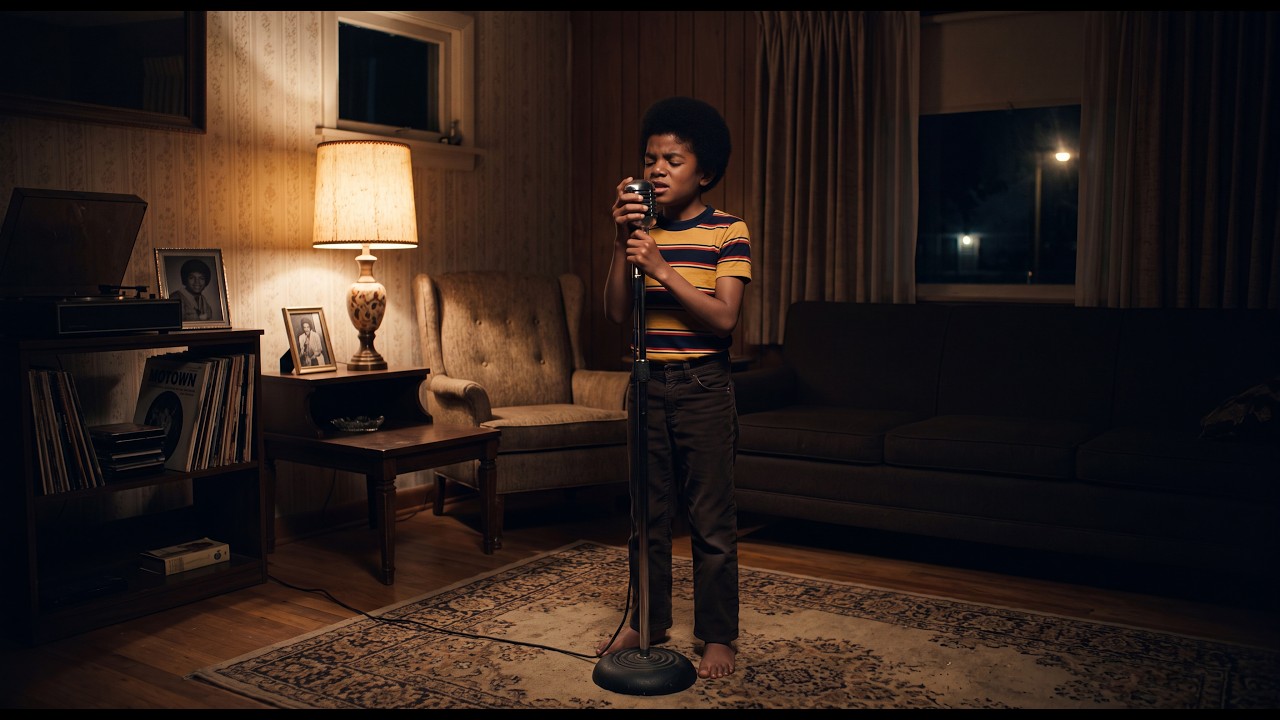
Michael was extraordinary, but the effortlessness was not effortless. It was the product of hours, every day, relentlessly, in a living room in Gary, Indiana, under the eye of a father who did not give credit easily, and who understood that credit given too readily was a form of softness he could not afford.
What Michael was underneath the talent and underneath the work was a child who had found in music something that the rest of his life did not consistently offer him. Something that made sense entirely on its own terms. When he was in the music, not performing it, not working at it, but inside it in the way that certain people are inside certain things, he was somewhere that Gary Indiana could not reach.
somewhere that the too small house and the too many people and the particular pressure of being the one everyone was looking at could not follow. He was 5 years old when he found this. He never lost it. The rest of Gary, Indiana mostly did not know that Michael Jackson existed until he was famous. This is not unusual.
Most famous people are unknown before they are famous. But it is worth pausing on because the gap between what was happening in the house on Jackson Street and what the city around it understood about what was happening there is part of the story that tends to get lost. His third grade teacher wrote in his file that he would amount to nothing.
She wrote it because he fell asleep in her class and missed school regularly and could not consistently focus on what she was trying to teach him. She was not wrong about what she saw. She was seeing a child who had been rehearsing until midnight and performing on weekends and traveling to shows in borrowed cars and was consequently too exhausted on too many mornings to be the student she needed him to be.
She did not know about the midnight rehearsals. Nobody outside the house on Jackson Street did. This is the essential quality of Michael Jackson’s childhood in Gary, that the thing being built there was invisible to the world around it. Invisible to the teachers and the neighbors and the other families on Jackson Street.
Not secret exactly, just not yet legible, not yet recognizable as the beginning of what it was the beginning of. The shoes are worth mentioning. There is a story documented by family members consistent across multiple accounts that Michael performed at the Apollo Theater at age 10 in shoes that were held together with electrical tape.
His mother had repaired them as well as they could be repaired. There was no money for new ones. Michael had tested the tape in the hotel room that morning, walking back and forth to make sure it would hold. It held. He performed one of the finest shows of his early career in those shoes at the most important stage in American music in a jacket that had been pressed carefully the night before and shoes held together with tape, the birthday parties, or rather the absence of them.
Michael Jackson never had a birthday party as a child. August 29th arrived every year in the middle of whatever was happening. A rehearsal week, a show to prepare for, a drive to the next city. Joseph ran the schedule without sentiment, and birthdays were not occasions that stopped the machinery.
Catherine knew this cost something. She has said so in various interviews over the years with the honest, careful precision of a woman who loved her children and understood that some of what they needed she could not give them. Michael understood it too in the way the children understand the shape of what is missing without having the vocabulary to name it.
He talked about this 30 years later in a television interview that was watched by millions of people. talked about it in the quiet factual way that he used for the true things. The way that was harder to watch than anger would have been because it contained no accusation, just the simple statement of what had been and what it had cost.
He said he had never had a birthday party as a child. He said it and then he was quiet. The interviewer was quiet, too. The city of Gary, Indiana, is a different place now than it was in 1958. The steel industry that built it has largely left it. The population has declined by 2/3 since its peak. The house on Jackson Street is a museum, a place that people travel from 40 countries to visit, to stand in the living room where the microphone stand was and look at the corner where it stood and try to understand how something like Michael Jackson comes out of something like this. What the house tells you if you stand in it long enough is something that the biography books tend to reach for but don’t always land on. It tells you that the most extraordinary things in the world begin in ordinary rooms. That they begin with
people who are too tired and too poor and too pressed by the weight of daily life to have any business producing what they produce. That the gap between where something starts and where it ends up is not a gap that talent alone can explain. that there is something else, something that doesn’t have a clean name that carries certain people from the ordinary rooms to the places they end up.
Michael Jackson carried it from a two-bedroom house in Gary, Indiana to the stages of 15 countries and the bedrooms of 4 million people and the cultural imagination of an entire planet. He carried it in shoes held together with tape. He carried it through every midnight rehearsal and every missed birthday and every morning when he sat in a third grade classroom too exhausted to be the student his teacher needed him to be.
He carried it to the Apollo at 10 years old where he stood on a stage that had hosted Ella Fitzgerald and James Brown and looked out in an audience that had seen everything and gave them something they had not seen. He kept carrying it for the rest of his life. The boy in the house on Jackson Street, the one nobody could see yet, was already carrying everything.
He just didn’t know yet where it was going to take him. None of them did. Not even Joseph, not even Catherine, not even Michael. He was 7 years old, and he was already the most extraordinary person in the room. and the room was Gary Indiana and nobody outside it knew his name yet. That is where it starts.
That is always where it starts. If this story moved something in you, share it with someone who needs to be reminded that the most extraordinary things in the world begin in ordinary rooms. Subscribe for more true stories about the human beings behind the legends. And tell us in the comments what ordinary room did your story begin in and how far have you carried