Princess Diana Was ‘The Most Watched Woman in Britain’ — And She Felt It Every Day D
A winter morning in late 1993. A woman in her early 30s walks out of an LA Fitness gym in Earl’s Court, West London, carrying a sports bag. Her hair damp, her face scrubbed of makeup. She has come here for one reason and one reason only. She wants an hour of her life in which no one is looking at her.
For several weeks she has been a member. She has used the leg press machine in the corner. She has, by her own description to friends, begun to relax. What she does not know, what she will not learn until the photographs appear in the Daily Mirror in November of that year, is that the owner of the gym, a man named Bryce Taylor, has installed a concealed camera in the ceiling directly above the equipment she uses.
He has been photographing her in her sports bra and cycling shorts for weeks. The pictures will be sold. They will be printed across multiple pages. They will be the front of a tabloid newspaper that sells more than 2 million copies a day. The woman is Diana, Princess of Wales. She is 32 years old.
And the camera in the ceiling is not the exception in her life. It is the texture of it. This is the central fact that any honest account of her must begin from. From the moment her engagement to Charles, Prince of Wales, was announced on the 24th February 1981, until the moment of her death in the Pont de l’Alma tunnel in Paris on the 31st August 1997, Diana, Princess of Wales, lived under a level of surveillance that no private citizen in modern British history has ever endured.
The phrase began appearing in Fleet Street newspapers from the mid-1980s onward repeated so often that it ceased to register as a claim and began to function as a job description. The most photographed woman in the world. It was not hyperbole. It was in the cold language of the picture desks who paid for the pictures, a market valuation.
Consider the scale of what she had walked into. On the 29th of July 1981, an estimated 750 million people watched her wedding at St. Paul’s Cathedral. She was 20 years old. Her previous employment had included a brief and modestly paid stint as a kindergarten assistant at the Young England School in Pimlico.
She had no university education. She had no public speaking experience. She had been chosen in part because the institution surrounding the heir to the throne believed she possessed the two qualities they required. A suitable background and the absence of a personal history that the press could excavate.
Within 18 months of her wedding day, she was the single most commercially valuable image in print journalism on Earth. By the mid-1980s, a single exclusive photograph of her taken in the right place at the right moment could earn a freelance photographer 10,000 pounds or more. A candid showing her with Prince William, born the 21st June 1982, or with Prince Harry, born the 15th of September 1984, could exceed 100,000 pounds.
Fleet Street tabloids did not merely cover her. They built circulation strategies around the predictability that her face on the front page would lift sales by a measurable percentage. Mark Saunders and Glenn Harvey, two of the freelance photographers who pursued her for years, later sat down in their book, Dicing with Di, a clear-eyed account of the economy that grew up specifically to track one woman through her ordinary days.
There were photographers who paid their mortgages on Diana. There were photographers whose entire professional existence consisted of standing in shifts on a pavement in Kensington waiting for her car to leave. The human cost of this began earlier than most public accounts acknowledge. Long before the famous interviews of the 1990s, long before the divorce, long before the tapes, she was already breaking under it.
We know this now because in 1991, she answered questions in secret, recorded onto cassette tapes through an intermediary, for the journalist Andrew Morton. Those answers became the book, Diana: Her True Story, published in June 1992. At the time, she denied any involvement. After her death, Morton confirmed she had been his source.
In those tapes, she described the engagement period not as a fairy tale, but as the beginning of a kind of siege. She described crying in her car between engagements. She described vomiting before public appearances. She described feeling from the earliest weeks of her engagement that she was being hunted by a force she did not understand and had not been prepared for.
She had not been prepared for it because no one had prepared her. The royal family she married into had spent the better part of the 20th century cultivating a posture of distance presided over by Queen Elizabeth II, whose private secretaries operated on the inherited principle that press attention was best managed by ignoring it.
The Queen did not give interviews. The Queen did not respond to stories. The Queen did not, in any meaningful sense, acknowledge that the press existed. This was institutional armor built up over decades, and it was effective for the woman who had grown into it. Diana inherited none of it. She was given no media training in any modern sense.
Patrick Jephson, who became her private secretary in 1988 and stayed in that role for 8 years, wrote later in his careful memoir, Shadows of a Princess, “The chief learned the press by being burned by it again and again, with no manual and no mentor.” She was, in effect, asked to walk into the most intense media environment on the planet wearing no protective equipment whatsoever, and then judged for how she handled it.
The pattern was set within months. By the autumn of 1981, she was pregnant with the child who would become Prince William. She was losing weight rapidly, the early signs of the bulimia she would later describe in detail. In early 1982, she and Prince Charles went on holiday to the Bahamas. A long lens located her on the beach.
She was photographed in a bikini, visibly pregnant, from across the bay by men she could not see and had not consented to. The pictures ran in British newspapers. The Queen, breaking her own rule of silence, made a rare personal complaint to Fleet Street editors. The complaint was received. It was noted.
It changed in any practical sense, nothing at all. The photographers went on photographing. The newspapers went on printing. The economy that paid for the lenses went on paying. And the young woman on the beach, 20 years old, 6 months into a marriage she was already beginning to understand, had not been what she was told it would be, learned the first and most important lesson of the next 15 years of her life, that even the most powerful woman in the country, the Queen of the United Kingdom herself, could not lift the camera off her daughter-in-law’s body. No one could. The lens, once trained, would not be called off. It would only multiply. The Bohemian beach pictures of early 1982 were not, as the palace briefly
hoped, an aberration that public outcry would correct. They were a prototype. By the middle of the decade, the surveillance of Diana, Princess of Wales, had hardened from an episodic intrusion into something closer to civic infrastructure. Freelance photographers worked Kensington Palace in shifts. Cars idled on Kensington High Street through the night, their occupants sleeping in reclined seats with cameras on the passenger side, waiting for the gates to open at 7:00 in the morning.
Ken Wharfe, who served as her personal protection officer from 1988 to 1993, and who later set down his account in Diana, Closely Guarded Secret, recorded that on certain days he counted more than a dozen photographers in rotation outside apartments eight and nine. It was not a story. It was an industry with its own rosters, its own pecking orders, and its own informal agreements about who got which corner.
The economics had only intensified since the wedding. A clean exclusive of Diana in the mid-1980s could earn a freelance £10,000, sometimes more. A candid with one or both of her sons, taken from a distance she had not consented to, could clear six figures in a single sale. Mark Saunders and Glenn Harvey, two photographers who had spent years pursuing her, and who eventually wrote about the experience in Dicing with Di, described a freelance economy that existed almost solely because she existed. Editors at The Sun, The Mirror, The Mail, and The Express built circulation strategies around her face. The cover price of a Tuesday tabloid in Britain was, in real terms, partly underwritten by what Diana had done on Monday.
She knew this. She lived inside the knowledge of it. And in the most ordinary parts of her life, she made decisions that ensured the cameras would never lose sight of her, because she refused to surrender the ordinariness itself. Consider the school run. From 1985 onward, against settled royal precedent that placed nannies and drivers between royal children and the outside world, Diana insisted on personally driving Prince William and later Prince Harry to school.
Every morning she did this, she was photographed. The photographers knew the route. They knew the timing. They knew which side of the car the children sat on. She continued anyway. Her reasoning, repeated to staff at the time and later relayed to Tina Brown for the Diana Chronicles, was constant. She wanted her sons to understand what an ordinary mother looked like.
Even if the only way to give them that knowledge was to perform ordinariness through a windscreen at men with telephoto lenses. There is a particular kind of stubbornness required to do something normal on the explicit condition that it will never feel normal. She did it for years. Consider then the gym.
By the early 1990s, Diana had joined the LA Fitness Club in Earl’s Court. She went on weekday mornings. She used the leg press machine. She wore cycling shorts and a sports bra. She believed for the duration of those sessions that she was in a private room. She was not. The gym’s owner, Bryce Taylor, had concealed a camera in the ceiling directly above the leg press station and had been photographing her for weeks.
In November 1993, The Daily Mirror published the images on its front page. The pictures showed her mid-exertion, head tilted back, unaware. The editor defended the publication on the grounds of public interest. There was no public interest. There was only a market. Diana sued. The case was eventually settled out of court with Taylor receiving, by some accounts, a financial settlement himself, which gave the episode its final sour twist.
But the immediate effect on Diana was not legal. It was internal. On the 3rd of December, 1993, 3 weeks after the photographs appeared, she stood at a Headway charity lunch and delivered what became known as the time and space speech. She announced that she was scaling back her public engagements. She thanked the public for their support.
And she asked the press, in a phrase that ran on every front page the next morning, to give her time and space. She was 32 years old. She had been the most photographed woman in Britain for 12 years. She was asking, in measured language, for the right to lift a weight in a room without being filmed.
It is worth pausing here on something the chronology can obscure. The relationship between Diana and the British press was never a clean opposition of victim and predator. It was more complicated than that. And she knew it was more complicated than that. In August 1992, The Sun had published a transcript of a telephone call she had made on the night of 31st of December, 1989, to her friend James Gilbey.
The recording, intercepted by an amateur radio enthusiast and circulated privately for 2 and 1/2 years before any newspaper printed it, captured her speaking in a register no princess had ever before been heard to use in public. Candid, lonely, affectionate, occasionally bitter about life inside the royal household because Gilbey at one point addressed her as Squidgey.
The tape entered the language as Squidgeygate. Five months later, in January 1993, a parallel recording surfaced. This one captured Charles, Prince of Wales, speaking intimately to Camilla Parker Bowles. It was franker still and substantially more humiliating to him than the Gilbey tape had been to her.
The press christened it Camillagate. By the spring of 1993, the marriage of the heir to the throne was being conducted, in effect, as a serialized transcript on the magazine racks of British newsagents. Anyone with 80 p could read the private telephone calls of the future king and the future queen consort over a cup of tea.
This was the environment in which Diana made her next decision. And it was the most consequential decision of her public life to that point. In the second half of 1991, working through an intermediary, she had begun answering questions submitted to her on tape by the journalist Andrew Morton. Morton never met her in person during the project.
She recorded her responses privately and the tapes were passed to him. The resulting book, Diana: Her True Story, was published in June 1992. It described, in her own carefully filtered words, a marriage that had collapsed within months of the wedding. A husband emotionally committed to another woman.
An eating disorder that had gone untreated for years and several episodes of self-harm. At the time of publication, Diana denied any involvement. After her death, Morton confirmed what many had suspected. The source had been the subject. The most intimate account of her marriage ever published had been dictated by her. This mattered for a reason that goes beyond the contents of the book.
It marked the first occasion on which Diana actively used the surveillance machine rather than merely suffering inside it. She had been hunted for a decade. Now, she had picked up an instrument and aimed it. The instrument happened to be a journalist, but the principle was the same one she would refine over the next 5 years.
If the cameras were going to be there regardless, the only remaining question was whether anything she said would travel with them. The institutional consequence followed quickly. On the 9th of December 1992, the Prime Minister John Major rose in the House of Commons to announce that the Prince and Princess of Wales had agreed to separate.
He stressed that there were no plans to divorce and that the separation had no constitutional implications. Neither claim aged well. What is most telling about the announcement is its venue. It was made to Parliament. The end of a marriage was reported to the legislature of the United Kingdom because by December 1992, the marriage had become a matter of state and the state could no longer maintain the polite fiction that it was not also a matter of news stand.
The Squidgey Gate tape, the Morton book, the Camillagate transcript, and the formal separation had all arrived within 6 months of each other. The royal family’s traditional answer to press attention, which was silence administered through gritted teeth, had collapsed under the weight of a story that had outgrown it.
By the close of 1993 then, the position was this. Diana had endured a decade of relentless coverage. She had been photographed pregnant on a beach, photographed driving her children to school, photographed exercising through a hole in a ceiling. She had taken the press to court, and she had also fed the press through Morton, the most damaging account of her marriage anyone had yet produced.
She had asked publicly and with dignity for time and space. She would receive neither. What she had begun to understand in the quiet months after the Headway speech was something more useful than the hope of escape. She had begun to understand that the lenses she could not switch off could, with sufficient nerve, be redirected.
The withdrawal she announced that December was real. It was also, although no one watching her step down from the lectern that afternoon could yet have known it, the first move in a return she was already planning. The withdrawal she announced at the Headway lunch in December 1993 was real, but it was not permanent.
Diana spent most of 1994 out of the diary, away from charity engagements, refusing photographs where she could refuse them. The cameras did not lose interest. They simply waited. And by the early months of 1995, she was working again. In a different register and to a different rhythm. She had not stopped understanding that she was the most watched woman in Britain.
She had begun to ask methodically what could be done with that fact. The first answer arrived on the evening of the 20th of November 1995. BBC 1 cleared its schedule. The program was Panorama. The interviewer was Martin Bashir, then a relatively obscure figure inside the BBC’s current affairs department.
The setting was a sitting room in Kensington Palace, lit low, the princess in dark eye makeup, her hands folded. Approximately 22.8 million people in the United Kingdom watched it live, a peacetime record for a current affairs broadcast that has never been surpassed. She had arranged the interview in conditions of near total secrecy.
Patrick Jephson, her private secretary since 1988, was not told. Buckingham Palace was not told. Bashir and a small BBC crew had been smuggled into Kensington Palace on a Sunday when most of her household staff were off duty. By the time anyone in the institution learned what had been recorded, it had already been edited.
She said two things that night which outlived everything else. Asked about Camilla Parker Bowles, she answered, “Well, there were three of us in this marriage, so it was a bit crowded.” Asked what role she now imagined for herself, she answered that she would like to be queen of people’s hearts. Both lines were prepared.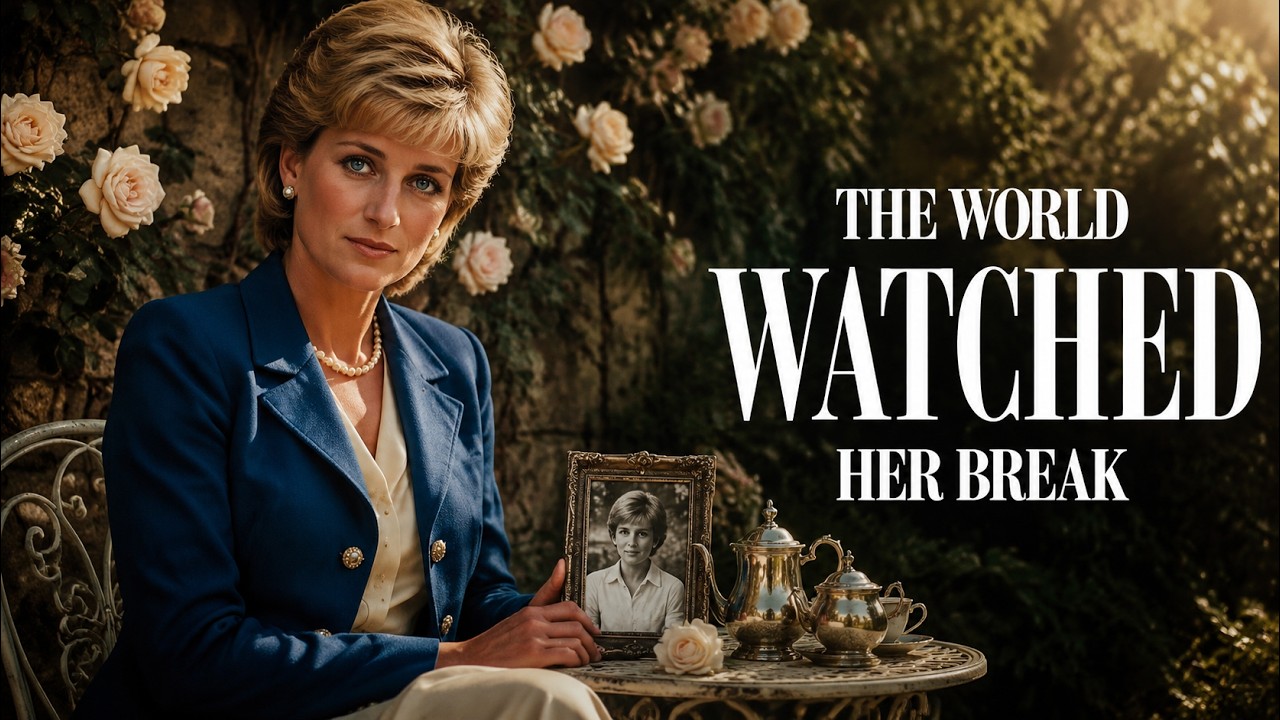
Both were delivered to a camera she had personally invited into her drawing room. For the first time on that scale, the surveillance was not happening to her. It was being conducted by her. It is necessary to acknowledge what the Dyson report would establish in May 2021, almost 26 years later, that Bashir had secured the interview through deceit, commissioning forged bank statements designed to convince Earl Spencer that members of Diana’s household were being paid by the security services to inform on her. The methods were dishonest. The report condemned them without qualification. But the words Diana spoke that night were her own. She had wanted to speak. Bashir’s deception determined the channel through which she spoke.
It did not write the script. The consequence arrived within weeks. In mid-December 1995, Queen Elizabeth II wrote separately to both her son and her daughter-in-law, instructing them in plain language to divorce. The letters were delivered by hand. Negotiations followed through the spring and into the summer of 1996.
The divorce was finalized on the 28th of August, 1996. Diana retained the title Princess of Wales and the use of Kensington Palace. She lost the style Her Royal Highness, which meant that her own sons, when she received them publicly, were now technically required to bow to their father and not to her.
She kept the cameras. She had always been going to keep the cameras. The second answer to what could be done with the watching arrived in January 1997 in a minefield in northern Angola. The country was emerging from a long civil war. The British Red Cross had been campaigning with limited international traction for a global ban on anti-personnel landmines.
Diana flew to Huambo and Kuito at the charity’s invitation. She walked in a protective visor and a flak jacket marked HALO Trust through a corridor of ground that had been partially cleared by deminers working a few meters ahead of her. She spoke quietly to amputees in hospital wards. She held the prosthetic limbs of children.
The photographs were on every front page in the world within 24 hours. They were not stolen images. She had walked deliberately into the frame knowing exactly what the frame was for. The campaign to ban landmines, which had been stalled at intergovernmental level for years, acquired sudden and irresistible momentum.
The Ottawa Treaty, formerly the Convention on the Prohibition of the Use, Stockpiling, Production, and Transfer of Anti-Personnel Mines, was open for signature in December 1997, 4 months after her death. More than 120 countries signed in the first round. This was the lesson she had spent 15 years learning applied with full force.
The same lens that had photographed her in a sports bra in a gym in Earl’s Court would also photograph her walking past the sign reading “Perigomenos”. The first image had humiliated her. The second image changed law. She had not freed herself from being watched. She had begun to direct what the watching showed.
The third answer, in the summer of 1997, was less calculated and more human. In July, a paparazzo named Mario Brenna, working from a boat off the coast of Sardinia, photographed Diana with Dodi Fayed aboard the Jonikal, a yacht belonging to Dodi’s father. The two of them were embracing on the deck. Brenna’s sequence was sold to the Sunday Mirror and from there to the world.
The total earnings on the package have been variously reported, but ran into figures approaching 1 million pounds. They were, at that point, among the most lucrative paparazzo photographs ever taken of any subject anywhere. The economic logic established a decade earlier had not eased. It had accelerated.
A picture of Diana in 1985 with one of her children had been worth perhaps 100,000 pounds. A picture of Diana in 1997 kissing a new partner was worth 10 times that. Patrick Jephson, who had resigned as her private secretary in early 1996, would write later, in Shadows of a Princess, that the financial scale of the chase had moved beyond what the palace’s traditional protective arrangements were designed to handle.
Royal protection officers were equipped to manage crowds, threats, security perimeters. They were not equipped to manage a freelance industry in which a single photograph could fund a photographer’s career for a year. The texture of those final weeks is documented in the recollections of people who spoke to her.
She was telephoning friends and complaining with a tiredness that several of them remarked on afterwards about the motorbikes. The motorbikes were a particular feature of that summer. Paparazzi on powerful two-wheeled machines could follow a car through traffic that protection vehicles could not penetrate.
They could pull alongside at speed. They could box a target in. And yet, in the same conversations, she was also tipping certain photographers off about certain movements. The relationship had never been simple predator and prey. She had favored photographers. She had nodded on occasion when she wanted a particular charity engagement covered.
The machine was symbiotic and toxic, and she understood both halves of that sentence completely. Ken Wharfe, who had left her protection detail in 1993 but remained in contact, would later observe that she had reached a stage where she could no longer tell on any given morning whether the cameras outside her gate were a threat or a tool.
The truthful answer was that they were both in shifting proportions every day. On the evening of 30th of August, 1997, she dined with Dodi Fayed at the Ritz Hotel in Paris. The hotel was owned by Dodi’s father, Mohamed Al-Fayed. The square outside the Place Vendôme was crowded with photographers who had been alerted to her presence in the city.
A decision was taken late to leave by a rear service entrance in an attempt to evade them. A Mercedes-Benz S280, not the couple’s usual vehicle, was brought to the back of the hotel. The driver was Henri Paul, the hotel’s deputy head of security, who had been called back to duty that evening, and who the subsequent French investigation would establish had a blood alcohol level well above the French legal limit and traces of prescription medication in his system.
In the front passenger seat was Trevor Rees-Jones, a bodyguard employed by the Al-Fayed family. In the rear seats were Diana, Princess of Wales, and Dodi Fayed. The car left the rear of the Ritz shortly after midnight on 31st August 1997. Photographers on motorbikes followed. The Mercedes accelerated down the Cours Albert 1er and into the underpass beneath the Place de l’Alma.
At approximately 12:23 a.m., traveling at a speed estimated at between 65 and 70 mph, it struck the 13th pillar of the Pont de l’Alma tunnel. The sound of the impact rolled along the concrete walls and out into the warm Paris night. For perhaps 30 seconds, the tunnel was almost silent. The engine had stopped.
Steam rose from the crushed bonnet. Dodi Fayed and Henri Paul were dead inside the wreckage. Trevor Rees-Jones, the only occupant wearing a seatbelt, was severely injured but alive. Diana, Princess of Wales, was conscious, trapped in the rear of the car, gravely wounded. The first people to arrive at the scene, on foot, running down the slope into the tunnel from the road above, were the photographers who had been following on motorbikes.
They arrived before the first paramedics. Several of them raised their cameras. The surveillance was present at the end, as it had been present at the beginning. Just after midnight on 31st August, 1997, the wrecked Mercedes sat against the 13th pillar of the Pont de l’Alma tunnel, with its engine still ticking.
The first people to reach the car were not paramedics. They were photographers on motorbikes who had been following the vehicle from the Ritz, and according to the subsequent French investigation, several of them began taking pictures before attempting to render aid. Some were later arrested at the scene.
The charges of failing to assist persons in danger were eventually dropped, and the formal inquiry concluded that the principal cause of the crash was the intoxication and excessive speed of the driver, Henri Paul, with the pursuit by photographers a contributing factor, rather than the determining one.
Trevor Rees Jones, the only survivor, remembered almost nothing. Dodi Fayed and Henri Paul were pronounced dead at the scene. Diana, Princess of Wales, was pronounced dead at the Pitié-Salpêtrière Hospital at 4:00 a.m. local time. What happened next had no precedent in modern British public life. By the morning of the 1st September, the gates of Kensington Palace were already disappearing under flowers, and within a week, the offerings extended for hundreds of yards in every direction.
The crowds outside the palace did not behave in the manner the institution understood. They were angry as well as grieving, and the anger was directed in two directions at once. At the press that had followed her into the tunnel, and at the royal family that had, in the public’s reading, failed to protect her while she lived, and failed to mourn her properly once she had died.
The funeral took place at Westminster Abbey on the 6th of September, 1997. The UK television audience was estimated at 32 million. The global audience was estimated at 2.5 billion. More people watched her funeral than had watched her wedding 16 years earlier. The woman British newspapers had spent a decade and a half calling the most photographed woman in the world was, in the act of being buried, watched by more human beings simultaneously than any person in recorded history.
Inside the Abbey, her brother, Earl Spencer, delivered a eulogy that broke with every convention of royal occasion. He described his sister as the most hunted person of the modern age. He said she needed no royal title to generate her particular brand of magic. When he finished, the crowd standing outside the Abbey in Parliament Square began to applaud, and the applause moved through the open doors and along the nave until the congregation inside, including members of the royal family, was applauding, too. Cameras carried it live. It was the sound of an audience answering back. If this account has been useful, subscribing to the channel costs nothing, and there are more stories like this one queued. The bell notification means you will see
them when they go up. Step back from the chronology now, because the evidence of 16 years points in a direction worth stating plainly. First, the surveillance was not incidental to Diana’s life. It was the central condition of it. From the engagement announcement on 24 February 1981 to the impact in the Pont de l’Alma tunnel in the early hours of 31 August 1997, there was no period of her adult life in which she was not being photographed, recorded, transcribed, or pursued.
The Bohemian beach in 1982, the school run through the 1980s, the hidden lens in the gym ceiling in 1993, the Squidgey gate and Camilla gate tapes circulating on cassette before they reached print. The Brenna photographs on the yacht of Sardinia in the summer of 1997 sold for a sum approaching 1 million pounds.
These were not episodes. They were a continuous environment. Second, she was not only its victim. From the moment she answered Andrew Morton’s questions on tape through an intermediary in 1991 and saw the result published as Diana, Her True Story in June 1992, she demonstrated that she understood the machine well enough to steer it.
The Panorama interview of the 20th of November 1995 was arranged in such secrecy that her own private secretary, Patrick Jephson, was not told. The walk through the Angolan minefield in January 1997, in body armor and visor, was a deliberate use of the lens that had haunted her, pointed now at a weapon she wished to see banned.
Four months after her death, the Ottawa Treaty was signed. The surveillance had been turned by her hand into legislation. Third, and this is the harder fact, understanding the machine did not protect her from it. The same photographers whose images from Angola moved the landmine campaign were, by structural necessity, the same trade that followed her car through Paris.
The economy that paid 100,000 pounds for a picture of her with her sons was the same economy that paid Mario Brenna close to a million for the yacht sequence. She could direct the apparatus. She could not switch it off. Patrick Jephson, who served as her private secretary from 1988 to 1996, concluded in Shadows of a Princess that Diana spent her adult life negotiating with an audience she could neither dismiss nor satisfy.
Tina Brown, writing a decade later in The Diana Chronicles, made the harder observation that the press economy constructed around Diana did not dissolve when she died. It became the template. The methods Fleet Street developed to track her through the 1980s and 1990s, the freelance networks, the long lenses, the motorbike pursuits, the bidding wars over single frames, were inherited intact by the celebrity coverage of the 21st century.
The infrastructure outlived the subject. Return then to the image we began with, a winter morning in late 1993, a gym at LA Fitness in Earl’s Court. A woman of 32 on a leg press machine, working out for an hour with the door closed and a sign on it that she was inside. Above her in the ceiling, a camera installed by the gym’s owner had been photographing her for weeks.
She did not know. For 1 hour, she believed herself to be unwatched. She was wrong. She had been wrong since she was 19 years old, since the engagement announcement of February 1981. She would be wrong for the remaining 4 years of her life. The phrase the British press used about her, the most watched woman in Britain, was never a compliment paid to her fame.
It was a description of a condition she lived inside without relief for 16 years. And there is one last thing to sit with because it does not resolve. When we look at the photographs of her now, the official portraits and the stolen frames, the Angolan visor and the gym leg press, the wedding train at St.
Paul’s and the last hotel lobby in Paris, we are still looking. The audience did not end on the 31st of August 1997. It did not end on the 6th of September 1997. It only changed hands. To study Diana now is to extend, however quietly, however respectfully, the act that she spent her adult life trying to survive. That is the inheritance she left, unresolved, to anyone who has ever clicked on her photograph.
Including, it must be said, this one.