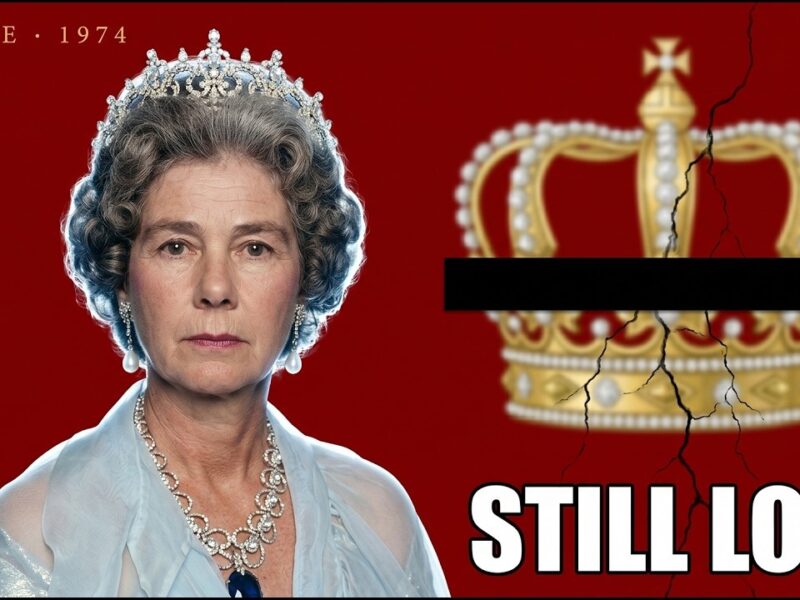
Queen Frederica: The Woman Her Own Son Promised To Banish — And Still Lost His Crown D
In December of 1974, a king in exile made a promise to his nation. Not about democracy, not about the future of Greece, about his mother. He promised publicly, formally, to keep her away from his country, away from politics, away from the throne. 69% of Greeks still voted to end the monarchy.
The woman they had feared for 30 years was already gone, and the crown fell anyway. The date was February 6th, 1981. The place was Tatoi, an estate of pine trees and crumbling stone walls north of Athens, where the Glücksburg dynasty had buried its dead for generations. A woman was being lowered into the earth.
She had been queen of Greece for 17 years. She had survived two exiles, a world war, a civil war, and the collapse of the very institution she had given her life to build. Her son flew in from London to attend the funeral. He was no longer a king. The Greek monarchy had been abolished seven years earlier, which meant the man who once wore the Greek crown was now a private citizen on a controlled visit permitted entry to his own mother’s burial on the condition that he and his family leave immediately. No extended mourning on Greek soil. Just arrive, stand at the grave, go. He stood at Tatoi and calculated how long he was allowed to remain. That image of a son at his mother’s grave, counting the minutes, is where this story ends. And it is impossible to
understand what it means unless you go much further back, to a young woman of 20 who fell in love with a Greek prince in Florence and made a decision that would cost her the rest of her life. Her name was Frederica of Hanover, born on April 18th, 1917 in the last months of the German Empire before it ceased to exist.
She was a granddaughter of Kaiser Wilhelm II and a great-granddaughter of Queen Victoria. Two imperial dynasties, two world wars, one woman who spent the following six decades trying to outlast both. She chose Greece. She chose it deliberately and completely. She was not coerced into the marriage, not traded between houses. She was a young woman who met a Greek prince, decided he was the one, and then decided that his country would be hers.
What she built inside that country is still debated. What it cost her is not. She loved Greece more openly, perhaps, than any foreign-born queen in modern European history. She was also described by credible voices across many decades as the single most dangerous person the Greek monarchy ever produced.
How does a woman end up in both of those sentences at once? What kind of love ends with a funeral on a deadline? What kind of danger gets buried under olive trees at Tatoi with her family told not to linger? To answer any of that, you have to go back to the beginning, to 1936, to a summer in Berlin and a question that one of them had not yet thought to ask.
She had first met Paul of Greece when she was 10 years old. He was 20, a grown man, a prince in a dynasty already twice displaced from its throne. Whatever that first meeting was, it was not the origin of anything. She was a child. He barely registered her. The real beginning came in Florence. Frederica was a student there in the early 1930s, staying near relatives.
Paul was visiting the same household. They met properly as adults or close enough, and something between them caught. By the summer of 1936, Paul was in Berlin to attend the Summer Olympics, and during that trip he proposed to her. She accepted. Their engagement was kept private for more than a year before the announcement was made officially on September 28th, 1937.
Greece needed to be consulted. So did Britain under the Royal Marriages Act. The permission of King George VI was required since Paul stood in line for the British throne through distant kinship. Permission was granted. The wedding took place on January 9th, 1938 at the Metropolitan Cathedral of Athens.
Frederica was 20 years old. Paul was 36. They moved into a villa in Psychiko, a suburb of Athens. Their first child, Sophia, who would eventually become Queen of Spain, was born in November of 1938 at Tatoi Palace. Their son, Constantine, the future king, arrived on June 2nd, 1940 in Psychiko.
A third child, Irene, was born in 1942, not in Greece, but in Cape Town, South Africa, where the family had been evacuated after Nazi forces invaded Greece in April of 1941. That evacuation is worth holding for a moment. The royal family fled Crete by flying boat. From there, they made their way through Africa and then Egypt, living in exile while their country was occupied, bombed, and broken apart.
Frederica was in her mid-20s. She had three children under the age of four. She had no safe country of origin to return to. Germany was now the enemy. The country she had chosen might not exist when the war ended. She could have asked for distance. She stayed close. In September of 1946, a referendum returned the Greek monarchy to power.
Means The family came home. Seven months later, George II died, and Paul became king. Frederica became queen at 29 young, physically energetic, already reshaped by years of difficulty that most European royals of her generation had watched from the safety of neutral territory. Greeks responded to her in those early years with something close to warmth.
She appeared on the cover of Time magazine. She appeared in Life. She was praised in American press as modern, direct, and unexpectedly grounded. Even those who found her manner to assertive tended to acknowledge the specificity of her commitment. She had chosen Greece when she did not have to.
She had come back when she could have stayed away. That counted for something. The picture from those years, Paul and Frederica side by side touring the country rebuilding an institution after the war, was one that the Greek public genuinely invested in. Not out of naivety, out of a recognition that this couple had shared something real with Greece and was prepared to go on sharing it.
That recognition would carry the marriage and the monarchy further than it had any structural right to go. Paul was, by most accounts, the quieter of the two. He was a careful man, deliberate, formal, worn down by a childhood that had included watching the Greek throne lost, restored, and nearly lost again before he was 20.
He had spent years in exile learning patience as a survival strategy. He did not rush. He did not improvise. He was not built for the kind of rapid, instinctive political engagement that Frederica seemed to operate on as a natural function. What they built together was, in practice, a system of complementary temperaments.
He provided institutional weight. She provided velocity. During the Greek Civil War, which ran from 1946 to 1949, this dynamic produced something genuinely remarkable. Frederica did not stay in Athens issuing statements. She organized. She created a network of social welfare programs, children’s homes, refugee shelters, relief operations reaching into the northern regions of Greece where the fighting was most intense.
Critics would later say these programs were instruments of political loyalty building rather than pure humanitarian work. That argument is ongoing. What is not disputed is the scale. Thousands of children from families displaced by a brutal guerrilla conflict were housed, fed, and cared for through networks that Frederica personally built and supervised.
In early 1948, she traveled to Konitsa, a town in northwestern Greece that had recently survived a military siege to stand alongside the affected population. The sea journey toward the area was dangerous. Her vessel, approaching Preveza, narrowly avoided a naval mine. At the time, King Paul was in Athens, bedridden most likely with typhoid fever. He could not go.
Frederica went without him into a region where active combat had ended only weeks before. She later described that visit as one of the most significant experiences of her life. This is the version of Frederica that her supporters kept with them through everything that followed, not the political meddler, not the dangerous woman, the one who was willing to cross a naval minefield to reach a besieged town while her husband lay ill and the rest of Europe was trying to determine whether Greece would still exist in 5 years. The marriage in those years carried the weight of a shared undertaking that most royal partnerships do not. Paul and Frederica were not performing recovery. They were actually attempting it inside an institution that had almost no room for failure. His reserve and her forcefulness formed a working mechanism. His institutional credibility gave her
visible activity a legitimate frame. Her energy compensated for what he could not sustain on his own. Whether the private marriage matched the public one is harder to assess. The diary Frederica kept published posthumously in a major three-volume edition spanning nearly 1,400 pages edited by historian Costa Stamatopoulos records daily schedules in careful almost bureaucratic detail, but avoids personal reflection.
She documented what happened. She rarely recorded what she felt about it. What emerges from those pages across the years of Paul’s reign is a portrait of consistent engagement, a woman who treated her role not as a ceremonial position, but as a professional one with responsibilities that required daily work, travel, decision-making, and presence.
A woman who was, in practical terms, co-governing a fragile Mediterranean monarchy during one of the most difficult periods in its history. That was, for a time, exactly what Greece needed from her. The problem was what came next, the moment when Greece decided it no longer needed what she was offering, and found that she was not prepared to offer something smaller.
The quality that made Frederica effective during wartime, her willingness to act without waiting for permission, was exactly what the Greek political establishment could not absorb once the emergency was over. She was not a subtle woman. She did not pretend to opinions she did not hold, and she did not confine herself to the conventional role of a queen consort once she had decided those conventions were obstructing something useful.
She intervened in electoral politics directly. At one point, she actively campaigned against Alexandros Papagos, the serving Prime Minister of Greece, a decorated field marshal who had twice led the Greek army to victory, and twice risked his career defending the Glücksburg dynasty. Frederica chose to oppose him, the same man who had protected her family.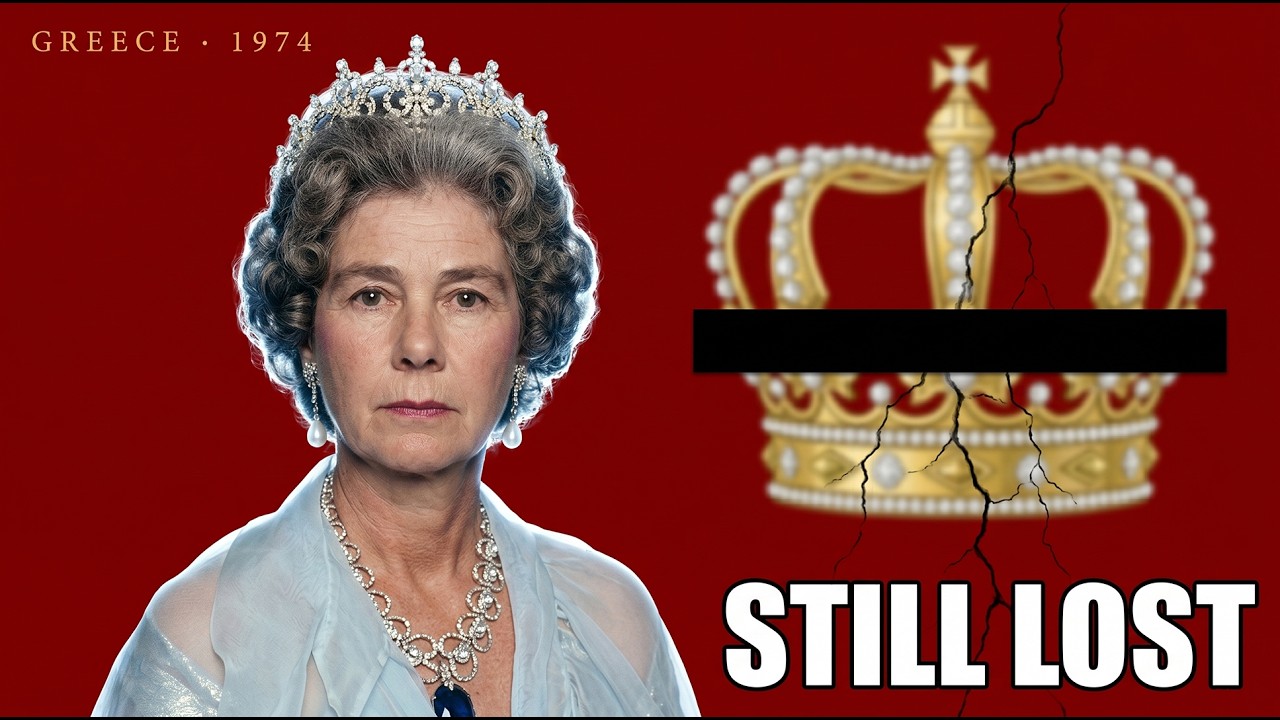
It is a striking choice. It is also a clarifying one. The German past was never far from the surface. Left-wing politicians used it methodically across decades. The fact that Kaiser Wilhelm II was her maternal grandfather, the fact that two of her brothers had served in the SS, these were documented history, not invented charges, and they were deployed with precision, particularly as Greek political life became increasingly split between royalist and communist factions in the 1950s.
Being called very Prussian was among the more restrained accusations. The word Nazi was used regularly in parliament and in the press. Frederica’s supporters argued that her membership in the Hitler Youth as a teenager in 1933 was circumstantially required, that leaving the organization had been genuinely dangerous under the conditions early National Socialist Germany, and that she had done so as soon as she could, going abroad to study in England and then Italy.
These arguments were technically honest. They were not politically sufficient. In a country that had been occupied and devastated by German forces, they had a ceiling on how far they could travel. Then came 1963. Frederica traveled to London. Greek left-wing emigres organized demonstrations outside her hotel.
The protests became violent enough that she was forced to leave the building and take refuge in the private home of a stranger on the street. The British government, embarrassed, sent what would later be described as a clumsy letter of apology to King Paul. The damage to Greco-British relations was real.
That same year, in May, a left-wing member of the Greek parliament, Grigoris Lambrakis, was struck by a motorcycle in Thessaloniki and died from his injuries 5 days later. A subsequent investigation found the attack was not accidental. It was a political assassination. High-ranking government officials with close ties to the palace were found to have been involved in organizing it.
The monarchy had not ordered it, but the monarchy was now entangled in public perception with the kind of power arrangement that had produced it. Paul was by now seriously ill. He had undergone surgery for a cataract in 1959, an emergency operation for appendicitis in 1963, and in late February of 1964, surgery for stomach cancer.
He died on March 6th, 1964. He was 62 years old. The timing of his death created a problem that no amount of Frederica’s energy could solve and her continued presence would only make worse. Her son Constantine was 23. He had not governed. He had spent his life learning sailing and protocol in the shadow of a father who had kept the institution running, however imperfectly, for 17 years.
And now he would inherit the throne of a country in the middle of another period of political instability with a queen mother standing just behind him who had spent two decades demonstrating that she, not her careful husband, was the real political force of the Glücksburg dynasty in Greece. What had been a functional asset during Paul’s reign was about to become a structural liability during Constantine’s.
And the architecture of what came next was already in place long before anyone named it. Paul’s funeral was held on March 11th, 1964. It was attended by Prince Philip of the United Kingdom, by former King Umberto II of Italy, by Infante Juan of Spain, by King Gustav VI Adolf of Sweden, by United States First Lady Lady Bird Johnson, and by former President Harry Truman.
Greece buried its king with the full weight of European royal solidarity present. Constantine II ascended the throne at 23. He was young, visibly likable, and popular in the way that is personal rather than institutional. People responded to him, not to what he represented. He married Princess Anne-Marie of Denmark in September of 1964.
She was 18. Two young royals photographed together seemingly full of promise for a new beginning. Frederica stepped back from official duties once Anne-Marie was settled. Protocol required it. She was present at events, visibly in photographs, attentive to her grandchildren as they arrived in Spain and Greece.
Officially, she had withdrawn. Opposition politicians and a substantial portion of Greek public opinion did not believe the withdrawal was real. Their position, stated openly and repeatedly, was that Frederica was still the decision-maker, that Constantine was governing in the frame his mother had built through advisers she had cultivated toward outcomes she preferred.
Whether that accusation was accurate or was a continuation of decades of political campaigns against her is genuinely disputed. What is not disputed is the effect. The more the opposition pointed at Frederica, the less Constantine’s authority appeared to originate from Constantine. Then came April 21st, 1967.
In the early hours of the morning, a military junta seized control of Greece. It was a coordinated coup carried out by a group of army colonels who had grown impatient with the country’s political instability. Constantine was informed. He did not resist immediately. He attempted in December of that year to organize a royalist counter-coup.
It failed and fled with his family into exile in Rome. He never returned as king of Greece. On the night of the April coup, a tank was parked outside Frederica’s private residence in Athens. When she went to the door, the officer in charge told her she was not permitted to leave for her own protection.
She went back inside. She returned wearing her highest military decoration, the decoration she had earned during the civil war years. She told the officer that she had earned the right to come and go. The officer did not move. She eventually managed to reach Constantine by radio since telephone lines had been cut.
The account is documented in later sources. It is a striking image, but it is also, by that point, beside the question. The monarchy Frederica had spent 30 years defending was now in the possession of a military government with no meaningful use for it. The junta fell in July of 1974. Greek democracy was restored.
A referendum on the monarchy was scheduled for December 8th, 1974. Constantine’s position on the throne would be put to a popular vote. He campaigned from outside Greece because he had no right of reentry. He acknowledged past errors explicitly. He described kind of monarchy restrained, accountable, structurally democratic. He made specific promises.
The most specific and most publicly noted was this. He promised to keep Frederica away from Greece, away from Greek politics. He named his mother in the context of the referendum campaign as a condition of his potential restoration. The implication was direct. The institution had lost credibility in part because of her.
The institution had come to mean things it should not have meant in part because of her. He was willing to say so publicly to save the crown. 69% of Greeks voted no. The monarchy was abolished. Constantine remained in exile. What does it mean when a son publicly promises to contain his mother and the institution falls anyway? It means the problem was never primarily about Frederica.
It means the institution had accumulated failures 1967 and everything before and after it that no single promise could address. The monarchy had aligned itself in perception and in practice with political interference, with authoritarian governance, with a distance from ordinary Greek life that had become insurmountable.
Frederica was the most legible symbol of what her opponents called royal arrogance. But she had not caused the junta. She had not caused the counter-coup’s failure. She had not caused 1967. Symbols do not bring down monarchies on their own. They concentrate in a single person’s face and name the failures that were always structural.
When Constantine named his mother in a campaign to restore himself, he was not correcting the real problem. He was finding a way to name it without taking responsibility for it. And 69% of Greeks saw through the difference. There is a version of Frederica’s story that arranges itself neatly into a cautionary tale.
A foreign-born queen with a compromised past overstepped the boundaries of her role, alienated the Greek public across three decades and contributed through her political ambition and her unwillingness to accept the limits of her position to the destruction of the very dynasty she claimed to serve. The narrative is clean.
It has a villain. It has a lesson about knowing your place. That version requires leaving out quite a lot. It requires leaving out 1948 and the naval mine near Preveza. It requires ignoring the children’s homes in northern Greece built by a woman in her late 20s during an active guerrilla war.
It requires dismissing years of documented genuinely difficult work in conditions that most of her royal contemporaries in post-war Europe never had to face at all. The harder version of the story is this: By the actual standards of the job she was asked to do, which was to help stabilize a monarchy that was perpetually on the edge of dissolution, Frederica was extraordinarily capable, more politically astute than her husband, more willing to act under uncertainty, more effective at building networks, managing public perception, and making decisions in real time. By the metrics of political performance, she outperformed the institution she served. And that was the problem, not the capability itself, the visibility of it. A queen consort, under the conventions of mid-century European monarchy, was
not supposed to have political strategy. She was permitted to represent, to appear, to add warmth and dignity to her husband’s authority. When Frederica exceeded those boundaries consistently, deliberately, and without much pretense that she was not exceeding them, she violated an implicit contract that the institution depended on.
The monarchy need its female members to be legible within a recognized frame. Frederica would not fit inside the frame. Her opponents understood this and they built a case around it. The Nazi past was a real liability. She had joined the Hitler Youth in 1933, however briefly. And the fact of her brother’s SS membership was documented and true.
But it was also a useful frame one that allowed her opponents to attach a charged emotionally simply labeled to a phenomenon that was actually much more complicated. She was not dangerous because of her grandfather. She was politically threatening because she was effective in ways the system had not been designed to accommodate.
The German ancestry made the targeting easier. It was not the origin of the targeting. This pattern is not specific to Greece. The history of European monarchy is densely populated with women who were described as dangerous precisely when they were capable of things men around them could not perform equally well.
Frederica did not invent the pattern. But her story runs through it with unusual clarity because the stakes were so high, the timelines so compressed, and the collapse so total. She wrote a memoir in 1971. She called it a measure of understanding. By all accounts, it is controlled reflective without being confessional, measured without being revealing.
She made no dramatic case for herself. She did not answer her critics directly or at length. She recorded what she had done and left the interpretation to others. That restraint in itself says something. A woman who had spent three decades in active political life, who had been called a Nazi and a manipulator and a danger to democracy and who chose, when she finally sat down to write her account, to leave most of the argument unresolved.
She had a version of herself she could have argued. She let the reader carry the question instead. Whether that was wisdom or withholding, only she would have known and she did not say. Frederica spent the last years of her life moving between Rome, London and Madrid, wherever family was, wherever a visit was possible.
She attended christenings in Spain where her daughter Sophia had become queen. She watched grandchildren grow up in countries that were not Greece. She was not idle, but the mechanism for the kind of work she had done was gone. She died in Madrid on February 6th, 1981. She was 63 years old. The reported cause was heart failure during what was officially described as routine eyelid surgery, though a biographer later noted the procedure was most likely for cataracts.
Even the manner of her death became a site of minor disputed fact. That too seems consistent with the life. Her body was returned to Greece and buried at Tatoi beside Paul in the hillside cemetery where the Glücksburg dynasty had placed its dead for generations. The monarchy she had served had been gone for seven years.
The olive trees were still there. The stone was still there. The ground was still Greek and she was allowed to enter it one last time. The former royal family was permitted to attend, then required to leave immediately after. Stand in that image for a moment. A woman who had sailed past a naval mine to reach a besieged town.
A woman who had appeared on the cover of Time magazine as a symbol of what modern European royalty could look like. A woman whose political presence was considered so consequential that her own son had to promise a nation to keep her contained and still could not save the institution.
Buried in the soil she had chosen on a government deadline while her family calculated how many minutes they had left. Paul had died in 1964 believing the monarchy was stable. He was wrong. But he did not live to see it fall. Frederica watched the referendum. She read the number, 69%. She was alive for all of it, the coup, the exile, the vote, the end.
What does a woman do with the knowledge that the thing she gave her life to has been voted out of existence by the people she spent decades working to serve? Her diary does not answer that. Her memoir does not answer it either. That part she kept private. Or perhaps there were no words adequate to the fact, which means the question stays open.
And maybe that is the point. The stories that stay with us, the ones that keep returning when we think we have finished with them, are not the ones where the verdict is clean. They are the ones where the evidence points in multiple directions at once and no single answer is sufficient to what actually happened. She loved Greece.
Greece could not hold what she was. The institution fell. She was buried under the trees she had chosen and the family that she built had to go home. That is not a tragedy with a lesson attached. It is something harder, a life that was larger than the frame constructed to contain it, lived all the way to the end without anyone managing to resolve that particular fact.
If that story stayed with you, this channel has more of them royal lives where the weight of what really happened is still not settled. Subscribe if you want to keep going. Turn on notifications so you do not miss what comes next.