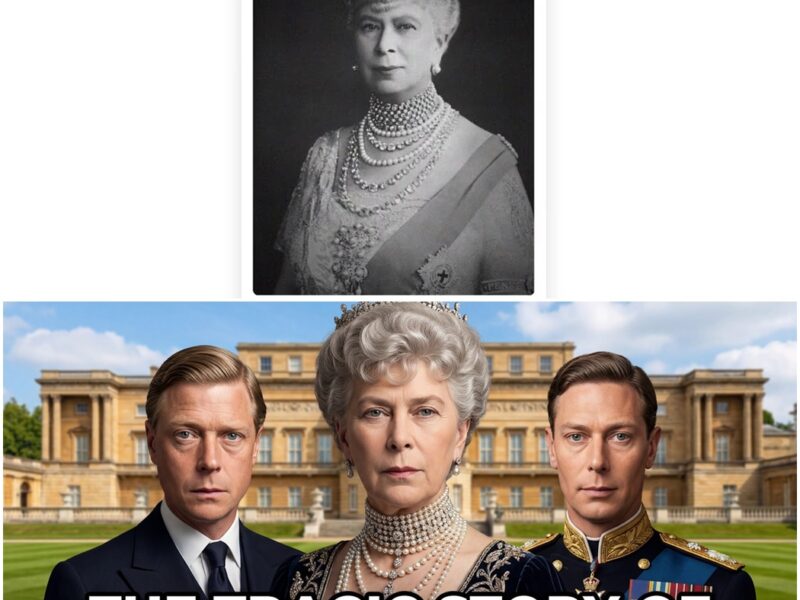
Queen Mary Went to Her Grave Refusing to Forgive Her Own Son D
In December 1936, Queen Mary sat in a room and listened to her eldest son tell her that he was giving up the throne of the British Empire to marry a twice divorced American. She had buried a husband, King George V, less than a year earlier. She had raised her children on a single unbending principle, the one she believed she had lived by every day of her own life, that the crown comes before the person, that duty outranks desire, that a royal does not get to choose happiness over the institution, and now her son, her king, was choosing a woman over the throne. Queen Mary didn’t weep. She didn’t plead. By every account, she went cold, and she stayed cold for the rest of her life. Edward gave up the crown and went into exile. And his mother, the most controlling matriarch the modern monarchy ever produced, treated him from that day forward with a formal glacial distance
that never once thawed. When she died 17 years later, 10 weeks before her granddaughter Elizabeth was crowned, she had still not forgiven him. This is the story of a mother who chose the crown over her own son and never looked back. One thing first, because it trips people up constantly.
Queen Mary, the woman at the center of this story, was Mary of Tech, born 1867, wife of King George V, mother of King Edward VIII and King George Viknan. She is the grandmother of Queen Elizabeth II. The woman you may be thinking of as the Queen Mother, Elizabeth Bose Lion, born 1900, was a different person entirely.
The wife of George V 6, the mother of Elizabeth II. They were mother-in-law and daughter-in-law. Both were titled Queen simultaneously during the 1940s, which is where the confusion starts. Queen Mary never took the title Queen Mother. She retained Queen Mary as a daager queen until her death in 1953.
Two women separated by 33 years and only one of them is this story. She was born Princess Victoria Mary Augusta Louise Olga Pauline Claudine Agnes of Tech on 26th May 1867 at Kensington Palace. The name alone tells you something about the aspirational mathematics of minor royalty.
six given names stacked like credentials staking a claim. Her father was Francis, Duke of Tech, a Morganatic offshoot of the royal house of Vertonberg, which meant royal blood without the financial backing to sustain it. Her mother was Princess Mary Adelaide of Cambridge, granddaughter of George III and famously extravagant with money the family didn’t have.
The texts lived abroad periodically to economize on debts. Florence in winter white lodge when funds improved slightly. Mary grew up in the specific discomfort of a household that was royal in status but precarious in practice close enough to the institution to understand exactly what it offered and what it cost.
The first lesson came early and it was a hard one. In 1891, she was engaged to Prince Albert Victor, Duke of Clarence and Aendale, the eldest son of the future Edward IIIth, first in line after his father to the throne. He wasn’t, by most accounts, an impressive man, intellectually limited, rumored to be dissolute, whispered about in ways the palace found embarrassing.
None of that was Mary’s problem. He was the heir. She was engaged to him. In January 1892, Albert Victor died of influenza that progressed to pneumonia within days. He was 28. The engagement dissolved with his death, not by any choice of marries. Less than 18 months later, in July 1893, she married Albert Victor’s younger brother, Prince George.
Same dynastic slot, different man. James Pope Hennessy, whose 1959 authorized biography remains the standard scholarly reference for Mary’s inner life, portrays this as the foundational act of her identity as a royal. She stepped into a dynastic requirement that had nothing to do with her own trajectory and made it her own.
Her feelings about Albert Victor’s death are, as Pope Hennessy notes, largely absent from her surviving letters, a silence biographers have consistently read as suppression rather than indifference. She didn’t perform grief. She performed duty instead. She married George on 6th July 1893, became queen consort when he exceeded in May 1910, and from that point forward, she increasingly identified herself with the monarchy as institution to an exceptional degree.
She consciously schooled herself out of spontaneous individual expression and into the role of queen, not because it was natural to her, but because she decided it was required. The girl called May of Tech from the precarious household in Florence remade herself into Queen Mary with the deliberateness of someone who had seen what happened when royalty couldn’t sustain the weight of its own dignity.
Prince John is one of the starkkest examples of where that deliberateness led. Mary’s youngest son suffered from epilepsy and developmental difficulties severe enough that the family kept him largely out of public view. Separated from the household at Woodfarm Sandringham under the care of a nanny named Laala Bill, he didn’t appear at public functions, he didn’t feature in the official portrait of the monarchy that the institution wished to project.
He lived at a careful remove and the world was told very little about him. He died in January 1919 at the age of 13 after a severe epileptic seizure. Biographers record Mary’s response as marked by self-control and a rapid return to public engagements. Edward, who was 11 years older than John and had barely known him, wrote his mother a letter after the death that was callous enough that he felt compelled to write a second letter apologizing for the first.
In the second, he wrote that he had been cold-hearted and unsympathetic and acknowledged how little poor Johnny had meant to him, that he had barely known his youngest brother. She didn’t reply to the first letter. What she made of the second isn’t documented. What we know is that she didn’t make it a rupture, and she maintained the same formal relationship with Edward that had always characterized her dealings with her children.
By 1928, she was applying the same logic she had applied to John’s situation directly to Edward, now the Prince of Wales. A letter she wrote to him that year, widely cited through Pope Hennessy and secondary sources, admonished him about marriage and his obligations. The formulation, most often quoted, that no one has a right to happiness in his position, and that he wasn’t only a private individual.
This isn’t a mother casually nagging an adult son about settling down. This is a woman delivering a verdict she had already applied to herself in writing to her heir as a statement of what she believed the crown required of him. He was 34 when she wrote it. She had been watching him for years by then and what she saw alarmed her.
George Thive her husband was more vocal about the same concern. In 1934, he said of Edward, Philip Ziegler records this in his authorized biography of Edward VIII, after I’m dead, the boy will ruin himself within 12 months. Mary shared the view. She expressed it through conduct rather than declaration, which is how she expressed most things.
The list of what she disapproved of, is specific and documented. Edward serial affairs with married women, most notably Winterfred Freda Dudley Ward, with whom he maintained a relationship from approximately 1918 to 1929, while she remained married to another man. Mary was aware of this by the early 1920s. She refused to receive Freda socially.
No letter of direct written denunciation exists. The disapproval is documented through behavior, the absent invitation, the closed drawing room, the turned shoulder of a woman who understood that silence was more effective than confrontation. Lady Thelma Furnus followed in the early 1930s, and the pattern repeated.
Distance, refusal, the same controlled expression of a position that needed no announcement. More broadly, Edward despised routine. He sherked official work. He had what biographers call an Americanization, an enthusiasm for jazz, informality, crowds, and unscripted interaction that Mary read as the systematic erosion of the crown’s dignity and mystique.
He made politically indiscreet public remarks on unemployment in Wales. He refused to open a new wing of Aberdine Royal Infirmary in August 1936, citing mourning for his father and was photographed the following day on holiday with Wallace Simpson. In a letter to Freda Dudley Ward, he had written of himself, “I’m not a big enough man for the job.
” His mother had known it for years before he wrote it down. Mary and George Levy had met Wallace Simpson at Buckingham Palace in 1935 and subsequently refused to receive her. The constitutional crisis that erupted publicly in early December 1936 wasn’t a shock to the family in terms of Edward’s attachment that was long established.
The shock was in the conclusion George V died on 20th of January 1936 at Sandringham and Edward exceeded as King Edward VIII. He had been king for less than 11 months when the crisis broke. By October 1936, it was rumored in high society and abroad that Edward intended to marry Wallace as soon as she completed her second divorce.
Prime Minister Stanley Baldwin warned him formally on 16th of November that such a marriage wouldn’t be acceptable to the government or the Dominions. Edward’s response, per his own later account, was unambiguous. If the government opposed the marriage, as the prime minister had given me reason to believe it would, then I was prepared to go.
Three options were put to the Dominion prime ministers. Marriage with Wallace’s queen, a Morganatic marriage without the Queen’s title or abdication. The Dominions rejected the first two. The British press had maintained a self-imposed silence on the affair through most of 1936. The silence broke on 3rd December when Alfred Blunt, Bishop of Bradford, gave a speech that was taken as public commentary on the king’s private life.
He later claimed he’d barely heard of Wallace Simpson, that he was simply expressing disappointment at Edward’s failure to attend church. The press had been waiting. Within 24 hours, it was front page news across the country. What Queen Mary said and did during that specific crisis week between 3 through 3 December and 11th December survives most reliably in the private diary of Archbishop of Canterbury, Cosmo Gordon Lang.
Writing on the eve of the abdication, Lang recorded that Queen Mary was much moved and distressed about her son, but as usual wonderfully self, the manuscript truncates there, but the shape is clear. Lang was a firstirhand witness writing for himself with no reason to soften the picture. He saw a woman in genuine distress who was containing it with practiced discipline.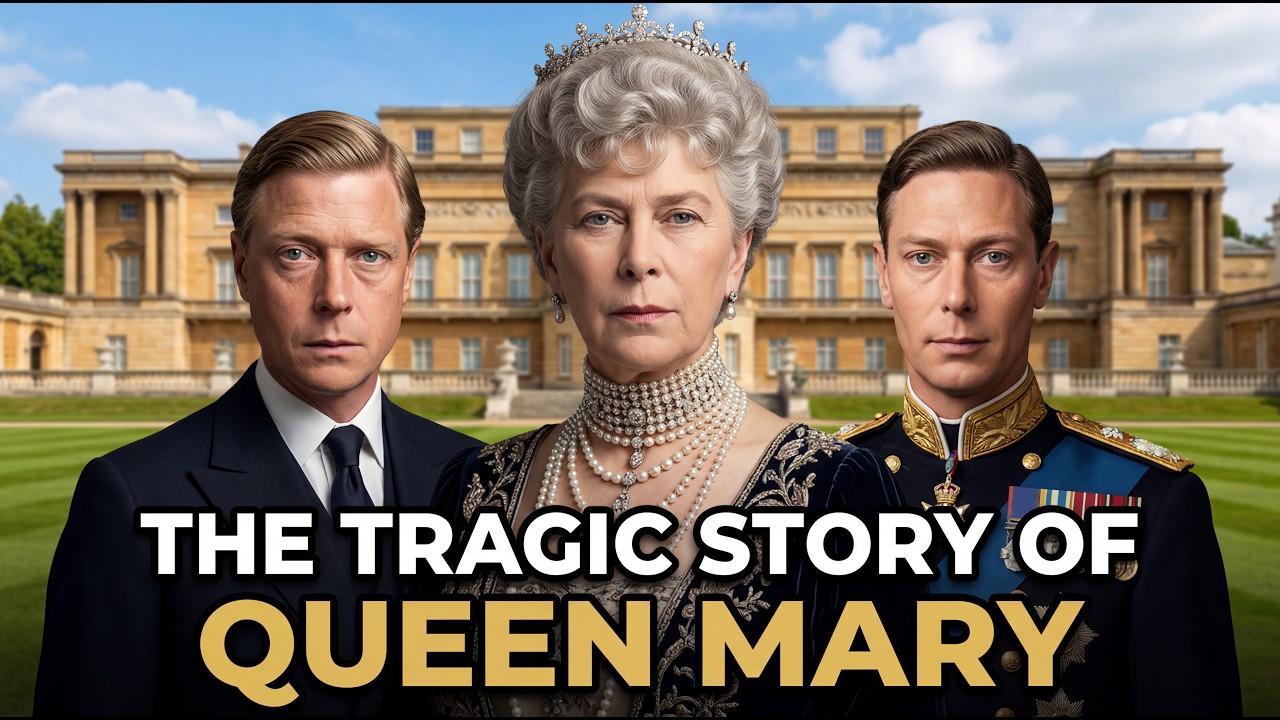
She wasn’t cold during the crisis week. She was in private grief, applying to that grief exactly the same containment she applied to everything else. The coldness that biographers describe came after. During the abdication itself, there was feeling tightly held, immediately controlled, and never performed for anyone who might have been moved by it.
She had been doing exactly this since 1892. On 10th of December 1936, Edward signed the instrument of abdication at Fort Belvadier. Three of his brothers, Albert, Henry, and George, co-signed as witnesses. Parliament gave it legal effect the following day, 11th December. Edward addressed the nation by radio that evening, explaining that he had found it impossible to carry the heavy burden of responsibility without the support of the woman he loved.
He became the Duke of Windsor. His brother Albert exceeded as King George V 6, a man who by multiple accounts viewed the abdication papers with revulsion and had never wanted the throne. Shortly afterward, Queen Mary wrote to Edward addressing him as HRH Prince Edward of Windsor, his new lower ranking style rather than as King.
The choice of address was deliberate. He was no longer her king, and the new form made that legible without requiring a single explanatory sentence. When a lady in waiting expressed sympathy for Edward after the abdication, Mary said, “The person who needs most sympathy is my second son.” Edward had a new title.
She had a new king. She turned her attention immediately and completely to supporting George V 6 and she moved forward. Two years later, she put the position in writing. In July 1938, she wrote to Edward directly. The key line from that letter confirmed through multiple biographical sources and cited to David’s study of the abdication.
All my life I have put my country before everything else, and I simply can’t change now. Not rage, not denunciation, a statement of a position she considered settled, delivered in the register of someone for whom this required no particular courage, because it required no particular decision.
It was simply where she stood. Now to the 17 years between December 1936 and March 1953. The arangement wasn’t total silence. Queen Mary and the Duke of Windsor were in occasional contact after the abdication. Letters were exchanged. Meetings happened. He attended family events. The arangement was cold and limited, not zero.
The record shows infrequent and formal contact rather than exile into silence and honesty about this matters. what the estrangement was. Queen Mary never received Wallace Simpson. Not once, not publicly, not privately, not socially, not officially. From the day Edward married Wallace in France on thr June 1937, no member of the royal family attended the ceremony to the day Mary died in March 1953.
There is no recorded meeting between the two women. Every major biography of the period agrees on this point. The wedding happened at the Chateau Deande in the Lir Valley. Edward wore morning coat. Wallace wore a mamboche gown in a shade she had specifically chosen, Wallace blue, because the French couturier thought it matched her eyes.
The ceremony was conducted by the Reverend R. Anderson Jardine, a Church of England vicer who defied his bishop by officiating and was shunned by the church for it afterward. Letters patent issued earlier that year confirmed the Duke of Windsor’s title as HR, but explicitly withheld the designation from Wallace.
She was the Duchess of Windsor, but she wasn’t her royal highness. This became Edward’s central grievance, the one he would pursue in various forms until his death. The formal decision was George V 6 as king with government involvement. The extent to which Mary personally engineered, it’s debated and shouldn’t be overstated.
What is clear is that she didn’t oppose it. Then came the Germany tour. In October 1937, Edward and Wallace visited Nazi Germany. They met Adolf Hitler at Burkisen. They met Joseph Gerbles, Herman Guring, Rudolph Hess. Photographs showed Edward in what appeared to be a Nazi salute. The German Reich’s ambassador to Britain, Yuim von Ribbentrop, had previously sent dispatches to Berlin, suggesting that opposition to Edward’s marriage had been motivated by a desire to defeat the Germanophile forces that had been working through Mrs. Simpson. The visit confirmed every concern the royal family and the government had harbored about Edward’s political instincts. When war came in 1939, wartime intelligence services documented concerns about his conduct and the risk he posed. He was appointed governor of the Bahamas in August 1940, partly to remove him from Europe, partly to give him an official
function at a safe distance from any position of real influence. He served in Nassau until 1945. Communication with the family during those years occurred at the level of official government correspondence. Not personal warmth, meetings between Queen Mary and the Duke of Windsor did occur.
A documented occasion on 6th and October 1945. Edward had returned briefly to Britain after the Bahamas governorship ended took place at Marlro House. Accounts describe it as a poignant example of the constrained relationship. Formal, brief, Wallace not present. The physical setting of Marlboro House, the high ceilings, the formal receiving rooms, the portraits of monarchs arranged with the deliberateness of institution over intimacy would have enforced the register of the meeting without either of them having to say a word about it. This was Mary’s London residence, her territory, her rules, her register. Edward arrived, they spoke, he left. No account describes warmth. The postabdication correspondence between them is described by biographers as correct but impersonal. The register of strained family duty, not of a mother writing to her son. A letter that
answers questions without asking any, that acknowledges events without commenting on them, that fulfills the minimum requirements of continued connection without creating the conditions for anything closer. It’s a particular kind of cruelty or a particular kind of integrity depending on your vantage point.
The cruelty of the technically present parent who refuses emotional access or the integrity of a woman who had decided that warmth was something the institution didn’t permit her to grant him. In 1951, Edward published his memoirs, A King’s Story. In them, he described his mother as having always been cold and unfeilling towards him.
This characterization is contested by the letters that survive between them, which some biographers argue show more warmth than he claimed publicly, but it reflects his stated experience of the relationship shaped by 17 years in which he had asked for something from her. The recognition of his wife, the acceptance of his choice, and she had consistently not given it.
The memoir reads as the account of a man who had been waiting for something that was never going to arrive and had finally at 57 put that fact into print. What did Edward’s reconciliation attempts actually look like? His primary demand consistent from 1937 until his death in 1972 was that Wallace be received that she be acknowledged as his wife within the social and institutional framework of the family.
He pursued HR status for her repeatedly and failed. He sought invitations for her to family functions. He wanted the family simply to meet her, to sit in a room with her, to treat her as something other than the permanent evidence of his dereliction. None of this was granted by Queen Mary. George V 6 made the formal decisions about HR status and official reception.
with his wife Elizabeth Bose Lion actively and personally hostile to Wallace. She referred to her privately as that woman and her lifelong feud with the Duchess is its own documented story. Mary’s position, as stated in the July 1938 letter, didn’t require elaboration. She had said what needed saying.
She didn’t unsay it. Whether George Vick pressed his mother to soften toward Edward isn’t documented anywhere in the available record. He had inherited the crown his brother abandoned at a moment he was constitutionally and temperamentally unprepared for. If he harbored any private wish that his mother might relent toward Edward, he didn’t apparently press it in any way that survived.
The family’s attitude did shift in the next generation. Princess Elizabeth, later Queen Elizabeth II, visited the Duke and Duchess of Windsor in France in March 1965. She visited Edward at his Paris home on 18th May 1972, days before his death, and received Wallace there. These partial thaws came from the next generation and post-date Mary’s death by more than a decade.
They change nothing about what Mary’s own record shows. No major biographical account records a reconciliation between Queen Mary and the Duke of Windsor before her death. The never forgave verdict isn’t supported by a single document in which he says those words. It’s argued from the pattern of conduct, the refusal to accept the marriage, the formal register of their contact, the July 1938 letter, and the absence of any documented moment of softening.
Pope Hennessy, with his authorized access and his careful interpretation, presents the estrangement as a tragic consequence of her principles. a woman whose consistency was real and whose pain was private. Hugo Vickers’s harder modern reading, drawn partly from Pope Hennessy’s own raw research notes published in the Quest for Queen Mary in 2018, treats the consistency itself as having functioned in practice as punishment, whatever its internal logic.
Both men work from the same documented conduct. The difference between them is a question of moral framing, not of disputed facts. Mary’s creed, the crown outranks the individual. Duty outranks desire. The institution outlasts the person, wasn’t something she invented to punish Edward.
It was the principle she had applied to herself first repeatedly across six decades. She stepped into a dynastic engagement after her first fiance died. She subordinated her personal narrative when the royal family renamed itself in 1917, stripping German titles from her own relatives, people she had grown up among and cared about because the institution required it.
She maintained public engagements through her husband’s serious illnesses. She returned to duty promptly after Prince John’s death. Whatever the private cost of these choices, and the cost was real, whatever the record doesn’t show, she made them consistently and she made them first.
When the same principal arrived at her own door in December 1936, wearing her son’s face and asking for an exception, she didn’t grant one. From her perspective, she was being consistent rather than cruel. She was applying to Edward the same standard she had applied to everyone, including herself. Edward’s self-ch characterization in his memoirs that she was cold and unfeilling reflects the experience of a man who needed something from his mother that she either didn’t know how to give or didn’t believe it was her role to give. He wanted a parent who would say you are my son and that outranks everything else. She believed the opposite was true. The abdication didn’t create the structural incompatibility between them. It simply made it irreversible. Marlboro House, London, 24th of March 1953, 10:20 in the evening. Queen Mary died there, aged 85. The death was officially attributed to
gastric problems, gastritis, and heart failure, though later press reports would describe lung cancer as the cause. She was 2 months short of her 86th birthday. The months leading to her death had been marked by the losses that accumulate when you outlive almost everyone who knew you at the beginning.
George V 6, the son she had transferred her full support to in December 1936. The man who had taken the crown he hadn’t wanted and carried it with unexpected steadiness through the war and after it died on 6th February 1952 at Sandringham. He was 56. Mary who had been 84 outlived him by 13 months.
She attended his lying in state. She stood in the room where her son’s coffin lay and she didn’t collapse. She did what she had always done. She had also watched her granddaughter, Princess Elizabeth, become Queen Elizabeth II at 25. The coronation was scheduled for destined to June 1953. Mary was determined to attend.
Her health was failing through the early months of 1953, but she was following the preparations, the planning, the institution going forward as it always had. She had spent her entire adult life in service to precisely this, the continuity of the crown, the ceremony of succession, the monarchy presenting itself to the world as something larger than any individual who wore it.
She made known to the royal household that the coronation shouldn’t be postponed on account of her death. Multiple independent sources confirmed the substance of this instruction. She wanted the ceremony to proceed on schedule. the date mattered more than whether she was there to see it. This isn’t an unusual sentiment for a woman who had spent her life subordinating personal presence to institutional requirement.
It’s entirely consistent with everything she had done since 1893. She died on the 24th of March. The coronation took place on the 2nd of June, 10 weeks and 2 days later, exactly as she had asked. The Duke of Windsor outlived her by 19 years, dying in Paris on 28th May 1972. In the decades between her death and his, Queen Elizabeth II eventually received Wallace at Edward’s deathbed and afterward, completing the partial thaw that Mary had never been willing to begin.
The institution had moved on. Mary had not moved at all. No full reconciliation had occurred. No document records are softening. No name witness describes a conversation in which she told Edward that she understood or that she forgave him or that she was sorry for the shape their relationship had taken. The absence of any such record across 17 years and multiple potential occasions is its own kind of answer.
Archbishop Lang had seen a woman much moved and distressed and wonderfully self-composed in December 1936. The self-composure lasted until the end. Queen Mary died in March 1953, 10 weeks before her granddaughter was crowned. And she made it known that the coronation should go ahead on schedule, even if she didn’t live to see it, duty to the very end, outranking even her own death.
She had spent 17 years refusing to forgive the son who chose love over the throne, and she went to her grave without bending an inch. You can call it cruelty. You can call it integrity. Queen Mary wouldn’t have recognized the difference because to her they were the same thing. The crown comes first, the person comes second.
And a mother who truly believes that does not get to keep her son. She believed it. She lost him and she would have made exactly the same choice again. Subscribe for more stories like