She Forced Her Daughter to Marry a Duke — America’s Own Queen Mother D
The morning of November 6th, 1895, the Vanderbilt family mansion at 665th Avenue, a French chatauesque fortress that took 1,000 workers 3 years to build, cost $3 million, and occupied an entire city block, was full of motion. Dressers, footmen, flower arrangements, all of it orbiting a single room.
Inside that room, Consuelo Vanderbilt, 18 years old and the most famous ays in America, was crying. In a few hours, she would be married to a man she didn’t love. By her own account, written decades later in her memoir, she had spent weeks being denied contact with a man she did love. The ceremony was scheduled for noon at St. Thomas Church on Fifth Avenue.
Crowds had already gathered outside. New York papers had sent reporters to cover what they were calling the wedding of the century. One paper would later run a cartoon showing Consuelo kneeling beside the Duke in her wedding gown, her hands handcuffed behind her back. The public understood perfectly what kind of ceremony they were watching.
This is where the story begins. Not because it’s simply a sad story, but because of what happened 31 years later when Alva Vanderbilt walked into a Vatican tribunal and confirmed every word of it. Alva Erskin Smith was born in January 1853 in Mobile, Alabama, the daughter of Murray Forbes Smith, a cotton merchant and commission broker.
Her family were wealthy slaveholders before the Civil War. The house on Government Street in Mobile, Summers in Newport, the trappings of southern elite life. Then the war ended and so did the money. The displacement came in stages. Around 1859, before the war broke out, Murray Smith moved the family to New York. After Lincoln’s assassination made New York increasingly hostile territory for southerners, he went to Liverpool to continue trading cotton while his wife moved the children to Paris.
Alva attended a private boarding school in New Cersen. Four years later, they came back. Murray Forbes Smith had not recovered the family standing. His wife ran a boarding house to keep them solvent. He died 10 days after Alva’s wedding in 1875, having spent his final months, by all accounts, worrying about whether his daughters would be taken care of.
The wedding was to William Kissum Vanderbilt, Willie Kay, grandson of railroad baron Cornelius Vanderbilt. The Cornelius Vanderbilt fortune was estimated at $94 million. Willie Kay was gentle, easygoing, non-combative. The Long Island Historical Journal described him as friendly, cultured, eventempered, gentle, a loving father, and non-combative.
Alva called him a weak, non- entity. They were mismatched within weeks of the honeymoon. Willie Kay famously signed the hotel register at Saratoga. William Kissum Vanderbilt, wife, two maids, two dogs, and 15 horses. As the years progressed, he gave way to her rather than be subjected to the tirades.
She had been introduced to Willie Kay through her childhood friend, Consuelo Eiznaga, a Cuban-American socialite who married into English nobility and became the Duchess of Manchester. Not to be confused with Consuelo Vanderbilt, who came later and whose Spanish name was chosen in honor of that same godmother.
Eaga ran in Vanderbilt circles made the introduction. Alva and Willie Kay married at Calvary Church, New York on April 20th, 1875. In one move, she had solved the family’s financial crisis and given herself a platform. The problem was that money alone didn’t get you into Caroline Shermerhorn Aers’s New York. Mrs.
Aster and her social arbiter Ward Mallister had built a system around a single principle. The Vanderbilts were Nuvo Ree, their fortune insufficiently aged, their origins too raw for the 400. The number supposedly reflected the capacity of Mrs. pastor’s ballroom. The socially acceptable inner circle of perhaps 400 people worth knowing.
Cornelius Vanderbilt, the family patriarch, had been notorious for spitting tobacco wherever he liked, even in fine homes. The family was excluded. Alva resented it with the intensity of someone who had already survived one fall from respectability, and intended never to repeat the experience. She spent years building toward a single event.
In 1879, she commissioned the Fifth Avenue Chateau. 1,000 workers, three years, $3 million. Architect Richard Morris Hunt. It was larger and more ornate than anything Mrs. Aster owned. By 1883, the chateau was finished and she was ready. On March 26th, 1883, approximately 1,200 guests arrived in carriages at 665th Avenue from 10:00 at night onward.
The New York World estimated the cost at more than a4 million, roughly 65,000 of it spent on champagne, 11,000 on flowers. Alva had invited every important name in the city and arranged through the mechanics of social pressure that the Aers understood they needed to ask to be included. The mechanism was elegant. Mrs.
Aers’s daughter Carrie had reportedly been practicing a quadrill for weeks in anticipation of the ball, but social rules decreed that because the Aers had never formally called on the Vanderbilts, no invitation could be extended. Mrs. Aster’s footman delivered her calling card at the Vanderbilt mansion.
The next day, Alva returned the call. The Aers received their invitation. Mrs. Aster and Ward Mallister attended, and Mrs. Aster was observed in animated conversation with her host. The Vanderbilts had arrived. Alva once said of herself, “I blaze the trail for the rest to walk in.” The 1883 ball was proof of method.
She identified a gate, located the key, and engineered a situation in which the gatekeeper had to open it. She would use the same method on her daughter. By the early 1890s, Alva had fixed her ambition on European nobility. She wasn’t inventing a practice. She was executing a known playbook at maximum intensity. Between 1874 and 1915, well over 400 American women married into the British aristocracy.
The phenomenon began in April 1874 when Jenny Jerome, daughter of New York financier Leonard Jerome, married Lord Randph Churchill in Paris, a union that would produce Winston Churchill within months. Mary Lighter of Chicago married Lord Kerzen, later viceroy of India in 1895, the same year as Consuelo’s wedding.
These women were called dollar princesses and they were the product of two colliding economic realities, American industrial surplus and British agricultural collapse. The repeal of the corn laws in 1846 had set off a long slide in grain prices. By the 1890s, landed English estates were hemorrhaging income.
One contemporary newspaper reported that the 9inth Duke of Marlboro’s income was only 8,000 per year against annual running costs at Benham of 14,000. The arithmetic wasn’t ambiguous. Charles Spencer Churchill, the ninth Duke of Marlboro, known as Sunny, first cousin to Winston Churchill, conservative politician and later Lord Lieutenant of Oxfordshire, educated at Winchester and Trinity College, Cambridge, had inherited that deficit.
He needed American money. Alva met him during a trip to England in 1895, and she decided on him for Consuelo. The matchmaker was Lady Padet, Mary Stevens, daughter of an American hotel entrepreneur whose position as a sort of international marital agent between eligible American aeryses and British noblemen was known in both countries.
The settlement, according to an affidavit reported in the New York Times in March 1923, put roughly $2.5 million in railroad stock in trust, specifically 50,000 shares, identified in Sylvia Hawford’s biography as stock in the Toledo, Peoria, and Warsaw Railroad, from which the Duke would draw approximately $100,000 per year for life.
Consuelo received a parallel $100,000 annual allowance from her father during his lifetime. What that money bought at Blenham was a palace pulled back from serious deterioration, roof repairs, stonework restoration, new plumbing, heating systems, electrical installation, redecoration of the principal stateaterooms. Blenhan Palace’s own heritage materials described the estate as having been saved from disrepair by funds brought through the marriage of American Aerys Consuelo Vanderbilt.
William K. Vanderbilt would subsequently spend a further $2.5 million constructing Sunderland House, a palatial London townhouse for the couple between 1900 and 1904. The Duke wasn’t a villain in this story. He was a man doing what the arithmetic of his world required. He reportedly told Consuelo on their honeymoon that he had married her only to save Blenhan.
That was, in the language of the transaction, the honest version. What makes the story something darker than a financial arrangement is what happened on Canuelo’s side. What her mother had to do to deliver her. In 1895, Canuelo Vanderbilt was 18 years old. Winthrop Rutherford was 32.
His full name was Winthrop Chandler Rutherford, born February 4th, 1862. He was a descendant of Peter Stivverent, the last Dutch director general of New Netherland, and of Lewis Morris, a signer of the Declaration of Independence. He had graduated Colombia in 1884, was a member of the 400, and was described at the time as the most eligible bachelor in New York.
He won the best in show prize at the Westminster Kennel Club dog show in 1907, 1908, and 1909 with his Fox Terrier. He was on every measurable social axis acceptable. He proposed to Consuelo. By multiple accounts, she accepted. What happened next exists primarily in a single source written nearly 60 years later.
In her 1953 memoir, The Glitter and the Gold, Consuelo Vanderbilt Balsson described the months that followed as a sustained campaign of confinement and psychological pressure. Scholars approached the memoir carefully. Amanda McKenzie Stewart in her 2005 biography, Consuelo and Alva Vanderbilt, and Sylvia D.
Hawford in her 2012 Alva Vanderbilt Belmont Unlikely Champion of Women’s Rights. Both note that the memoir was written decades after the events it describes and after the enolment had already been obtained, which gave Consuelo structural reasons to frame her consent as coercion. Both scholars nonetheless accept that Alva applied serious and sustained pressure.
The degree and form of that pressure is where interpretation enters. What the record does support is this. Willie Kay had separated from Alva in 1894 and divorced her in March 1895, 8 months before the wedding. By Consuelo’s account, he offered no intervention. His daughter’s father chose not to be on the receiving end of Alva’s rage and by doing so, according to the Long Island Historical Journal, condemned Consuelo to 11 years of marriage to an arrogant man who hated everything that wasn’t British. According to Raymon Spinzia’s article in that same journal, an academic source, Alva kept Consuelo under virtual house arrest and threatened to shoot Rutherford. The same source states that during bursts of anger, Alva claimed she had had a heart attack and that if Consuelo didn’t marry the Duke, she would be responsible for her mother’s
death. The Wikipedia entry on Winthre Rutherford, drawing from secondary sources, notes that after Consuela was persuaded that Alva might suffer a fatal heart attack if she disobeyed, she agreed to forsake Rutherford and marry the Duke. The National Park Services biography of Alva states plainly, “She forced her daughter Canuelo to marry the Duke of Marorrow and threatened to shoot Canuelo’s real love if she refused.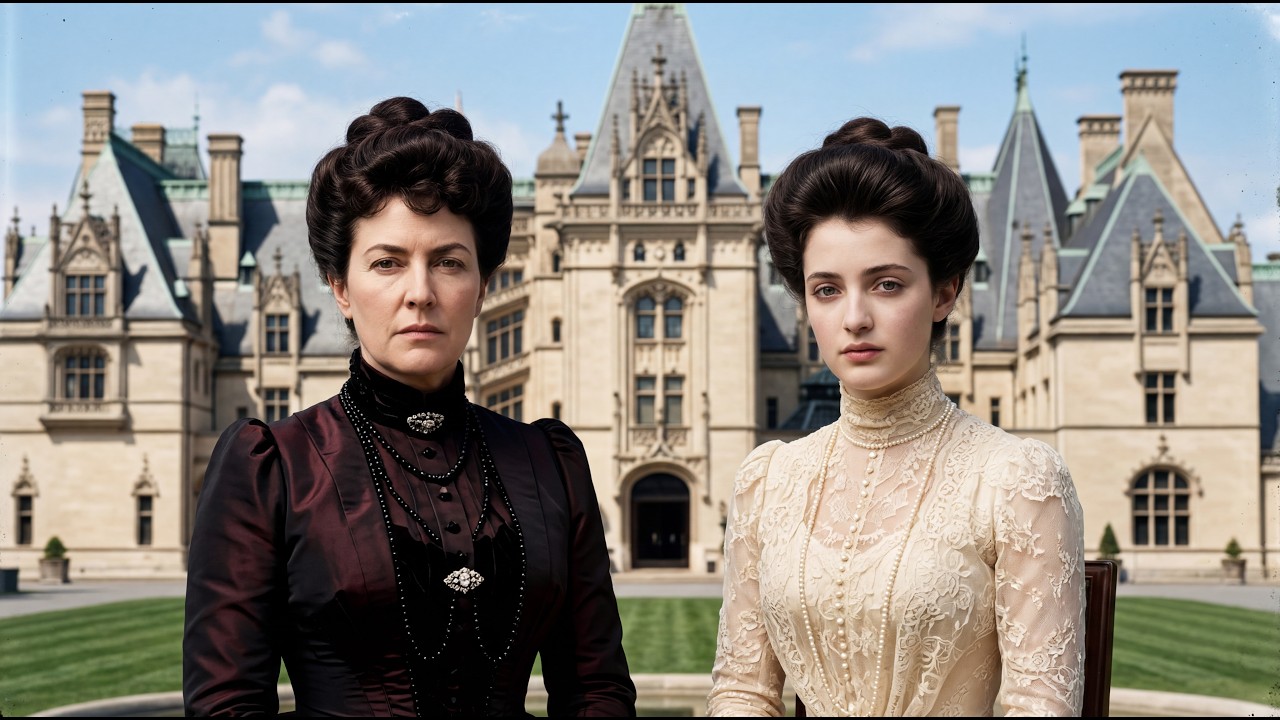
” A December 1925 letter from Cansuel to her friend Lucy J, later submitted as part of the anulment proceedings described how Alva’s supposed heart condition had been presented to her as reason enough to abandon all resistance. Canuelo wrote that she believed this completely at the time. The memoir’s most dramatic details, the locked room, the specific threats, the weeping too severe for the ceremony to begin on schedule, rest on Cansuel’s account alone.
Written when she was a woman in her 70s, looking back on events from before she was 20. Readers of the 1953 edition, which runs to 290 pages, describe her as an unsnobbish but often amused observer. Language that suggests someone who processed her ordeal into ry distance rather than permanent damage. That’s not nothing, but it’s important to hold the epistemic line.
These details are hers, not independently verified by press coverage from 1895. What is verified? Winthre Rutherford remained a bachelor until the age of 40. He married Alice Morton in 1902, the fourth daughter of former vice president Levi Parsons Morton. He died on March 19th, 1944 in Aken, South Carolina after a long period of failing health.
In 1926, when the enulment was announced, the New York Times reported that Canuelo, when 17 and in love with an American named Rutherford, had been forced by her mother to give him up to marry the Duke. The procession from 665th Avenue to St. Thomas Church on November 6th, 1895 drew crowds large enough to require control. St.
Thomas was then a Gothic revival structure completed in 1870. The current church on the same site wasn’t built until 1913 after the original burned in 1905. New York papers ran the wedding across multiple pages. By Consuelo’s own account in the memoir, she had wept so hard before the ceremony that her face was swollen behind her veil.
Canuelo took up residence at Blenhan Palace, Woodstock, Oxfordshire. Built between 1705 and 1722, designed in the English Baroque style by Sir John Van Bru, the largest house in England and purpose-built as a national monument rather than a home. She was 19. She was the ninth Duchess of Marlboro. She learned the hierarchies of Blenhum, the rhythms of the English political season, the expectations of a political wife.
Her husband was appointed paymaster general in 1899 and under secretary of state for the colonies in 1903. She was present, visible, and useful. She was adored by the estates poorer tenants whom she visited regularly and helped with practical assistance. She organized charitable work during the second boar war as part of the American hospital ship main fund alongside other American-born aristocratic wives including Mary Stevens Padet and Mary Endeott Chamberlain.
In 1897 she gave birth to John Albert Edward Spencer Churchill later the 10th Duke of Marlboroough godson of King Edward IIIth. Lord Ivor Charles Spencer Churchill followed in 1898. Giovani Baldini’s portrait of Consuelo with Ivor, painted in 1906, now hangs in the Metropolitan Museum of Art.
Winston Churchill appears in photographs with Consuelo at Blenhum in 1902. She was his hostess, his cousin’s wife, by all accounts, a social success in circles that had not been born expecting to accept her. Wikipedia describes the marriage as a well-known example of the advantageous but loveless marriages common during the guilded age.
By the early 1900s, the Duke and Duchess were no longer living as a couple. Consuelo, by some accounts, had reconnected briefly with Rutherford and subsequently entered into other relationships. The Duke had fallen for Glattis Deacon, an American of no money but considerable brilliance.
They formally separated in 1906. Civil divorce was finalized in England in 1921. That same year, Consuelo married Jacqu Balsson, a French aviator born in 1868, a pioneer in aeronautics in a civil ceremony in France. The Duke married Glattis Deacon the same year. She was 44. She had been a duchess for 26 years. She was done being a duchess.
The Catholic anulment came 5 years after the civil divorce. Consuelo was the plaintiff, confirmed by the New York Times on November 14th, 1926. The Duke, having converted to Catholicism, also wanted the church’s recognition, but the case was Consuelos to make. The canonical ground was what canon law called grave fear externally imposed coercion that had invalidated her free consent at the time of marriage.
A November 1926 article in the Catholic Telegraph noted that Jacqu Balsong was himself a Catholic making the enolment necessary to regularize their union. The local tribunal in Southwork, England, returned a favorable verdict in early 1926. The Holy Roa, the Vatican’s senior appellet court, confirmed the anulment in July of that year.
On November 13th, 1926, the New York Times ran the headline, “Moral Burrow gets marriage anolled by Catholic court, Vatican.” 12 days later, a second Times headline. Mother threatened death. Winthrop Rutherford was named in the coverage. Time magazine reported that the sacred roa had published the testimony it swore it received before anolulling the marriage of Consuelo.
Protestant commentators called the anulment a legal fiction. The Vatican confirmed it anyway. Alva testified. According to published accounts of the proceedings cited by Southampton History Museum, multiple secondary historians and Time magazine’s own 1933 obituary of Alva. Her statement was direct as reported across these sources drawing from the tribunal record.
She told the court that she had forced her daughter to marry the Duke, that she had always held absolute power over her daughter, and that when she issued an order, no one discussed it. She gave this testimony by most accounts without apparent embarrassment. Time magazine’s 1933 obituary of Alva Belmont noted that she had frankly admitted coercion.
The Rhode Island Heritage Hall of Fame records that she testified that she had forced Consuelo into the marriage. The year was 1926. The wedding had been 1895, 31 years, and then she said the truest thing she ever said about any of it under oath in a Roman courtroom to a Catholic tribunal and apparently without flinching.
The daughter had already left the palace. The mother had already moved to France. And now the mother had confirmed everything. What happens next is where the comfortable narrative collapses. Oliver Belmont died in 1908 of complications from an appendecttomy. He was 50. Alva was 55 and now one of the wealthiest women in the United States.
She had inherited his fortune of approximately $10 million plus several estates in addition to Marble House in Newport, which she had owned outright since 1892 and a $100,000 annual alimony payment from Willie Kay. She spent the rest of her life fighting for women’s rights. In 1909, she joined the National American Woman Suffrage Association, attended lectures by suffragist Ida Houston Harper, and funded the organization’s relocation from Warren, Ohio to New York, paying 2 years rent for its new offices. She opened Marble House that same year for a major suffrage symposium with herself as the headlining speaker and formed the political equality league which backed pro-suffrage candidates for New York State office and established 11
suffrage settlement houses across New York City including the first attempt to integrate the infranchisement movement in New York by funding a black women’s branch in partnership with community leaders. including Sarah JS Garnet and Francis Reynolds Kaiser. In 1912, she led the PEL’s division of the Women’s Vote Parade through 50 blocks of Manhattan, which reporter Marie Manning credited as a turning point for political interest in the suffrage movement.
By 1914, she had joined the more militant Congressional Union, founded by Alice Paul. In 1916, she and Paul co-founded the National Women’s Party with Lucy Burns. In February of that year, she co-wrote and performed a suffrage opereta called Melinda and Her Sisters at the Walddorf Histori Hotel. The fundraiser netted $8,000 in donations.
She financed the first ever picketing of the White House in January 1917. She was elected NWP president and held that office until her death. She bought the organization its permanent headquarters in Washington DC, a building on Constitution Avenue that now stands as the Belmont Paul Women’s Equality National Monument named for both of them by President Barack Obama on Equal Payday 2016.
The Library of Congress describes her as the most important financial benefactor among the leaders of the Congressional Union for Women’s Suffrage and its successor, the National Women’s Party. In her will, she left $100,000 to the NWP. The total she spent on suffrage across two decades has never been precisely calculated.
individual gifts were large enough that when she eventually began reducing her contributions, the NWP’s finances showed it. Sylvia Haofert’s biography argues that Alva was a feminist visionary and that her financial support was crucial to the success of the suffrage and equal rights movements.
Haford also observes that Alva’s defining personality trait, a resolve to get her own way regardless of consequences, was the same engine that drove her suffragism. It wasn’t a conversion. It was a redirection. The woman who had used social architecture to force a gate open in 1883 simply applied the same force to a different structure after 1908.
This is where every verdict runs a ground. Alva Vanderbilt had trapped her daughter in precisely the marriage system that suffragism was built to dismantle. She coerced a free woman into a contractual union for money and status. And then she spent decades and a significant portion of her fortune attacking the social conditions that made such coercion normal and legal.
Neither Stuart nor Hafort fully resolves this contradiction. Both scholars having spent the most time with the primary sources arrive at the same place. A woman whose self-standing was always, as Hawford writes, fragmentaryary. Alva appears to have believed simultaneously that what she did to Consuelo was necessary, the best available move in a world structured against women, and that the world structured against women was unjust and had to change.
Both things were true for her. They just applied to different women in different decades with different consequences. On January 26th, 1933, Alva Vanderbilt Belmont died in Paris. She had suffered a paralytic stroke several months earlier. She was 80. Her body was returned to New York. All of her pawbearers were women. Her casket was draped with a banner bearing Susan B.
Anony’s words, “Failure is impossible.” The funeral service was held at St. Thomas Episcopal Church on Fifth Avenue, the same street where Consuelo had been walked to the altar 38 years before in a church that had burned and been rebuilt since then, which seems about right. Consuel Vanderbilt Balsson died on December 6th, 1964 in Southampton, New York at 87.
She had lived in France before the Second World War, moved with Balsson to the United States when France fell, and published The Glitter and the Gold in 1953, a memoir that is careful, literate, dry in places, devastating in others, and available in the internet archive if you want to read the source for yourself.
She asked in her will to be buried at St. Martin’s Church in Bladen, Oxfordshire, the parish church for Blenhan Palace. She had left the marriage, left the country, outlived the Duke and the mother both, and chose to be buried within sight of the palace. That choice belongs to her. The memoir doesn’t explain it. No one else can.
Alva Vanderbilt got everything she wanted. The daughter became a duchess. Blenham was saved with Vanderbilt money. The old families who had refused to receive her were receiving her by the end. And 31 years after the wedding, in a Vatican courtroom, she said the truest thing she ever said about any of it.
The daughter survived. She left. The mother spent the rest of her fortune on women’s rights. Make of that what you will. The audience already is. If stories like this are what brought you here, subscribe and leave your verdict in the comments.