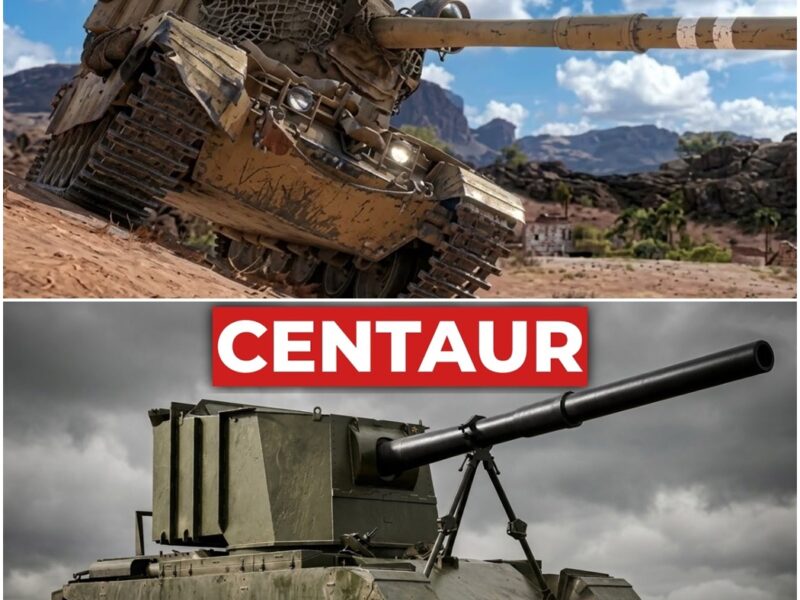
The ‘Absurd’ British Tank With A Cannon So Large One Shell Could Destroy Any Soviet Tank Ever Built D
September 7, 1945. Charlottenber Strasa, Berlin. The war in Europe had been over for four months. American, British, French, and Soviet commanders stood together on a reviewing platform to watch the Allied Victory Parade. They had already watched their own armor roll past. Shermans, Comets, M26s.
The parade appeared to be winding down. Then the Soviets sent their armor through. 52 brand new heavy tanks ground down the boulevard in perfect formation. Western commanders had never seen anything like them. The hull sloped away at the front in a sharp angular pike, angled so steeply that shells would glance off rather than penetrate.
The turret was a smooth semi-hemismhpherical dome of cast steel rounded to defeat any round that struck it. The frontal armor on that pike measured 110 mm thick, but because of its extreme slope, it was effectively far thicker than that. It carried a 122 mm gun capable of destroying any Western tank at combat range.
The vehicle was called the IS-3. It weighed 45.8 8 tons and it was by any measure Britain or America possessed. Practically immune to anything NATO had in service. That was the moment the problem was born and its name eventually was the FV4005. The British Army’s best tank gun at the time was the 84mm 20 pounder.
Technical data showed its armor-piercing discarding Sabot round could penetrate 330 mm of vertical steel plate at 1,000 yd against the angled pike nose of the IS-3. That figure collapsed to somewhere around 174 millimeters. A first strike kill at combat range was not guaranteed. It was not even probable.
The Soviets were not finished. In 1946, they introduced the IS-4, a heavier vehicle with frontal hull armor up to 160 mm thick and a turret face approaching 250 mm. Then in 1953, the T10 arrived, weighing 52 tons, protected by over 200 mm of shaped steel on its turret, producing somewhere between 1,400 and 2500 examples, depending on which Soviet archive is referenced.
NATO’s armies looked at these vehicles and understood that their existing guns could not reliably kill them at the ranges war in Germany would demand. To understand why the F4005 existed, you need to understand the requirement that created it. Major General Stuart Rollins, Director General of artillery at the War Office, set the threshold in 1950.
Britain needed a gun capable of defeating 152 mm of armor plate sloped at 60° at a range of 2,000 yd. He was not asking for a marginal improvement. He was asking for something that had never been built. At that requirement, no conventional armor-piercing shell was reliable enough.
The slope defeated everything. There was only one physics-based alternative. High explosive squash head or HSH does not need to punch through armor. The round detonates on contact, pressing a disc of plastic explosive against the steel surface for a fraction of a second before the fuse fires. The shock wave transmits directly into the plate, shearing off a mass of high velocity fragments from the interface.
The crew inside are killed by their own tank. Slope is largely irrelevant. A big enough HSH round fired at any angle will produce a catastrophic kill on any vehicle ever built. The question was how big? 183 mm. 7.2 in. That was the answer. The caliber was chosen because Britain already had a mature 7.2 in Hesh shell.
The wartime British artillery family at that caliber had proven its lethality throughout the war in Europe. Adapting the shell to a tank gun was faster and cheaper than developing a new caliber from zero. The gun was designated the Ordinance quick firing 183 mm, tank L4. The complete two-piece round weighed 97 kg.
The projectile alone, the part that actually struck the target, weighed 65.8 kg. To load it, a crew member first rammed in the projectile. A second crew member then rammed the propellant case. The complete round was 1 1/2 m long. That is taller than many of the men who would have fired it. The muzzle velocity was 762 m/s. The gun weighed 4 tons.
When it fired, the recoil force transmitted into the vehicle was approximately 87 tons. For reference, 87 tons is heavier than the entire vehicle it sat in. The requirement was issued in November 1950. The Ministry of Supply called for a stop gap solution on an existing hull.
To fill the gap, while a purpose-built heavy tank destroyer, the FV215, was developed. The stop gap was the FV40005. Vicers Armstrongs at their Elswick plant in Newcastle began work in what they called workshop 5, the secret shed. They chose the Centurion Mark III as the hull. It was already in production, mechanically reliable, and rated at 50 tons.
No other available British hull could absorb a recoil of 87 tons without structural failure. Three prototypes were ordered, one stage one and two stage two. The stage one was an open platform. No roof, no armored enclosure. A mechanical loading assist system held five rounds on a carousel. Trials at Vicar’s own proof range at Ridsdale in Northland began in April 1952.
The results were extraordinary, and not in a positive sense. Without a recoil spade bolted to the rear hull before firing, a single shot lifted the front of the 50-ton vehicle 17 in into the air and dropped the rear 10 in. Sideways fire shoved the entire vehicle 2 in to the side on a flat surface.
Repeated firing sheared internal components. The concentric recoil mechanism proved unreliable. By June 1953, the stage 1 was judged too dangerous and too impractical for further development. The stage 2 was a completely different machine. It was the largest, tallest armored vehicle Britain had ever built at 3.6 m high.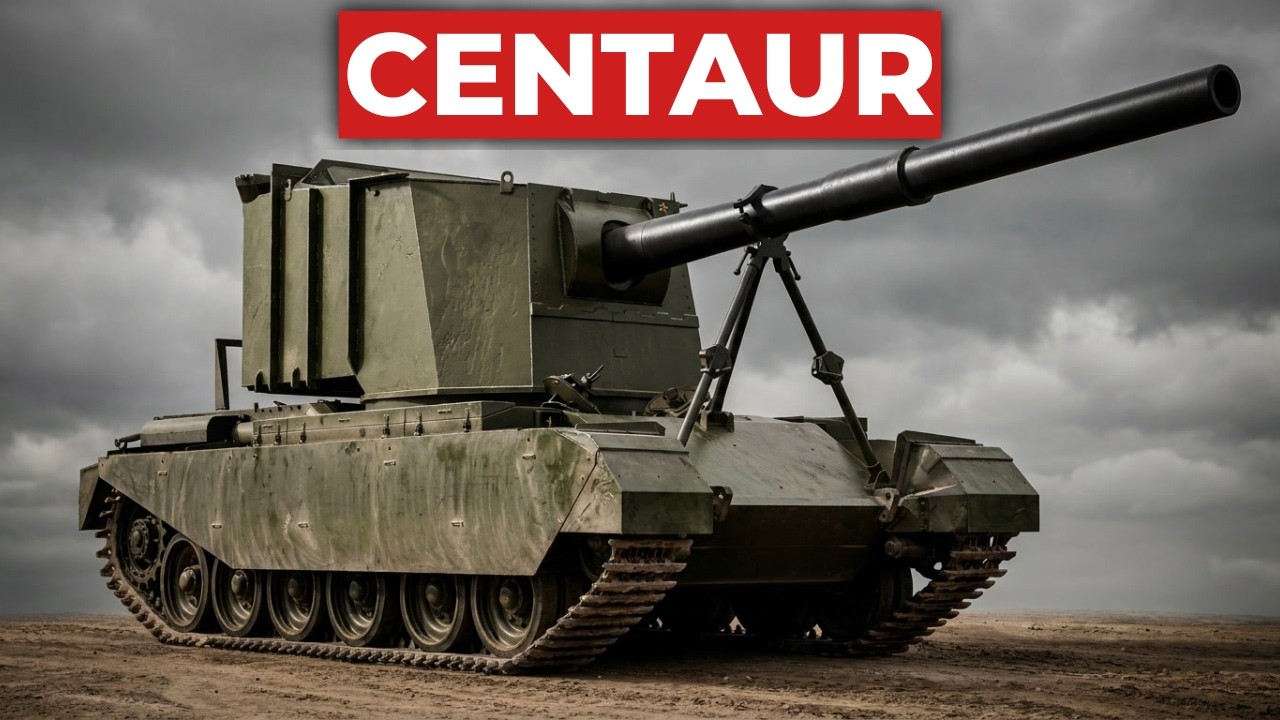
Its turret was a massive square box of welded steel. The armor on that turret was 14 mm thick, enough to stop shell splinters and nothing else. A heavy machine gun would penetrate it, but armor was not the point. Speed of displacement was. The FV4005 was conceived as a tank destroyer that would fire and immediately move.
It would never be expected to take a hit. Inside the turret, the autoloader was gone. Two human loaders worked in its place, one for the projectile and one for the propellant case. The gun was now mounted on conventional hydronneumatic recoil cylinders. above the barrel rather than the unreliable concentric system.
A rail and winch ran along the engine deck to pull fresh rounds from a supply truck parked directly behind. 12 rounds were stowed internally. A crew of five operated the vehicle, commander, gunner, two loaders, and driver. Firing trials for the stage 2 took place in 1955 and March 1956. 32 shots were fired with mannequins in the crew positions at 0° elevation.
The front of the vehicle lifted 22 cm and the rear rose 12 cm with each shot. The worst oscillation was at 3° elevation where the front lifted 27 cm. The Ministry of Supplies formal assessment in the 1955 armored fighting vehicle development liaison report recorded that general functioning had proved satisfactory.
What the gun did to test targets was not satisfactory. It was terminal. A single 183 mm HSH round fired at a Centurion target blew its turret clean off the hull. A Conqueror heavy tank fitted with extra bolted on spaced armor on the bow and turret cheeks to simulate upgrades. Had its turret cracked and its gun mantle split in two by a single round.
The requirement was met at any range against any angle. Against any Soviet armored vehicle that existed or was planned, it did not matter. The FV4005 was cancelled in August 1957. Now, before we get into why, if you are following this deep dive into British Cold War engineering, hit subscribe. It takes a second, costs nothing, and helps the channel grow.
Five reasons killed the FV4005, and none of them were about the gun’s raw power. First, accuracy. A 762 m/s muzzle velocity is relatively low for a gun of this size. At 2,000 meters, crosswind drift and shell dispersion made reliable first round hits against moving Soviet armor in European conditions extremely questionable.
Second, rate of fire, two rounds per minute. The original requirement had been six rounds per minute, which would have demanded an autoloader that was never successfully developed at this caliber. Against a formation of Soviet heavy tanks, two rounds per minute was dangerously slow. Third, survivability.
14 mm of turret armor. The FE4005 could be killed by an enemy heavy machine gun before it fired a single round. A vehicle that has to expose itself at 2,000 meters range with 14 millimeter protection was asking its crew to die. Fourth, the threat changed. British and American intelligence had drastically overestimated Soviet heavy tank production numbers.
The armies of the Warsaw Pact were pivoting to the T-54 and T-55, faster medium tanks that demanded an entirely different kind of counter rather than an extreme range heavy tank destroyer. The IS- series and the T10 were becoming a diminishing fraction of Soviet armor. Fifth and most decisive, the Malcara missile arrived.
The Malcara was a joint British and Australian anti-tankg guided missile that entered British service in 1958. It carried a Hesh warhead containing 15.9 kg of explosive delivered at approximately 250 m/s to a maximum range of 4,000 m, double the effective range of the FV4005. It could be guided to the target by a single operator.
It was carried on a wheeled 4×4 vehicle that could be air dropped. The FV 40005 was a 50-tonon tracked vehicle requiring five crew and a resupply truck parked behind it. The Malcara remains to this day the largest warhead anti-tank missile ever fielded by any army. Britain chose the missile. The F4005 was officially terminated.
On paper, the American answer to Soviet heavy armor. The M103 heavy tank fielded a 120 mm gun and weighed 58 tons. It entered service in 1957 and served the United States Marine Corps until 1974. Its gun was capable and its armor was credible. The British answer, the Conqueror, the FV214, also mounted a 120 mm gun and was produced in 185 examples.
Both were the production solutions that the FV4005 was bridging toward. Neither, however, mounted a gun remotely approaching 183 mm. No nation before or since has mounted a direct fire conventional gun of greater caliber on a tank chassis and actually fired it in trials. The FV4005 holds a record it never sought and never needed because it never entered service.
Three prototypes were built. One stage 1, two, stage two, one stage two turret survived. It came to the tank museum in Bovington Dorset in 1970. Donated from the Royal Military College of Science at Shivvenham. For roughly 30 years, it sat in the museum car park, a massive steel shed with no vehicle beneath it, unknown to most visitors.
In 2007, it was mounted on a Centurion hull and positioned as a gate guardian. A veteran volunteer at the museum workshop. Harold Hamilton Taylor, who had been part of the original FV4005 trials team decades earlier, gave it a nickname. He called it Spud. The name is still painted on the turret today. In 2023, the Tank Museum launched a fundraising campaign to restore Spud to running order. The target was £20,000.
Supporters raised it in 24 hours. The video game World of Tanks matched it. Restorer AW Hughes of Market Harbor took the turret off, had it sandblasted, fabricated missing components from original drawings, and mounted the complete vehicle on a correct Centurion Mark III hull for the first time since the original trials.
On June 28th, 2024, the F4005 drove laps of the arena at Tankfest, 67 years after the Ministry of Defense canceled it. Return now to Charlottenburg Estrasa. September 1945 52 IS-3 heavy tanks grinding past Western commanders who had no answer to them. The FV4005 was never elegant. Its turret armor could not stop a heavy machine gun.
Its rate of fire was two rounds per minute. It was 3.6 6 m tall on a battlefield where height meant death. Its accuracy at design range was marginal. Its crew compartment smelled of cordite and fear and 67 kg shells that had to be manhandled into a breach the size of a domestic washing machine.
And yet, in every single test it was ever asked to pass, it passed. Against a Centurion, it blew the turret off. Against a conqueror with additional armor, it split the mantlet in two. against the paper armor of every IS-3, IS-4, and T10 that Soviet factories ever produced. Its single HSH round was, in the words of the requirement, it was built to satisfy a kill regardless of the position of the point of strike.
It never fired a shot in anger. It never faced a Soviet tank. The war it was designed to fight never came. That is not failure. That is British engineering solving a problem so completely that the problem itself became unnecessary. The gun still exists. The turret still turns. Spud still drives.