The ‘American’ Truck Britain Turned Into The Ghost Patrol That Burned Rommel’s Airfields D
Alexandria, Egypt. The summer of 1940, an officer of the Royal Signals walked into a Chevrolet dealership on the waterfront and asked to buy trucks. Not military trucks, civilian trucks. The kind of farmer in Ohio would haul cabbages in. The salesman thought he had misunderstood. The officer had not.
Britain was at war with Italy. The Italians held Libya. And the man buying the trucks, Major Ralph Bagnold, was about to take those civilian American vehicles, strip them down to the frame, and use them to burn so many aircraft on RML’s airfields that the Italians would name his patrols Petulia Fantasma, the Ghost Patrol.
2 years and 3 months later, 12 of those same trucks would tear out of the Libyan darkness at midnight, smash through an Italian tanket roadblock at the top of an escarment, and drive directly onto a Luftwafa airfield with their machine guns already firing. They had driven 1,155 mi to get there. They would drive the same distance home, fighting off stookers for an entire day.
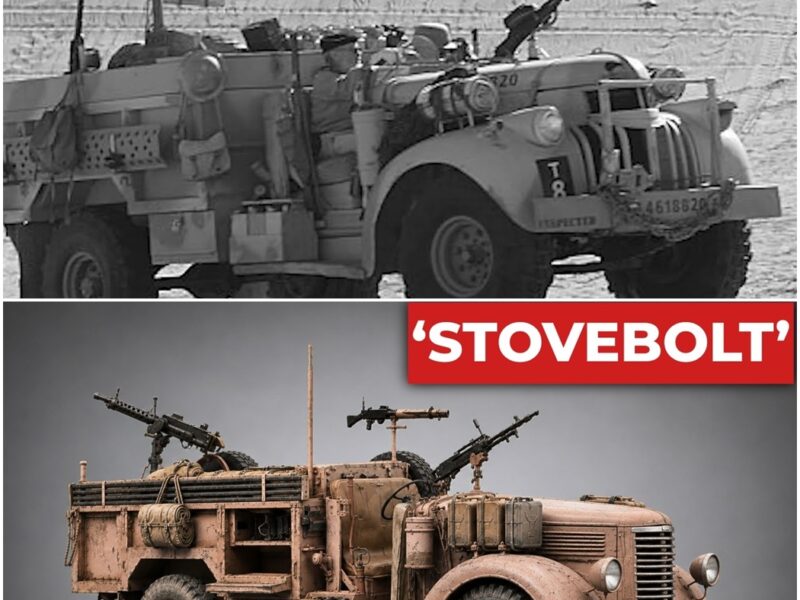
The truck was never meant to be a weapon. The truck Banold bought was the Chevrolet WB 3000 weight. A 1940 model year, 1 1/2 ton commercial chassis, 85 horsepower, two-w wheelel drive. By any reasonable military assessment, it was the wrong vehicle for the job. Within 2 years, it would be the platform on which a 350man unit destroyed more enemy aircraft on the ground than the Desert Air Force shot down in the air.
This is how Britain turned an American showroom truck into the longest ranged raiding vehicle of the Second World War. In June 1940, the British position in North Africa looked impossible. Italy had just declared war. Marshall Gratzani held Libya with a quarter of a million men. The inner Sahara, the vast empty quarter south of the coast road, was considered impassible by motor vehicle.
Bagnel disagreed. Before the war, he had spent 10 years driving across the Libyan desert as a private explorer. He had won the Royal Geographical Society Gold Medal in 1934 for the first east to west crossing of the great sand seas. And he had invented two pieces of equipment that no army possessed, the sun compass and the radiator condenser.
He proposed to General Sir Archerald Wavevel a unit of motorized patrols that would live in the desert for weeks at a time, ranging a thousand miles behind Italian lines. Wavvel asked him what he would do if he found nothing. Piracy on the high desert, Banold answered. Wavvel approved the unit within 4 days.
The problem was the vehicle. The standard British Army truck overheated, drank fuel, and was nose heavy. Bagnold looked instead at the American commercial vehicles already on the streets of Cairo. The Chevrolet WB was fast for a truck of its class. The engine was the 216.5 in stovebolt inline 6. Spares were abundant in every Egyptian garage.
According to LRDG historian Gavin Mortimer, Bagnold chose the Chevrolet because it was fast, simple, and easy to handle. He bought roughly 35 of them from dealerships with army money. Then he took them apart. In workshops outside Cairo, British and Egyptian fitters performed surgery on the new trucks.
The doors came off, the windscreen came off, the cab roof came off. What remained was a flat firewall, a steering wheel, and a small flipup screen for the driver. The radiator grill bars were cut out for air flow. Then came the modifications no civilian truck had ever carried. The condenser system was Banold’s pre-war invention.
A two gallon can was welded to the front fender and connected to the radiator overflow. When the engine boiled, the steam was captured. When the engine cooled, the condensed water was sucked back through a one-way valve. The result was a truck that could cross hundreds of miles of hard desert without refilling its radiator.
No German vehicle in North Africa could do the same. The springs were rebuilt with extra leaves to handle a warloaded weight of nearly 4 tons, twice the civilian rating. Sand tires were fitted at low pressure to float across soft sand. Down each side of the bed were strapped steel sand channels. When a truck bogged, the crew dug, slid the channels under the tires, drove forward a few feet, and repeated.
A long crossing could mean doing this 50 times in a day. Where the dashboard had been, Bagnold’s sun compass was mounted. A horizontal disc with a central pin that cast a shadow against a graduated card. A magnetic compass is useless inside a metal truck full of weapons. The sun compass gave bearings accurate to a fraction of a degree as long as the sun was visible.
Now, the truck needed teeth. The Vicar’s K machine gun was an obsolete RAF observer’s weapon designed in the early 1930s for the dorsal turrets of ferry battle and Bristol Blenheim bombers. By 1941, the RAF had switched to beltfed Brownings and large stocks of Vicar’s Ks were withdrawn to storage. The LRDG drew them out.
By accident, the gun was almost perfectly designed for desert raiding. Gas operated, top fed from a flat 96 round pan magazine, cyclic rate adjustable between 950 and 1,200 rounds per minute, mounted in pairs on the rear pintle of a stripped Chevrolet. A patrol truck could deliver a combined cyclic rate approaching 2,400 rounds per minute of incendry and tracer.
The heavier weapon was the boy’s anti-tank rifle, a bolt-action 0.55 inch caliber monster firing a 60 gram armor-piercing bullet at 747 m/s. It could penetrate 23.2 mm of armor at 100 yd. Against German medium tanks, by 1942, it was obsolete. Against a parked Yners fuel cell or an Italian tanket on a darkened airfield, it was murderously effective.
One truck per patrol also carried a 37 mm bow force anti-tank gun. Later patrols replaced it with the captured 20mm breeder. A single LRDG truck carried more concentrated firepower than a German motorized infantry squad. Now the question was whether stripped down civilian trucks navigated by a homemade sun compass crewed by New Zealand farmers could actually get this firepower to within bombthrowing distance of RML’s air force.
Now, before we see how this performed on RML’s airfields, if you are enjoying this deep dive into British engineering and small unit warfare, hit subscribe. It takes a second and it genuinely helps the channel grow. Let us see what happened when these trucks finally reached the enemy.
The weapon that actually killed the aircraft was none of these. It was something left tenant Jock Lewis of the newly formed SAS invented in a tent at Cabrit in the autumn of 1941. the Lewis bomb, a canvas bag containing roughly one pound of plastic explosive, a quarter pound of thermite, a measure of diesel oil, and a handful of steel filings.
A time pencil detonator typically set for 30 minutes. The plastic explosive ripped the wing apart. The thermite ignited fragments hot enough to melt aluminium. The diesel oil sustained the fire long enough to set off the aircraft’s own fuel tanks. Placed accurately on the wing route, a single Lewis bomb destroyed a Yners as completely as a 250lb bomb dropped from a Wellington.
The first raid came on the night of December 14th, 1941. Three SAS sticks were driven by LRDG patrols to within walking distance of three coastal airfields. Patty Mine and seven men hit Tamt. They burst into the officer’s mess where the German and Italian pilots were drinking, gunned down some 30 men where they sat, then walked the dispersal line, planting Lewis bombs on the wing routts.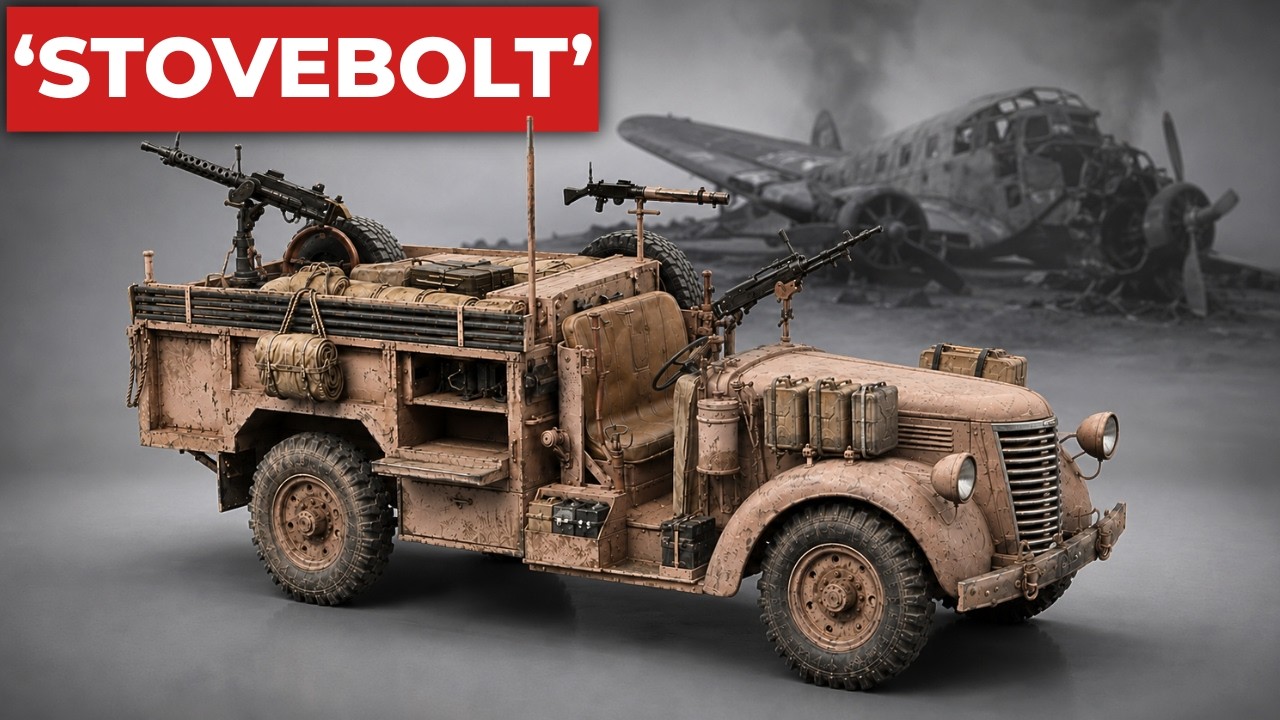
When Maine ran out of bombs, his afteraction report says he climbed into the cockpits and tore the instrument panels out with his bare hands. 10 days later, on Christmas Eve, he came back to Tamt and did it again. 27 more aircraft destroyed. The same night, Maine first hit Tamt, Lieutenant Bill Fraser, and five men hit the airfield at Agadabia.
eight CR42s, five Fiat G50s, six Matchy C200s, two Caproni reconnaissance machines. The combined December tally was around 61 aircraft destroyed on the ground in 2 weeks. The Desert Air Force flying every fighter and bomber it had could not match that rate from the air. On the withdrawal from Nefilia on December 30, an LRDG truck carrying Jock Lewis was strafed by a BF-110.
The inventor of the bomb that made the raids possible was killed. Sterling later said that Jot could far more genuinely claim to be founder of the SAS than I. For the next eight months, the LRDG was the SAS’s taxi. The men called it the Libyan Desert Taxi Service. Then the SAS got its own jeeps and went its own way, and the LRDG mounted its single greatest operation, 1,155 mi from base, Operation Caravan.
The attack on the airfield at Bas deep in eastern Libya. September 13, 1942. Major Jake Een Smith commanded B squadron, 47 men, 12 Chevrolet 3000 weightight trucks, five jeeps. They left Fume on September 1st and drove for 11 nights across the Kalancho sand sea. Just before midnight on the 13th, they topped the escarment above Bass and ran head first into an Italian roadblock manned by two L3 tankets.
The lead jeep’s twin vicar’s K’s opened up first. Tracer arked into the tankets at point blank range. The column did not slow down. They drove straight through and the trucks rolled into the sleeping town with their guns already firing. Captain Nick Wilder’s New Zealanders peeled off to the airfield.
The guards patrol drove onto the barracks in the railway station. Een Smith with two jeeps cruised the streets shooting at anything in uniform. On the airfield, Wilder’s trucks drove down the dispersal lines while gunners poured Vicar’s KF fire into parked Ctz 107 motor bombers and Caproni reconnaissance aircraft.
Bombs went on the bigger machines. The LRDG claimed 32 to 35 aircraft destroyed. Italian records, more reliably, give 16 destroyed and seven damaged. Even at the lower figure, it was a catastrophe for a forward access airfield. The price came on the way home. Italian fighters caught the patrol in the open from midm morning to dusk on September 14th.
CR42s, BF 109s, Stookers. 14 vehicles were lost, 10 men were captured. By the time the survivors limped back to base, they had completed a round trip of roughly 2,300 mi behind enemy lines. It is the longest deep penetration raid by ground troops in 20th century warfare. This is where the comparison becomes uncomfortable for the Axis.
The Volkswagen Cubal Vargon, the German Africa Cors standard light vehicle, could not have left a brook and reached the Kufra Oasis on a single tank. The Cry Protzer, the German light truck, consumed 24 L per 100 km. By 1942, it was considered obsolete. None of the Axis light vehicles had condenser cooling.
None of them had been designed by an officer who had spent 10 years driving across the same sand they were trying to fight on. In honest historical terms, the Axis answer existed, and it was Italian. The company Auto Saharian had been operating motorized desert patrols since 1923, 15 years before the LRDG.
In 1942, the Italians produced the SPA Viberti AS 42 Saharana, specifically designed to hunt the LRDG. Only about 140 were built before Allied bombing crippled the Turin factory. They were excellent vehicles. They were not enough. The most quoted line about the LRDG is RMLS. The longrange desert group caused us more damage than any other British unit of equal strength.
It is the line that built the legend in the English-speaking world. The honest answer about that quote is more complicated. It appears in Beach Little Hart’s edited volume, the RML papers, published in 1953. Little Hart’s editorial hand has been criticized by later scholars, including the political scientist John Musheimimer, who concluded that Little Hart was inclined to put words in the mouths of German generals.
The sentiment is firmly Romelian. A captured German document cited by Bagnold himself records that the LRDG plays an extremely important part in the enemy sabotage operation. But the precise English language formulation everyone quotes belongs to Little Hart’s edition. Not to a confirmed wartime entry in RML’s own hand.
The Italians who suffered more from the LRDG than anyone had given them their nickname 2 years earlier. As Bagnold wrote in 1945, “To the Italians, the raiders seem to appear from nowhere, as if from a fourth dimension, and to disappear as rapidly. The combined SAS and LRDG total of aircraft destroyed on the ground is widely reported as over 400.
Italian records where they survive confirm roughly half. The real number is probably between 200 and 300. Still, almost certainly more enemy aircraft destroyed on the ground than the Desert Air Force shot down in the air across the same period. One Chevrolet WB survives. In 1980, the LRDG Association recovered a stripped down patrol truck from the open Egyptian desert.
Truck number eight of W Patrol named Wikaha by trooper Clark Waitford. Major General David Lloyd Owen, the LRDG’s last wartime commander, presented it to the Imperial War Museum in London. It sits there today. Its paint scoured back to bare metal by 40 years of sun and sand. It is, as far as anyone can tell, the only original LRDG patrol vehicle in existence.
The truck Britain found in an Alexandria showroom and turned into a ghost patrol does not need to be repainted to be understood. It just needs to be seen for what it was. The most useful thing General Motors ever sold to a customer who took the doors