The ‘Awkward’ British Tank With the Only Gun That Could Kill a Panther at 1,000 Metres D
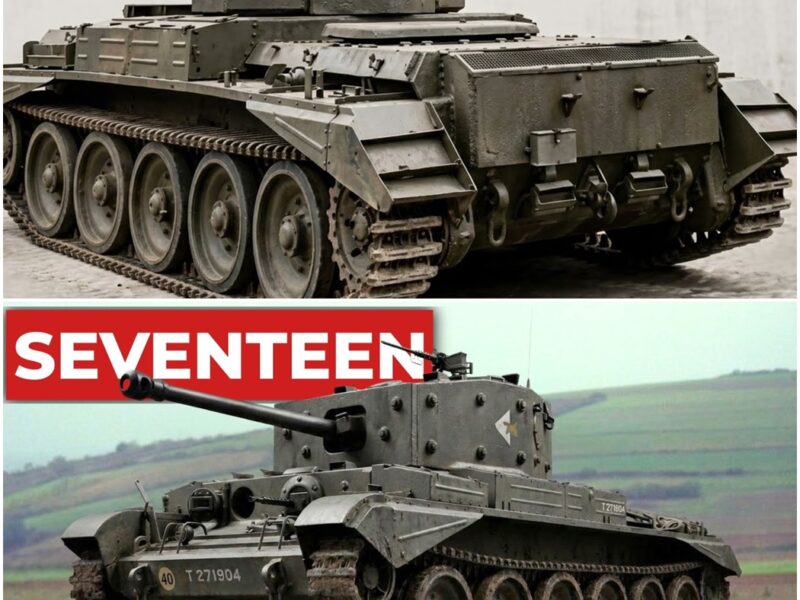
January 1943, the Lulworth Armoured Fighting Vehicle Gunnery School, Dorset, England. A new tank rolls onto the firing range. It moves like a Cromwell. It sounds like a Cromwell, but something is wrong. The hull is stretched longer than any cruiser the army has ever fielded, riding on six road wheels instead of five, and sitting on top of that elongated chassis is a turret so tall and so narrow that it looks like someone bolted a church steeple onto a racing car.
Officers watching from the observation point exchange glances. The Chief Inspector of Gunnery will later describe the entire project as a pointless waste of effort. He’s not entirely wrong about the appearance, but he is catastrophically wrong about the gun, because inside that absurd turret sits a 17-pounder anti-tank gun, the most powerful anti-tank weapon any Allied nation will field in the Second World War, and this strange top-heavy machine is the only British cruiser tank that can carry it.
Within 18 months, vehicles exactly like this one will be the only tanks in entire British armored regiments capable of killing a Panther or a Tiger from the front at combat range. Every other cruiser tank in the formation will depend on it. Every troop commander who faces German heavy armor will call for it by name.
Its designation was the A30 Tank Cruiser Challenger. It was the ugliest answer to the most dangerous question of the war, and without it, British armored divisions would have entered Normandy with nothing that could punch through a Panther’s glacis plate. To understand why the Challenger existed, you need to understand the problem Britain faced in 1942.
The German Tiger heavy tank had entered service on the Eastern Front. Reports filtering back to London described a vehicle with frontal armor so thick that nothing in the British arsenal could penetrate it at normal combat ranges. The Panther medium tank was coming next, and intelligence suggested its sloped glacis plate would be even harder to defeat.
Britain’s standard cruiser tank, the Cromwell, carried a 75-mm gun that could not penetrate either vehicle from the front at any range. The 6-pounder could manage it only at suicidally close distances, the entire British armored force was about to become obsolete against the newest German armor. Britain did have a weapon that could solve the problem.
The Ordnance QF 17-pounder fired a 7.62 cm armor-piercing round at velocities high enough to punch through approximately 150 mm of armor at 1,000 m. With the new tungsten-cored APDS discarding sabot round, that figure climbed past 200 mm, enough to defeat a Panther frontally and threaten even a Tiger II.
No other Allied gun in production could match it. The problem was getting it onto a tank. The 17-pounder was enormous. Its breech was too long, its recoil too violent, and its ammunition too large for any existing British cruiser turret. The Cromwell’s turret ring measured 60 in. The 17-pounder needed at least 70. There was no shortcut, no clever mounting trick, no way to squeeze it in.
Roy Rubottom, the Rolls-Royce car division executive who sat on the tank board and had already driven the creation of the Meteor engine, proposed the most direct solution available. Take the Cromwell hull, add an extra road wheel, stretch it by nearly 2 ft, and build an entirely new turret large enough to house the gun, two loaders, and a commander.
Delete the hull machine gun to make room for the long 17-pounder ammunition. Accept thinner turret armor, 63 mm on the front and 40 on the sides, because the hull structure could not carry more weight without sacrificing the speed that made a cruiser tank a cruiser tank. The Birmingham Railway Carriage and Wagon Company received the production order.
Stothert and Pitt built the turret and gun mounting. The first prototype appeared in August of 1942, roughly 7 months into the program. It was immediately found to be flawed. A second prototype followed in January ’43 and fared only slightly better. A War Office report described the Challenger as a temporary and rapid means of putting a 17-pounder into Cromwell formations, adding that it was not considered suitable for mass production and was also too thin-skinned.
But the Tiger was real, the Panther was coming, and Britain had nothing else. 200 vehicles were ordered in February 1943. No further orders would follow. In November of that year, the decision was made to cap production at 200 so that the Birmingham Railway Carriage and Wagon Company could concentrate on building Cromwell’s.
A simpler solution had been found. And a Vickers engineer named W. G. K. Kilbourn had worked out how to mount the same 17-pounder into the turret of a Sherman tank. The result was the Sherman Firefly, and it would be built in numbers exceeding 2,000. The Challenger was already a dead end before the first production vehicle left the factory floor in March of 1944.
The vehicle itself weighed 31 and 1/2 long tons. Its Rolls-Royce Meteor engine, the same 600 horsepower petrol V12 that powered the Cromwell, gave it a top speed of 32 mph on roads. It carried 42 rounds of 17-pounder ammunition. Its turret offered 20° of elevation and 10° of depression, better than the Firefly’s 5°.
A genuine advantage in hold-down fighting. But the turret did not sit on a conventional ring. It rested on a large steel ball mount on the hull floor, leaving the turret base exposed and prone to jamming if struck. Four internal semi-automatic jacks were fitted to clear jams in the field. Crews discovered that traversing the turret while parked across a slope was nearly impossible. It stood 9 ft and 1 in tall.
That was actually shorter than a Sherman. But next to the low, sleek Cromwell it was supposed to fight alongside, it looked like a lighthouse parked in a column of sports cars. Now, before we get into where this vehicle actually fought and what happened when it met the armor it was designed to kill, if you’re enjoying this deep dive into British engineering, hit subscribe.
It takes a second, costs nothing, and helps this channel grow. The Challenger could not wade ashore. No deep wading equipment had been designed into the hull. A remarkable oversight for a tank that existed solely to support Cromwell formations in the coming invasion of France. On June the 6th, 1944, when Sherman Fireflies rolled off landing craft onto the beaches of Normandy, the Challenger sat in depots across southern England.
It would not reach France until harbors and Mulberry piers were operational in July. When the first Challengers arrived in August 1944, they were immediately pulled from service. The front idler wheels were smaller in diameter than the Cromwell’s. And under the stress of combat driving, the tracks kept throwing.
It was a fixable problem, solved by fitting standard Cromwell idlers, but it cost weeks of availability at exactly the moment when British armored divisions were breaking out of the bocage and beginning the pursuit across France. Once the tracks were sorted, the Challenger found its role. It was issued to the armored reconnaissance regiments of the Guards Armoured Division and the 11th Armoured Division and later to Cromwell units of the 7th Armoured Division.
The distribution was always the same, one Challenger to every troop of three Cromwell’s. The Cromwell’s carried the 75 mm gun, good for high explosive work against infantry, soft vehicles and buildings. The Challenger carried the 17-pounder. Its single job was to kill tanks that nothing else in the troop could touch.
Crews had complicated feelings about it. An official report from late 1944 recorded that after a period of unpopularity, mainly due to the idler trouble, the Challenger had become generally popular. One or two instances of the tank surviving direct hits from Panzerfaust rounds without fatal damage had given it a reputation for immunity that the report admitted was probably not justified.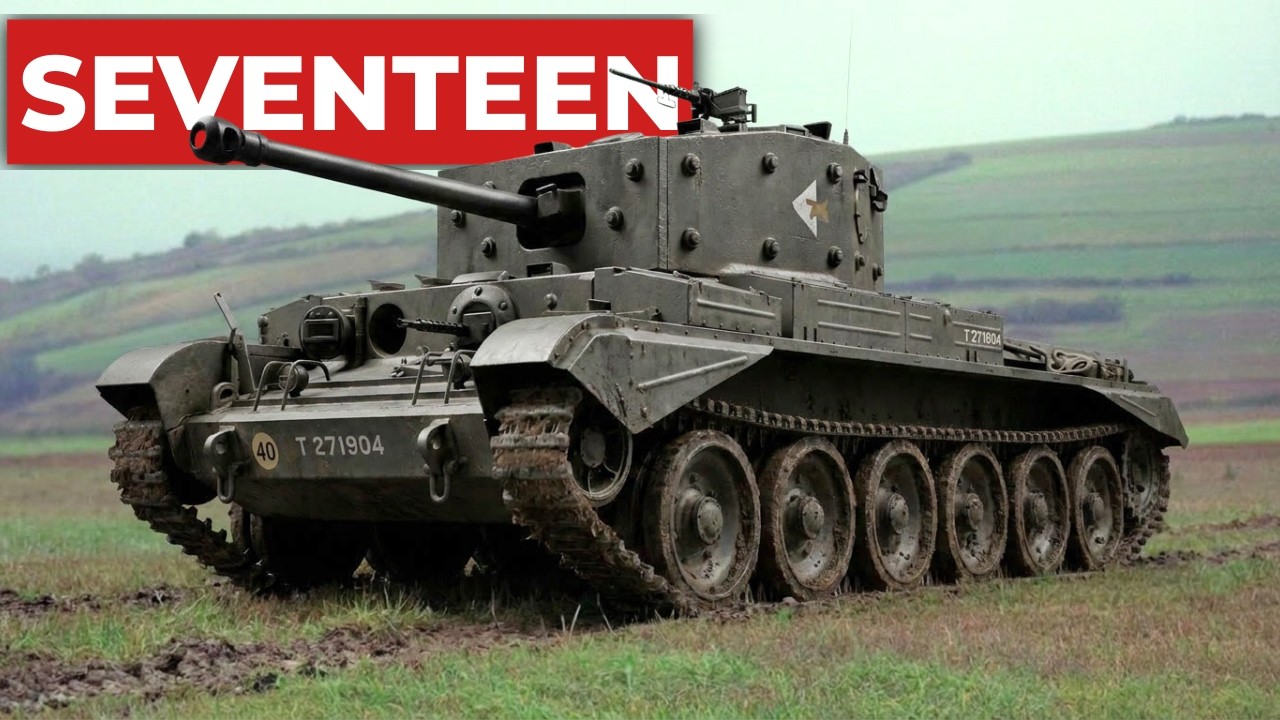
The armor was thin, everyone knew it, but the gun was the gun and the gun was everything. The 15th/19th Hussars, the armored reconnaissance regiment of the 11th Armoured Division, operated Challengers throughout the autumn and winter of 1944. On September the 20th, during Operation Market Garden, elements of the regiment fought alongside paratroopers of the American 101st Airborne Division around the Dutch village of Son.
A combined force of Cromwell’s, infantry and anti-tank guns engaged Panthers of the German Panzer Brigade 107 commanded by Major Berndt Joachim Freiherr von Maltzahn. The fighting lasted all day. Roughly five Panthers were destroyed in and around Sun with kills credited to a combination of American 57 mm anti-tank guns, bazooka teams, and British armor.
The bridge at Sun held. It was exactly the kind of engagement the Challenger was built for. Mixed formations, fast-moving armor, and the sudden appearance of Panthers that no 75 mm gun could stop. The 2nd Armoured Reconnaissance Battalion, Welsh Guards operated Challengers as part of the Guards Armoured Division.
The 8th King’s Royal Irish Hussars fielded them. The 2nd Northamptonshire Yeomanry used them. In each regiment the pattern was identical. The Challenger sat at the back of the troop during advance protected by the faster and lower Cromwell’s. When German armor appeared, the formation reversed. The Cromwell’s found cover.
The Challenger moved to a hull-down position and engaged at range with the 17-pounder. It was not elegant. It was not how the pre-war cavalry manuals described armored warfare, but it worked because the gun worked. The 1st Polish Armoured Division received a small allocation of Challengers in early April of 1945 issuing them to the 10th Mounted Rifles.
The 1st Czechoslovak Independent Armoured Brigade held approximately four during the Siege of Dunkirk. In both cases the tank was valued for the same reason it was valued everywhere. It was the only cruiser speed platform that could kill heavy German armor from the front at ranges where the crew had a reasonable chance of surviving the return fire.
A photograph taken on March the 4th, 1945 now held by the National Army Museum and the Imperial War Museum shows a Challenger of the 15th/19th Hussars crewed by Lieutenant Deeming and Troopers Ken Harrison, D.J. Cain, S.T. Ellis, and P.F. Smith. Smith’s nickname was Smacker. They are standing beside the tank in a flat Dutch landscape.
The enormous turret towering behind them. None of them are smiling. They look like men who trust their gun and tolerate everything else. On paper, the Sherman Firefly was the superior vehicle in almost every way that mattered for industrial war. It used a chassis that was already being built in the tens of thousands.
It required no new hull, no new suspension, no additional road wheel. Kilborn’s conversion could be performed on existing Shermans in workshops across Britain. By May the 31st, 1944, 342 Fireflies had been delivered to the 21st Army Group in time for D-Day. By war’s end, total Firefly production reached somewhere between 2,100 and 2,200 vehicles.
The Challenger managed 200, but the comparison was not as one-sided as the number suggest. The Firefly’s turret was cramped and offered only 5° of gun depression, making hull-down fighting difficult. The Challenger offered 10°, a genuine tactical advantage on the undulating terrain of northern France, Belgium, and the Netherlands.
The Firefly was taller than the Challenger. The Firefly could not match the Cromwell’s speed, meaning Firefly troops in Sherman-equipped regiments moved at the same pace as the rest of the formation. While the Challenger, being Cromwell-based, could keep up with the fastest British cruiser tanks in service.
The difference mattered in pursuit operations and in the fast-moving reconnaissance role where the Challenger actually served. The real rival was not the Firefly, it was time. The Comet, designated a 34, began reaching front-line units in early 1945. It mounted a 77-mm high-velocity gun that fired the 17-pounder’s projectile with a reduced propellant charge fitted into a properly designed turret on a Cromwell-derived hull that did not need to be stretched or raised.
It was everything the Challenger should have been, and it rendered the Challenger obsolete overnight. From February 1945, the 11th Armoured Division began replacing its Challengers with Comets. By the German surrender, the Challenger was finished as a front-line British tank.
After the war, 22 Challengers were sold to Czechoslovakia, where they served with the 11th and later the 23rd Tank Brigade before being placed in reserve in 1951 and scrapped by 1959. No other nation bought them. No variants were developed. The related A30 Avenger, a lower open-topped self-propelled 17-pounder on the same chassis, came too late for combat and was withdrawn from service by 1950.
Two Challengers survive today. One sits at the Overloon War Museum in the Netherlands. A vehicle connected to the First Polish Armoured Division’s operations during the Battle of Delfzijl. The other is a composite of two separate vehicles formerly displayed on the Isle of Wight and now held by the Bovington Tank Museum awaiting restoration. Two out of 200.
January 1943, Lulworth, Dorset. A tank rolls onto the range that nobody wants. The turret is too tall. The armor is too thin. The hull is an awkward stretch of a proven design built to carry a gun that has no other home. The inspectors are unimpressed. The War Office calls it a temporary solution. The production run is capped before the first vehicle reaches a fighting unit.
And none of that changes what the gun could do. It could kill a Panther through the glacis plate at 1,000 m. It could threaten a Tiger frontally at ranges where the Tiger’s own 88 could not guarantee a kill in return. It could do this while moving at 32 mph alongside the fastest cruiser tanks in the British Army.
No other British cruiser tank in Normandy could make that claim. Not one. The Challenger was not fast enough to be a true cruiser. It was not armored enough to stand and trade blows. It was not produced in enough numbers to equip more than a handful of regiments. It arrived late, broke down early, threw its tracks, and scared its own crews with its height.
And every troop commander who faced a Panther thanked God he had one. It was not elegant. It was not loved. It was British. And it carried the only gun that mattered when the killing started.