The ‘Boring’ American Dragon Wagon Keeping Ukrainian Abrams Alive Since Desert Storm D
February 24th, 1991. 0300 hours, 40 miles south of the Iraqi border. On a strip of Saudi desert the army called Tapline Road, a column is moving north in the dark. M1 A1 Abrams tanks at the front. Bradley fighting vehicles on the flanks. Apache helicopter gunships overhead and buried in the column, almost invisible against the sand, the truck nobody photographed.
Eight wheels, diesel smoke, a flat green slab of a cab with a folded crane behind it. No turret, no gun, no glamour. The men on the Abrams cruise barely registered it. Their fight was ahead. In the Republican Guard positions across the line of departure, the truck was just background, cargo, plumbing, the boring part of the war.
It looked obsolete. It looked agricultural. The men on the tanks did not think of it as a war vehicle at all. Over the next 100 hours, this truck would do something the United States Army had never asked of a logistics vehicle before. It would chase tank brigades across 260 mi of open desert through deep sand and broken rock and lose not a single one to thirst.
The crews called it the dragon wagon. The Pentagon 6,000 mi away called it something nobody remembers. And in the afteraction reports written months later by the officers who actually depended on it, one sentence kept appearing in slightly different words. They never got stuck. They did not break down.
And when the smoke cleared, the Pentagon would discover something embarrassing about its own logistics fleet. 30 perfectly serviceable tanker trucks had sat unused in the Saudi sand for the entire war. February 23, 1981. The proposal deadline at the United States Army Tank Automotive Command in Warren, Michigan.
Four manufacturers had answered the Army’s call for a new heavy tactical truck. Pacific Car and Foundry paired with General Motors, AM General, the German consortium machine fabric, Agsburg Nerburgg, Mn and a small Wisconsin firm founded in 1917 by two Milwaukee engineers named William Bessadich and Bernard Mosling.
Oshkosh Truck Corporation. Pacific Car and Foundry was expected to win. Their pre-production assembly line was already built. In May, the contract went the other way. Oshkoskosh’s bid was simply cheaper. $251 million for the first 2140 trucks with options for over 5,000 more. The truck Oshkoskosh had been paid to build had a designation almost no one outside the army would learn.
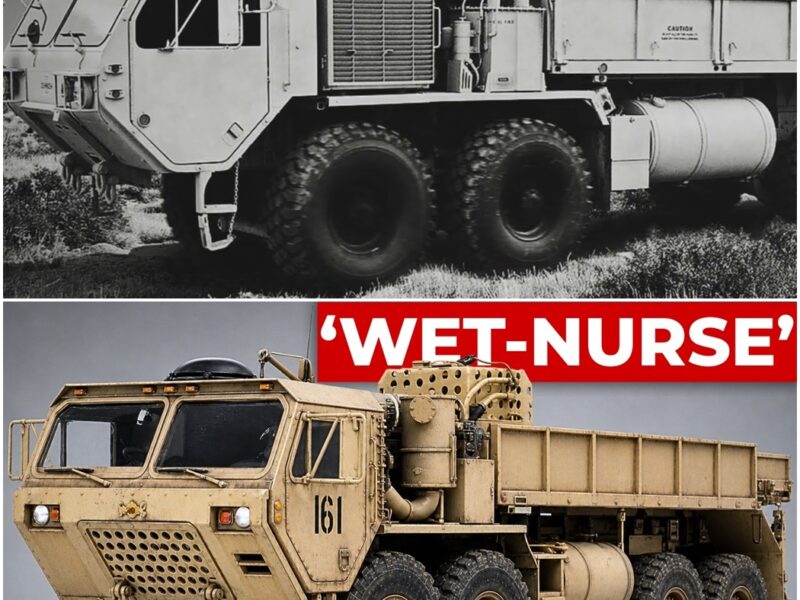
The M977 heavy expanded mobility tactical truck. Soldiers pronounced it. The men who drove it borrowed an older name, the Dragon Wagon, from a flame breathing tank transporter Pacific Car and Foundry had built in the Second World War. The army needed a new heavy truck because the vehicle it was replacing was one of the most hated machines in American service.
The M520go built by Caterpillar was an articulated cargo carrier with no suspension. Its wheels bolted directly to its chassis. Its cab oscillated on a hinge so violently that turning it over could spin the steering wheel. Its governed top speed was 31 mph and a driver could not safely run it at 31 mph on a hard surface because the truck bounced.
Only 1,300 were built before production was cancelled in 1976. The army wanted something faster, tougher, something that could keep pace with the new generation of armor coming into service. The Abrams main battle tank, the Bradley fighting vehicle, the M270 multiple launch rocket system. These vehicles moved across open ground at speed and their logistics had to move with them.
The first prototype rolled out of Oshkosh, Wisconsin in December 1981. Production deliveries began in September 1982. The truck used an 8 by8 permanent all-wheel drive layout with all four axles powered through an Allison automatic transmission. The engine was a Detroit diesel 8V9 2T, a turbocharged two-stroke V8 producing 445 horsepower.
Top speed of 57 mph match the cruising pace of the Abrams on hard surfaces. range of 300 miles covered an armored division’s daily move and the truck could carry 10 short tons of cargo fully loaded across deep sand with no concession to terrain. That last specification was the one that mattered. The dragon wagon could climb a 60% gradient.
It could ford 48 in of standing water with no preparation. Running Michelin radial tires on a Hendrickson walking beam suspension, it crossed soft mud without bogging. deep sand without sinking and broken rock without losing axles. Five variants entered service. The base M977 cargo carrier with a Grove crane. The M978 fuel tanker with a 2500gal capacity and a multi-stationary fueling module on its back.
The M983 tractor used as the prime mover for the Patriot air defense missile system. the M984 Wrecker with a 60,000lb recovery winch and the M985 cargo carrier designed specifically to feed the M270 rocket launcher with six rocket pods. Each truck cost the American taxpayer roughly $212,000. The Pentagon ordered them by the thousand.
By August 1990, more than 13,000 were in service across the United States Army and then Saddam Hussein invaded Kuwait. What Lieutenant General William Pagonus was about to ask of his Wisconsin-built fleet had never been attempted before. But first, if you are enjoying this deep dive, hit subscribe. It helps the channel grow.
Now, the buildup. August 10, 1990. Lieutenant General William Pagonus lands at King Abdulaziz Air Base in Darren with four handpicked staff officers. Ground temperature 120° F. He sleeps the first night in the back of a Chevrolet Blazer. Pagonis is the man Norman Schwarzoff has chosen to build a theater logistics base from nothing.
Over the next 6 months, his 22nd Theater Army Area Command will move 550,000 troops into Saudi Arabia, 7 million tons of supplies, 48,600 vehicles. He will build forward log bases code named Alpha, Bravo, Charlie, and Echo. He will rent 1,300 tank transporters from Saudi Arabia, Egypt, Germany, and Czechoslovakia because the American H fleet is too small.
And he will write later that he learned a single hard truth in those months. You do not drive tanks to a battlefield. You use wheeled vehicles to get them there. The wheeled vehicle Pagonis depended on most was the HMT. The Army Material Command shipped extra M978 fuel tankers into the specifically because the M1 A1 AB rooms burned fuel at a rate that frightened the logisticians.
Its Honeywell gas turbine consumed 10 gall at idle, 30 at tactical idle, 60 cross country. An armored division on the move could burn 600,000 gall in a single day. By the 3rd of February 1991, the 18th Airborne Corps alone had stockpiled 5.8 8 million gallons of fuel at its forward staging areas.
35,000 tons of ammunition, 2 million meals, a million gallons of water. The ground offensive began at 0300 hours on February 24, Gday. The 24th Infantry Division mechanized under Major General Barry McAffrey crossed the line of departure leading 7th core. Schwarzkov had called the maneuver his Hail Mary.
The press called it the left hook. McAffrey’s division advanced 260 mi in four days to the Euphrates and east to Bazra. The division moved in 40 mile leaps the army called battle boxes. And inside each box alongside the tanks and Bradleys, the fueler convoys ran with the maneuver force. M978s carrying their 2500 gallons each.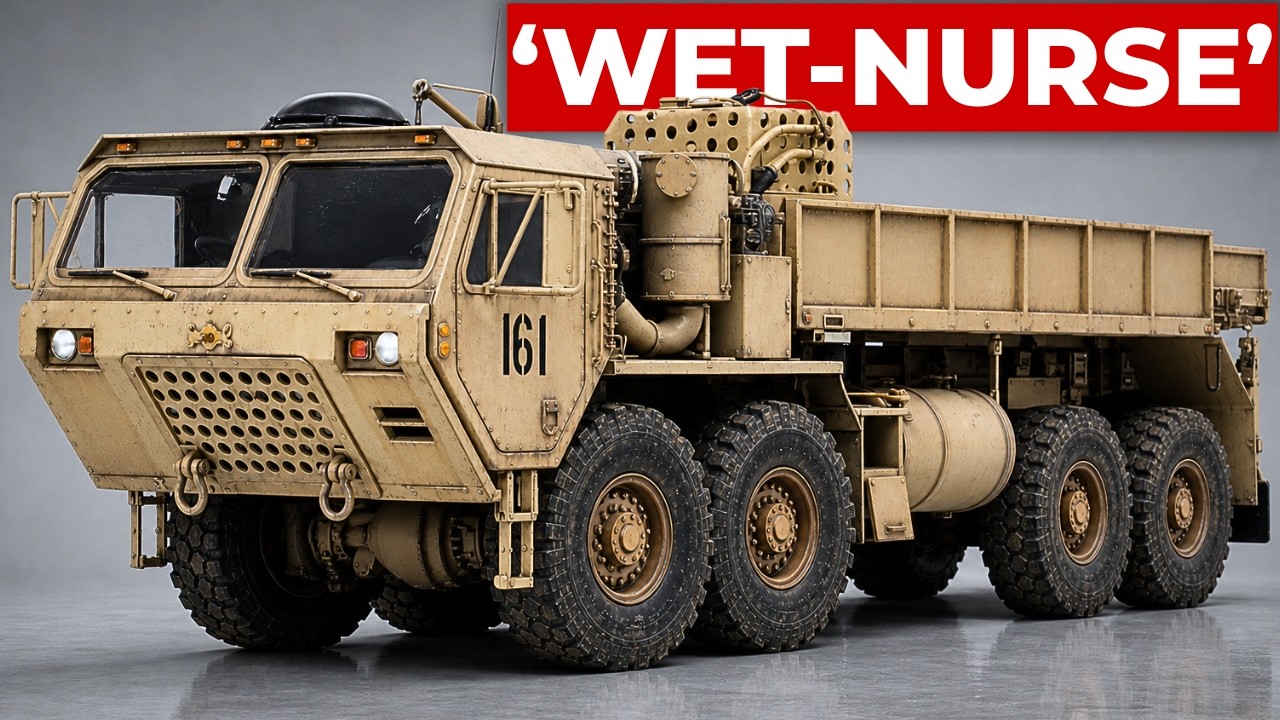
M985s hauling ammunition pods for the rocket batteries. M983 tractors hauling Patriot launchers behind the advance. The pace was unprecedented. Lieutenant General Frederick Franks’s seventh corps ran parallel to Macaffrey with the first armored division, the third armored division, the first infantry division, the second armored cavalry regiment, and the British first armored division.
The third armored division executed a single night move of 120 mi in which every one of its 300 plus tanks arrived in operating condition, the seventh transportation group during one 48-hour window pumped 860,000 gall of fuel forward. when Captain HR McMaster’s Eagle Troop, Second Squadron, Second Armored Cavalry Regiment, destroyed more than 50 Iraqi vehicles in 23 minutes at the Battle of 73 Easting on February 26.
The column behind never had to stop. The Iraqi T72s were dying in front of the Abrams. The Abrams were drinking from the dragon wagons. One soldier left a firstirhand account. Specialist Dave Bo of the Third Armored Division drove a fuel tractor across the line of departure on February 24th.
Bo wrote later that he sat on his flack vest, hoping that if he hit an Iraqi mine, it might save his life. Behind him on the trailer were 5,000 gall of jet propulsion fuel for the helicopters supporting his task force. There were no cameras on Bose’s truck. There were no embedded reporters.
There was a young soldier driving a bomb on wheels behind a tank column at 30 mph through enemy territory. Not every mission ran clean. when MET 985s of the 27th Field Artillery attached to the Third Armored Division towed M989 ammunition trailers loaded with rocket pods through soft sand on the jumpoff.
Five drive shafts snapped within the first hours. Drivers changed technique. The problem disappeared. The 18th Field Artillery Brigade Airborne wrote its postwar review months later. The brigade’s commander, Colonel Floyd Banks, signed it. The vehicle, the brigade reported, was an outstanding asset. It could travel through all types of terrain, deep sand, mud, and rocks with a full load. They never got stuck.
They did not break down. On July 2, 1991, Colonel John Costello of First Armored Division Artillery filed his own afteraction report. Costello argued that every truck operating forward of a division’s rear should be from either the Humvey family or the HMT family. Nothing else could keep up.
The closest pier the Soviets had to the Dragon wagon in 1990 was the Ural 4320, a six- wheeled cargo truck with a 5-tonon payload and a 210 horsepower diesel. The Ural was a fine truck on Soviet roads. It carried less, it climbed less, it forded less, and Soviet doctrine had never asked it to do otherwise.
Red Army logistics moved in waves of medium six-wheelers behind a frontal advance, not in a continuous high-speed dash across open desert. The Soviet 8×8, the MAZ543, existed almost entirely to carry Scud missiles and S300 air defense launchers. It was a missile platform, not a fueler. The British had built a truck closer in philosophy.
The Foden drops, fielded in the late 1980s, was a load handler with a flat rack body and a Rolls-Royce Eagle diesel. Only 1820 were built and the British Treasury had imposed a procurement specification that the truck operate only in NATO European climatic conditions. In the Saudi desert, the hydraulics on British drops vehicles clogged with sand.
The Germans had built the right shape. The man category 110 ton 8×8 fielded from 1976 used an aircooled Dout 8 engine and shared the dragon wagon’s general configuration. Roughly 8,600 were built. The German truck served quietly and well, but it was never produced in the numbers a coalition campaign demanded. The French Renault TRM 10,000, a six-w wheeled 10-tonon truck, was supposed to be built in runs of 5,000.
Actual production fell short of 1,000. Oshkosh, by contrast, would build more than 35,000 dragon wagons across the truck’s career. By the time of Desert Storm, the United States Army was operating more 8 by8 cargo trucks than any other army on the planet in more terrain types than any other army on the planet had ever asked an 8×8 cargo truck to operate in.
The truck’s successor was in many ways itself. The A2 version arrived in the mid 1990s with electronic engine controls. The F4 version, fielded from 2008, replaced the Detroit diesel two-stroke with a Caterpillar C156cylinder diesel making 500 horsepower. added air suspension and added an armored cab in response to the roadside bomb threat in Iraq.
Foreign operators came in 20 nations, Bahrain, Egypt, Iraq, Israel, Jordan, Saudi Arabia, South Korea, Turkey, Ukraine. The Ukrainian army began receiving M978 fuel tankers and M984 wreckers from American stocks in two,22. The trucks that had refueled Abrams across the Saudi desert in 1991 were now refueling Bradley fighting vehicles and leopard two tanks east of the Nepro River.
The truck Oshkosh had built for a war against the Warsaw Pact in central Europe had outlived the Warsaw Pact, fought in two American invasions of Iraq, fought in Afghanistan, and was now fighting Russians anyway. February 24th, 1991, 0300 hours. The column moving north on Tapline Road. The Dragon Wagon was not perfect.
Its 8×8 drivetrain was complex and expensive to maintain. The early variant had no central tire inflation system, no air conditioning, no armor on its cab. It cost more than the trucks it replaced. It was loud. It was thirsty, burning 154 gall of its own diesel to deliver 2500 gall to a tank that drank 10 of them standing still.
And per Colonel Chris Paparon of First Corps Support Command, who wrote the most honest postwar assessment of Desert Storm logistics anyone has published, the entire offensive ran at the outer edge of what the fuel haulers could deliver. Had the ground war exceeded 100 hours, the 18th Airborne Corps would have required an operational pause.
The Dragon Wagon fleet could not cycle long distances back and forth fast enough to maintain the tempo of the attacking force indefinitely. Only the brevity of the war made it feasible, and yet it worked. It worked through deep sand. It worked through mud. It worked through broken rock.
It worked at speed alongside the most famous tank in American history. It worked while 30 perfectly good highway tankers sat unused on Saudi pavement because their crews could not cross open desert. It worked in the hands of men whose names the country never learned in trucks the country never photographed while the cameras stayed on the Abrams.
The dragon wagon was not new. It was not fast. It was American and it worked when it mattered.