The ‘Boring’ British Box That Carried The Army For Fifty Years Without Replacement D
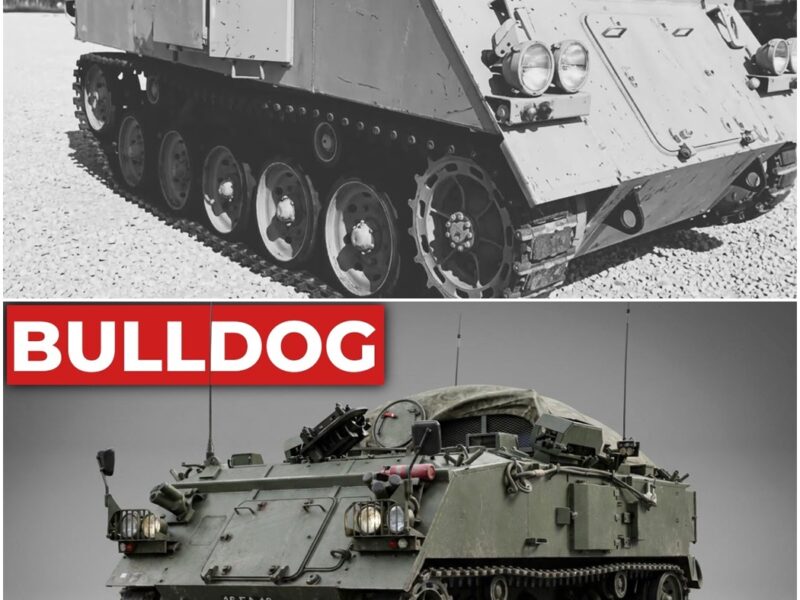
1963, the GKN Sankey factory, Hadley Castle Works, Telford, Shropshire. A tracked vehicle rolls off the production line and onto a rain-slicked test yard. It is 15 tons of welded steel, flat sides, flat roof, a slab front plate angled just enough to deflect a rifle round.
No turret, no cannon, a single general purpose machine gun mounted on a pintle that looks almost like an afterthought. The engine is a six-cylinder, two-stroke, opposed piston design by Rolls-Royce that can burn diesel, petrol, or kerosene, whatever happens to be available. Inside, 10 soldiers sit on fold-down benches facing each other across a hull so plain it could pass for an industrial shipping container on tracks.
It looked like nothing. It looked like a steel box somebody had welded tracks onto and called finished. Officers in the War Office were already describing it as a battle taxi, a phrase that made it sound disposable. The Americans had the M113, lighter, faster, amphibious from the factory. The Soviets had vehicles that let infantry fire from inside.
The French mounted 20-mm cannons on theirs. The British got a box. That box would go on to serve in every major British military operation for the next six decades. It would patrol the Rhine corridor through the coldest years of the Cold War. It would breach barricades in Belfast. It would cross the Iraqi desert in 1991 and return to Basra in 2006 wearing bolt-on armor it was never designed to carry.
It would outlast its own replacement. Then it would outlast the replacement of its replacement. It would still be carrying British soldiers into the 2020s with a retirement date that has been pushed back so many times no one in the Ministry of Defense is willing to guarantee when it will actually stop.
Its designation was the FV432. The army tried to name it Trojan. The Trojan Car Company objected, so the troops just called it the four-three, and it became the longest-serving armored personnel carrier in British military history. To understand why the FV432 existed, you need to understand the problem Britain faced in the the 1950s.
The British Army of the Rhine, known as BAOR, was the country’s largest single military commitment. Tens of thousands of British soldiers were stationed across West Germany, positioned to hold the North German plain against a Warsaw Pact invasion that NATO planners believed could come with as little as 48 hours warning. The battlefield they trained for was not like anything Britain had fought on before. It was expected to be nuclear.
It was expected to be chemical. Infantry who fought on foot, exposed to fallout and nerve agent, would be combat ineffective within hours. Britain needed a vehicle that could carry a full infantry section across contaminated ground, protect them from shell splinters and small arms fire, and deliver them to a dismount point where they could fight.
It did not need to be fast. It did not need to be heavily armed. It needed to be cheap enough to produce in thousands, reliable enough to start every morning in a German winter, and simple enough for a 19-year-old conscript to maintain in the field. The requirement was issued in September 1958 under War Office Policy Statement 26.
GKN Sankey, an engineering firm based in Telford with deep experience in military vehicle production, won the development contract. The design drew heavily on the canceled FV432 series, particularly the FV432 load carrier. A prototype was completed by 1961. A production contract followed in 1962.
First deliveries reached units in 1963. The vehicle itself was a masterpiece of deliberate under-engineering. The hull was all-welded steel, roughly 13 mm at the front and 8 mm around the sides, enough to stop a 7.62 mm round, not enough to stop anything heavier. The Rolls-Royce K60 engine produced 240 brake horsepower, enough to push the vehicle to 52 km per hour on a road, and significantly less across broken ground.
A semi-automatic transmission built under license by Rolls-Royce from a General Motors Allison design kept the drivetrain simple. Torsion bar suspension with five dual road wheels per side absorbed the worst of the terrain. The fuel tank held 454 L, giving a road range of roughly 480 km. That range mattered.
In a continental war against the Soviet Union, supply lines would be the first thing to collapse. A vehicle that could operate for days without refueling was a vehicle that could still fight when the logistics chain broke. The multi-fuel capability of the K60 engine was not a luxury. It was NATO doctrine.
Allied armies ran on different fuels. A British vehicle that could burn captured Soviet diesel, American petrol, or aviation kerosene from any airfield was a vehicle that would never be stranded for want of the right fuel. Every design decision in the FV432 came back to one principle: keep it simple, keep it running, get the infantry where they need to be.
By the time production ended in 1971, GKN Sankey had built approximately 3,000 FV432s. At peak strength in the 1980s, nearly 2,500 were in active service. No other British armored vehicle of its generation came close to those numbers. Now, before we get into where this vehicle actually fought, if you are enjoying this deep dive into Cold War British engineering, hit subscribe.
It takes a second, costs nothing, and it helps the channel grow. The FV432 was designed for a war in Germany that never came. Instead, it fought everywhere else. Its first operational deployment outside the Rhine Corridor came in Northern Ireland when the Troubles escalated in the early 1970s. The British Army needed armored vehicles that could absorb petrol bombs and rifle fire while moving through urban streets.
On July 31st, 1972, Operation Motorman, the largest British military operation since Suez, deployed over 21,000 troops with armored support to dismantle barricades in the No-Go areas of Derry and Belfast. FV432s rolled through streets that had been sealed off for months. They were too heavy and too loud for the narrow terraced roads, but they were also the only vehicles the army had sufficient numbers that could take a hit from a sniper’s round and keep moving.
The 432 became a fixture of the Northern Ireland Garrison for the next three decades. Then came the desert. In 1991, during Operation Granby, FV432s deployed to Saudi Arabia with the first United Kingdom armored division. They served as command vehicles, ambulances, mortar carriers, and Milan anti-tank missile platforms.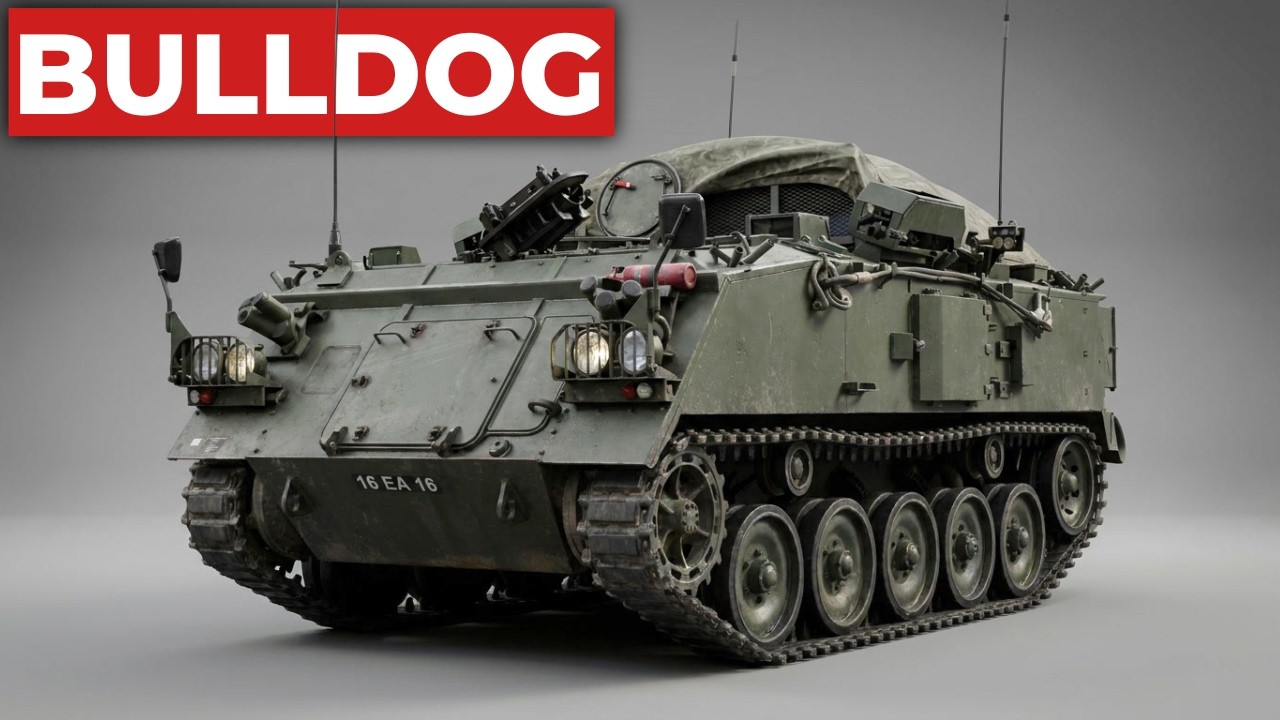
The Gulf exposed every weakness the vehicle had. Crews sweltered inside in full nuclear and biological and chemical protection suits because the 432 had no air conditioning. Sand clogged filters designed for European mud. The thin armor that was adequate against Soviet shell fragments offered uncertain protection against the heavier weapons Iraq had purchased from its own Soviet suppliers.
A hasty program to fit satellite communications terminals into the hull produced vehicles that worked barely. But, the operation made clear that the FV432 was being asked to do things it was never designed for. In the Balkans, the 432 found a role that suited it better. During Operation Grapple in Bosnia from 1992 onward, FV432s served as ambulances, convoy escorts, and troop carriers around Vitez and on the dangerous roads into Sarajevo.
Five Cymbeline mortar locating radar sets mounted on FV432 chassis deployed to Sarajevo in 1994 to detect heavy weapons fire in violation of ceasefire agreements. In Kosovo in 1999, under the command of Lieutenant General Sir Mike Jackson, light role British units used the 432 for protected mobility in the uncertain early days of the KFOR peacekeeping mission.
But, it was Iraq for the second time that transformed the vehicle. By 2003, the FV432 was 40 years old. It had been scheduled for retirement more than once. Instead, it was sent to Basra. The insurgency that followed the invasion exposed the base vehicle as dangerously vulnerable. Roadside bombs, the improvised explosive devices that defined the Iraq conflict, could tear through the flat belly and thin steel of an unmodified 43 with lethal ease.
Soldiers began calling it a mobile coffin. The House of Commons Defense Select Committee raised formal concerns about protection levels. The answer was the Bulldog under an 85 million pound urgent operational requirement contract with BAE Systems. Over 1,000 FV432s were rebuilt to Mark III standard.
The original Rolls-Royce K60 engine was replaced with a 250 horsepower Cummins turbo diesel. A new fully automatic transmission replaced the old semi-automatic. Bolt-on explosive reactive armor panels designed by Rafael were fitted to defeat rocket-propelled grenades. Kevlar lined belly plates were added to absorb blast from below.
Air conditioning, electronic countermeasures, and a remote weapon station replaced the exposed pintle-mounted machine gun. The first 500 Bulldogs were delivered just before Christmas 2006 and went straight into service with infantry battalions patrolling Basra City. A vehicle designed to cross the nuclear battlefields of West Germany in 1963 was now fighting an urban counterinsurgency war in southern Iraq in 2007 and it was working.
In 2022, the 43 found its most unlikely theater yet. At least 17 Bulldog variant FV432s were donated to Ukraine where their tracked mobility and armored protection found new purpose on the Eastern Front more than 60 years after the first prototype left the factory in Telford. The vehicle the FV432 is most often compared to is the American M113.
The comparison is instructive. The M113 was built from aluminum. It was lighter, faster, and fully amphibious without any preparation. It could pivot against a tree stump, something Australian Army trials in 1962 proved the heavier FV432 could not do. Australia chose the M113. So did over 50 other nations.
The M113 became the most widely exported armored personnel carrier in history. The FV432 was never exported at all beyond surplus donations. On paper, the American vehicle was superior in almost every measurable way. In practice, the FV 432 had one advantage that mattered more than speed or agility.
Steel does not burn. When an aluminum hull is struck by a rocket-propelled grenade, the molten jet can ignite the metal itself. Steel absorbs the impact without combustion. In a vehicle whose entire purpose was to keep 10 infantrymen alive long enough to reach the fight, that distinction was not theoretical.
It was the difference between a crew that walked away and a crew that did not. The real story of the FV 432, however, is not what it did. It is what outlasted it. The vehicle that was supposed to replace the 43 was the mechanized combat vehicle 80, which became the Warrior. Warrior entered service in 1987, but the army could only afford 789 of a planned 800.
The 43 survived. The next replacement was the Future Rapid Effect System, a program that consumed years of study and millions of pounds before being canceled without producing a single vehicle. The 43 survived. Then came Ajax, a 5.5 billion-pound program plagued by noise and vibration problems so severe that crew training had to be suspended.
Ajax replaces the reconnaissance fleet, not the 43. Then came Boxer, the multinational wheeled armored vehicle that may eventually absorb most of the 43’s remaining roles. Boxer deliveries began in 2025. The FV 432’s current out-of-service date is 2030. If that date holds, the vehicle will have served for 67 years.
A defense survey conducted at Shrivenham reportedly rated the FV 432 the most reliable vehicle in British armored history. Soldiers who served in it had a saying, “The British army will be fighting on Mars in the FV 432 in 2157.” Dozens of surviving examples sit in museums across Britain, from the Tank Museum at Bovington to the Muckleburgh Collection in Norfolk.
Hundreds more are in private hands. Cheap to buy and surprisingly simple to maintain, at least one was converted into a replica German assault gun for the television series Band of Brothers. 1963. The GKN Sankey Factory, Hadley Castle Works, Telford. A tracked steel box rolls onto a rain-slick test yard, and no one watching thinks they are looking at history.
It has no cannon, no sophisticated fire control, no night vision, no digital backbone. Its armor will stop a rifle bullet and not much else. Its engine is loud, its ride is brutal, and its interior leaks when it rains. And yet it worked. It worked on the frozen plains of northern Germany in the dead of the Cold War.
It worked on the burning streets of Belfast and Derry. It worked in the sands of Kuwait and the rubble of Basra. It worked in the mountains of the Balkans and the mud of eastern Ukraine. It outlasted the Warrior. It outlasted every program designed to replace it. It adapted to roles its designers never imagined, from missile carrier to radar platform to battlefield ambulance to urban patrol vehicle.
It did this not because it was advanced, but because it was simple enough to fix, strong enough to modify, and cheap enough that there were always more of them than the army could throw away. The FV432 was never the best armored personnel carrier in the world. It was never the fastest, the lightest, the most heavily armored, or the most comfortable.
It was British, and it carried the army for 60 years because nobody ever built anything to replace it that actually worked. That is not mediocrity. That is the most dangerous kind of engineering there is, the kind that refuses to become obsolete.