The ‘Boxy’ British Fighting Vehicle That Survived More Roadside Bombs In Iraq Than Any Allied Tank D
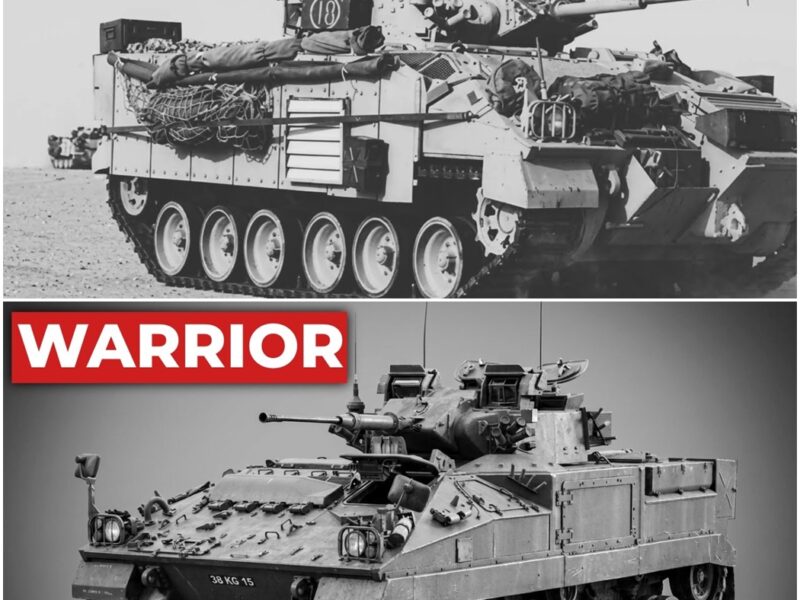
May 1987, the Hadley Castle Works, Telford, Shropshire, a tracked vehicle rolls off the production line and onto a flatbed transporter bound for West Germany. It is 25 tons of welded aluminum, 6 m long, 3 m wide, with a boxy turret bolted on top carrying a 30-mm cannon that has to be fed by hand in three round clips.
The hull is angular, the silhouette is tall, the rear compartment designed to carry seven infantrymen has no firing ports, no drop ramp, and a single hydraulic door that takes 4 seconds to open. It looks like a steel shipping container on tracks. It looked slow. It looked clumsy. It looked like the kind of vehicle that belonged at the end of the Cold War, not the beginning of the wars that followed.
It would go on to fight in the Gulf, in Bosnia, in Kosovo, in Iraq, and in Afghanistan. It would absorb more roadside bombs, rocket-propelled grenades, and shaped charge strikes in southern Iraq than any other British armored vehicle in history. Its driver would earn the first Victoria Cross awarded to a living British soldier in 40 years.
And across nearly four decades, it would carry more British infantrymen into more combat than any tracked vehicle since the FV432. Its designation was the FV510 Warrior, and it was the backbone of British armored infantry for an entire generation. To understand why the Warrior existed, you need to understand the problem Britain faced in the mid-1970s.
The standard British armored personnel carrier was the FV432. It had been in service since 1963, and by the late ’70s, it was exhausted. Its only weapon was a 7.62-mm machine gun mounted behind a thin steel shield. Its top speed could not match the new Challenger tank, and its armor, designed for shrapnel and rifle rounds, offered no protection against the Soviet 14.
5-mm heavy machine guns that every BMP carried as standard. NATO doctrine had shifted. Infantry were no longer expected to ride to the rear of the battle and dismount at a safe distance. They were expected to fight forward, keep pace with their tanks, and dismount on the objective under fire. The FV432 could not do any of that.
Britain needed a vehicle that could. The program was called MCV-80, Mechanized Combat Vehicle for the 1980s. GKN Sankey, a pressed steel manufacturer from Telford that had built the FV432 two decades earlier, won the contract against both Vickers and an American offer to license build the Bradley.
The requirement was precise. Carry a full seven-man infantry section. Keep pace with Challenger at 75 km/h on roads. Mount a cannon capable of defeating enemy infantry fighting vehicles. Protect the crew against 14.5-mm armor-piercing rounds over the frontal arc and shell fragments all round. And do it within 25 tons.
The vehicle itself was a study in pragmatic engineering. The hull was all welded aluminum alloy, lighter than steel but strong enough to meet the protection standard when bolted with applique panels. Power came from a Perkins CV8TCA Condor turbocharged diesel producing 550 brake horsepower mated to a four-speed automatic gearbox.
This gave a top road speed of 75 km/h and a range of 660 km on internal fuel. Two crew members could swap the entire power pack in under an hour, a logistical advantage that would prove critical in the desert. The suspension was torsion bar, six aluminum road wheels per side, and the vehicle forded 1.
3 m of water but was deliberately not amphibious. The British Army did not ask for swimming capability, and GKN did not waste weight providing it. The armament was the most controversial element. The main gun was the L21A1 Rarden 30-mm cannon, a long recoil weapon jointly developed by the Royal Armament Research and Development Establishment and the Royal Small Arms Factory at Enfield.
It fired armor-piercing discarding sabot rounds at 1,175 m/s, enough to penetrate 40 mm of rolled steel at 1,500 m. But it was manually fed in three-round clips, with a practical rate of fire limited to short bursts. Critically, it was not stabilized. The Warrior had to stop to shoot accurately. Alongside the Rarden sat a coaxial L94A1 chain gun in 7.
62-mm with 2,000 rounds. Eight smoke grenade launchers completed the package. It was not elegant. It was not modern by the standards of the Bradley or the Marder, but it was reliable. It was deliverable. And it was British. GKN built 14 prototypes between 1979 and 1984. An order for 1,053 vehicles was signed in 1985.
Production began at Telford in January 1986. The first production Warrior was handed to the 1st Battalion Grenadier Guards in May 1987. Then the Cold War ended, and Options for Change cut the order to 789 vehicles. The Warrior had been designed for a war in the North German Plain that would never come.
The wars it actually fought were far stranger. Now, before we get into where the Warrior actually fought and how it performed under fire, if you are enjoying this deep dive into British armored vehicle history, hit subscribe. It takes a second, and costs nothing, and helps the channel grow. The Warrior’s baptism came in February 1991 in the deserts of southern Iraq and Kuwait.
1st United Kingdom Armoured Division under Major General Rupert Smith deployed roughly 316 Warriors of all variants alongside 179 Challenger 1 tanks as the right flank of the American 7th Corps. This was the operation for which Chobham composite applique armor was first bolted to the Warrior’s hull, a rushed field modification that would become permanent.
Between the 24th and 28th of February, the division advanced 217 miles in 97 hours. Fleet availability across the Warrior fleet ran at 95%. Warriors carrying Milan anti-tank missiles on their turret roofs destroyed dug-in Iraqi T-55 tanks at Objective Platinum. At Objective Brass, Warrior-mounted infantry shattered an Iraqi tank battle group.
Over 7,000 prisoners were taken and 300 Iraqi armored vehicles destroyed. Not one Warrior was destroyed by Iraqi action. The two Warriors that were lost died to American fire. On the 26th of February, two United States Air Force A-10 Thunderbolts fired Maverick missiles into Warriors of C Company, 3rd Battalion Royal Regiment of Fusiliers.
Nine British soldiers were killed and 11 wounded. Six Fusiliers, Lee Thompson, Steven Satchell, Conrad Cole, Richard Gillespie, Kevin Leach, and Paul Atkinson, along with three privates of the 1st Battalion Queen’s Own Highlanders, Martin Ferguson, John Lang, and 18-year-old Neil Donald, the youngest British soldier killed in the war.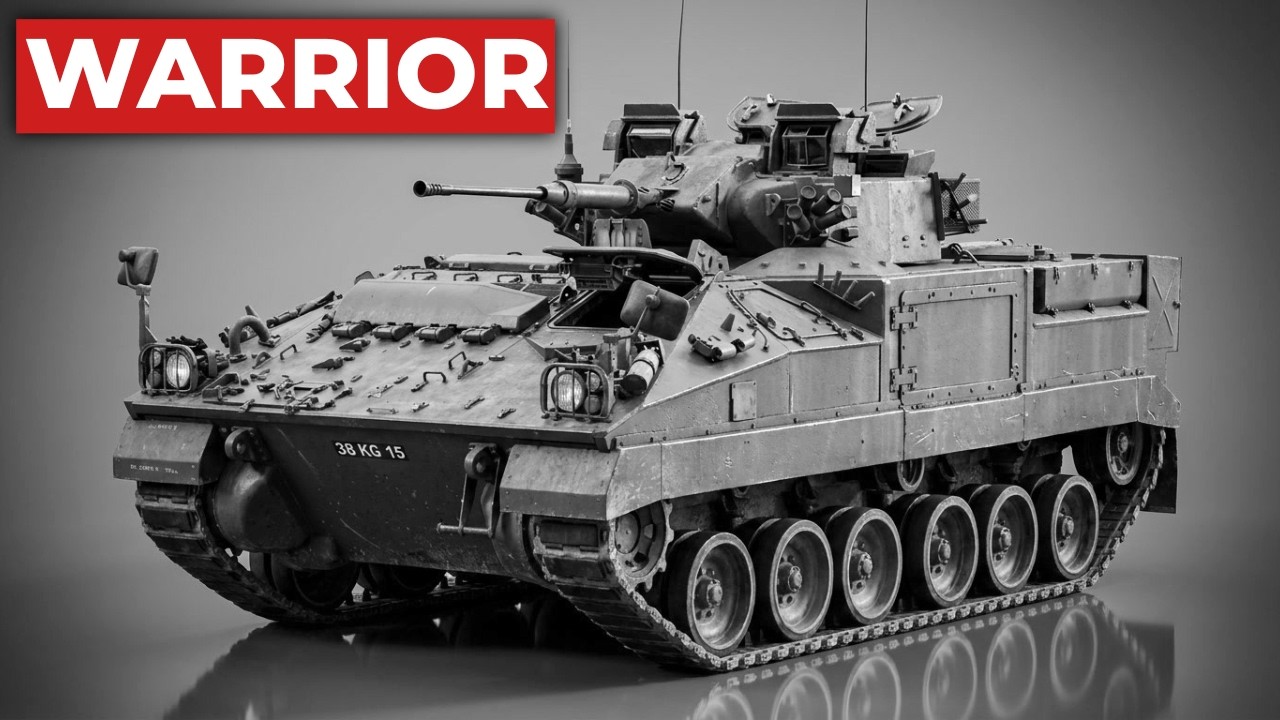
Both Warriors had been carrying inverted V coalition recognition devices and orange air identification panels. The pilots did not see them. An Oxford coroner later returned verdicts of unlawful killing. 12 years later, the Warrior went back to Iraq. In March 2003, four Warrior battle groups deployed for the invasion alongside Challenger 2.
On the 6th of April, Warriors of 7th Armoured Brigade entered Basra from the north and fought a three-hour battle through the streets, destroying Ba’ath party positions and Fedayeen strongpoints. The 30-mm Rarden proved perfectly suited to this work, methodically demolishing reinforced buildings and technicals at ranges where tank rounds would have been excessive.
Then came the insurgency. From 2004, the threat shifted to roadside improvised explosive devices, RPG-29s, and the most lethal weapon of all, Iranian-supplied explosively formed projectiles. These copper dischargers formed hypersonic metal slugs capable of penetrating any vehicle in the British inventory.
Warriors were progressively up-armored with bar and cage armor against shaped charges, then heavier wrap-two applique panels, then electronic countermeasure jammers to defeat radio-controlled detonators. Over 80 urgent operational requirement modifications were pushed through during Operation Telic. The Warrior’s combat weight climbed from 25 tons to 32, then toward 40.
The defining story of the Warrior belongs to this period. Private Johnson Beharry, a 24-year-old Grenadian-born driver in C Company, 1st Battalion the Princess of Wales’s Royal Regiment, earned the Victoria Cross for two separate actions in Al Amarah, Maysan Province. On the 1st of May 2004, his platoon was ambushed while extracting a pinned foot patrol.
Multiple rocket-propelled grenades struck his Warrior, incapacitating the commander and gunner, destroying the radios, and setting the vehicle on fire. With his periscope shattered, Beharry drove 1,500 m through a barricade with his head exposed above the hatch, a 7.62-mm round lodging in his helmet liner.
He led five Warriors to safety at the CIMIC house compound, then climbed three times onto the burning turret to extract his wounded crew before collapsing. On the 11th of June, a second ambush detonated a warhead 6 in from his head, fracturing his skull. Barely conscious, he reversed the Warrior out of the killing zone before losing consciousness.
He was the first living recipient of the Victoria Cross since 1965. His citation credited him with saving approximately 30 lives. The Warrior also deployed to Afghanistan. From April 2007, Warriors operated in the Upper Gereshk Valley and supported the recapture of Musa Qala in Helmand Province.
Successive Operation Herrick rotations kept Warriors in theater through 2010 and beyond. But on the 6th of March 2012, a Warrior of the 3rd Battalion Yorkshire Regiment struck what investigators believed was an exceptionally large improvised explosive device near Lashkar Gah. The blast overturned the vehicle and ignited onboard ammunition.
All six occupants were killed. Sergeant Nigel Coupe, Corporal Jake Hartley, and Privates Anthony Frampton, Christopher Kershaw, Daniel Wade, and Daniel Wilford. The inquest expert testified bluntly that no vehicle in the British inventory was designed to survive that device. On paper, the American M2 Bradley looked superior in almost every respect.
It carried a stabilized 25-mm Bushmaster cannon that could fire accurately on the move. It mounted twin TOW anti-tank missile launchers. It had been produced in quantities exceeding 6,700 vehicles and had destroyed more Iraqi armor during the Gulf War than the Abrams tank itself.
The German Marder offered heavier armor. The Soviet BMP-2 offered amphibious capability and a stabilized 30-mm autocannon. In practice, the Warrior offered something none of them matched. It carried a full seven-man dismount section, one more than the Bradley, one more than the Marder. Its Perkins diesel was rugged, fuel tolerant, and field swappable.
Its torsion bar suspension, while primitive, absorbed punishment that more complex hydropneumatic systems could not. And its aluminum hull, once wrapped in Chobham applique, proved capable of absorbing repeated RPG strikes that would have killed softer vehicles outright. Britain spent 600 million pounds trying to modernize the Warrior through the Warrior Capability Sustainment Program, awarded to Lockheed Martin UK in 2011.
The plan was to replace the RARDEN with a stabilized 40-mm cased telescoped cannon, fit a new digital turret, and extend the vehicle’s life to 2040. By 2021, the program was 3 years late and over 200 million pounds over budget. In March 2021, the Ministry of Defense canceled the entire program.
No upgraded vehicles were delivered. The prototype sits in the Tank Museum at Bovington. The replacement is the Boxer, a wheeled 8×8 vehicle armed only with a 12.7-mm machine gun, no cannon, no anti-tank missile. 789 Warriors are being retired without a true successor. As of 2024, 632 remained in British service with full retirement expected around 2030.
May 1987, Telford, Shropshire. A boxy aluminum vehicle rolls off a factory floor and into the hands of the Grenadier Guards. It has no stabilized gun, no missile, no swimming capability, no firing ports, and a 30-mm cannon fed by hand in three-round clips. And yet it worked.
It worked in the flat deserts of Kuwait, where it ran at 95% availability while heavier vehicles broke down. It worked in the shattered streets of Basra, where its cannon dismantled strongpoints that tank rounds could not reach without leveling entire buildings. It worked in the ambush alleys of Al Amarah, where it absorbed warheads that should have killed every man inside.
It worked in the green zone of Helmand, where it carried infantry into valleys that no wheeled vehicle could reach. The Warrior was not fast enough, not well armed enough, and not modern enough for the wars it was asked to fight. It was underpowered, undergunned, and overweight by the time it reached Afghanistan.
Its upgrade program consumed 600 million pounds and delivered nothing. Its replacement carries no cannon at all, but for four decades, it kept British infantrymen alive. It carried them forward, and when everything around it burned, it brought them home. That is not luck. That is the difference between a vehicle built by committee and a vehicle built by engineers who understood what infantry actually need.