The ‘Boxy’ Turkish Hedgehog That Drove Into PKK Ambushes And Brought Every Soldier Home Alive D
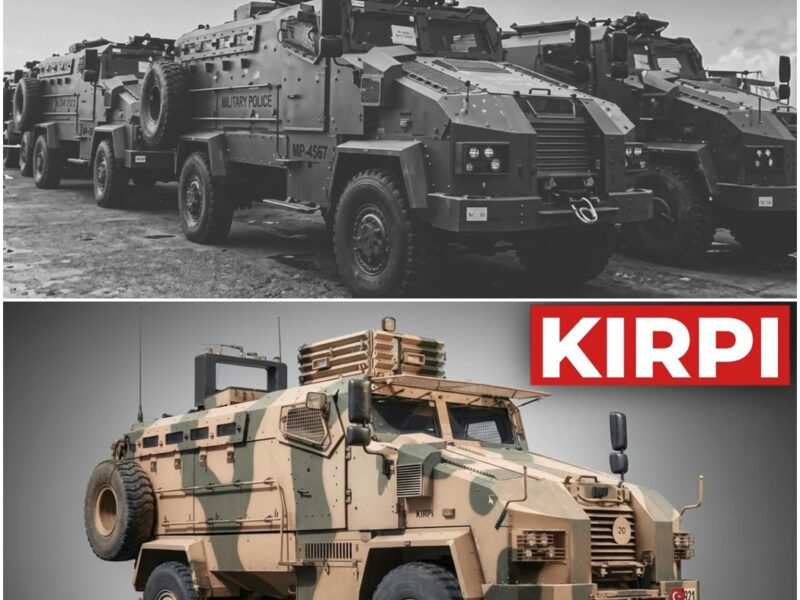
August 17th, 2011. A mountain pass outside Yuksekova, Hakkari Province, deep in the southeastern frontier of Turkey. A boxy steel vehicle rolls forward at the head of a Turkish military column. 16 tons of welded plate, a wedge-shaped belly designed to deflect explosions sideways instead of upward.
Tires standing taller than a soldier’s chest. A driver visor barely wider than a letterbox slot. It looks like a shipping container that has been bolted onto a heavy truck chassis and painted in desert sand. It looks crude. It looks over the sized. Soldiers nicknamed it the walking castle. Then the road erupts.
A chain of buried bombs detonates beneath the convoy. The lead vehicle absorbs the first blast and keeps rolling. The Otokar Cobra behind it is destroyed. The BTR-80 following them is torn apart killing its entire crew. But the boxy thing at the front of the column, the one that looked too crude and too slow, the one engineers had finished in just 5 months of three-shift production, that one keeps its men alive.
Over the next decade that same design would absorb roughly 60 mine attacks across Turkey’s southeast without producing a single confirmed soldier killed inside. It would carry commandos into Syria. It would ride beside Tunisian patrols hunting Al-Qaeda in the Chambi Mountains. It would become a mobile fortress for Ukrainian Marines facing Russian armor.
Its designation was the BMC Kirpi, the hedgehog, and it would become the most combat-proven mine-resistant vehicle Turkey ever built. To understand why the Kirpi existed, you need to understand the war Turkey was losing in the late 2000s. By 2007, the Kurdistan Workers’ Party, the PKK, had abandoned set-piece battles.
Their war had become a war of pressure plates. Buried explosives along the goat tracks of Hakkari, Sirnak, Diyarbakir, and Mardin. The October 2007 raid on the Dağlıca outpost killed 12 soldiers and saw eight more dragged across the Iraqi border. On October 3, 2008, an assault on the Aktütün outpost killed 17 troops.
The drumbeat did not stop. Nine soldiers killed in a Diyarbakir roadside bombing on April 29th, 2009. Six more at Hanterpa a month later. 11 at Gediktepe in June 2010. The vehicles Turkey was sending into those mountains were Cold War relics, BTR-80s, BTR-60s, Land Rover patrol trucks. None of them were designed for a war fought through the floorboards.
International Crisis Group data later showed that during a single 2016 escalation, 48% of all Turkish security force deaths 150 out of 312 came from improvised explosive devices. Ankara’s answer arrived on December 18th, 2008. The Defense Industry Executive Committee selected an Izmir truck maker called BMC Automotive for a sweeping tactical wheeled vehicles tender.
The contract with the Undersecretariat for Defense Industries, the body Turks call SSM and now SSB, was signed on March 27th, 2009. It covered roughly 2,000 vehicles, including 468 mine-resistant trucks designated BMC 35016Z. But BMC did not start from a blank sheet. On May 21st, 2009, the company sealed a discreet design and technology agreement with an Israeli firm called Hatehof Industries.
Hatehof’s 16-ton Navigator vehicle, itself built on a BMC chassis, became the genetic basis for what Turkey would soon call its first national hedgehog. The name was chosen for symbolism. Small, fast, low to the ground, but bristling with armor. Kirpi, in Turkish, is the hedgehog. BMC Vice Chairman Naci Postolu took to calling it Yuruyen Kale, the walking castle.
The first prototype rolled out in 2009. The international debut came at the Eurosatory show in Paris in 2010. And on March 31st, 2011, BMC handed over the first 70 vehicles to the Turkish Land Forces at its Pinabasi plant in Izmir. Postolu told Defense Turkey magazine the project had been completed in 5 months of three shift, 24-hour work with 280 subcontractors, 70% domestic content, and a production rate of 40 to 60 vehicles a month.
The vehicle itself is unapologetically utilitarian. Length 7.07 m, width 2.51 m, height 2.86 m, ground clearance 400 mm, combat loaded weight around 20 tons. Its single most important feature is what the eye cannot see. An all-welded steel monocoque hull whose lower half forms a V designed to channel mine blast energy sideways away from the crew capsule.
Inside that capsule sit 13 people, driver, commander, gunner, and 10 dismounts on five-point harness blast attenuating seats. Protection meets STANAG 4569 level three for ballistic threats and level three A and three B against mines on the original Kirpi, climbing to level four under the belly of the Kirpi 2.
Power comes from a Cummins ISL 9E3 turbo diesel, 8.9 L, 375 horsepower, mated to an Allison 3000 series automatic gearbox driving four run flat tires through AxleTech axles. Top speed 105 km/h, range 800 km, fording depth 1.2 m. It can climb a 60% gradient and hold a 30% side slope. The roof carries a remote weapon station.
A Aselsan SARP turret mounting either a 12.7 mm heavy machine gun or a 40 mm automatic grenade launcher. Some carry both. Variants quickly multiplied. A 6×6 version that carried 15 troops, an ambulance, a command post, an explosive ordnance disposal vehicle with a robotic arm, and from 2018, the heavier independently suspended Kirpi 2.
Now, before we get into where this vehicle actually fought and what it survived, if you are enjoying this deep dive into modern armor design and the wars it was built for, please hit subscribe. It takes 1 second, costs nothing, and it genuinely helps the channel grow. The first true test of the Kirpi came on the road outside Cukurca on August 17, 2011.
The same convoy that opened this script, a complex PKK ambush walked Turkish armor into a chain of buried bombs. The lead Kirpi mine clearance vehicle absorbed a direct blast and kept its crew alive. The Otokar Cobra immediately behind it was destroyed and overturned, killing three.
A BTR-80 dispatched as reinforcement struck a second improvised device. Every soldier aboard the BTR was killed. The Turkish newspaper Zaman was blunt the next morning. Had Kirpis been used instead of BTR-80s, the soldiers would still be alive. Vice Chairman Postolu later told a Turkish television interviewer that around 60 mine attacks had been conducted against Kirpis to that point, not a single soldier killed, not a single martyr lost.
The pattern repeated across the southeast. On July 31, 2015, in Diyarbakir’s Hani district, a Kirpi convoy struck a remote detonated mine. The vehicle overturned. Three soldiers were lightly wounded, none killed. In September 2015, in Mus province, an explosion so violent it tore the front axle off the chassis wounded 12 soldiers, none killed.
Then, on May 18, 2016, came the photograph that defined the platform. A Kirpi caught by what early reports described as more than a ton of explosives detonated directly beneath it. The exterior was shredded. The V-hull held. Nine of the 13 soldiers aboard walked away alive, but the hedgehog was not magic.
On September 6, 2015, in the Dalarca Highlands, a roadside bomb struck the Kirpi of Lieutenant Colonel Ilker Celikcan. The commanding officer and his driver were killed. Turkey later named the follow-up operation in Celikcan’s honor. The Kirpi was an excellent vehicle. It was never an undefeated one. When Turkey’s southeast erupted into urban warfare in late 2015, the Kirpi became the workhorse of Operation Cukur, the so-called trench operations in Cizre, Sur, Nusaybin, Silopi, and Idil.
It carried special operations police behind tank-led barricade clearing teams into PKK fortified neighborhoods. It returned to the Highlands for Operation Claw in 2019. It crossed the border for the Pensi series of cross-frontier strikes from May 2019 onward and rolled into Operation Claw Lock from April 2022 ferrying Turkish maroon beret commandos into bases carved 15 to 30 km deep into northern Iraqi mountain country. Then came Syria.
The Kirpi accompanied Leopard 2A4 tanks and M60T main battle tanks into Operation Euphrates Shield, which ran from August 24th, 2016 to March 29th, 2017. Turkish armor took heavy losses around the city of al-Bab. Roughly 10 Leopards were knocked out by anti-tank guided missiles. An ATGM strike on a Kirpi heading to a Turkish base inside the Euphrates Shield zone killed two soldiers and wounded two more, the clearest documented case of fatalities inside the vehicle.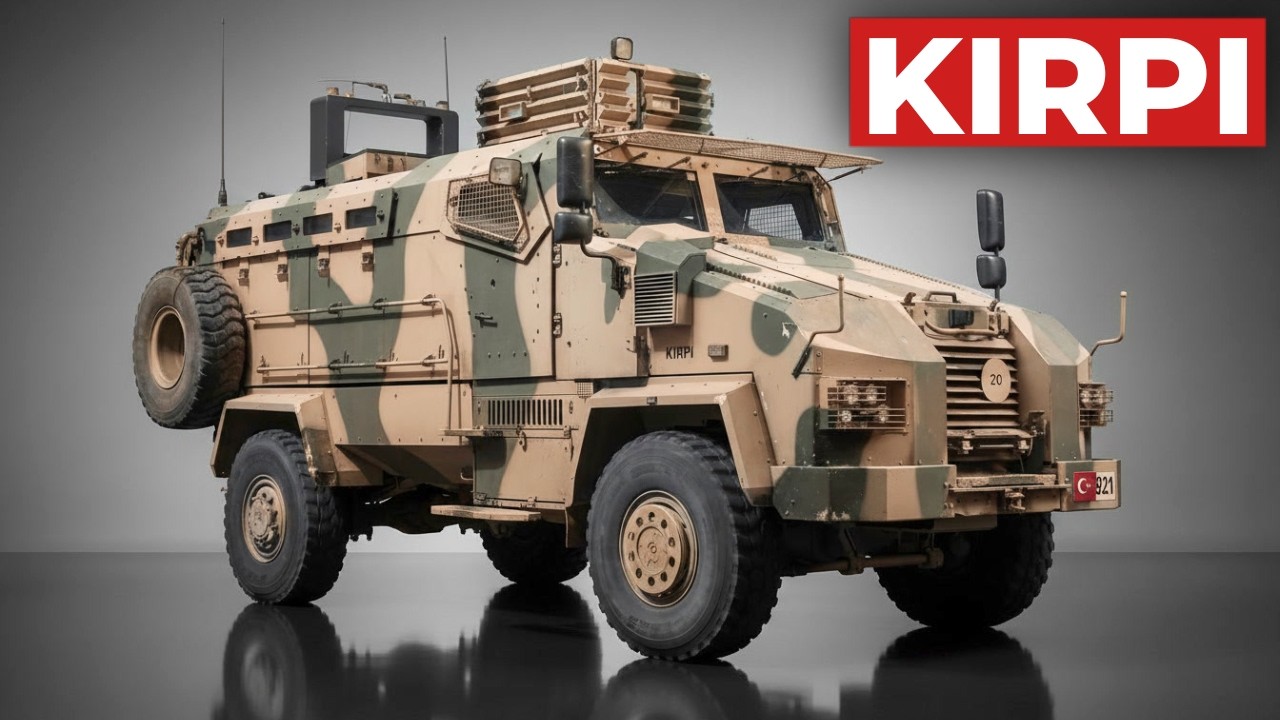
The Turkish army learned. By Operation Olive Branch in Afrin in early 2018, Kirpis were rolling out of factories already fitted with Roketsan slat armor cages designed to defeat tandem warhead rocket-propelled grenades. In Operation Peace Spring in October 2019, at least one Kirpi was captured intact by Kurdish forces near Tel Tamer.
It later appeared in the propaganda photographs of the Syrian Democratic Forces during the de-escalation period after Operation Spring Shield in Idlib. On March 27th, 2022, near the town of al-Atarib, a Syrian army Konkurs missile tore into a Kirpi 2. The vehicle was severely damaged. An officer and two soldiers were wounded. All three lived.
Then came the foreign careers. Tunisia became the first export buyer in 2014. Postolu’s account of what followed has become a BMC sales legend. When al-Qaeda in the Islamic Maghreb attacked Tunisian Kirpis in the Chambi Mountains, every soldier walked out alive. Tunis ordered a hundred more. By 2021, after a follow-on contract for 41 troop carriers and five ambulances, Tunisia operated 233 Kirpis, the largest non-Turkish fleet at the time.
But, it was the Russian invasion of Ukraine that gave the Kirpi its largest combat trial. The first 50 vehicles crossed the Romanian border in August 2022 for the Ukrainian Marine Corps under a government-to-government deal. By March 2025, BMC disclosed 687 vehicles delivered to Ukraine, 507 of the original Kirpi and 180 Kirpi 2s.
A Ukrainian Marine known only as Anton told the defense outlet Defense Express that there were moments when his unit was hit by both tank fire and anti-tank missiles, and the vehicles withstood. Another crewman recalled a Kirpi that took two first-person view drone hits to the front and still drove out of the engagement.
A viral video circulated in 2024 showing a single Ukrainian Kirpi surviving four consecutive drone strikes during one ambush. Only the fifth drone defeated the vehicle, and it did so by flying through a rear door the crew had left open after evacuating. The cost has nonetheless been real. As of late 2025, the open-source visual loss tracker Oryx had documented 133 Kirpis destroyed, damaged, abandoned, or captured across the Ukrainian front.
Russia has captured at least nine intact and pressed them into its own service. On paper, the Kirpi looked unremarkable beside its Western competitors. The American MaxxPro carried six to 10 soldiers in a bolted hull. The Cougar seated just six in a 14-ton package. The South African RG-31 Nyala was lighter and faster. The legendary Casspir was older and more proven.
In practice, the Kirpi split the difference. Heavier than the lithe Nyala, more modern than the Casspir, built around a true welded steel monocoque rather than bolted plate construction, capable of carrying 13 men instead of six and critically far cheaper. The 2017 Kirpi 2 contract for 529 vehicles came in at roughly 350 million dollars, about 660,000 dollars per vehicle, a fraction of the MaxxPro’s near 1 million dollar unit cost.
Turkey had built a mine resistant ambush protected vehicle that the Tunisian, Qatari, and Ukrainian armies could actually afford to buy in numbers. The export list grew quickly. At the Doha defense exhibition in 2018, Qatar signed for 50 Kirpi 4x4s alongside 35 BMC Amazon armored cars, fitting given that Qatar’s sovereign defense fund QAFIC owned roughly half of BMC at the time.
Turkmenistan ordered 10 Kirpis and 90 of the lighter Vuran scout vehicles. Turkey donated 12 Kirpis to Somalia’s Gorgor Commando Brigade for the war on Al-Shabaab. Kosovo ordered 14. Libya’s Government of National Accord received over 40. Bosnia and Herzegovina signed in December 2024 and the first four Kirpi 2s were delivered as a Turkish donation in June 2025.
Bosnian Defense Minister Zukan Helez explained his choice plainly. These vehicles, he said, had demonstrated exceptional performance in Ukraine. The road to that legacy was not smooth. In 2013, BMC’s parent company Çukurova Holding collapsed. 173 vehicles were left undelivered. Workers picketed the factory gates with placards reading “Do not stop the Kirpi.
Do not get soldiers shot.” The Turkish state seizure agency rescued the program and sold the company in 2014 to a consortium led by Ethem Sancak for 751 million Turkish lira. Qatar’s QAFIC took a 49.9% stake. In 2021, the Turkish half passed to the Tosyalı steel dynasty. Around the Kirpi, BMC built an entire armored family, the lighter Vuran, the compact Amazon, the new Altug 8 by 8, and the long-awaited Altay main battle tank, whose first two production T1 vehicles rolled out on October 28th, 2025, and on January 10th, 2025, BMC delivered its first 100 Kirpi 2s powered by the new Tuner, a 400 horsepower diesel engine built by sister company BMC Power at Karasu, finally replacing the imported American Cummins block. The head of Turkey’s defense industry, Professor Haluk Gorgun, stood beside
chairman Fuat Tosyali as Tosyali called it a very important step toward reducing external dependency. Return to that mountain pass outside Cukurca on August 17, 2011, a boxy steel vehicle, 16 tons of welded plate, a V-shaped belly, slab-sided armor that critics called crude. The Kirpi was never elegant.
It was tall and slow. It was originally dependent on an American engine. It lost two soldiers to an anti-tank missile in northern Syria. It lost Lieutenant Colonel Ilker Celikkan in the Darlac Islands. By the end of 2025, 133 of them had been knocked out across the Ukrainian front, and yet it worked. It worked in the mountains of Hakkari.
It worked in the burning streets of Cizre. It worked on the Albab plain. It worked in the Chambi range against Al-Qaeda. It worked in the swamps of Kherson under Russian drones. By BMC’s own count, the platform’s first 600 vehicles plausibly saved between 6,000 and 7,000 Turkish soldiers. It dragged a struggling truck factory in Izmir into the front rank of NATO armored exporters.
It gave Turkey its first mass-produced indigenous military diesel engine. And on the day the road exploded, it mostly let the soldiers walk home. That is not luck. That is the difference between theory and war.