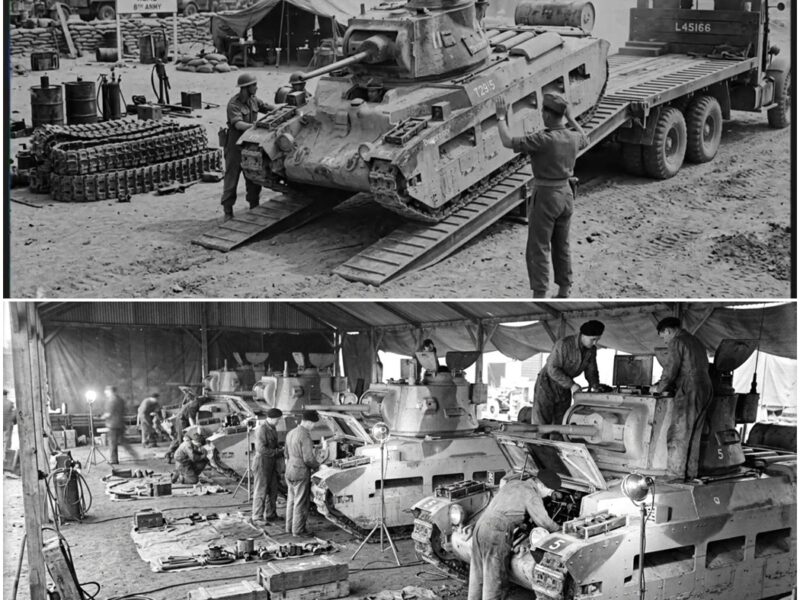
The British Trick That Made Matilda Tanks Nearly Impossible to Stop in North Africa D
Sidi Barrani, the 9th of December, 1940. A column of British tanks rumbles across the Egyptian desert at a top speed of just 15 mph, slower than a man on a bicycle could manage on a good road. German and Italian anti-tank crews watch them come, load their guns, and fire. Shell after shell strikes home.
Shell after shell bounces off. By the time the smoke clears at Beda Fomm, 2 months later, an entire Italian army has been shattered, and the tank that did it, the Matilda II, has earned a nickname from its enemies that says everything. Queen of the Desert. On paper, this machine should have been a liability.
It was slow, thinly gunned, and mechanically unglamorous. In practice, it was nearly unkillable, and that apparent weakness in mobility was about to be revealed as the very thing that let its armor do something no one on the Axis side had planned for. Standard military thinking in the late 1930s, on both sides of the channel, prized speed and firepower above all else.
Cavalry doctrine had simply been transplanted onto tracks. A tank was meant to exploit a breach, race through open and outmaneuver the enemy before he could react. The German Panzer II and Panzer III were built around this philosophy, with armor barely thick enough to stop rifle fire and small arms, because their designers assumed speed itself was the defense.
Critics of the Matilda, and there were many within the British army itself, argued along the same lines. Major General Percy Hobart, an early champion of armored warfare, wanted fast cruiser tanks that could range across the battlefield. The Matilda, weighing in at over 26 tons and capable of barely outpacing a marching seemed to belong to an earlier war.
Standard doctrine held that a tank this slow would simply be outflanked, surrounded, and picked apart at leisure. They were right that it could not run. They were wrong about what that would cost it. The secret was in the armor, and in a decision that had nothing to do with impressing anyone in peacetime testing.
The Matilda II carried up to 78 mm of cast and rolled armor on its front hull and turret at a time when most tanks in the world carried between 15 and 30 mm, that number alone does not convey what it meant on a battlefield. So, consider the maths that German gunners were doing in their heads every time a Matilda came into range.
The standard German anti-tank gun of 1940 and early 1941 was the 3.7 cm Pak 36, a weapon so thoroughly outclassed by the Matilda that German troops gave it a bitter nickname of their own, the Heeresanklopfgerät, the army door knocker, because that was all it seemed to do, knock politely on the Matilda’s hide and then bounce away.
At standard combat ranges of 500 to 1,000 m, the Pak 36 could penetrate perhaps 30 to 35 mm of armor. Against the Matilda’s frontal 78 mm, it was firing blanks with extra steps. Even the Italian 47/32 anti-tank gun, a notably better weapon than the German 37/30, struggled to consistently penetrate the Matilda’s glacis at anything beyond point-blank range.
What actually mattered on the ground was not how fast a tank could run from a threat, but whether the threat could hurt it at all. If nothing in the enemy’s arsenal could reliably punch through, then speed became irrelevant. The tank did not need to dodge blows it could simply absorb. Operation Compass proved this in the most brutal terms imaginable.
Beginning in December 1940, the British 7th Royal Tank Regiment took fewer than 50 Matildas into action against a numerically vastly superior Italian force defending fortified positions at Sidi Barrani, Bardia, and Tobruk. Italian gunners at Sidi Barrani reported firing directly into advancing Matildas at ranges under 200 m and watching their rounds glance off.
Captured Italian officers, questioned after the fall of Bardia in January 1941, told their British interrogators that they simply had no weapon capable of stopping the tanks once they closed distance, and that infantry morale collapsed at the mere sight of them advancing, unhurried and seemingly untouchable, through positions that had been built specifically to repel armor.
By the time the campaign reached its climax at Beda Fomm in February 1941. The Italian 10th Army had lost some 130,000 men captured alongside more than 400 tanks and 190 artillery pieces for a British cost that barely registered by comparison. The Matildas that led these assaults were not fast. They did not need to be.
Italian anti-tank crews described the experience of watching their shells simply fail to penetrate as more demoralizing than any barrage because it removed the one thing a defender relies on. The belief that his weapon can hurt what is coming at him. This wasn’t a lucky accident of armor thickness stumbled into by British engineers with no larger plan.
It reflected a design philosophy that dated to the Matilda’s origins as an infantry support tank built under the direct requirement that it survived contact with whatever anti-tank guns the enemy fielded because its job was to accompany foot soldiers directly into the teeth of prepared defenses at walking pace absorbing punishment so the infantry behind it did not have to.
Vulcan Foundry, which built the Matilda, used cast armor sections for the turrets and thick rolled plate for the hull specifically because ballistic protection, not speed, was the entire point of the vehicle’s existence. Commanders who insisted on this heavy armor over a faster, more lightly protected design were not clinging to outdated cavalry romance.
They understood something that peacetime trials conducted on smooth ranges against known gun types at known ranges could never fully capture. That in actual combat, an infantry tank’s job was to survive an unpredictable barrage from guns of uncertain in position for as long as it took to break a defensive line and no amount of speed helps a tank that has already been destroyed trying to outrun a shell it never saw coming.
The turning point and the moment that proved just how deliberately effective this design was came when the Germans finally found an answer and it tells you everything about how extreme the Matilda’s advantage had been. Erwin Rommel arrived in North Africa in February 1941 to find his own Panzer Regiment’s guns essentially useless against the British infantry tank and he did not solve the problem with a better anti-tank gun in the conventional sense.
He solved it by repurposing the 8.8 cm flak 18 and 36, an anti-aircraft gun originally designed to reach enemy bombers at high altitude and leveling its barrel to fire directly at tanks over open sights. At the Battle of Hellfire Pass in May 1941, later remembered by British troops as Hellfire Pass, dug-in 88-mm guns destroyed roughly a dozen Matildas of the 4th Royal Tank Regiment in a matter of minutes during Operation Brevity and again during Operation Battleaxe the following month where British armored losses again concentrated heavily around 88-mm gun positions. The 88 could penetrate over 80 mm of armor at 1,000 m, finally exceeding what the Matilda could shrug off, but the fact that Germany needed to press an anti-aircraft weapon originally built to engage targets miles overhead into a desperate ground role tells you how completely their existing anti-tank arsenal had failed. Rommel himself in reports back to Berlin noted that British Queen of the Desert tanks were proof against standard anti-tank fire and that only the
heaviest guns available could stop them. That is not a minor technical footnote. That is the commander on the ground admitting that his standard doctrine had been rendered obsolete by a slow, unglamorous tank that critics back home had dismissed as behind the times. Why did it work beyond the raw armor figures? Because battlefields are not gunnery ranges and the chaos of an actual engagement rewards different qualities than a controlled test does.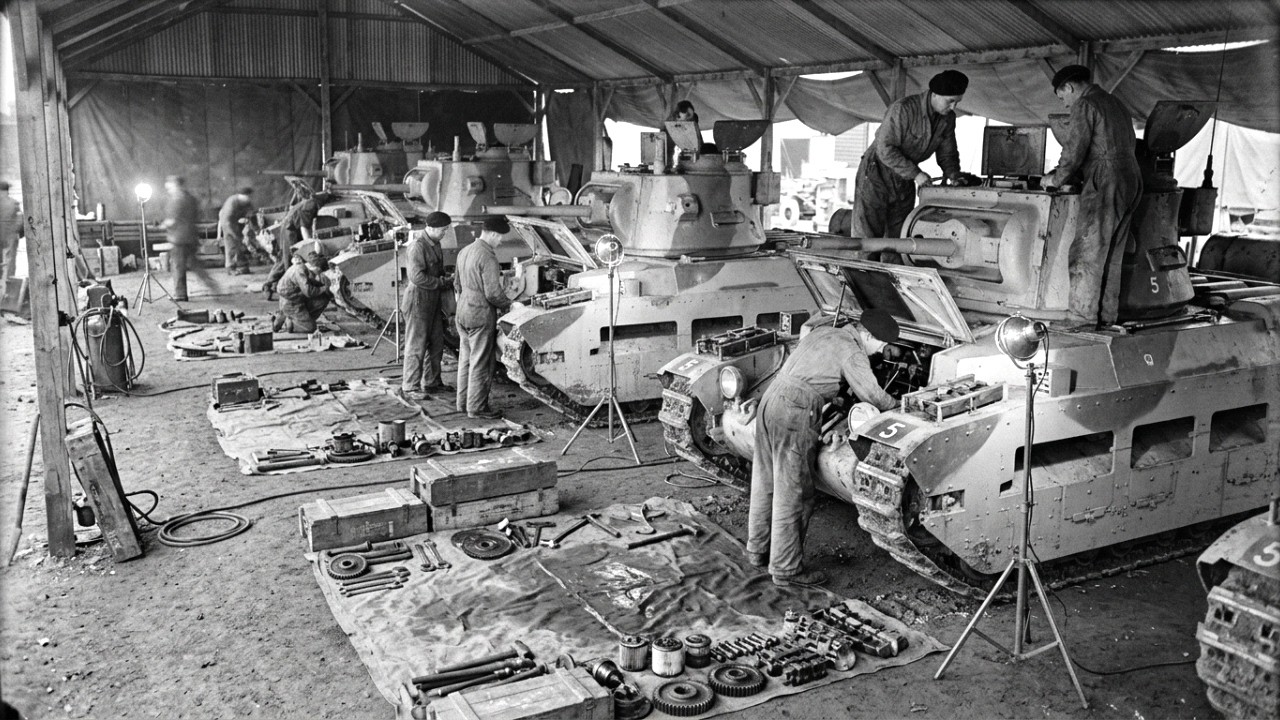
What looked unimpressive in peacetime demonstrations, a top speed that a determined man could nearly match at a jog, became irrelevant the moment it turned out the enemy could not hurt the thing regardless of how fast it moved. What looked good on paper for the German and Italian anti-tank guns, adequate penetration figures against typical armor thicknesses, collapsed the instant they met a tank that had simply been built heavier than anyone expected an infantry support vehicle to be.
The Matilda’s 2-pounder main gun was itself unremarkable and British tank crews knew it, but that hardly mattered when the vehicle’s core function was not to win tank duels at range, but to walk directly into a defended line, survive the incoming fire that would have killed anything else, and let the infantry behind it do the rest.
This is precisely why the Matilda earned respect it never should have deserved by the numbers alone. It survived the one test that mattered most in actual combat, which was not, can it move quickly, but can it be killed with what the enemy actually has in his hands right now? There’s a second, quieter piece of this story that rarely makes it into the headline version.
And it concerns the crews themselves rather than the steel around them. Standard doctrine assumed that thin, fast tanks kept their crews safer through evasion, whilst thick, slow tanks exposed their men to prolonged fire simply because they took longer to cross open ground. In practice, Matilda crews reported something close to the opposite experience.
Trooper accounts collected after Operation Compass describe an odd, almost surreal calm inside the tank during an advance. Because the crew could hear enemy rounds striking the hull, a flat metallic crack, rather than the catastrophic bang of a penetrating hit, and carry on regardless. One account from a 7th Royal Tank Regiment crewman, recorded after Bardia, described counting eight direct hits during a single approach without the tank so much as losing a track.
That sound, repeated shot after shot with no effect, did more for crew morale than any amount of speed ever could have, because it told the men inside exactly what it told the Italian and German gunners outside. Whatever they were shooting with was not going to be enough. Fear in combat is rarely about statistics.
It is about what a soldier can see and hear happening to him in the moment. And a Matilda crew’s moment-to-moment experience was one of near total confidence that the machine around them would carry them through, regardless of how slowly. This mattered tactically as well as psychologically. Because Matilda crews were not managing the constant exhausting calculations of exposure time and firing lanes that faster, thinner-skinned tank crews had to perform, they could commit to a more direct, deliberate style of attack.
Commanders used the Matilda not to maneuver cleverly around a defensive position, but to walk straight through the middle of it, trusting the armor to soak up whatever the defenders threw back, whilst infantry followed close behind under that same cover. This is precisely the infantry tank concept as originally conceived, and North Africa was the first time it was tested against a real determined defense rather than a training exercise.
It succeeded not because the tactic was subtle, but because the Matilda made the subtlety unnecessary. A frontal assault that would have been suicidal for a Panzer II or an early model Panzer III, both of which carried armor that German rifle grenades could occasionally damage, became almost routine for Matilda crew who knew the enemy gunners were, in effect, firing blanks.
Even the limitations critics pointed to before the war reinforced this pattern rather than undermining it. The Matilda’s notoriously low top speed, deliberately capped by a modest diesel engine setup that prioritized reliability over performance, meant it rarely outran its own infantry support or its supply chain, a problem that plagued faster cruiser tank formations later in the campaign when they surged ahead of fuel and ammunition resupply and were picked off in isolation.
Slowness, treated as an unambiguous weakness by peacetime theorists, became a form of battlefield discipline once paired with armor that removed the usual penalty for moving cautiously. By late 1941, newer German guns, the long-barreled 5 cm Pak 38 and eventually up-gunned Panzer IIIs and IVs firing improved ammunition, closed the gap and the Matilda’s reign as the desert’s near-invulnerable king came to an end almost as quickly as it had begun.
Its own armament, never more than a 2-pounder gun with no effective high explosive shell, was already a growing liability against dug-in anti-tank positions and infantry, and newer designs like the Valentine and eventually the American Grant and Sherman would take over the front line role. But for roughly a year, from Operation Compass through the early clashes with Rommel’s Afrika Korps, a tank that critics inside its own army considered obsolete before it ever left England had done something no cruiser tank, however fast, however elegantly designed, had managed. It had made the enemy’s entire anti-tank arsenal, save for one desperately repurposed anti-aircraft gun, functionally irrelevant. German and Italian gunners who had trained for years against the standard doctrinal assumptions of thin, fast tanks found themselves facing something their manuals had not prepared them for. And the psychological toll of watching shell after shell fail to penetrate proved just as decisive as the armor plate itself. The lesson British planners drew from this and carried forward into later tank designs was not that speed didn’t matter in general. It
was that survivability against the weapons actually in the enemy’s hands mattered more in that specific campaign than survivability against the weapons a design committee assumed he might eventually field. Standard military thinking had prized mobility as the universal virtue of armored warfare. The Matilda’s brief, brutal dominance in the desert showed that mobility is only ever a means to an end, which is staying alive long enough to accomplish the mission, and that a tank too slow to run from a fight it could simply not lose was, in its own way, the most dangerous machine on the field. Critics had been right that the Matilda could not outmaneuver a determined enemy. They had simply failed to imagine an enemy who, for a full year in the North African desert, had nothing in his arsenal capable of making that matter.