The ‘Cheap’ French Personnel Carrier That Armed More Foreign Armies Than Any Western APC D
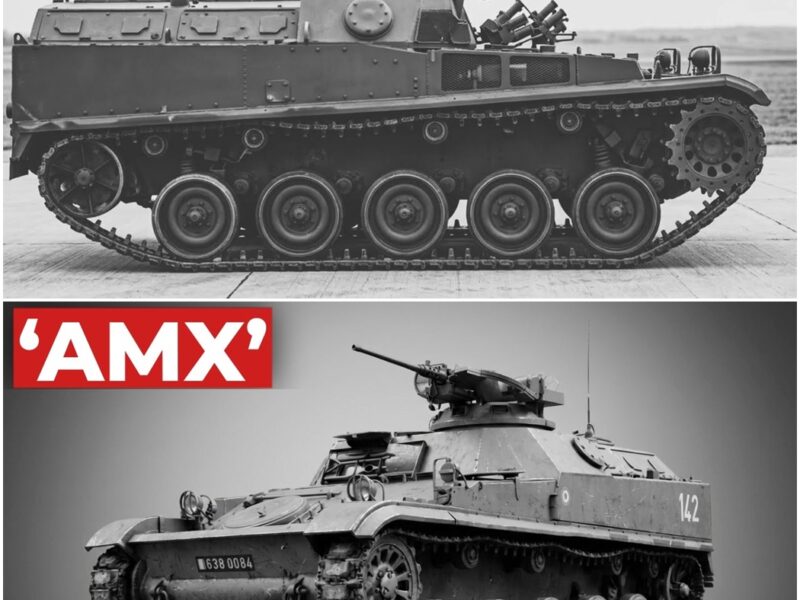
1957, the Atelier de Construction de Roanne, deep in the Loire Valley, Central France. A tracked vehicle rolls off the production line and into the gray morning light. It weighs 15 tons. It sits low on five road wheels per side. It’s welded steel hull rising into a flat-topped superstructure that looks like someone saw the turret off an AMX 13 light tank and bolted a metal shed in its place.
The engine, a petrol unit mounted backwards and offset to the right, rumbles through a compartment so tight the exhaust heat bleeds into the troop bay behind it. 10 infantry men are supposed to ride back there, pressed shoulder to shoulder on two metal benches, breathing fumes, staring at four pistol ports per side that nobody has yet proven will work under fire.
The armor is 30 mm at the front, 10 at the sides, enough to stop a rifle bullet, not much else. It looked cheap. It looked expendable. It looked like something a conscript army would build because it could not afford anything better. That vehicle would go on to equip more than a dozen foreign armies across four continents, serve in at least five wars France itself never fought, spawn over 20 specialist variants from ambulance to missile destroyer, and remain in front-line military service for nearly 70 years. Its designation was the AMX-VCI, the Véhicule de Combat d’Infanterie, and it was the armored personnel carrier that France sold to the world while never once taking it to war itself. To understand why the AMX-VCI existed, you need to understand the problem France faced in 1952. The French army had been rebuilt after 1945 almost entirely with American equipment. M3 half-tracks carried the infantry. M24 Chaffees crewed the reconnaissance squadrons.
American M75 armored personnel carriers, loaned under mutual defense agreements, filled the mechanized brigade stationed in occupied Germany. Every one of those vehicles belonged to Washington. Every spare part depended on American goodwill. And France, under the Fourth Republic, was determined to build a sovereign defense industry that owed nothing to anyone.
The engineers at the Atelier de Construction d’Issy-les-Moulineaux, known as AMX, had already solved half the problem. Under Engineer General Joseph Molini, director of AMX from 1945 to 1961, the workshop had produced the AMX 13 light tank, a 14-ton tracked vehicle with an oscillating turret and an autoloader that no other Western nation could match. The chassis was proven.
The SOFAM 8 GXB petrol engine, an eight-cylinder water-cooled unit delivering 250 horsepower, was in mass production. The torsion bar suspension, the Cleveland type steering differential, the front mounted drive sprockets were all understood. What France lacked was a vehicle to carry the infantry alongside those tanks.
In 1952, the Section Technique de l’Armée issued a formal requirement for a tracked troop carrier. Two prototypes from Hotchkiss were rejected. Molini’s team at AMX proposed the obvious solution. Strip the turret from the AMX 13, raise the hull, weld a steel superstructure over the engine and troop compartments, keep the powertrain, the running gear, the transmission, everything that already worked.
Build a battle taxi from a light tank. Four prototypes were tested between April and June of 1956. The design was accepted. A pre-series of 25 vehicles followed in 1957. Mass production began in 1960 with 230 vehicles delivered that year alone. By the time the line closed in 1973, roughly 3,400 hulls of all variants had been built.
The vehicle itself was a masterpiece of practical economy. The hull measured 5.7 m long, 2.67 m wide, and 2.41 m high. Combat weight sat at 15 tons in the basic troop carrier configuration, rising to 16 and 1/2 tons with the later 20 mm autocannon turret. The SOFAM petrol engine pushed the vehicle to a top road speed of 60 km/h with a range of 350 km.
Three crew rode up front, a driver on the left, the engine to his right, a commander behind. 10 infantrymen entered through twin outward opening doors at the rear. Four pistol ports per side and one in each rear door allowed the squad to fire from inside, a feature that predated the Soviet BMP-1 by nearly a decade.
Armament evolved across the production run. Early vehicles mounted a simple AA-52 machine gun on an open ring. Then came the CAFL-38 one-man cupola, then a shielded 12.7 mm Browning mount, and finally the T2013 2 can one turret mounting a 20 mm GIAT auto cannon, the configuration that earned the vehicle the VCI designation and made it, arguably, one of the world’s first infantry fighting vehicles.
A 60 mm internal mortar reloadable through the roof hatch was available as an option. The hull could not swim. It had no amphibious capability whatsoever. That single limitation would define its competitive position for the rest of its career. The base hull spawned one of the broadest variant families of any Western Cold War vehicle.
Command posts, combat engineer vehicles with dozer blades and hydraulic cranes, artillery support carriers for the 155 mm self-propelled gun, armored ambulances, 81 and 120 mm mortar carriers, cargo haulers, ground surveillance radar platforms, and anti-tank missile destroyers carrying ENTAC, SS-11, Milan, and TOW guided weapons.
An anti-aircraft variant mounted twin 20 mm cannon. A Roland surface-to-air missile carrier rounded out the air defense role. Belgium produced 641 vehicles in six subtypes. The Netherlands fielded roughly 599. Argentina assembled 60 of its 240 vehicles under license. The VCY was not just a troop carrier, it was a chassis that could become almost anything an army needed, and that versatility sold it to nations that could not afford a different vehicle for every role.
Now, before we get into where this vehicle actually fought, if you are enjoying this deep dive into Cold War armored vehicle history, hit subscribe. It takes a second, costs nothing, and helps the channel grow. Here is the strangest fact about the AMX-VCI. France never took it to war, not once. The vehicle’s operational career in French hands was pure Cold War deterrence, decade after decade of exercises in the forests and plains of West Germany.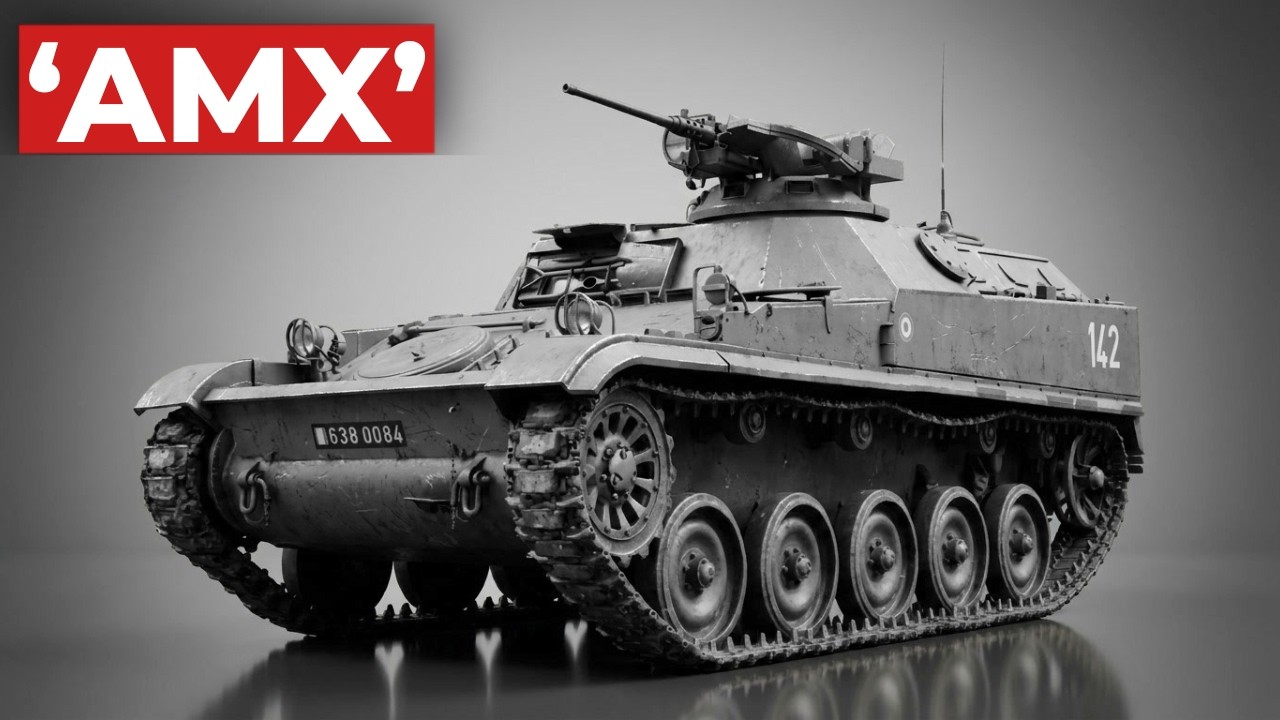
The Forces Françaises en Allemagne fielded for seas in their standard mechanized brigades, 56 vehicles per infantry regiment. The 24th Group de Chasseurs Port at Tubingen was the first unit equipped in 1964. The second and fifth Cuirassier, the 11th Regiment de Chasseurs in Berlin, the 42nd Regiment d’Infanterie Mécanisée at Wittlich.
All of them trained for a Soviet offensive that never came. Crews rotated to the Berlin garrison aboard the secret train militaire français de Berlin, a 25-hour rail journey through East German territory. They exercised, they maintained, they waited. They never fired a shot in anger.
The wars belonged to other armies. Lebanon is the AMX-VCI’s defining battlefield. The Lebanese army received 60 vehicles in 1971 and 1972, followed by 30 more in May of 1983. When the Lebanese Civil War shattered the national army in January of 1976, most of those vehicles bled into the hands of the competing militias. The Lebanese Forces took some.
The Amal Movement captured others from 1984 onward, operating them until returning the vehicles to the reconstituted army in October of 1990. The Israeli-backed South Lebanon Army kept its share until the SLA collapsed during Israel’s withdrawal in April of 2000. 90 French-built armored carriers, intended for a single national army, ended up arming at least four factions in a war that lasted 15 years.
The vehicle outlasted every ceasefire that failed to hold. The most dramatic episode came during the Elimination War of February 1990 in East Beirut. General Michel Aoun’s loyalist forces, desperate for anti-armor capability, bolted American M40 106-mm mm recoilless rifles onto VCI hulls and used them as improvised tank destroyers against the Christian Lebanese Forces militia in the streets of Ain el Remmaneh and Hadath.
The Lebanese Forces captured several of the same vehicles in the fighting that followed. A French-built troop carrier designed to deter the Soviet Union in Germany was killing Lebanese in a civil war that France had no part in. Two abandoned Lebanese VCIs were picked up by Israeli forces during the 1982 invasion.
One sits today at the Yad La-Shiryon Tank Museum at Latrun, a trophy from someone else’s catastrophe. Indonesia is the second great combat operator. 32 vehicles arrived from France between 1960 and ’62. When the Dutch withdrew from West Papua, AMX-13s and VCIs deployed under Operation Tricora. In October of 1965, VCIs rolled into Jakarta to secure the capital for General Suharto.
During the crackdown following the 30th of September Movement, Indonesian VCIs are documented in Operasi Seroja, the December 1975 invasion of East Timor under the command of Brigadier General Dading Kalbuadi. They appeared again in the 2003 to 2004 Aceh offensive. By 2016, only about 75 remained operational. Indonesia’s state-owned manufacturer Pindad has retrofitted survivors with a 400 horsepower diesel engine, extending the hull by 20 cm, and replacing the original petrol fire hazard with something that might last another decade. Mexico represents the most recent chapter. In the early 2000s, the Mexican Army acquired 401 ex-Belgian VCI hulls refurbished by the Belgian firm Sabiex International and modernized by Mexico’s own defense ministry as the DNC-1. The vehicles received diesel engines, 20-mm cannon turrets, Milan anti-tank missiles, and MK-19 grenade launchers. They remain front-line
equipment today. In February of 2026, following cartel attacks after the killing of a major cartel leader, DN C1s deployed into the streets of Puerto Vallarta. A vehicle designed in 1952, built in the 1960s, retired by Belgium in the 1990s, and sold as surplus, was conducting urban security operations in 2026, 70 years after the first prototype.
On paper, the American M113 looked superior. It was lighter at 12.3 tons, genuinely amphibious without preparation, vastly cheaper per unit, and produced in staggering numbers, more than 80,000 built, equipping over 50 nations. Against that industrial juggernaut, the VCI’s export record of roughly 13 to 15 operators looks modest.
The popular claim that it equipped more foreign armies than any Western APC of its generation is, against the M113, simply false. But against every other European competitor, the French vehicle won. The British FV432 was heavier, less versatile, and barely exported at all. The German HS.
30 was a procurement disaster that cost the Bundeswehr years of delay and political scandal. The VCI outsold both combined, and in one critical respect, the French vehicle offered something the early M113 did not, firing ports, a cannon turret, the ability for infantry to fight from inside the vehicle rather than simply ride to the battlefield and dismount.
The AMX-VCI was conceptually closer to an infantry fighting vehicle than a battle taxi. Years before the Soviet BMP-1 made that concept standard doctrine, the Americans built the M113 as a battlefield taxi. Get in, ride forward, get out, fight on foot. The French built the VCI as a vehicle the infantry could fight from.
That philosophical difference, born in 1952, would not become Western orthodoxy until the Marder and the Bradley arrived decades later. The AMX-10P replaced the VCI in French service beginning in 1973. Fully amphibious, NBC protected, fitted with the Toucan 220 mm turret, the new vehicle corrected every limitation of its predecessor.
The 30th Group de Chasseurs of the 7th Division Blindee was the last French unit to retire the VCI, finally letting it go in 1990. France itself now fields the wheeled VBCI. The AMX-10P is gone. The VCI’s replacement has been replaced. And yet the VCI itself endures in Mexican armories, in Indonesian barracks, in Venezuelan National Guard depots, where refurbished examples were delivered as recently as May of 2024.
At the Musee des Blindes at Saumur, a runner appears at dynamic displays. Its SOFAM engine still turning over after six decades. 1957, the Atelier de Construction de Roanne, the Loire Valley. A 15-ton tracked box rolls off the line with a backwards mounted petrol engine, 30 mm of armor, and room for 10 men who would rather be anywhere else.
It had no amphibious capability. It had no night vision. It had no NBC protection. Its engine ran on petrol in an era moving to diesel. Its armor stopped rifle bullets and nothing heavier. Every specification sheet said it was adequate, nothing more. And yet it worked in the forests of Germany where French conscripts trained for a war with the Soviet Union, in the streets of Beirut where militias bolted recoilless rifles to its hull and fought house to house, in the jungles of East Timor where Indonesian paratroopers used it to secure a nation that did not want to be secured, in the mountains of Aceh, in the cartel corridors of Western Mexico. 70 years after the first hull left Roanne, France built the AMX-5CI to fill a gap. It filled gaps on four continents that France never intended and never controlled. 15 nations bought it, three are still using it. That is not marketing. That is the difference between a specification and a machine that refuses to die.