The “Civilian” Canadian Truck Ukrainians Use To Survive Russian FPV Drones And Land Mines D
Summer 2024, the Kupiansk axis, Kharkiv Oblast. A Ukrainian major with the call sign Achilles is showing Canadian journalists what his unit drives to the line. Major Yuri Fedorenko commands the Achilles strike drone battalion of the 92nd Assault Brigade. He has lost vehicles. He has buried friends.
He has spent 2 years learning what works and what does not on the long thin ground east of Kharkiv. He points at the truck. It is not designed to drive off-road, he tells the camera. This is an option for the police, for the protection of public order, but it fulfills its task. It saves people.
When there is no alternative, it is what we need. The vehicle behind him does not look like a war machine. It is built on a North American pickup truck chassis. The same chassis fire departments use in rural Ontario. The same chassis American farmers use to haul cattle trailers down county roads. Across the front sits a heavy armored cab with run-flat tires bulging under the wheel arches.
Underneath, hidden from the camera, runs a V-shaped hull rated to swallow 8 kg of anti-tank mine under any wheel and keep moving. It was designed in a Toronto warehouse for cash-in-transit guards and SWAT teams. By 2026, it would be the most widely fielded western armored vehicle in Ukrainian service.
And the one Ukrainian special forces would credit with surviving a direct FPV drone strike near Pokrovsk in July 2025. Eight men inside, all eight walked away. Ukrainian crews call it the Rochelleka. The Canadians who built it call it the Senator. Toronto, 2016. A small industrial unit in the city’s north end.
Roman Shimonov, an Israeli army veteran with 15 years in the Israel Defense Forces and a Toronto MBA, registers a company called Roshel Smart Armored Vehicles. The first customers are Canadian banks and a handful of municipal police departments. Cash in transit, SWAT raids, riot control. The work is quiet. The orders small.
By 2018, the first vehicle leaves the line. Shimonov has built his business around a single design principle. He will not engineer a bespoke military chassis. He will buy Ford F-550 Super Duty trucks off the commercial line, ship them to his Ontario facility, and bolt a custom armored capsule onto a frame that Ford already builds at industrial scale.
2020 rolls around. The Senator is now niche enough that NASA buys one to escort the Crew Dragon demonstration two astronauts at Cape Canaveral. Outside that contract, the company is still small, fewer than 100 employees, a few hundred vehicles built in total. Then February 24, 2022. Roshel goes from making armored trucks for police forces to building them at three shifts a day, six days a week, for a war 4,000 mi away.
The vehicle is officially designated the Roshel Senator armored personnel carrier. The combat modified version, the one Canada and the rest of NATO would soon be shipping to Kyiv, is the Senator MRAP. The specifications matter. The Ford F-550 brings a 6.7 L Power Stroke turbo diesel V8, 330 to 400 horsepower, 750 Newton meters of torque, a 10-speed automatic gearbox, and permanent 4×4 drive. Top speed exceeds 100 km/h.
Range approaches 1,000 km on internal fuel. That commercial drivetrain is the entire premise of the platform. Every spare part exists in any Ford dealership on three continents. The armor is where Roshel adds the war. The perimeter capsule is rated to CEN B7, defeating 7.62 by 51 mm NATO armor-piercing rounds at 10 m.
The V-shaped underbelly is certified to STANAG 4569 level three, surviving 8 kg of explosive under any wheel, 6 kg under the hull center line, or 25 kg of TNT as a side charge. Inside sit blast-attenuating seats with four-point harnesses, capacity for eight crew in the MRAP or up to 10 in the APC, 360° video surveillance thermal optics, and a roof hatch ring for a remote weapon station.
Each vehicle costs approximately $600,000. Assembly takes roughly 2 weeks per unit. By 2024, the Brampton plant is producing 1,500 Senators a year, employs 500 full-time workers, and reserves a third of its workforce for Ukrainian refugees who fled the same war their vehicles are now fighting. The Canadian government becomes Roshel’s first major sovereign customer.
On April 26, 2022, Prime Minister Justin Trudeau announces a 500 million Canadian dollar Ukraine aid package. Eight Senators ship out within weeks. On January 18th, 2023, Defense Minister Anita Anand visits Kyiv and announces 200 additional Senators worth 90 million Canadian dollars. “I have heard repeatedly,” Anand tells the press conference, “Ukrainian troops appreciate their maneuverability and their adaptability.
They are equipped with smart tech, and that helps soldiers detect threats early.” What Anand does not say in that press conference is that the Canadian government order has just hit fuse. The United States State Department is watching. The European Union is watching. Ukrainian charities, led by the Serhiy Prytula Foundation in Kyiv, are watching.
By 2026, more than 90% of every Senator Ukraine receives will be funded by someone other than Ottawa. Canada had handed the world a vehicle worth buying. What happened to a Ukrainian border guard windscreen at Vovchansk in 2024 and to a special purpose detachment near Pokrovsk in July 2025 would prove the design philosophy a Toronto entrepreneur had bet his company on.
But first, if you are enjoying this deep dive into Canadian engineering, hit subscribe. It takes a second and helps the channel grow. Now, the combat record. The first eight Senators reach Ukrainian border guard units in May 2022. They are pushed straight into the Donetsk approaches and the Sumy frontier.
Ukrainian crews discover almost immediately that the platform is not what they expected. Drivers who learned their trade on Soviet armored carriers are stunned by the cab layout, the air conditioning, the digital instrument cluster. One former civilian freight forwarder driving for a border guard brigade tells Ukrainian outlet Militarni that the Senator drives like a passenger car.
By July 2023, the delivery count passes 550. By December that year, the 1,000th Senator rolls off the Brampton line bound for Ukraine. The Serhiy Prytula Charity Foundation pays for five Senators to be converted into mobile command posts and hands them to the Communications and Cybersecurity Command of the Armed Forces.
The combat doctrine that emerges is unusual. Ukrainian crews begin tucking Senators behind tanks during mechanized assaults, using the MRAP as a follow-on infantry carrier while the tank ahead breaks the trench line. Forbes documents the tactic in September 2023. It works. The Senator is too light to lead an assault, but with a Leopard or a T-64 in front, it is fast enough, protected enough, and small enough to thread between shell craters.
The vehicle’s signature trick is staying alive when nothing else around it does. At Vovchansk in 2024, a Ukrainian border guard from the Heart Brigade, identified only by the call sign Sensei, watches a Russian FPV drone strike his windshield at full speed. The glass holds. The crew compartment stays intact.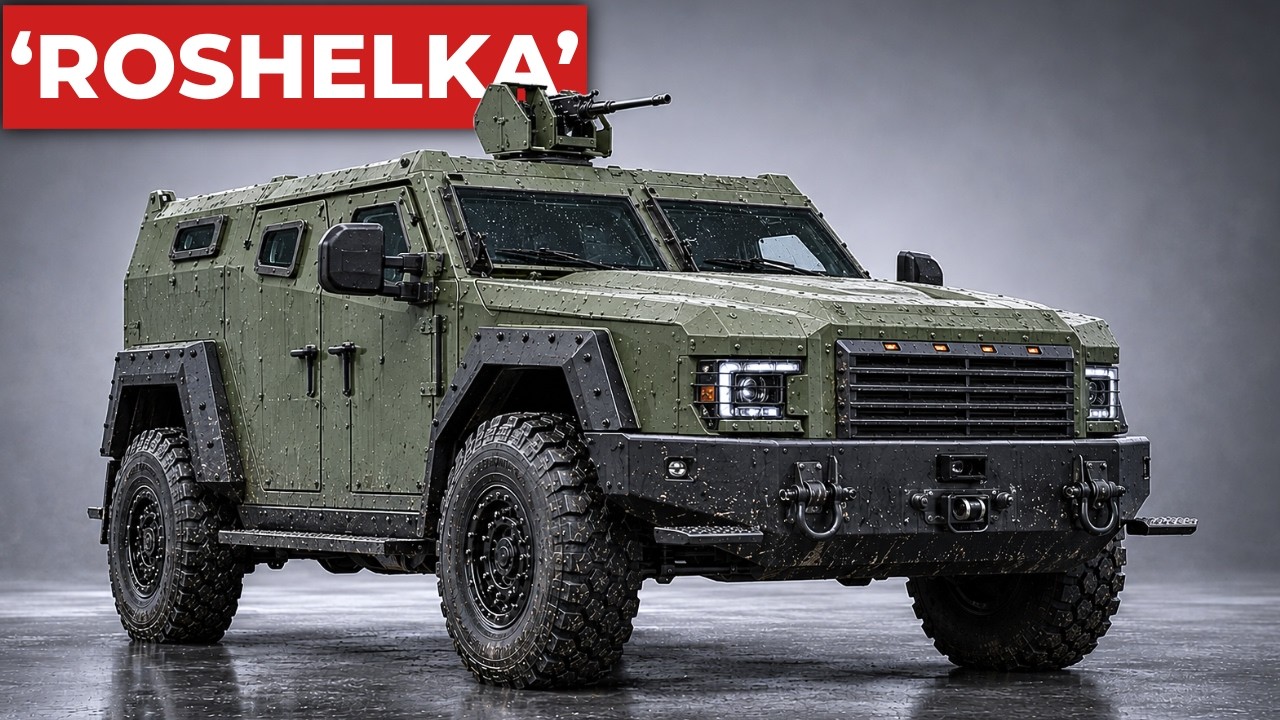
Sensei drives the vehicle away from the contact point under his own power. The Heart Brigade press service circulates the footage on Telegram. The brigade’s official statement notes the obvious. “The Rashelka,” they write, “will easily pass through places where ordinary pickup trucks can get into difficulties.
” In August 2024, the 80th Air Assault Brigade crosses into Kursk Oblast as part of the Ukrainian incursion. Some of the Senators in the assault element are doing work that strikers have been doing 6 months earlier. The Brampton truck on a Ford chassis is now an air assault vehicle. The defining incident comes in July 2025. A team from the 5th Special Purpose Detachment Omega, an elite unit of the National Guard of Ukraine, is moving toward a combat task in a single Senator MRAP.
A Russian FPV drone scores a direct hit at speed. The vehicle takes the impact at the armored roof. The National Guard’s official statement reads almost like an after-action report from a NATO exercise. The entire team, the statement says, was at the epicenter of the explosion.
Fortunately, all of the special forces soldiers survived. After a successful evacuation, fighters from the 5th Special Purpose Detachment Omega completed their mission. Helmet cam footage is released. Roshel founder Roman Shimonov reposts it. “The crew survived and was able to return safely,” he writes, “because the vehicle continued to perform as designed.
” A month earlier, in June 2025, Ukrainian open-source monitors share footage of a Senator on the Pokrovsk axis missing its rear right wheel. The wheel is somewhere behind the vehicle, blown off by an anti-tank mine. The Senator continues to roll on three wheels with wounded soldiers inside. An anonymous crew member tells Defense Blog the vehicle remained operational even after a direct anti-tank mine detonation.
Ukrainian fighters being extracted on three wheels from a minefield is not a scene Roshel’s cash-in-transit ancestors were designed for. The Russian response is, “By the standard of this war, remarkably quiet.” The Russian open-source site Lost Armor catalogs 188 destroyed or damaged Senators and 12 captured.
Oryx records 176 losses by December 2025 out of more than 2,000 delivered. That is an 8.6% attrition rate across a vehicle the donors specifically asked to be used in the most dangerous tactical roles available, an evacuation vehicle, a medical carrier, and an assault platform. No Russian regiment showcases captured Senators on parade.
There is no Senator equivalent of the Leopard 2 pulled into Mariupol. The reason is awkward for Russian propaganda. A captured Ford-based pickup is not a trophy. It is an admission that Ukraine has fielded thousands of them. Honest losses still happen. Senators have been killed by Lancet loitering munitions, by Krasnopol guided rounds in dry weather, by Iskander strikes on rear area aid stations, and by anti-tank mines that the V-hull could not catch.
The Russian vehicle that most directly faces the Senator in Ukrainian service is the Tiger and its modernized Tiger M variant, built by the Gorky Automobile Plant. The Tiger is a Russian 4×4 military scout vehicle. Combat weight is 5.3 to 7.8 tons. Ballistic protection meets STANAG level 1 to level 2. Mine resistance is poor.
There is no V-hull on the base variant. Top speed approaches 140 km/h on road. Crew capacity is 10. The vehicle has been in Russian service since 2005 and was supposed to be Russia’s answer to the Humvee. In Ukraine, the Tiger has bled. By December 2024, Oryx documents eight standard Tigers and 29 Tiger M variants captured by Ukrainian forces.
The vehicle has been criticized, even in Russian sources, for vulnerability to FPV drone top attack and for offering minimal blast protection in the underbelly. The heavier Russian equivalent is the Kamaz Typhoon K, an MRAP class vehicle, weighing 14 to 24 tons, with a V-hull and proper STANAG level 3 blast resistance.
The Typhoon is, on paper, a better protected vehicle than the Senator. In practice, Russia builds them in single-digit batches per month. The Chechen-built ZSTS Akhmat is lighter and less protected than either. The structural Russian disadvantage is industrial. The Tiger and Typhoon family was designed around the bespoke military chassis with low production volumes.
The Senator was designed around a Ford pickup. A chassis Ford builds at a rate of tens of thousands per year in Kentucky. Roshel can produce 140 vehicles a month from a single Brampton plant. The entire Russian light MRAP industry combined cannot match that output, which brings the script to what Canada actually gave up.
The answer is honest. Canada has directly donated 208 Senators since 2022. Confirmed by Department of National Defense spokesperson Andrée Ann Poulin to CBC News on February 24, 2026. Defense Minister David McGuinty announced a further package of 383 Senators within a roughly 2 billion Canadian dollar military assistance commitment for 2026 to 2027.
That brings cumulative Canadian government donations to approximately 591 Senators, roughly a quarter of the fleet now in Ukraine. The other three quarters were paid for by the United States State Department, by individual European governments, by the Serhiy Prytula Foundation in Kyiv, and by Ukraine’s own defense budget.
The State Department alone awarded Roshel multiple blanket purchase agreements totaling 130.6 million US dollars in 2024 for 330 additional vehicles. What Canada really gave was not a fleet. It was a procurement signal. Ottawa was the first sovereign customer to bet on a small Ontario startup at industrial scale.
Everyone else followed. Back at the Kup’yansk axis, Major Yuriy Fedorenko had not changed his mind. The Senator is not designed for off-road use. The springs break. The shocks fail under the kind of cross-country mileage Ukrainian brigades log every week. The ballistic protection is level two, not level four.
The vehicle cannot survive a tank round, cannot survive an Iskander, cannot survive an FPV swarm if the crew has nowhere to hide, but it saves people. When there is no alternative, it is what they need. The donor wrote a Ford pickup off as a swap platform. Ukraine made it the most widely fielded Western armored vehicle in the war. Of Chansk knew the Senator.
The Pokrovsk axis knew the Senator. The Kursk Woodlands knew the Senator. The Donetsk demining fields knew the Senator. The Kharkiv approaches knew the Senator. Every front Ukraine fought from the spring of 2022 to the spring of 2026 saw at least one Ford pickup running under Canadian armor with Ukrainian markings.
It does not look like a war winner. The crews coming back alive learned otherwise. Built like a truck, driven like a war machine, bringing Ukrainian crews home.